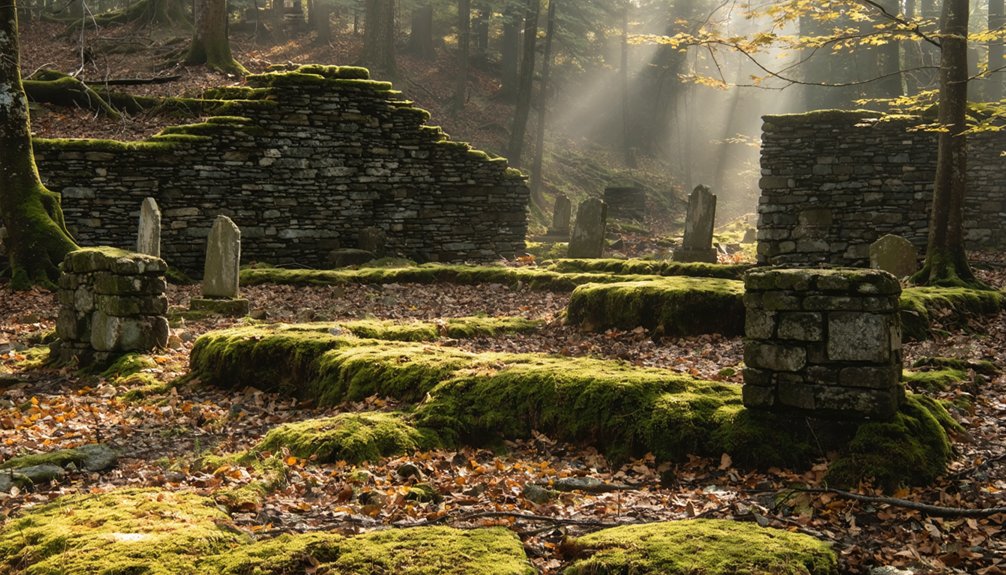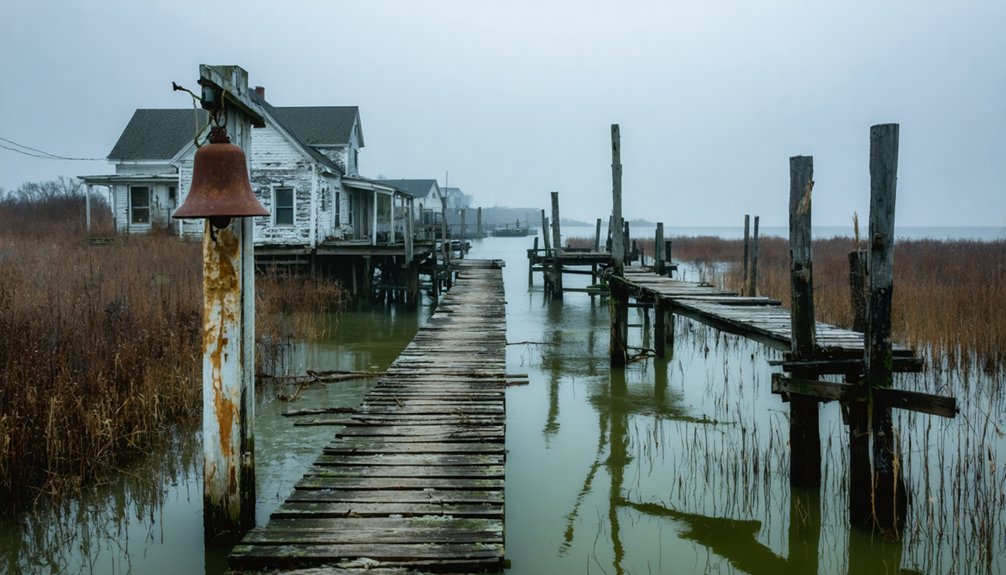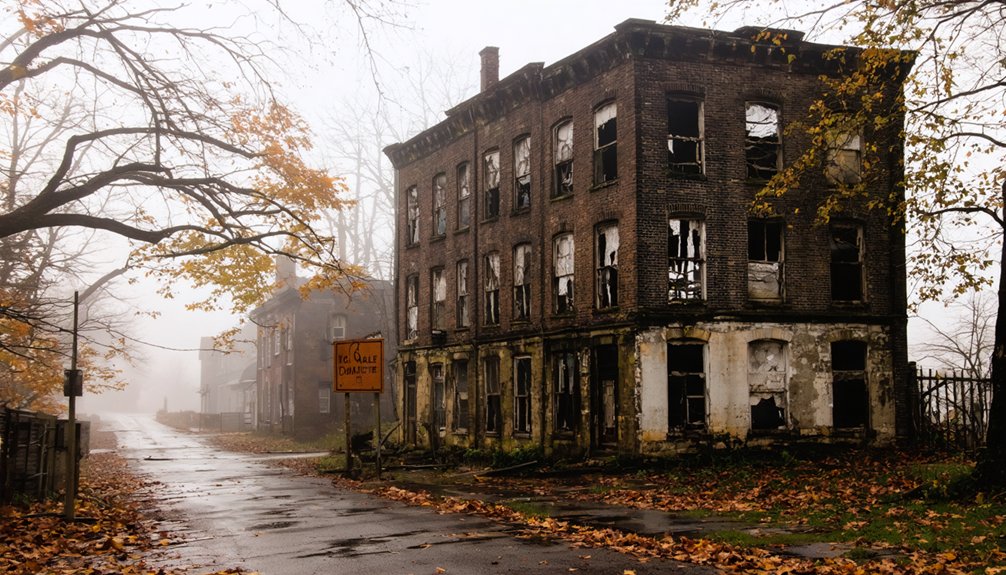
You’ll find that Connecticut’s most notable ghost town sale occurred in July 2017, when Johnsonville—a 62-acre Victorian-era mill hamlet in East Haddam—sold to Iglesia Ni Cristo for $1.85 million. This authentic 19th-century village features preserved buildings, a covered bridge, and structures spanning three centuries of architectural history. The property’s journey from Raymond Schmitt’s living museum through failed auctions to its current ownership represents a rare opportunity to document complete town acquisitions. The hamlet’s transformation reveals fascinating insights into historic preservation challenges and community revitalization efforts.
Key Takeaways
- Johnsonville, a 62-acre Victorian hamlet in East Haddam, was sold to Iglesia Ni Cristo for $1.85 million in July 2017.
- The property includes restored Victorian buildings, a covered bridge, waterfall, and pond-fed lake between the Moodus and Salmon rivers.
- Johnsonville declined after mill fires in 1924 and 1972, remaining abandoned for nearly 20 years before multiple ownership changes.
- Failed auction attempts occurred from 2014 to 2017 due to economic downturns and stalled development plans after the Great Recession.
- The site features authentic 19th-century structures including a Quaker meetinghouse, chapel, and stables across three centuries of architectural history.
The Story of Johnsonville: From Mill Town to Abandoned Village
When Emory Johnson constructed the Triton Mill in 1862 along the northern edge of Millpond, he set in motion the transformation of a scattered rural settlement into Johnsonville, a thriving industrial hamlet in East Haddam’s Moodus section.
Connecticut’s twine production center flourished throughout the mid-1800s, with twelve mills harnessing power from the Moodus and Salmon rivers. This industrial heritage defined the village’s identity for generations.
Twelve mills along the Moodus and Salmon rivers powered Connecticut’s mid-1800s twine production boom, shaping generations of industrial identity.
However, the Triton Mill’s 1924 fire signaled decline. The Neptune Mill replaced it but burned in 1972 after lightning struck. By then, most mills had already succumbed to fires or abandonment.
Despite this community resilience, the golden age had ended. You’ll find aerospace manufacturer Raymond Schmitt purchased the property in the 1960s, transforming it into a Victorian tourist attraction before closing it in 1994. After Schmitt’s death in 1998, the property was sold to Meyer Jabara, a hotel conglomerate. Johnsonville has been abandoned for nearly 20 years.
Location and Natural Features of the Property
You’ll find Johnsonville situated in the Moodus section of East Haddam, Connecticut, where 62 acres of mixed-use terrain document the settlement’s historical footprint.
The property’s positioning between the Moodus and Salmon rivers wasn’t coincidental—these waterways powered the mills that defined the village’s industrial character from its 1802 establishment.
Natural features including wooded expanses, an integrated waterfall, and a pond-fed lake system created both the operational infrastructure and the scenic backdrop that shaped this riverside hamlet.
The overflowing pond adds distinctive character to the landscape, contributing to the property’s overall appeal for potential developers and investors.
The town includes a distinctive covered bridge among its collection of Victorian-style buildings and historical structures.
Geographic Setting and Accessibility
Situated along the Moodus River in East Haddam’s coastal Connecticut region, Johnsonville occupies a 62-acre property that’s been documented in land records since its 1802 establishment as a twine production center.
This blank space on Connecticut’s landscape map draws urban exploration enthusiasts through accessible roads that permit public photo stops. The village’s positioning along the Moodus and Salmon Rivers enabled the Neptune Twine and Cord Mill‘s operations for over a century.
You’ll find William Raveis Real Estate in Old Lyme managed the listing, facilitating national interest through online auctions beginning in 2014.
The site’s proximity to East Haddam’s infrastructure supports historical preservation efforts while maintaining the hamlet’s isolated character—woods, overflowing ponds, and waterfall views defining this former mill community‘s geographic footprint. A covered bridge spans across the property, offering scenic views of the lake and waterfall that characterize the town’s natural landscape. The property’s architectural features include multiple design styles across its relocated historic buildings, with original marble flooring preserved in several structures.
Natural Landscape and Terrain
Beyond the architectural footprint and transportation corridors, Connecticut’s abandoned settlements reveal themselves through distinct topographical signatures that shaped—and ultimately defined—their rise and abandonment.
You’ll find Dudleytown nestled in Dark Entry Forest’s valley, where deathly silent grounds surround old foundations despite normal wildlife presence.
Gay City’s 1,500 acres showcase rolling terrain with babbling brooks and seasonal transformations—green summers yielding to vibrant autumns.
The natural beauty of Saugatuck Reservoir’s wooded trails contrasts sharply with inky waters exposing drowned foundations during droughts.
Each location’s historical significance connects directly to its terrain: Johnsonville’s 62 acres integrate Victorian ruins into forested slopes, while Bara-Hack and Pilfershire feature stone walls snaking through wild Connecticut woods, their overgrown wagon trails marking paths toward genuine isolation and self-determination.
Devil’s Hopyard State Park encompasses diverse acreage bisected by Hopyard Road, where Chapman Falls sits immediately left of the northern entrance amid a landscape of hiking trails and mystical ambiance.
The Dark Entry Forest Association controls 800-900 acres of private property surrounding Dudleytown’s remnants, maintaining strict boundaries that prevent public access to the abandoned settlement’s terrain.
Architectural Treasures and Historic Buildings
Connecticut’s ghost towns preserve remarkable architectural records spanning three centuries, from colonial settlement patterns to Victorian-era commercial infrastructure.
You’ll discover stone foundations and cellar holes marking 18th-century utopian experiments at Gay City, while Dudleytown’s scattered farmstead remnants showcase rural colonial building techniques.
Bara-Hack’s Welsh settler structures demonstrate early immigrant adaptation to New England’s environment.
The architectural preservation at Johnsonville stands apart—62 acres of restored Victorian buildings including stables, chapels, and commercial structures powered by Moodus River mills.
These sites hold historic significance as tangible evidence of economic shifts, community failures, and industrial evolution.
Pleasure Beach’s deteriorating 20th-century pavilions and bathhouses represent Connecticut’s seaside resort heritage, though coastal erosion threatens these architectural treasures.
The state’s industrial castle structures, like North Grosvenordale Mill along the French River in Thompson, showcase the scale and ambition of Connecticut’s textile manufacturing era.
Johnsonville’s buildings have appeared in notable productions, including the Billy Joel music video for “The River of Dreams” and the horror film Deep in the Darkness.
Each location documents distinct building traditions and settlement patterns.
Ownership Changes Through the Decades
Johnsonville’s ownership trajectory reflects broader patterns in historic preservation and adaptive reuse, beginning with Raymond Schmitt’s 1960s acquisition that transformed the industrial site into a curated Victorian theme park.
After Schmitt’s 1994 departure, the property cycled through Meyer Jabara Hotel Group’s stalled residential development plans and multiple failed auction attempts between 2014 and 2017.
You’ll find the most recent chapter began when Iglesia Ni Cristo purchased the 62-acre village for $1.85 million in July 2017, adding it to their portfolio of Connecticut religious properties.
Raymond Schmitt’s Vision Era
In the early 1960s, aerospace magnate Raymond Schmitt acquired the Neptune Mill property and surrounding land, launching an ambitious preservation project that would span three decades.
The AGC Corporation owner envisioned recreating Johnsonville’s Victorian-era glory through extensive restoration efforts. He transplanted authentic 19th-century structures—including a Quaker meetinghouse, stable, general store, and chapel—transforming the site into a living museum.
His personal collection of Victorian antiques, carriages, and even a paddleboat populated these buildings. Schmitt recognized the tourist potential from the outset, opening the 100-acre property for public visits, weddings, and charity events.
The 15-acre millpond with its dam, bridges, and docks became a centerpiece. This eccentric millionaire’s preservation work maintained historical authenticity while creating an accessible destination for those seeking connections to America’s independent past.
Failed Sales and Auctions
Following Schmitt’s death in the 1990s, Johnsonville entered a turbulent ownership period marked by ambitious visions and economic realities that consistently derailed development plans.
Meyer Jabara Hotel Group acquired the property in 2001 for $2.5 million, envisioning a 55+ residential community. However, the September 11 attacks and subsequent economic impacts immediately stalled progress.
The 2008 Great Recession delivered another crushing blow to development prospects. By 2014, frustrated ownership attempted auction, but failed auctions became the pattern—no successful bidder emerged despite marketing the 62-acre Victorian ghost town’s lake views and historic structures.
The property languished on market listings from 2015 onward, its rundown condition and paranormal reputation deterring developers. After sixteen years holding this non-core asset, Meyer Jabara finally sold Johnsonville in 2017 for $1.85 million.
Iglesia Ni Cristo Acquisition
After sixteen years of stalled development schemes and failed auctions, Johnsonville’s fate shifted dramatically when Iglesia Ni Cristo, a Philippines-based Christian denomination with 110 countries of operation, closed on the 62-acre property for $1.85 million in an all-cash transaction on July 7, 2017.
The deal stunned East Haddam officials, who received only ten days’ notice before closing. Representatives had spotted the listing in June, toured the grounds, and negotiated within one month—a stark contrast to Meyer Jabara Hotels’ prolonged $2.4 million asking price since 2015.
Founded in 1914 by Felix Manalo, Iglesia Ni Cristo operates under strict hierarchical authority from Executive Minister Eduardo Manalo. The church promised renovation of existing structures and construction of new worship facilities, though no timeline emerged.
This acquisition marked community impact potential you hadn’t seen since Raymond Schmitt’s tourist-attraction vision collapsed.
Hollywood Spotlight and Haunted Legends
The ghost town‘s haunting Victorian architecture captured Hollywood’s attention in 1993, when Billy Joel selected the abandoned village as the backdrop for his music video “The River of Dreams.”
This initial exposure established Johnsonville as a viable film location, leading to subsequent productions including the 2014 horror film “Deep in the Darkness,” which centered on a small town harboring dark secrets, and Cuba Gooding Jr.’s “Freedom,” also filmed on-site that same year.
You’ll find the property’s cinematic allure stems from its authentic decay and haunted aesthetics.
Rumored ghosts of mill workers and former owner Raymond Schmitt reportedly inhabit the grounds, creating supernatural legends that amplify the site’s atmospheric appeal.
Media outlets including Zillow, WTOP, and Smithsonian have documented these hauntings, reinforcing Johnsonville’s reputation as Connecticut’s premiere abandoned film location.
The 2017 Sale: How Iglesia Ni Cristo Acquired the Town
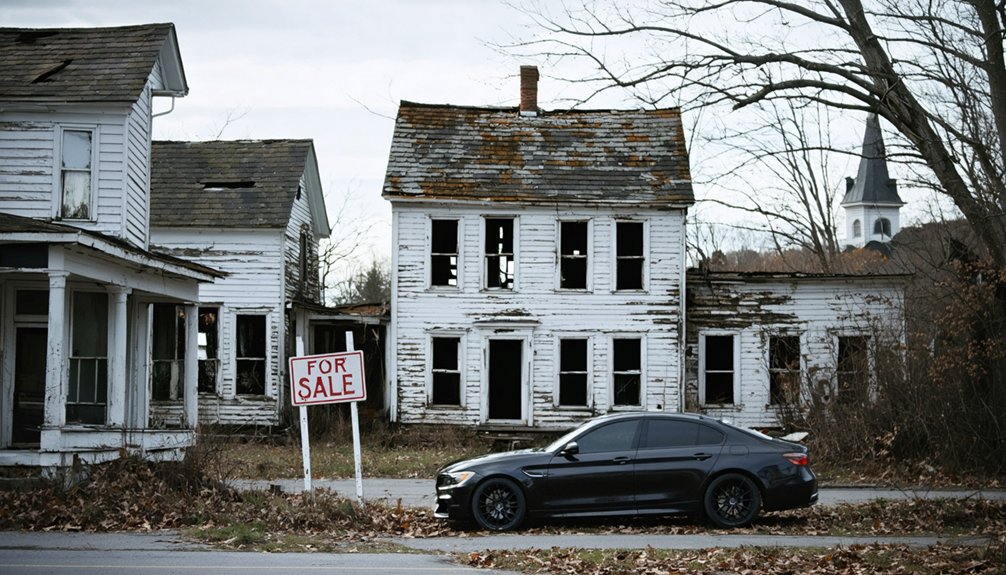
When Iglesia Ni Cristo‘s emissaries toured Johnsonville in late June 2017, they encountered a 62-acre property that had languished on the market for years, priced far below the $2.5 million Meyer Jabara Hotels had invested in 2001.
Their acquisition strategy proved remarkably efficient—within weeks, they’d closed the deal at $1.85 million on Friday, July 7, 2017. This swift transaction followed a failed 2015 auction where a $1.9 million bid never materialized.
The Philippine-based church, operating in 110 countries with three Connecticut congregations, took possession of keys to historic structures including the old post office, schoolhouse, general store, and abandoned church.
Their documented plans emphasized community impact through preservation, restoration, and reinvigoration of the nearly 200-year-old hamlet, supporting both spiritual and physical upliftment.
Development Possibilities and Future Vision
Iglesia Ni Cristo’s acquisition of Johnsonville opened a spectrum of development pathways documented across Connecticut’s ghost town revival initiatives.
You’ll find future opportunities mirror state brownfield programs transforming blighted properties into mixed-use developments—like West Hartford’s 34-acre conversion into housing and commercial spaces, or Norwalk’s public housing rebuild creating 55 apartments.
Community engagement drives these projects, as evidenced by Torrington’s three-grant cleanup targeting job-creating commercial uses and Shelton’s $28.2 million investment supporting 857 housing units.
The state’s remediation efforts generate 1,400 jobs while converting abandoned sites into parks, stadiums, and behavioral health clinics.
Successful ghost town transformations like Cerro Gordo demonstrate viable tourism models.
However, you must navigate depopulation risks, utility infrastructure gaps, decontamination requirements, and zoning restrictions that’ve plagued Johnsonville’s multiple failed development attempts.
Frequently Asked Questions
Can Individual Buildings in Johnsonville Be Purchased Separately From the Entire Property?
Unlike Humpty Dumpty’s scattered pieces, you can’t acquire individual structures separately. Historical documentation reveals no property division provisions—Johnsonville’s building acquisition requires purchasing the entire 62-acre assemblage as one consolidated transaction, preserving your complete ownership autonomy.
Are There Any Zoning Restrictions That Limit Development Options in East Haddam?
Yes, East Haddam’s zoning laws impose significant restrictions on your development potential. You’ll face strict coverage limits at 45% maximum lot usage, setback requirements, mandatory buffering, and performance bonds that constrain your property development options.
What Maintenance Costs Are Required to Preserve the Historic Victorian Buildings?
You’ll face substantial restoration costs including structural repairs, weatherproofing, and utilities overhaul. Preservation techniques require specialized contractors familiar with Victorian-era siding, foundations, and architectural standards—expect significant investment documenting original materials and construction methods throughout.
Can the Public Visit Johnsonville or Is It Private Property?
You can’t visit Johnsonville—it’s strictly private property owned by Iglesia ni Cristo since 2017. Despite its historical significance, public access remains prohibited, continuing restrictions that began in 1994 due to zoning disputes with East Haddam.
Are There Other Abandoned Towns for Sale in Connecticut Besides Johnsonville?
You won’t find other abandoned towns listed as real estate in Connecticut. Search records show Johnsonville stands alone as the state’s only documented ghost town offered for sale, with no comparable properties currently available on the market.
References
- https://www.6sqft.com/buy-this-entire-62-acre-ghost-town-in-connecticut-for-just-1-9m/
- https://www.businessinsider.com/photos-johnsonville-connecticut-ghost-town-2017-7
- https://wtop.com/real-estate/2017/05/entire-conn-ghost-town-goes-sale/
- https://thespaces.com/entire-connecticut-ghost-town-1-9m/
- https://www.ctpost.com/realestate/article/Connecticut-ghost-town-finally-sold-11280706.php
- https://www.williampitt.com/johnsonville-connecticuts-hauntingly-beautiful-ghost-town/
- https://www.governing.com/archive/gov-johnsonville-connecticut-sale.html
- https://www.vice.com/en/article/inside-johnsonville-the-victorian-ghost-town-that-no-one-wants-922/
- https://i95rock.com/the-abandoned-ghost-town-of-johnsonville-ct-then-now/
- https://www.youtube.com/watch?v=vFRKgaXHLy4