You won’t find traditional ghost towns for sale in Delaware—the state’s compact size and continuous development have prevented complete abandonment of settlements. However, Delaware offers eight meticulously preserved historic properties averaging $538,031, primarily concentrated in Old New Castle, a National Historic Landmark district that’s maintained its colonial character since 1777. These properties require adherence to strict preservation guidelines but provide authentic ownership of Georgian and Colonial Revival architecture. The sections below explore how Delaware’s historic real estate compares to Western ghost towns and what investment opportunities await.
Key Takeaways
- Delaware has no traditional ghost towns for sale due to its compact size and population density causing quick redevelopment of abandoned areas.
- Eight historic properties average $538,031, with 440 vintage homes available across Delaware’s three counties as alternative investments.
- Old New Castle offers preserved colonial properties within a National Historic Landmark district, maintaining architectural integrity since 1777.
- Historic Delaware properties require adherence to preservation guidelines and use of natural materials for repairs and renovations.
- Delaware investments offer coastal tourism potential and short-term rental opportunities with higher ROI than remote Western ghost towns.
Understanding the Ghost Town Market in America
While most real estate markets focus on thriving communities, America’s ghost town sector represents a unique intersection of historical preservation and speculative investment.
You’ll find over 3,800 documented ghost towns across the United States, with Texas and California leading in concentration due to historic mining and oil booms.
Ghost town trends reveal pricing from $250,000 to multiple millions, depending on property size and condition. The American West dominates this market, particularly Nevada, Colorado, and Montana, where economic decline from closed mining operations and resource depletion created these opportunities.
Ghost town prices span from quarter-million to multi-million dollar investments, concentrated primarily across Nevada, Colorado, and Montana’s abandoned mining territories.
Heritage tourism now revives select sites, attracting global visitors seeking authentic historical experiences. Recent sales include Eagle Mountain, California for $22.5 million and Cerro Gordo for $1.4 million, demonstrating genuine market demand.
Investment properties play a significant role in areas experiencing high vacancy rates, with some ZIP codes seeing over two-thirds of vacant homes classified as investment properties rather than abandoned residences. Buyers should understand that purchasing these properties means acquiring land and structures rather than municipal governing authority, as most ghost towns consist of unincorporated land with existing buildings.
Why Delaware Has No Traditional Ghost Towns
Delaware’s geographic and demographic characteristics fundamentally distinguish it from Western states where ghost towns proliferate.
You’ll find that abandoned settlements here rarely persist due to the state’s compact size and population density. When communities decline, redevelopment quickly follows, preventing the formation of enduring ghost towns.
Several factors explain this phenomenon:
- Native decline through wars and diseases dramatically reduced the Lenape population by the 1700s, establishing patterns of settlement transformation rather than preservation.
- Economic shifts from rail networks like Queen Anne’s Railroad bypassed communities, yet proximity to active areas prevented complete isolation.
- Natural disasters force government buyouts and relocations, as seen when flooding eliminated Glenville by 2004.
- Camden’s vacant property ordinances mandate registration, accelerating redevelopment cycles.
Delaware’s ghost towns exist only as temporary phases between abandonment and renewal. Unlike Michigan’s copper mining region where towns like Delaware were established in 1846 and subsequently abandoned, Delaware state’s infrastructure prevents such long-term vacancy. The Delaware Railroad opened in 1855, spurring development of new towns like Greenwood that remained connected to active commercial networks rather than falling into complete isolation.
Historic Properties Available in Delaware
The Delaware real estate market presents a documented inventory of eight historic properties currently listed at an average price of $538,031, complemented by 440 vintage homes distributed across the state’s three counties.
You’ll find diverse architectural styles ranging from Colonial estates and Georgian residences to stone farmhouses and Colonial Revival structures.
Twenty-two Victorian homes are available, including an 1906 Late Victorian in Milford ($414,900) and an 1880s beach bungalow ($499,000).
The Victorian Dover Historic District offers median listings at $244,950, while Old New Castle features 23 qualifying properties.
These historic home renovations provide opportunities for preservation-minded buyers seeking authentic period architecture.
Properties span Kent County and Sussex County, with notable listings in Dover, Clayton, Seaford, Harbeson, Georgetown, Lincoln, and Harrington.
Resources like OldHouseDreams.com and CircaOldHouses.com maintain updated listings with architectural documentation and pricing data across all Delaware municipalities.
Notable offerings include a Mill in Newark listed at $240,000 on 0.73 acres, showcasing the range of historic commercial properties available for adaptive reuse.
Old New Castle: Delaware’s Closest Alternative to Historic Town Living
While Delaware lacks true ghost towns for sale, you’ll find Old New Castle offers the closest approximation—a meticulously preserved colonial settlement that’s languished in architectural stasis since losing its capital status to Dover in 1777.
The town’s 1764 charter granted commissioners authority over its common lands and streetscapes, enabling preservation efforts that’ve maintained brick sidewalks and eighteenth-century structures largely untouched by modern development.
You can explore available properties within a National Historic Landmark district where Federal-era buildings, including the 1738 Amstel House and circa-1690 Dutch House, document three centuries of continuous habitation rather than abandonment.
The town’s economic significance waned further when the county seat relocated to Wilmington in 1881, cementing New Castle’s transformation into a living historical enclave.
Cobblestone streets and colonial architecture create an atmosphere that recalls the town’s prominence as Delaware’s first capital, before its governmental functions shifted northward.
Historic Architecture and Preservation
Preservation in Old New Castle operates through a multilayered regulatory framework that dates back to the 1929 purchase of the Amstel House, the city’s first formal preservation effort that eventually evolved into the New Castle Historical Society.
The Historic Area Commission enforces stringent guidelines protecting architectural integrity:
- Materials standards: Natural replacements only, with wood siding, trim, and windows featuring true divided lights
- Construction approach: Repair preferred over replacement; new additions must harmonize with existing architecture
- Funding mechanisms: Delaware Preservation Fund awarded $124,122 across 24 grants in 2024 for New Castle County projects
- Tax incentives: State Historic Preservation Tax Credit Program and county credits for NRHP-listed properties
The Commission convenes second Thursday monthly meetings at 6:30 p.m. to review applications on a case-by-case basis. You’ll find historic preservation here isn’t bureaucratic obstruction—it’s community-driven documentation protecting property rights and authentic character without federal overreach.
Beyond the historic district, properties like the 180-year-old Buttonwood mansion face preservation challenges when relocated from their original sites, complicating eligibility for historic tax credits and National Register listing despite their architectural significance.
Current Real Estate Listings
Anyone searching for historic properties in Old New Castle today encounters a modest but authentic inventory—currently 4 homes listed through eXp Realty, with Realtor.com documenting 3 properties in the Historic District proper and Zillow tracking 4 matches under “Historic Old” designations.
Current listings reveal market trends favoring colonial-era architecture, with detached wood frame homes from the late 1700s featuring original pine floors, corner fireplaces, and built-in cabinets.
You’ll find median pricing at $429,950 to $500,000, with properties averaging 58 days on market. The inventory spans colonial townhomes with elevators and river views to authentically preserved structures maintaining tin ceilings and period moldings.
Multiple platforms—eXp Realty, Redfin, Weichert, and REMAX—document availability across ZIP 19720, providing transparent access to Delaware’s most historically concentrated residential market.
Community Character and Amenities
Beyond property specifications and price points, Old New Castle functions as Delaware’s most authentically preserved colonial settlement—settled by Dutch forces under Peter Stuyvesant in 1651, contested through Swedish and English occupations, and established as colonial capital until the Revolutionary era shifted governance to Dover.
You’ll encounter genuine community engagement through:
- Brick-sidewalked streets leading to the Delaware River, flanked by eighteenth-century houses and Federal-era structures
- Immanuel Episcopal Church (established 1689) with Revolutionary War tombstones marking the town’s historical significance
- New Castle Historical Society operating Dutch House (circa 1690) and Amstel House (1738) as accessible museums
- Fourth Friday Art on the Town events and documented ghost tours exploring authentic supernatural folklore
The town’s preservation occurred without tourist commercialization—Delawareans maintained architectural integrity while commissioners regulate streets, markets, and public spaces under independent charter granted 1704.
Coastal Delaware Communities With Historic Character
While ghost towns typically evoke images of abandoned Western settlements, Delaware’s coastal communities offer a different narrative—one where historic character hasn’t faded but rather evolved into sought-after residential markets.
These unique accommodations in Delaware ghost towns provide an intriguing way to experience history while enjoying modern comforts. Visitors can explore the remnants of the past, all while staying in properties that celebrate the area’s rich heritage. This blend of old and new promises a memorable retreat for those looking to escape the ordinary.
Delaware’s coastal heritage hasn’t vanished into history—it’s transformed into premium real estate where preservation meets profitability.
You’ll find Lewes at Delaware Bay’s mouth, showcasing Victorian and Colonial architecture across its walkable half-square-mile footprint. The coastal charm extends beyond preserved structures—communities like Olde Town at Lewes and Whites Pond offer modern construction starting at $575,000, respecting historic allure while providing contemporary amenities.
Nearby Milton, Millville, and Ocean View maintain small-town character minutes from beaches.
The vintage home market demonstrates this appeal: 510 historic properties statewide, with Lewes listings averaging $1,297,500. These aren’t abandoned settlements—they’re thriving communities where architectural heritage commands premium pricing.
Comparing Delaware Historic Properties to Western Ghost Towns
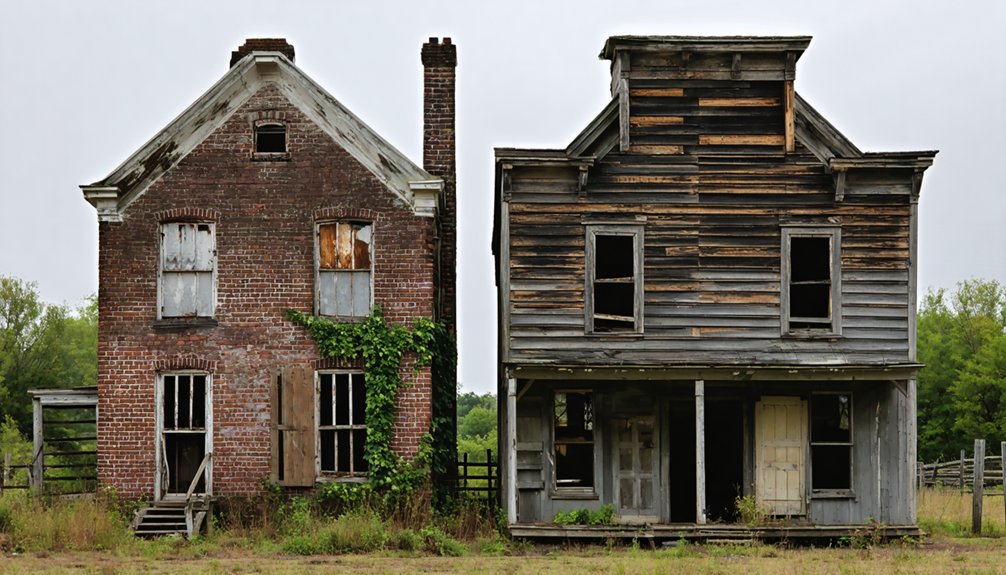
When you examine Delaware’s historic properties against Western ghost towns, you’ll find fundamental distinctions in scale, investment thresholds, and structural condition.
Delaware listings typically range from $215,000 to $876,500 for single restored homes within active communities, while Western acquisitions often demand $1.2 million to $6.6 million for multi-acre sites containing 20+ abandoned structures requiring substantial rehabilitation.
These contrasts directly affect your development timeline, tourism viability, and operational requirements—Delaware offers immediate occupancy in preserved settings, whereas Western properties position you as a reconstruction architect converting derelict infrastructure into commercial ventures.
Price and Scale Differences
Delaware’s historic property market operates at a fundamentally different scale than Western ghost town offerings, with an average listing price of $538,031 for individual homes compared to the $250,000 starting point for South Dakota’s six-acre Swett townsite.
These market comparisons reveal distinct pricing dynamics between single Delaware residences and multi-structure Western properties.
The scale differences manifest clearly:
- Delaware properties average $33,266 per acre for individual lots versus Western sites spanning 6 to 62 acres with multiple buildings.
- Western ghost towns include 20-24 standing structures, while Delaware focuses on single-home transactions.
- Top-tier Western properties like Campo reach $6.6 million for extensive historic sites with hot springs.
- Delaware’s coastal Lewes developments max at $2.23 million for modern amenities, not authentic town infrastructure.
Preservation vs. Abandonment Status
Historic preservation frameworks separate Delaware’s six ghost towns from the 99 in Colorado or 106 in Nevada through systematic rehabilitation requirements rather than natural decay patterns.
You’ll find Delaware’s Historic Preservation Tax Credit Program mandates active restoration of depreciable properties, contrasting sharply with Western sites like St. Elmo, Colorado—abandoned in 1936 after mining collapse—where natural deterioration proceeds unchecked.
Delaware’s State Historic Preservation Plan (2018-2022) identifies properties requiring federal assistance, while Western towns face preservation challenges without standardized protection.
Economic impacts differ fundamentally: Delaware’s Transportation Department implements NHPA Section 106 compliance through Memoranda of Agreement, preventing the total depopulation seen at Kennicott, Alaska (abandoned 1938) or Harrisburg, Utah (1895).
Delaware’s Certified Local Government Program guarantees legal mitigation over squatter reclamation, prioritizing documented rehabilitation instead of abandonment.
Tourism and Investment Potential
While Western ghost towns command premium prices exceeding $1 million for their preserved mining infrastructure and wilderness isolation, Delaware’s historic properties offer accessible investment opportunities averaging 40-60% below comparable Western sites due to existing urban connections and reduced infrastructure development costs.
Your ghost town tourism potential hinges on strategic positioning:
- Beach Integration: Coastal proximity lets you capitalize on millions in annual beach visitor spending, positioning ghost town sites as complementary day-trip destinations.
- Rental Market Advantages: Short-term rental infrastructure delivers higher ROI through established tourism demand versus Western properties requiring remote infrastructure buildout.
- Historic Preservation Incentives: National Register properties qualify for restoration grants while maintaining lower preservation costs than isolated Western counterparts.
- Seasonal Limitations: Winter quietude exposes dependency on coastal tourism cycles, demanding year-round programming strategies.
Investment Considerations for Historic Delaware Real Estate
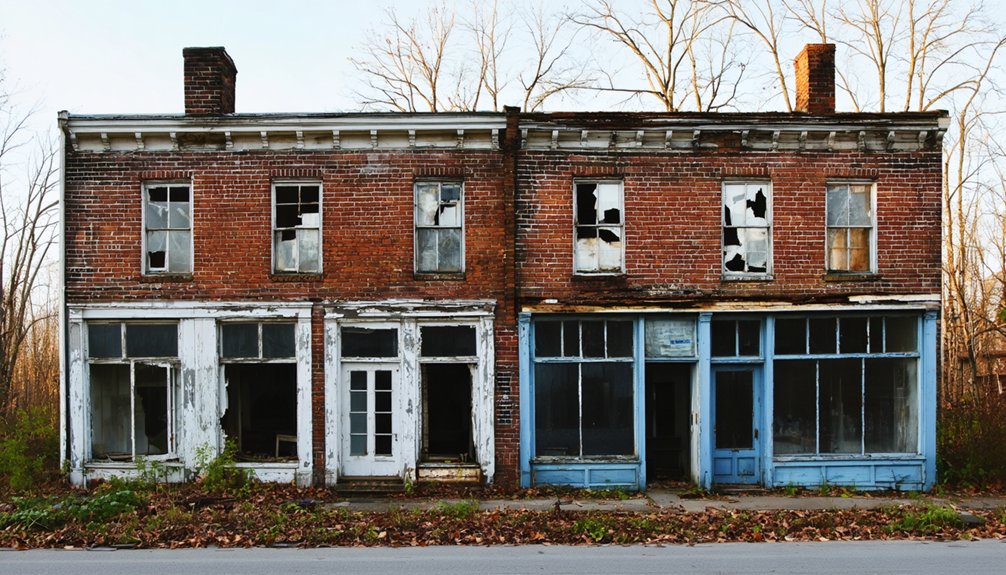
Unlike Western states where entire mining settlements stand frozen in time, Delaware’s real estate market offers a distinctly different proposition for investors interested in historic properties.
You’ll find investment opportunities starting at $355,000 for colonial estates with preservation requirements built into ownership. Land parcels range from $130,000 to $995,000, positioned in stable markets near Wilmington and New Castle County.
Your property management responsibilities include adhering to historic preservation guidelines while maintaining Georgian and Colonial Revival architecture.
Delaware’s economic stability means you won’t face the abandonment risks associated with resource-dependent communities. Instead, you’re acquiring documented heritage in growing areas like Townsend and Newark, where proximity to amenities supports residential development or vacation rental conversion.
These properties demand authentic restoration expertise rather than speculative ghost town tourism ventures.
Building Your Own Legacy in Delaware’s Historic Neighborhoods
When you purchase property in Delaware’s historic neighborhoods, you’re documenting your ownership within communities that maintain authenticated colonial records spanning three centuries.
Legacy building here means joining established preservation efforts in areas like Historic Old New Castle, where 23 Georgian homes and Colonial Revivals currently await new stewards.
Your investment directly contributes to neighborhood preservation through:
- Maintaining architectural integrity in communities with documented sales histories
- Accessing Delaware’s 8 historic properties averaging $538,031
- Establishing roots in coastal Lewes developments near preserved districts
- Participating in restoration projects for colonial estates and stone farmhouses
These neighborhoods offer freedom from cookie-cutter developments while providing tangible connections to America’s founding era.
You’ll own property where authenticity isn’t manufactured—it’s documented, preserved, and legally protected through historic designation.
Frequently Asked Questions
What Legal Requirements Exist for Purchasing Historic Properties in Delaware?
You’ll need property owner approval for National Register nominations and must comply with historic preservation standards. Local property regulations require Historic Review Board approval for exterior alterations in New Castle County and Certificates of Appropriateness in Kent County.
Can I Convert a Delaware Historic Home Into a Commercial Business?
You can convert a Delaware historic home into commercial business if it meets zoning regulations, obtains required business licenses, and secures a certificate of appropriateness—provided the conversion doesn’t exceed 10,000 square feet for retail or service uses.
Are There Tax Incentives for Preserving Historic Properties in Delaware?
You’ll find Delaware’s bureaucratic maze ironically rewards your independent spirit: historic preservation grants and tax credits offer 20-30% returns on documented rehabilitation expenses, with federal programs stacking additional benefits—your autonomy funded through government incentives for certified restoration work.
How Do Insurance Costs Compare Between Historic and Modern Delaware Properties?
You’ll pay 50-100% more for historic Delaware properties due to insurance factors like specialized materials and outdated construction. Property age greatly impacts premiums—50+ year homes average $2,110 annually versus $1,220 for modern properties.
What Financing Options Are Available for Delaware Historic Property Purchases?
You’ll find specialized financing options for historic property purchases including hard money lenders offering 70-80% purchase coverage plus full renovation costs, Delaware Preservation Fund grants, and transferable tax credits ranging from 20-40% of qualified expenditures.
References
- https://www.10news.com/ghost-towns-sale-us/
- https://www.ezhomesearch.com/blog/towns-for-sale-in-the-usa/
- https://www.loveproperty.com/gallerylist/51810/entire-villages-and-towns-for-sale-that-you-can-actually-buy
- https://www.activeadultsdelaware.com/neighborhood/olde-town-at-whites-pond/
- https://www.oldhousedreams.com/state/delaware/
- https://www.curtscully.com
- https://www.zillow.com/new-castle-de-19720/historic-old-new-castle_att/
- https://www.landsearch.com/historic/delaware
- https://247wallst.com/special-report/2018/11/02/30-american-ghost-towns-3/
- https://trueparity.com/blog/real-estate-ghost-towns-invest-in-hidden-gems