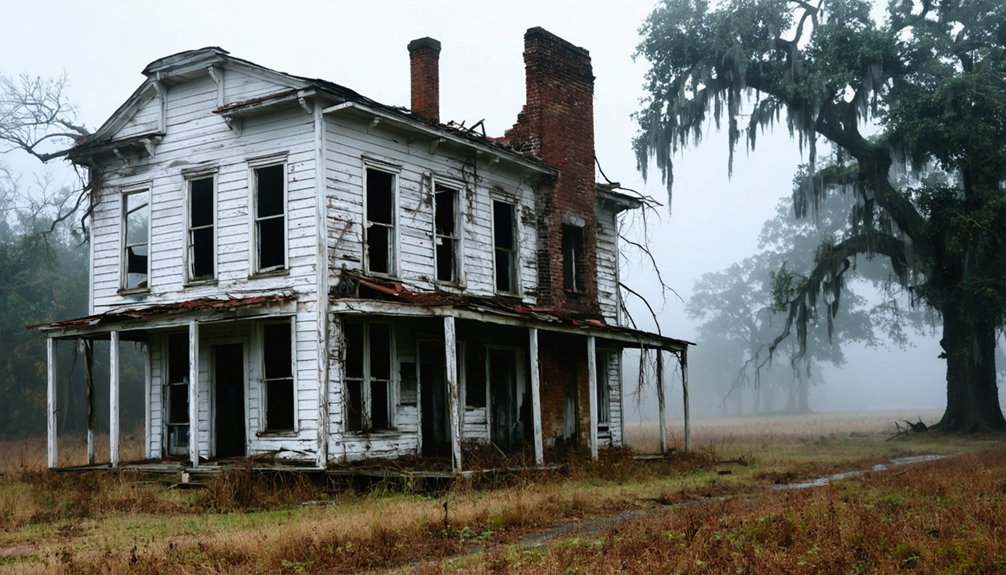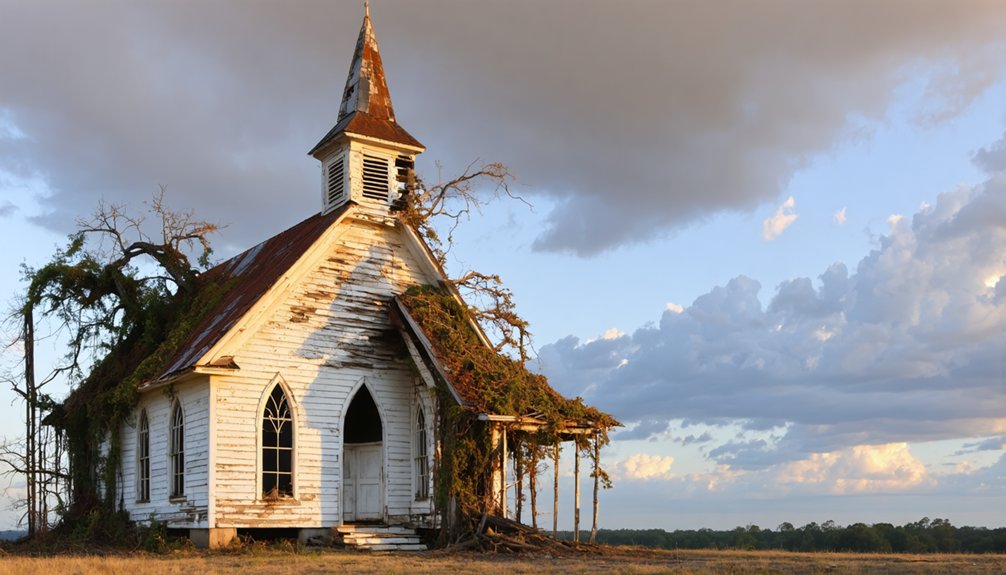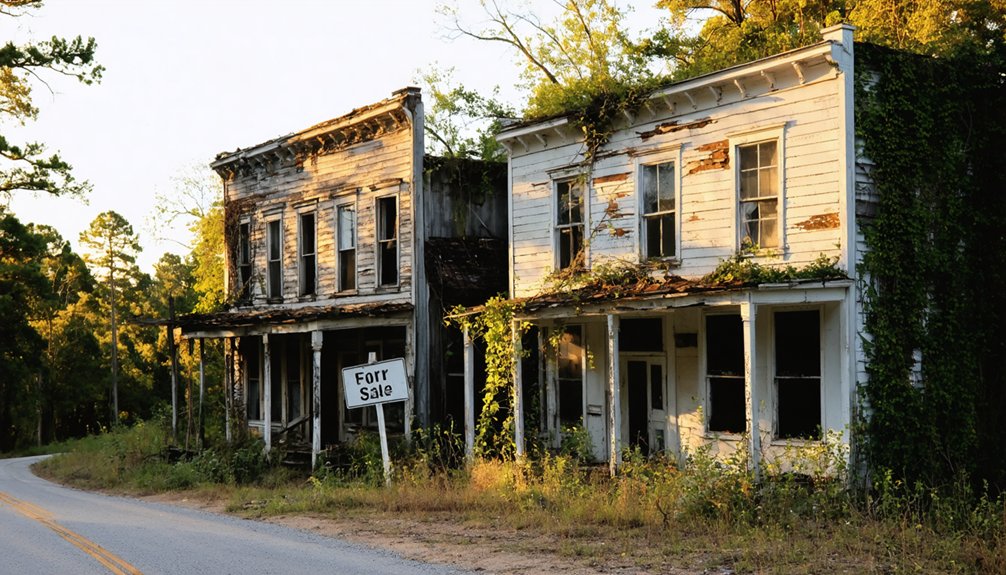
You’ll find Toomsboro, a 40-acre package with 36 properties, listed at $1.7 million—less than Atlanta’s median home price. The town features pre-Civil War structures and the 1916 Swampland Opera House, positioned near major highways for accessibility. Georgia’s ghost town market typically ranges from $1.7-$2.5 million for complete packages, with individual parcels priced between $800,000-$1.15 million. These properties attract investors interested in film production sets, heritage tourism, or preservation projects, particularly given Georgia’s $210 million annual tourism revenue. The following sections explore specific opportunities and market comparisons.
Key Takeaways
- Toomsboro, a 40-acre historic town with 36 properties, is currently listed for $1.7 million after a price reduction.
- Individual Georgia ghost town parcels range from $800,000 to $1.15 million, with complete packages priced between $1.7 and $2.5 million.
- Historic properties in Georgia average $48,198 to $53,297 per acre, significantly higher than the state’s average of $29,641 per acre.
- Ghost towns offer commercial potential for film production sets, heritage tourism, and adaptive reuse of authentic 19th-century buildings.
- Georgia’s heritage tourism generates $210 million annually in local taxes, demonstrating strong economic potential for ghost town investments.
Toomsboro: a Complete Town Package With Historic Mills and Railroad Heritage
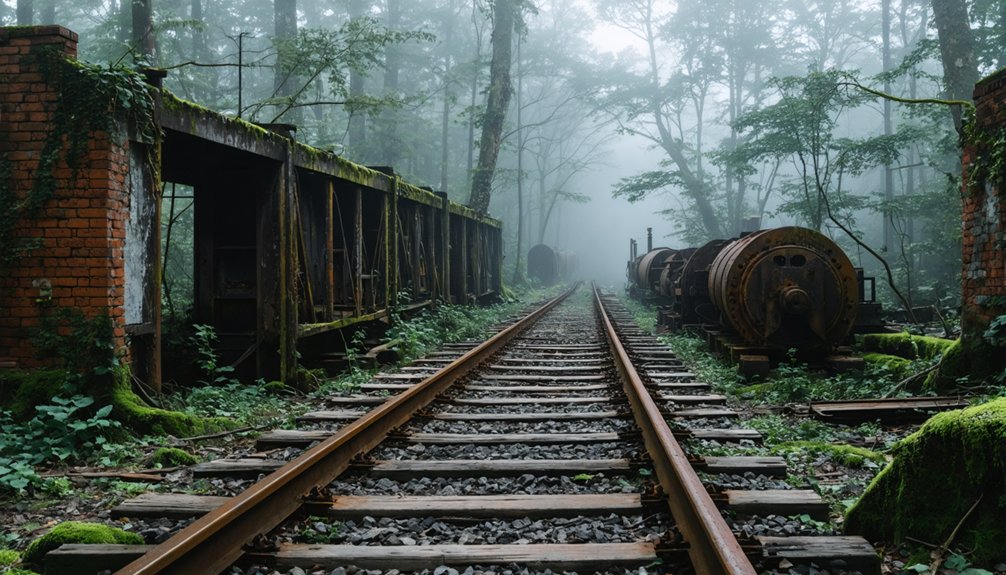
Railroad tracks brought life to Toomsboro in 1869, when the Central of Georgia Railway extended its terminal to this strategic junction between Savannah and Macon County.
The Central of Georgia Railway’s 1869 arrival transformed Toomsboro into a vital junction linking Savannah and Macon County.
You’ll find a complete package here: 36 properties across 40 acres, listed at $1.7 million in 2018.
The Toomsboro Heritage includes pre-Civil War structures like Murray Hall General Store and the 1916 Swampland Opera House, which hosted weekend performances until 2000.
Sherman’s troops marched through on November 22-25, 1864, cementing its historical significance.
Despite Community Revitalization attempts—including a 2012 developer initiative marketing it as a tourist destination—this railroad town remains frozen in time.
Developer David Bumgardner invested over $1 million in restoration work before listing the properties for sale.
You’re fundamentally purchasing a film-ready set with authentic buildings, railroad infrastructure, and untapped potential for transformation.
The town gained incorporated status in 1904 through the Georgia General Assembly, establishing its official municipal boundaries.
Understanding Georgia’s Ghost Town Market and Pricing Trends
Unlike Western states where ghost towns saturate real estate listings, Georgia’s market offers limited but strategically valuable opportunities concentrated around defunct railroad and mill operations.
You’ll find entire bundled packages ranging $1.7-$2.5 million for 37-40 parcels spanning 40+ acres, while individual village parcels command $800,000-$1.15 million depending on structures included.
Historic properties average $48,198 per acre across 195 sites, though recent trends pushed this to $53,297 amid 188 active listings.
Ghost town renovations targeting film production or tourism drive investment potential, particularly near Atlanta (119 miles) or Savannah (137 miles).
Historical preservation efforts enhance value when 1800s-1900s structures remain authentic.
Price reductions from $2.5 million to under $2 million signal negotiation opportunities as sellers compete for developers willing to restore abandoned communities.
Buyers should budget for restoration costs that often exceed purchase prices, especially when addressing structural repairs and infrastructure upgrades in remote locations.
Similar to other ghost town markets, Georgia properties often attract international news coverage when entire communities become available for purchase.
Grantville’s Downtown Buildings and The Walking Dead Connection
Grantville’s commercial real estate market presents a unique case study where Hollywood filming history directly impacts property values and investor interest.
Downtown buildings that served as filming locations for The Walking Dead‘s second season continue drawing attention from buyers seeking properties with entertainment industry credentials. Currently, you’ll find 26 retail properties spanning 1,679,675 square feet available in Grantville, with commercial listings averaging $628,738.
The Walking Dead connection transformed this small Georgia town into a destination for fan tourism, creating residual economic benefits beyond the 2011-2012 filming period.
Properties near the preserved downtown facades maintain elevated interest from investors recognizing the Walking Dead tourism potential. Commercial land averages $26,046 per acre, offering entry points for buyers capitalizing on Grantville’s unique market position. Nearby Hogansville offers additional commercial opportunities with downtown buildings ranging from 3,574 SF to 9,639 SF priced between $324,900 and $385,000. The town’s proximity to major highways enhances its appeal for commercial development, making it accessible to both tourists and business operations.
What Makes a Georgia Town Valuable: Location and Accessibility Factors
Accessibility challenges directly impact property values.
Mountain gravel roads blocked by winter snow isolate communities like Tlugi, while prolonged rain washes away small roads entirely.
You’ll notice proximity to urban centers matters—Athens-adjacent ghost towns including Dunlap and Smithonia remain reachable, whereas Mississippi communities feature blocked roads preventing unsupervised access.
Campbellton’s Cochran Road access prevented complete abandonment, maintaining its grocery store operation.
Railroad construction routes in the 1870s determined which towns prospered, as Fairburn’s growth along the A&WP Railroad directly caused Campbellton’s decline.
The mountainous terrain surrounding villages near the Russian border creates additional barriers that discourage both potential buyers and tourism development.
From Original Listing to Price Reduction: Toomsboro’s Sales Journey
Toomsboro’s 40-acre property hit the market in 2012 with a $2.5 million price tag for 37 parcels containing a restaurant, syrup mill, opera house, bank, railroad depot, and multiple houses.
After failing to attract a buyer over several years, developers David Doomgartner and Bill Lacata slashed the asking price to $1.7 million—an $800,000 reduction designed to compete with residential real estate markets.
You’ll find this pricing strategy positioned the historic town below many single-family homes in urban markets, targeting developers interested in film production sites and heritage tourism ventures. The Freedom Georgia Initiative has shown interest in the area as part of efforts to create a safe haven for black families seeking community and historical connection.
2012 Launch at $2.5M
When the town of Toomsboro hit the market in 2012, its $2.5 million price tag represented a bold bet on Georgia’s ghost town real estate potential.
You’d get 40 acres, 37 parcels, and historic structures spanning an abandoned restaurant, syrup mill, opera house, bank, railroad depot, and multiple houses—all serving 700 residents.
The Toomsboro history dating back to its 1904 incorporation added legitimacy that western ghost towns couldn’t match.
The investment appeal was clear: previous town sales like Rocky Bar, Idaho ($250,000) and Palisade, Nevada ($150,000) established precedent, yet Toomsboro offered superior development potential.
Restoration specialists and developers could pursue mixed-use projects, while the thorough package provided governance opportunities unavailable with individual property purchases.
It was market-testing at its finest.
Subsequent Reduction Under $2M
The market ultimately rejected Toomsboro’s ambitious $2.5 million valuation, forcing sellers to drop the asking price below $2 million.
After languishing since 2012, this 37-parcel package spanning 40 acres now positions itself as a legitimate bargain against inflated urban alternatives.
You’ll acquire Toomsboro features including an opera house, bank building, railroad depot, syrup mill, abandoned restaurant, bed and breakfast, gas station, museum, office complex, and multiple residences—one stretching 4,000 square feet.
The price reduction mirrors successful ghost town sales: Rocky Bar, Idaho moved at $250,000, The Grove, Texas at $200,000, and Palisade, Nevada at $150,000.
MarketWatch.com confirms active listing status.
Located strategically between major cities with 700 current residents, the property requires significant rehabilitation but offers unprecedented development potential.
Historic Structures and Their Potential Uses for Buyers
Toomsboro’s abandoned structures—including an opera house, railroad depot, and cotton warehouse—offer you distinct commercial possibilities beyond residential renovation.
The town’s authentic 19th-century buildings can serve as film production sets, where Georgia’s tax incentives attract movie studios seeking period-accurate locations without expensive set construction.
You could alternatively develop these 40 acres into a heritage tourism destination similar to working history museums, generating revenue through admission fees, guided tours, and event hosting in venues like the restored opera house.
These properties require preservation-minded buyers who understand the value of maintaining historical architectural integrity while adapting structures for modern commercial use.
Film Production Set Opportunities
Why do filmmakers repeatedly return to Georgia’s abandoned settlements? You’ll find the answer in film location logistics and rural aesthetic appeal that translate directly to lower production costs.
Haralson’s 28 productions—including The Walking Dead and Driving Miss Daisy—demonstrate how authentic decay eliminates expensive set construction. At 172 residents, you’re buying exclusive filming access without crowds or noise ordinances constraining your schedule.
Georgia’s ghost towns deliver ready-made atmospheres. Abandoned cotton mills provide industrial backdrops. Weathered storefronts require minimal dressing for period pieces or post-apocalyptic scenes.
Sweetwater Creek State Park’s appearances in The Resident and Falcon and the Winter Soldier prove the market demand.
You’ll leverage Atlanta’s crew talent pool within 40 miles while controlling your property outright.
Senoia’s Walking Dead success shows how one location generates sustained revenue through repeated productions.
Tourism and Museum Development
Beyond film revenue streams, Georgia’s ghost towns offer you museum and tourism development opportunities backed by $210 million in annual local tax revenue from heritage tourism.
You’ll find infrastructure already supporting 117,000 heritage-related jobs statewide, with historic downtowns showing 2.8 to 4.6 business openings per closure—outperforming national averages.
Your adaptive reuse options include converting church structures, cemetery sites, and standing buildings into cultural centers that attract sustained visitor traffic.
However, tourism growth creates challenges you’ll need to manage. Small towns struggle when visitor volumes triple permanent populations, and chain businesses threaten the cultural significance that draws tourists initially.
You’re balancing revenue potential against authenticity—the exact characteristic that makes these properties marketable.
Infrastructure limitations and commercialization pressures require strategic planning before development begins.
Comparing Georgia Ghost Town Sales to Other Notable Purchases
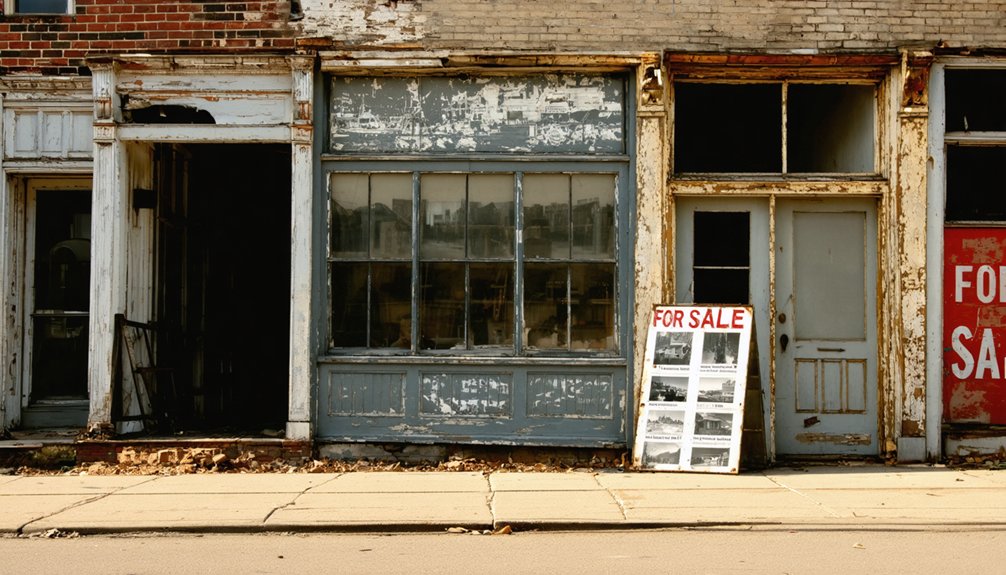
Georgia’s ghost town listings reveal striking price variations when measured against comparable properties nationwide.
You’ll find Grantville’s $680,000 price tag delivers concentrated downtown retail space, while Toomsboro’s $2 million asking price includes operational mills and infrastructure across 40 acres.
These figures contrast sharply with out-of-state opportunities:
- Henry River Mill Village offered 72 acres with 20+ buildings at $1.4 million, showcasing ghost town aesthetics despite fire damage
- Rocky Bar, Idaho sold half its territory for $250,000, including mineral rights and minimal preservation challenges
- The Grove, Texas auctioned at $200,000 after failed eBay attempts
Per-acre valuations expose market inefficiencies—Toomsboro commands $50,000-$62,500 per acre versus Georgia’s distressed property average of $29,641, suggesting significant negotiation opportunities for independent investors seeking unrestricted development freedom.
Investment Opportunities: Tourism, Film Production, and Preservation
When you acquire a Georgia ghost town, you’re purchasing more than deteriorating structures—you’re securing revenue streams through heritage tourism that generated $210 million in local taxes annually statewide.
Towns like Madison prove the model works, shifting from decline to profitable destinations attracting weekend visitors.
Film production offers additional returns. Georgia’s abandoned structures provide authentic period backdrops, while locations like Shenandoah’s industrial ruins suit dystopian shoots.
Filming incentives make the state competitive nationally.
Preservation benefits extend beyond aesthetics. Heritage sites maintained during recessions show resilience, with historic downtowns averaging 2.8 to 4.6 business openings per closure.
You’ll leverage Georgia’s $20 billion tourism industry—second only to agriculture—while controlling infrastructure development to avoid the overcrowding plaguing commercialized towns like Helen.
Other Notable Properties and Towns Across Georgia
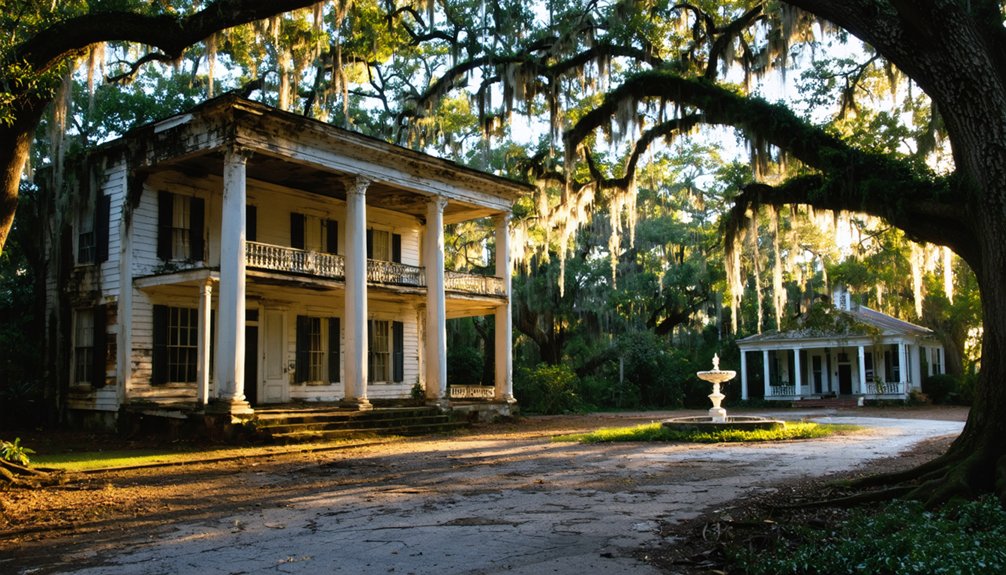
Toomsboro’s 37 parcels across 40 acres represent Georgia’s most extensive ghost town offering, with developer David Bumgardner listing the property below $2 million after acquiring it from preservationist Bill Lucado.
These abandoned properties span from opera houses to railroad depots, positioned 119 miles southwest of Atlanta.
Beyond Toomsboro, Georgia’s rural revitalization opportunities include:
- Grantville’s downtown district: Nine buildings covering 25,000 square feet across two blocks, listed at $680,000. The former textile hub gained recognition as a “Walking Dead” filming location.
- Georgia Trust’s Revolving Fund: Architecturally significant structures statewide, monitored for preservation compliance post-sale.
- 87 distressed properties: Averaging $298,784, these bank-owned estates and handyman specials offer entry points for restoration-focused investors.
Each property provides distinct pathways toward autonomous ownership and community rebuilding.
Frequently Asked Questions
What Are the Typical Property Tax Rates for Ghost Towns in Georgia?
You’ll face Georgia’s standard 40% property assessment rate and millage rates averaging 30 mills, though ghost towns won’t qualify for homestead tax exemptions. Expect rates varying from 0.38% to 1.28% depending on county location.
Do Ghost Town Purchases Include Mineral or Water Rights on the Land?
You’ll find mineral rights and water rights aren’t automatically included—despite buying entire ghost towns, you must verify each deed separately. Georgia properties vary wildly, with some explicitly bundling all resource rights while others retain nothing.
What Zoning Restrictions Apply When Redeveloping Abandoned Georgia Town Properties?
You’ll face local zoning classifications that require municipal approval before redevelopment. Abandoned properties need redevelopment permits, compliance with current ordinances, and possible rezoning through public hearings. Cities control density, land use, and structural standards throughout rehabilitation.
Are There Grants Available for Historic Preservation of Ghost Town Buildings?
You’ll find historic preservation grants through Georgia’s Heritage Grant Program, Federal HPF grants for Certified Local Governments, and the 1772 Foundation offering up to $10,000. These funding opportunities require matching contributions and target Register-eligible properties.
What Insurance Costs Should Buyers Expect for Vacant Historic Structures?
You’ll pay 1.5 to 3 times standard rates for vacant property insurance on historic structures. Expect higher historic structure coverage costs due to specialized materials, craftsmanship requirements, and increased risks like fire, theft, and vandalism exposure.
References
- https://abcnews.go.com/Business/12-towns-sale-toomsboro-georgia-latest-town-sale/story?id=16243378
- https://www.southernthing.com/an-entire-town-in-georgia-is-for-sale-and-its-actually-kind-of-a-bargain-2646165719.html
- https://www.youtube.com/watch?v=qMqSgEPatvc
- https://www.ezhomesearch.com/blog/towns-for-sale-in-the-usa/
- https://www.ksl.com/article/33683988/walking-dead-town-for-sale
- https://jonkohler.com/property/georgia/southlands/
- https://www.aol.com/articles/10-ghost-towns-us-actually-200604529.html
- https://vanishinggeorgia.com/tag/georgia-ghost-towns/
- https://oldhousesunder50k.com
- https://en.wikipedia.org/wiki/Toomsboro