You won’t find traditional ghost towns for sale in Hawaii due to unique land ownership structures and federal protections on archaeological sites. However, you can explore 39-43 homestead properties ranging from $435,000 to $4,950,000, off-grid homes in Pahoa starting at $30,000, or extraordinary opportunities like the 55,000-acre Molokai Ranch. Hawaii’s 119 historic properties and remote Big Island parcels offer alternatives to mainland ghost towns, each with distinct investment potential and cultural significance worth exploring further.
Key Takeaways
- Hawaii has no traditional ghost towns for sale due to unique land ownership, federal protections, and private control of abandoned sites.
- 119 historic properties are available statewide, offering alternatives with plantation-era homes and vintage estates ranging from $666,000 median price.
- Molokai Ranch’s 55,000 acres with deteriorating luxury structures represents Hawaii’s closest equivalent to a ghost town investment opportunity.
- Off-grid homesteads in areas like Pahoa and Hawaiian Acres provide rural properties from $30,000 to $4,950,000 with sustainable living features.
- Beachfront heritage properties and conservation lands offer historical significance, priced between $3.2 million and $21.95 million requiring cultural preservation diligence.
Why Hawaii Has No Traditional Ghost Towns on the Market
Unlike the American West where you can browse listings for decaying mining camps with clear titles and asking prices, Hawaii’s abandoned settlements remain conspicuously absent from real estate markets due to a complex intersection of land ownership structures, cultural preservation mandates, and geographic isolation.
The abandonment factors differ fundamentally—you’re not finding boom-and-bust mineral towns but rather sites emptied by tsunamis, environmental shifts, and prehistoric resource depletion.
Preservation challenges prevent sales: federal protections encompass Nihoa’s 88 archaeological sites and Necker’s 52 structures within Papahānaumokuākea Marine National Monument, while Kaloko-Honokohau’s 1,160 acres remain locked under National Park Service control. The park preserves ancient fishponds alongside agricultural sites that demonstrate sophisticated Hawaiian resource management. Even privately-held ruins like the Koloa sugar mill stay off-market, controlled by wealthy individuals like AOL co-founder Stephen Case who block traditional transactions.
Federal ownership creates permanent barriers—from Papahānaumokuākea’s protected archaeological sites to National Park Service holdings that eliminate any possibility of private acquisition.
The ancient land management system divided territories from mountains to sea, creating sustainable zones that modern property laws struggle to accommodate when these historic sites change hands.
Understanding the Ghost Town Phenomenon in the Continental United States
While Hawaii’s abandoned settlements remain locked away from buyers, the continental United States presents a starkly different landscape—over 4,500 documented ghost towns scattered across all 50 states, with varying degrees of accessibility to investors and tourists.
Texas dominates with 550 ghost towns, while Oklahoma, Kansas, California, and Florida each claim over 240.
The ghost town causes reveal consistent patterns: mining booms and busts, oil discoveries like Texas’s 1901 Spindletop strike, and the devastating 1930s Dust Bowl.
Urban migration transformed these demographics, shifting populations from 80% rural to 80% urban in industrialized areas.
You’ll find modern examples emerging too. San Francisco dropped 7.4% in population between 2020-2023, while St. Louis experienced -6.6% decline.
Detroit’s population fell by 1% during the same period, with new building permits decreasing by 15%.
Many ghost towns have evolved into tourist attractions, with Montana’s Bannack serving as a notable example of preservation efforts.
These shifts create unique acquisition opportunities unavailable in Hawaii’s restricted market.
Historic and Rural Properties Available in Hawaii Instead
While Hawaii doesn’t have traditional ghost towns available for purchase, you’ll find 119 historic properties across the islands that offer similar rural and cultural appeal.
These alternatives range from restored 1903 Queen Anne estates in Kahala listed at $4,950,000 to plantation-style homes in Hawaii County with a median price of $666,000.
Your options include off-grid mountain retreats in Kula with native koa trees, beachfront estates with 65+ feet of sandy shoreline, and early twentieth-century bungalows in Kaimuki’s streetcar-era neighborhoods. Kaimuki properties feature diverse home styles including single-family homes, contemporary Hawaiian architecture, and traditional plantation-style houses along lightly traveled residential streets. The majority of historic properties are located on Oahu, particularly in Honolulu, with notable neighborhoods including University of Hawaii Manoa and Punchbowl.
Historic Homesteads and Off-Grid Living
Hawaii’s real estate market offers 119 historic homes and 39-43 homestead properties as alternatives to ghost towns, with prices ranging from $435,000 for a 2.12-acre parcel to $4,950,000 for a Queen Anne estate.
You’ll find historic preservation opportunities in properties like the 1903 Nehoa Street estate and the 1931 Tudor cottage at Kahala Avenue, both on the National Register of Historic Places.
For sustainable living, homesteads provide off-grid capabilities with solar power and rainwater catchment systems.
The Hakalau property at $950,000 demonstrates complete self-sufficiency with 960 square feet on fully fenced land.
Waimea Homesteads offers lots from 5,400 square feet to 2.5 acres with agricultural zoning, enabling farming and rural independence.
Properties like the 6.56-acre Mountain View oasis feature professionally installed yurts with skylights and high ceilings for retreat or homestead use.
These properties deliver autonomy without requiring entire town purchases. With 64 vintage homes currently available in Hawaii County and a median listing price of $649K, buyers have diverse options to explore rural and historic living opportunities.
Beachfront and Mountain Properties
Luxury beachfront estates dominate Oahu’s coastline with prices reaching $15,000,000 for prime oceanfront parcels.
You’ll find Ewa Beach’s gated properties at $5,190,000 featuring four houses across 18,474 square feet, while Paiko Drive offers 65+ linear feet of sandy beach access.
Haleiwa presents 16 waterfront options for immediate acquisition.
Maui’s beachfront vistas concentrate in Wailea’s gated Maluhia condominiums and Makena’s exclusive Palauea coastline.
Kihei maintains the island’s largest beachfront inventory with varied price points.
Menehune Shores in Kihei features direct oceanfront views with modernized two-bedroom units priced at $1,399,999.
Beachfront homes command premium valuations due to their scarcity and rarity, with properties directly adjacent to sandy beaches proving significantly more valuable than standard oceanfront locations.
Mountain retreats appear throughout Big Island’s rural corridor, where Volcano, Mountain View, and Kurtistown offer homestead acreage.
Puna region properties blend oceanfront access with jungle privacy, including Kehena Beach Estates’ bulldozed lots starting at lower entry points.
You’ll discover 72 homestead properties across non-Honolulu locations.
Big Island Homesteads and Off-Grid Living Opportunities
Although Hawaii’s plantation era ended decades ago, the Big Island continues to offer unconventional homesteading opportunities that range from historic lava refuge subdivisions to modern off-grid parcels.
The Kikala-Keokea Lava Refugee Subdivision exemplifies this freedom-oriented approach, offering 67 one-acre lots on 65-year leases for just $132 annually. You’re exempt from zoning and building codes here, enabling traditional living with sustainable agriculture and livestock.
Current market listings showcase 127 off-grid properties ranging from $18,000 Volcano lots to million-dollar Kailua Kona acreage.
These parcels support cultural preservation through layouts reminiscent of pre-contact Hawaiian villages at Kaloko-Honokohau, where communities sustained themselves through fishponds, crops, and mountain trade networks.
You’ll find bulldozed lots with septic systems ready or jungle parcels with existing structures featuring ghost wood siding.
Beachfront and Unique Land Parcels Across the Hawaiian Islands
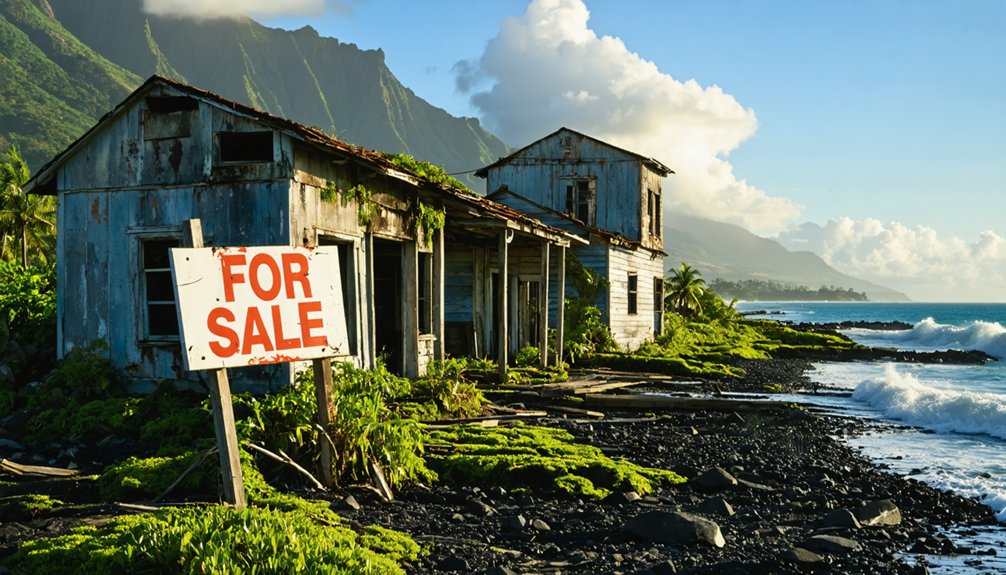
Beyond the conventional real estate market, Hawaii’s most extraordinary land opportunities include a $260 million abandoned ranch empire and million-dollar oceanfront parcels that rarely reach public listings.
Molokai Ranch’s 55,000 acres represent one of Hawaii’s largest potential acquisitions, featuring deteriorating luxury structures from its 2008 closure. The absent foreign owner maintains barbed wire restrictions while the property sits in limbo—a stark contrast to Larry Ellison’s successful Lanai purchase.
At 55,000 acres, the abandoned Molokai Ranch remains Hawaii’s most controversial investment opportunity—deteriorating behind barbed wire since 2008.
For immediate beachfront opportunities, you’ll find East Honolulu’s 65-foot Paiko Beach lot listed under $15 million, fronting established surf breaks Toes and Secrets. This unique land represents the only available beachfront vacant parcel in the area.
Historic properties offer alternative investment angles, including Manoa Valley’s 1911 estate and Kaimuki’s R-5 zoned parcels with panoramic Diamond Head views—rare intact lots within established neighborhoods.
Alternative Investment Options for Those Seeking Historic Hawaii Properties
If you’re targeting Hawaii’s heritage property market, you’ll find traditional ghost towns are scarce, but historic homesteads, plantation-era estates, and vintage beachfront parcels offer comparable investment potential.
The current market shows 54 vintage homes in Hawaii County at a median $666K, while restored Queen Anne estates in Honolulu have dropped from $4.95M to $3.68M, signaling pricing adjustments in the premium historic segment.
Your alternatives range from National Register beach cottages in Kahala to off-grid jungle sanctuaries near protected historic parks, where adjacent land development capitalizes on eco-tourism growth without the regulatory constraints of actual ghost town acquisitions.
Historic Homesteads and Estates
While ghost towns may be scarce in Hawaii, historic homesteads and estates offer investors tangible opportunities to own significant pieces of the state’s architectural heritage.
You’ll find properties like the 1903 Queen Anne estate at 1302 Nehoa Street ($4,950,000) and the 1911 Manoa Valley home at 2626 Hillside Avenue showcasing architectural significance worth preserving.
The 5,300-square-foot estate at 3805 Old Pali Road represents early Nuuanu development, while 187 Dowsett Avenue provides 3.7 acres of historic land holdings.
For historic preservation enthusiasts, Kaimuki’s early twentieth-century bungalows and plantation-style homes demonstrate successful renovation approaches.
Hawaii County currently offers 54 vintage properties at a median $666,000, with most selling within 119 days.
These estates provide autonomy unavailable in conventional developments while preserving Hawaii’s cultural legacy.
Beachfront Heritage Land Parcels
Hawaii’s coastal heritage properties represent a different preservation opportunity, combining oceanfront access with historical significance.
You’ll find that beachfront investments with historical value differ substantially from traditional ghost town acquisitions. Current market listings show conservation lands and legacy properties ranging from $3.2 million to $21.95 million, though these aren’t abandoned settlements requiring full restoration.
Your heritage conservation options focus on oceanfront parcels where documented historical structures or archaeological sites exist.
Unlike mainland ghost towns, Hawaii’s limited land availability means you’re purchasing active beachfront with historical elements rather than derelict communities.
These investments demand thorough due diligence regarding cultural preservation requirements, Native Hawaiian rights, and coastal zone regulations.
You’ll need specialized legal counsel familiar with Hawaii’s unique property laws before pursuing these alternative historical investments.
Off-Grid Rural Properties
Since traditional ghost towns don’t exist in Hawaii’s real estate market, off-grid rural properties on the Big Island offer you the closest alternative for remote, undeveloped land investments.
Available Off-Grid Investment Options:
- Pahoa Properties – 72 off-grid homes ranging from $30,000 bare-bones structures to $469,000 developed homesteads, providing entry points for sustainable living enthusiasts seeking autonomy.
- Hawaiian Acres Land – 115 parcels with median prices at $215,000, featuring undeveloped lots in Kurtistown and Mountain View where off grid communities establish rainwater catchment and solar systems.
- Rural Big Island Holdings – 279 properties averaging $55,316 per acre across Puna’s lava terrain and North Hilo’s farmland, offering complete independence from municipal infrastructure.
These investments bypass conventional utility dependencies while securing appreciating Hawaiian real estate.
Frequently Asked Questions
What Are Typical Price Ranges for Ghost Towns in Other States?
You’ll find abandoned properties ranging from $70,000 for basic sites to $22.5 million for developed towns. Market trends show small fixers under $500,000, mid-range properties at $1-2 million, and premium locations exceeding $5 million nationwide.
Can Foreign Buyers Purchase Historic Properties in Hawaii?
You’ll face evolving foreign ownership regulations in Hawaii, though current restrictions primarily target farmland and military-adjacent properties. Historic preservation laws don’t specifically prohibit foreign purchases, but proposed legislation could expand restrictions affecting your acquisition options considerably.
Are There Tax Benefits for Buying Historic Properties in Hawaii?
Yes, you’ll receive significant tax incentives through Hawaii’s Historic Preservation Income Tax Credit Program. You can claim a 30% credit on qualified rehabilitation expenditures for certified historic structures, with income-producing properties receiving 20% credits and low-income housing qualifying for an additional 10% bonus.
How Do Financing Options Differ for Ghost Towns Versus Standard Properties?
You’ll need creative financing for abandoned settlements since they require leasehold eligibility and specialized programs offering zero-down options, while standard properties demand 30-40% down through conventional loans—dramatically different investment strategies altogether.
What Zoning Restrictions Apply to Abandoned or Historic Hawaii Properties?
You’ll face strict zoning regulations requiring State Historic Preservation Division review for properties over 50 years old, plus mandatory historic preservation compliance if listed on Hawaii’s Register—processes that typically take months and restrict demolition, alterations, and expansions considerably.
References
- https://www.aol.com/articles/10-ghost-towns-us-actually-200604529.html
- http://www.bcre.com/hawaii-historic-homes-for-sale.php
- https://www.zillow.com/old-pali-honolulu-hi/
- https://www.ezhomesearch.com/blog/towns-for-sale-in-the-usa/
- https://www.homes.com/hawaii/homestead/
- https://www.hawaiirealestatesearch.com/big-island/hamakua
- https://www.hawaiiliving.com/oahu/ewa-kapolei/ewa-villages-homes/
- https://hbs.bishopmuseum.org/PUBS-ONLINE/pdf/op28p35-49.pdf
- https://www.tourmaui.com/hawaii-history-timelines/
- https://nvtami.com/2023/04/26/big-island-hawaii-ghost-towns/