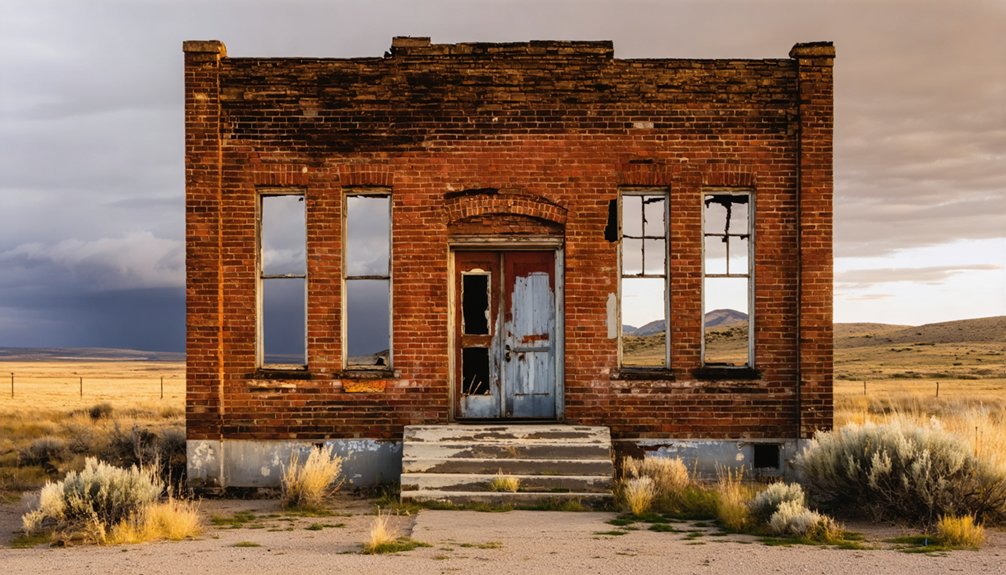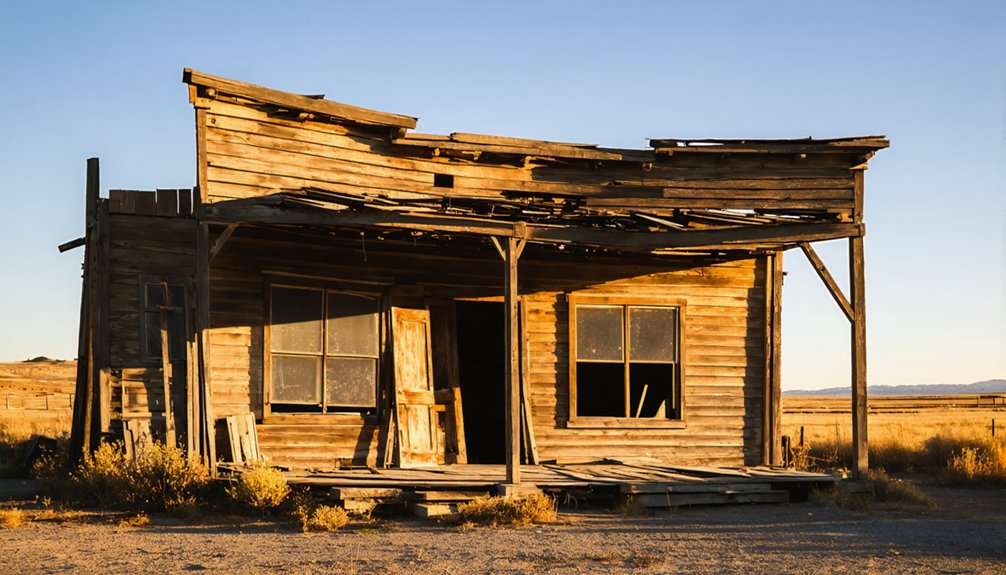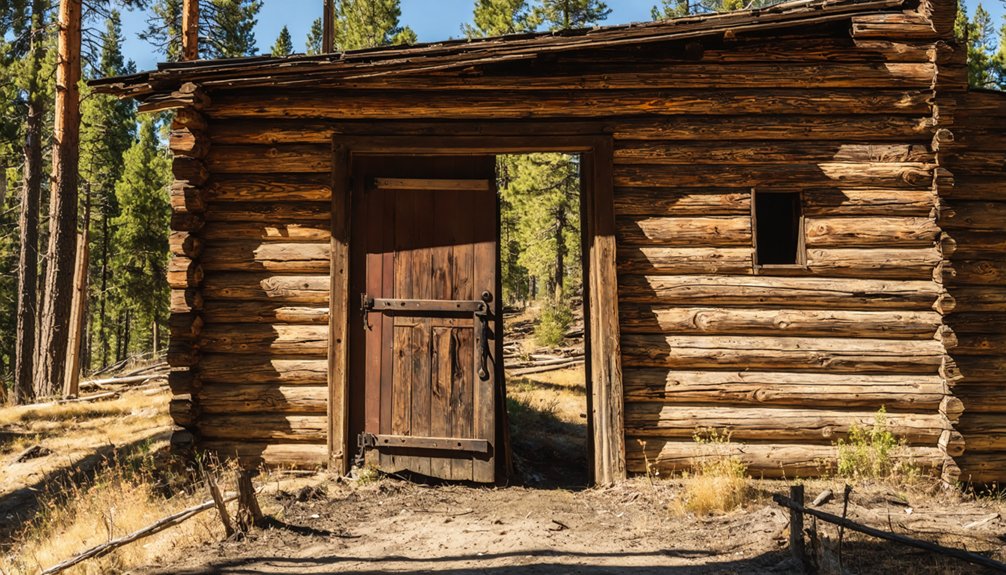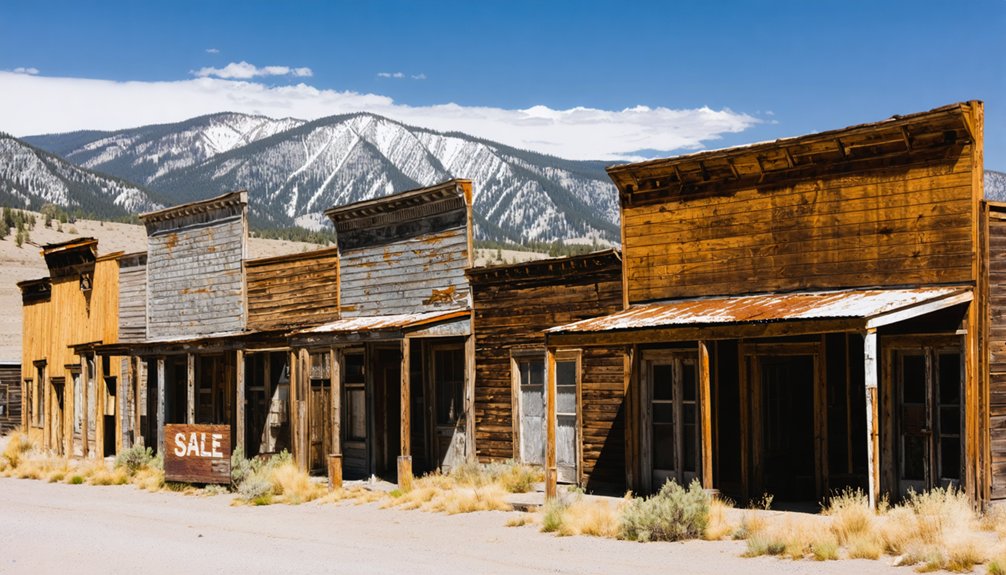
You’ll find Idaho’s ghost town market offers complete Western communities like Emmett’s $899,999 frontier property featured in *Murder in the Heartland*, alongside isolated mining camps in the state’s historic gold corridors. With 84 documented ghost towns scattered from Boise County to Owyhee County, your options range from raw land parcels under $100,000 to restored settlements near Silver City and Bayhorse. These properties blend authentic heritage with off-grid potential and tourism income opportunities. Discover how Idaho’s pricing, location advantages, and preservation quality compare to neighboring Western states.
Key Takeaways
- Idaho features 84 documented ghost towns available for purchase, with properties ranging from $99,900 raw land to $1.15 million complete communities.
- The featured Emmett property at $899,999 offers authentic frontier architecture built in 1997 with multiple structures and film production potential.
- Southern Idaho’s mining corridor from Boise County to Owyhee County contains the state’s highest concentration of available ghost town properties.
- Off-grid investments include Bayhorse, Yankee Fork, and Silver City sites with solar arrays, well systems, and minimal zoning restrictions.
- Properties near established tourist destinations like Silver City benefit from Idaho’s $1.4 billion tourism industry and growing heritage travel interest.
Understanding Idaho’s Rich Ghost Town Heritage
When gold-seekers first struck pay dirt in Pierce in 1860, they triggered a settlement pattern that would scatter nearly 70 ghost towns across Idaho’s mountains and valleys over the next three decades.
You’re looking at communities where nearly one-quarter of all historic Idaho patenting activity occurred—these weren’t insignificant outposts but thriving commercial centers with genuine cultural significance.
Pierce City swelled to 7,000 miners within months. Silver City housed over 300 homes and 75 businesses. Warren peaked at 5,000 residents.
This mining legacy represents authentic American expansion, where independent prospectors built entire economies from raw wilderness. The Warren Mining District alone produced approximately $15 million in placer gold between 1862 and 1935, demonstrating the substantial economic impact these communities generated.
Today’s ghost town market offers you tangible connections to this frontier heritage—properties where settlers chose freedom over comfort, where entrepreneurial spirit transformed remote canyons into bustling settlements, and where architectural remnants still stand as symbols to self-determined lives. These sites range from barren foundations where buildings have been destroyed or covered with water, to semi-abandoned communities with buildings still standing and a few residents present.
Featured Property: Emmett’s $899,999 Western Frontier Community
You’ll find one of Idaho’s most distinctive offerings at 3800 E Black Canyon Hwy in Emmett—a complete western town replica priced at $899,999.
Built in 1997 to capture authentic frontier architecture, this multi-structure property delivers movie-set quality without historic preservation restrictions.
The site gained national attention when *Murder in the Heartland* featured it in their “To Kill a Cowboy” episode, documenting a 2013 crime that forever linked this roadside attraction to Idaho’s darker modern history.
Located four hours east of Boise, the property offers proximity to outdoor attractions like Downata Hot Springs, where visitors can experience covered wagon life.
Meanwhile, Emmett’s actual historic downtown struggles with vacant storefronts, a stark contrast to this meticulously maintained replica just miles away.
Property Details and Pricing
This authentic Western frontier community sits at 3800 E Black Canyon Hwy in Emmett, Idaho, carrying an asking price of $899,999—positioning it below the million-dollar threshold while offering considerably more character than standard rural properties.
The property valuation reflects current market trends for unique Western investments:
- Competitive Pricing: Aligns with ghost town parcels ranging $800,000-$1.15 million
- Value Proposition: Multiple structures versus single off-grid lots starting at $99,900
- Investment Scale: Accessible compared to larger acquisitions like Campo’s $6.6 million
- Built-in Assets: Includes complete frontier town layout with authentic Old West architecture
Originally constructed in 1997, you’ll find several acres supporting this frontier-style community.
The property combines modern construction with 1800s-1900s aesthetic appeal, featuring multiple buildings that evoke saloons, stores, and period-authentic cabins along Highway 16. Unlike smaller ghost town properties in locations such as St. Elmo, Colorado, where small older structures can approach $90,000 to $100,000, this frontier community offers a complete town layout at a proportionally higher scale. Prospective buyers should budget for restoration and maintenance costs that may exceed the initial purchase price, particularly given the property’s size and multiple structures requiring upkeep.
Film History and Tourism
Since its 1997 construction, this frontier-style property has positioned itself strategically for film production and heritage tourism ventures.
You’ll find authentic western architecture that’s camera-ready for period productions without extensive set modifications. The buildings provide immediate backdrops for filmmakers seeking genuine frontier aesthetics, potentially generating revenue through location fees while you’re developing long-term tourism promotion strategies.
The property’s proximity to Emmett creates opportunities for film restoration projects that’ll attract history enthusiasts and cinema buffs alike. Idaho’s transition from Oregon Trail pit stop to mining hub established the state’s rich frontier heritage that continues to draw visitors today.
You can capitalize on Idaho’s growing agritourism sector by combining authentic western experiences with behind-the-scenes film history tours. Consider how Bayhorse Ghost Town attracts visitors annually through its Ride the Bayhorse ATV event, demonstrating the revenue potential of combining historic preservation with recreational activities. This dual-purpose approach maximizes your investment potential, letting you tap into both entertainment industry contracts and heritage tourism markets.
The property’s established infrastructure means you’re starting with proven facilities rather than building from scratch.
Southern Idaho Ghost Town Hotspots and Historical Sites
Southern Idaho’s eighty-four documented ghost towns represent distinct investment opportunities shaped by their mining, railroad, and lumber mill origins.
You’ll find authentic late 1800s and early 1900s architecture still standing in locations like Bayhorse, Yankee Fork, and Silver City, where original saloons, general stores, and banks survived economic collapse and natural disasters.
These mapped historical sites offer heritage preservation potential alongside the commercial value of owning a tangible piece of the Old West.
When evaluating these properties, the information deemed reliable but not guaranteed nature of historical data requires independent verification of property boundaries and features.
Wayne C. Sparling’s comprehensive 1974 guide describes the history of mining boomtowns and their decline across the region.
Mining Heritage Preservation Sites
While ghost towns across Idaho capture imaginations, southern Idaho’s mining heritage preservation sites stand out as some of the region’s most historically significant and well-maintained properties.
These locations offer exceptional opportunities for historical significance exploration and mining relics preservation.
Key preservation sites include:
- Bayhorse Ghost Town – Features stone buildings, charcoal kilns, and well-maintained trails within Salmon-Challis National Forest, representing over $300 million in historical mineral production.
- Silver City – The West’s best-preserved mining camp with dozens of intact structures, offering summer operations and 360-degree mountain views.
- Mackay Mine Hill Sites – Encompasses multiple ghost towns, transportation ruins, and miners’ cabins between active communities.
- Rocky Bar – Showcases Sawtooth Mountains gold rush heritage with preserved 1863-era foundations.
You’ll find these sites combine accessibility with authentic preservation.
Mapped Historical Town Locations
Idaho’s ghost town landscape concentrates most densely in a triangular corridor stretching from Boise County through Owyhee County and down to the state’s southeastern border.
You’ll find seven ghost towns within 50 miles of Boise City, with Idaho City, Placerville, and Pioneerville marking prime territory on clickable maps.
Owyhee County’s cluster—Silver City, Ruby City, and De Lamar—showcases exceptional historical significance through visible 1892-era remains.
Modern mapping techniques reveal Lemhi County holds Idaho’s highest concentration with four documented sites.
The southeastern fringe includes Battle Creek, Rushville, and Coulam along former railroad corridors.
When you’re evaluating properties, these mapped locations provide vital market intelligence.
Understanding regional density patterns helps you identify undervalued sites where historical significance meets investment potential.
Each mapped town represents tangible freedom—unencumbered land with authentic frontier heritage.
Economic Decline and Abandonment
When metal prices collapsed in the early 20th century, Idaho’s most prosperous mining communities transformed into real estate opportunities you can still acquire today.
Economic downturns devastated towns like Bayhorse, where $10 million in minerals couldn’t sustain operations past 1925. Population shifts emptied Silver City’s 75 businesses and Gilmore’s thriving smelter operations as residents relocated seeking better prospects.
These abandonment patterns created today’s investment landscape:
- Ore depletion forced closure of profitable operations despite previous production success
- Undiversified economies collapsed when single-industry mining ceased sustaining communities
- Infrastructure challenges including rugged terrain and isolation accelerated population exodus
- Natural disasters and harsh winters eliminated remaining holdouts from struggling settlements
You’ll find preserved structures from towns that once housed 300-500 residents, now available as heritage properties with authentic mining-era architecture.
Off-Grid Land and Ghost Town Investment Opportunities
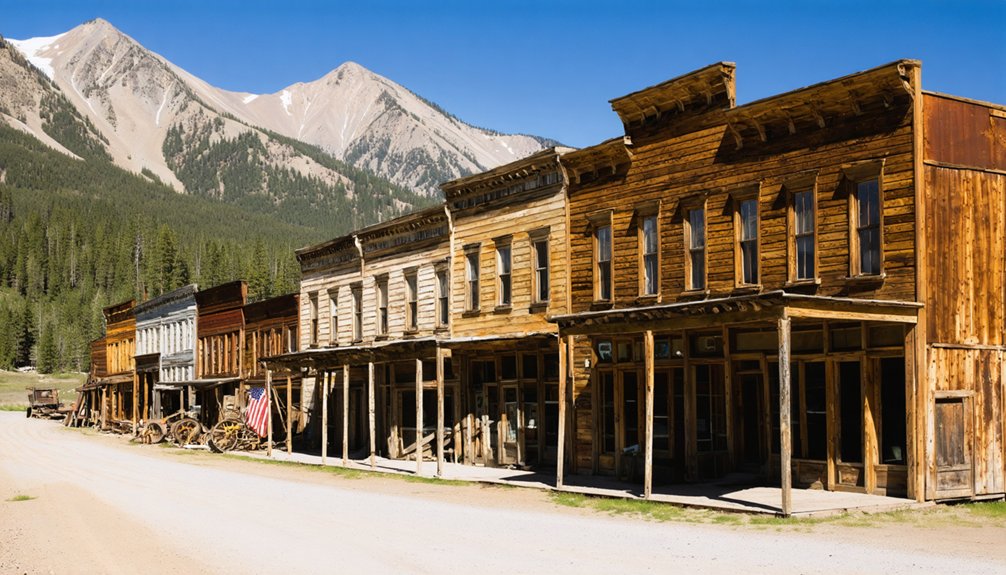
Across southern Idaho’s mining corridors, 84 documented ghost towns present off-grid investment terrain where modern utilities never arrived—or vanished decades ago.
You’ll find Bayhorse’s isolated mining ruins, Yankee Fork’s expansive dredge-scarred parcels, and Silver City’s dirt-road-only lots—all primed for sustainable living infrastructure you control.
Remote investments here start below $100,000 for raw land, while Emmett’s complete 1997-built western frontier community commands $899,999 for immediate town-scale operations.
You’re purchasing more than property; you’re securing autonomy through solar arrays, well systems, and septic installations no utility company can meter.
Restoration demands sweat equity, yet isolation guarantees privacy commercial developers can’t replicate.
Idaho’s ghost pockets reward self-reliant builders willing to embrace heritage-conscious development where freedom isn’t marketed—it’s engineered into every off-grid decision you make.
How Idaho Compares to Other Western Ghost Town Markets
Among 4,531 ghost towns scattered across America, Idaho’s 84 properties occupy a distinct market position—offering mid-tier pricing between Colorado’s premium alpine ruins and Kansas’s depopulated prairie bargains.
Your Idaho comparison reveals strategic advantages for ghost town investments:
- Entry Points: Idaho’s $899,999 Emmett property sits between Montana’s frontier complexes and Texas’s $80,000-$100,000 Lobo structures.
- Location Premium: Sawtooth National Recreation Area sites like Custer and Bonanza command higher values than South Dakota’s $70,000-$100,000 prairie cabins.
- Development Potential: Idaho’s mining-era towns offer film set conversions and vacation rental transformations.
- Market Activity: Western parcels consistently sell at $800,000-$1.15 million, outpacing Kansas townships at $40,000-$95,000.
You’ll navigate fewer zoning restrictions than coastal states while accessing authentic Western heritage properties that appreciate beyond Midwest alternatives.
Tourism Potential and Exploration Resources for Buyers
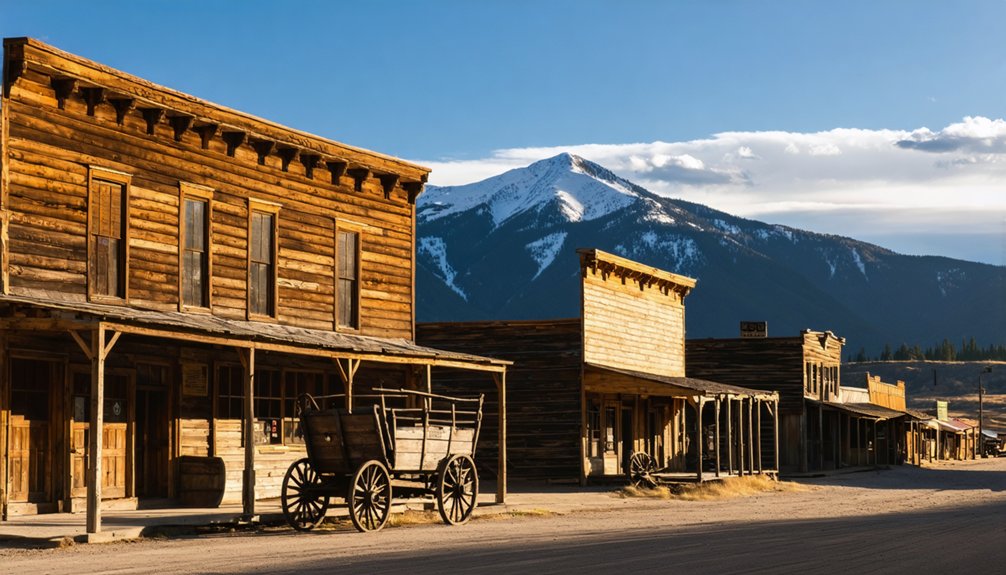
Idaho’s ghost town properties generate measurable tourism revenue that directly enhances their investment value—the state’s $1.4 billion tourism industry positions heritage sites as income-producing assets rather than static relics.
You’ll find tourism growth backed by 1.8% lodging tax increases and 4.9 million Southwest Idaho trips annually, with historic places ranking as top visitor interests.
Properties near Bonanza, Custer, and Silver City offer immediate exploration incentives: established trails, guided tours, and preserved structures that attract thousands without requiring infrastructure investment.
Idaho City’s Boise Basin Museum and Chesterfield’s pioneer buildings demonstrate proven visitor engagement models you can leverage.
Your acquisition gains value from state-supported initiatives like Travel with Care, which drive tourism recovery to pre-pandemic levels.
These properties position you within Idaho’s third-largest industry, converting historical significance into tangible revenue streams.
Frequently Asked Questions
What Legal Restrictions Apply to Owning Historic Ghost Town Properties in Idaho?
Steering ghost town ownership is like stepping through a time portal with modern responsibilities. You’ll face zoning laws, property taxes, preservation requirements, mining claim restrictions, and environmental regulations that protect Idaho’s heritage while respecting your autonomy.
Are Ghost Town Buildings Structurally Safe or Do They Require Immediate Repairs?
Ghost town buildings typically aren’t structurally safe—you’ll need professional structural assessments before purchase. Budget substantially for repair costs, as most require immediate stabilization work to prevent collapse and address hazardous materials like lead paint.
Can I Charge Admission Fees if I Buy a Ghost Town?
You’ll likely have freedom to set admission pricing after purchase, though you should verify zoning regulations first. Your ghost town’s tourism potential depends on accessibility, historical significance, and marketing strategy to attract paying visitors.
Do Ghost Towns Have Access to Utilities Like Electricity and Water?
You’ll find utility infrastructure pleasantly absent in most Idaho ghost towns. You’re looking at off-grid living—solar panels, propane, and creek water become your lifelines. Securing water rights requires research, but independence awaits those craving authentic frontier freedom.
What Insurance Coverage Is Available for Century-Old Ghost Town Structures?
You’ll face severe challenges securing standard homeowners insurance due to wildfire risks, structural instability, and hazardous materials. Historic preservation requirements and insurance liability concerns make coverage scarce and expensive, often forcing you to self-insure.
References
- https://www.ezhomesearch.com/blog/towns-for-sale-in-the-usa/
- https://www.highplainsprospectors.com/products/southern-idaho-ghost-towns
- https://www.mrt.com/realestate/article/5-for-Friday-the-13th-Spooky-Ghost-Towns-for-Sale-17716649.php
- https://liteonline.com/fascinating-old-western-town-for-sale-in-emmett-for-under-1-million/
- https://www.zillow.com/id/off-grid_att/
- https://www.realtor.com/news/trends/ghost-towns-properties/
- https://nwdetectors.com/products/idaho-ghost-towns-sites-then-and-now
- https://www.aol.com/articles/10-ghost-towns-us-actually-200604529.html
- https://en.wikipedia.org/wiki/List_of_ghost_towns_in_Idaho
- https://www.allmccall.com/history_museums/warren_ghost_town.php