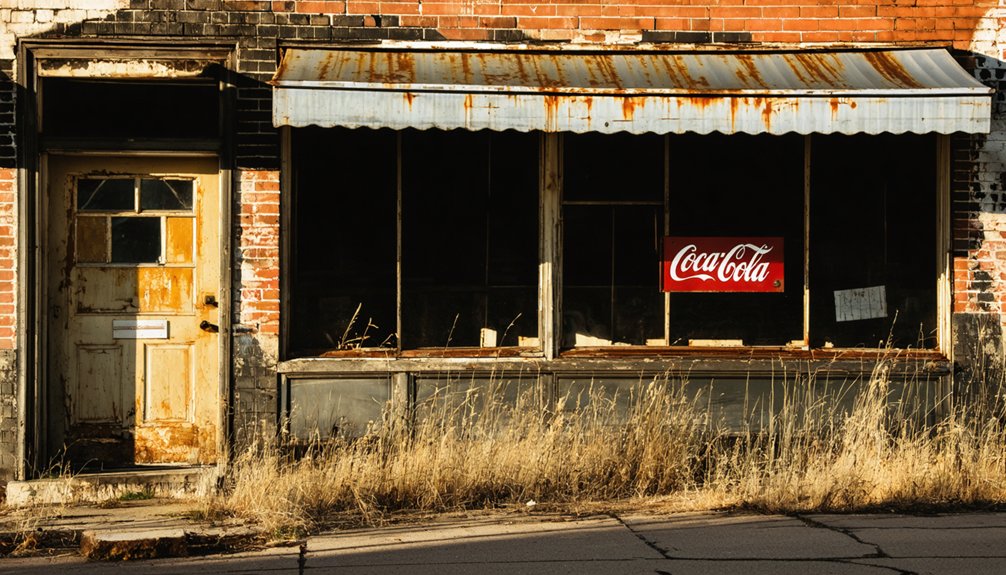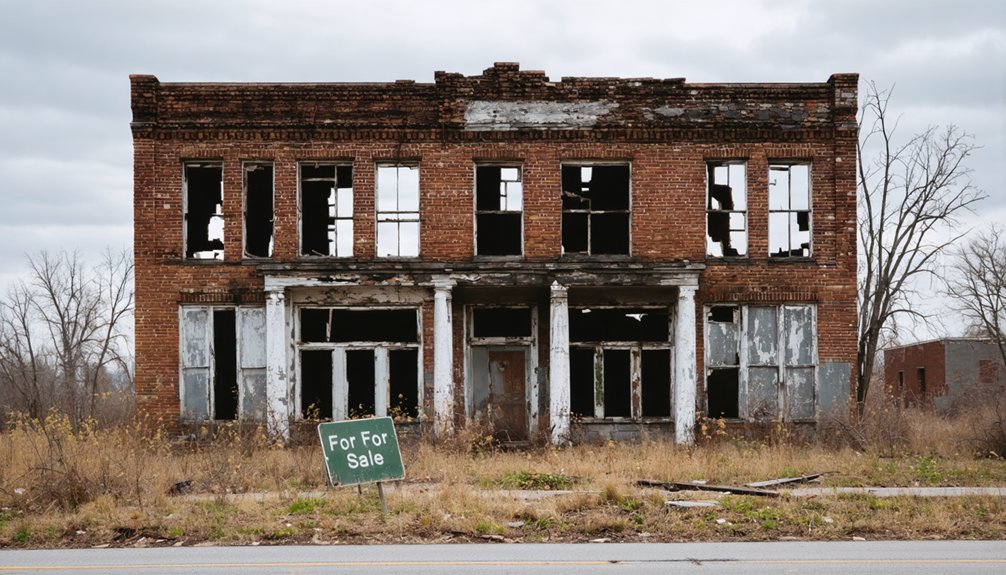
You won’t find entire Illinois ghost towns listed for sale, but East St. Louis ZIP codes 62205 and 62206 offer something remarkably similar—hundreds of abandoned homes in census tracts that’ve lost 60% of their population since 1950. With median property values between $21,000-$44,600 and over 1,200 vacant structures, these areas represent functionally abandoned neighborhoods where you could acquire multiple historic properties for preservation. The article ahead explores acquisition pathways, foreclosure opportunities, and what systemic decline really means for potential buyers.
Key Takeaways
- East St. Louis offers 843 vacant homes with median values of $21,000-$44,600, representing extreme investment opportunities in declining areas.
- Illinois has 89 historic properties averaging $524,716, with preservation-focused options available significantly below this threshold for interested buyers.
- ZIP 62206 shows 32% vacancy with expected housing excess of -1,247 units by 2030, indicating severe market distress.
- Zombie foreclosures and municipal partnerships create acquisition pathways for properties priced under $50,000 in high-vacancy zones.
- Illinois ranks third-worst nationally for foreclosures with 1,439 REO properties available for rehabilitation and community revitalization projects.
Understanding Illinois Ghost Towns and Vacant Properties
When examining Illinois ghost towns, you’ll find settlements that ceased to function after their economic foundations collapsed—whether through railroad route changes, resource depletion, or catastrophic flooding.
These ghost town characteristics reveal themselves through remaining structures: cemetery markers at Old Totten, mill foundations near Travis, and grain elevators at Spires.
Economic decline manifested differently across regions—Fulton County’s river landings like Copperas Creek became obsolete when railroads replaced waterway commerce, while southern Illinois towns faced repeated flood devastation that prompted complete federal-authorized relocations.
You’re witnessing places where substantial buildings still stand, others reduced to foundations, and some vanished entirely except for GNIS aerial documentation showing plowed fields.
Understanding these patterns helps you identify viable properties beyond mere abandonment statistics.
Illinois experienced dramatic population growth from 2,458 people in 1800 to 1.7 million by 1860, with settlement expansion driven by military posts, railroads, and agricultural development.
Towns like Tuscumbia flourished briefly after its 1837 platting but was completely abandoned by 1855.
East St. Louis ZIP 62205: A Modern Ghost Town
The demographics of East St. Louis ZIP 62205 tell a stark story of urban decline.
You’ll find 455 vacant homes—15.1% of all housing stock—in a city that’s lost 28.4% of its population since 2010. From its 1950 peak of 82,366 residents, only 17,642 remain today. The median home value sits at $44,600, compared to $239,100 statewide.
Post-industrial collapse decimated the meatpacking and stockyards industries, leaving abandoned properties and polluted industrial sites. Without urban renewal resources, the tax base can’t sustain basic infrastructure like sanitary sewers. The city’s descent accelerated after the Panic of 1873, which triggered wage cuts and labor unrest that derailed economic momentum. With only 1 home in foreclosure, the area reflects a market where traditional lending has largely retreated.
While community engagement has helped reduce crime rates from their 2016 peak, this modern ghost town still struggles. Downtown’s 2014 National Register listing offers preservation hope, yet extensive abandoned structures remain.
East St. Louis ZIP 62206: Vacancy and Decline Statistics
You’ll find ZIP 62206 exhibits a 26.24% vacancy rate—exceeding the national average by 16.1 percentage points—while its population continues to contract and median home values have collapsed to $57,700.
These metrics document a community experiencing accelerated abandonment, where more than one in four properties stands empty amid a poverty rate of 29% and unemployment reaching 10.2%.
The statistical record reveals a neighborhood evolving from urban decline into a catalogued example of Midwestern depopulation. The ZIP code encompasses 12,929 residents spread across Saint Clair County, reflecting a population density of 1,577 people per square mile.
Demographic projections indicate the area will face an expected housing excess of -1,247 houses by 2030, further compounding the challenges of an already oversaturated property market.
Extreme Vacancy Rates
While East St. Louis’s 7.7% rental vacancy rate appears modest on paper, you’ll find it masks deeper market deterioration when combined with the township’s 32% overall vacancy figure.
The homeowner vacancy rate of 1.9% tells you that occupied properties remain stuck in a stagnant ownership pattern, while rental units turn over without attracting stable tenants.
Market analysis reveals ZIP 62206’s median home value of $50,254 paired with $1,428 monthly rent creates an unsustainable investment equation.
Vacancy trends show Illinois statewide improvements from 7.5% to 6.5% between 2023-2024, yet East St. Louis bucked this recovery.
You’re witnessing a community where occupied housing comprises just 68% of stock—documentation of systematic abandonment that preserves declining neighborhoods rather than revitalizing them.
The demographic reality shows just 52.9% owner-occupied housing units among occupied homes, revealing a community struggling to maintain stable residential ownership patterns.
For context, the neighboring St. Louis metro area recorded vacancy at 7.73% in 2023, the highest since 2019, yet still maintained functional rental markets with properties averaging just 22 days on the market.
Declining Population Trends
Since 1950, East St. Louis has lost three-fifths of its residents, documenting one of America’s most dramatic cases of urban decay.
You’ll find population demographics that tell a stark preservation story: the city peaked mid-century before entering freefall.
Current statistics reveal accelerating abandonment:
- 18,278 residents remain as of 2023, down from approximately 82,000 in 1950
- 7,893 people departed in recent years alone, representing a 30% population loss
- 2025 projections estimate just 17,659 residents, continuing the decline trajectory
The numbers expose transformation beyond simple migration.
While ethnic composition shifted dramatically—from three-fifths white in 1950 to mainly African American by 2000—the relentless exodus affected all communities.
Economic indicators paint an equally grim picture, with the city’s poverty rate reaching 32.85% and median household income languishing at just $30,992.
Between 2000 and 2010 alone, the area experienced a 14.89% population decrease, shedding 4,708 residents in just one decade.
You’re witnessing a freedom-seeking departure that’s converted a once-thriving industrial center into documented evidence of regional economic collapse.
Property Value Collapse
East St. Louis ZIP 62206 reveals stark property value trends that define modern urban decay.
You’ll find median home prices plummeted to $21,000, reflecting a 16.67% year-over-year decline in this specific zone. The broader East St. Louis market shows even sharper contractions, with median sale prices reaching $29,000—down 55.4% annually. Price per square foot stands at just $23, declining 43.9% since last year.
Vacancy rates compound the collapse. Illinois rental vacancy decreased to 6.5% statewide in 2024, yet East St. Louis properties factor 10% vacancy into investment calculations.
Homes sell 2% below list price, pending in 29 days, while the market scores 48 out of 100 for competitiveness. These metrics document a community where property values continue their downward trajectory.
The Historic Illinois Ghost Tour Mansion
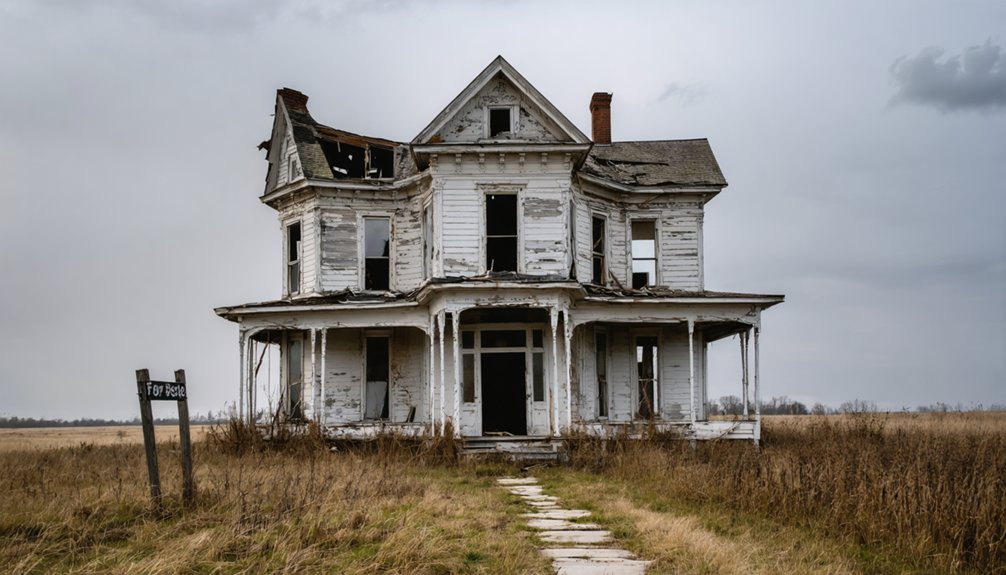
Perched atop Mount Lookout at Alton’s highest elevation, the McPike Mansion stands as a tribute to Victorian-era craftsmanship and one family’s prominent role in shaping nineteenth-century Illinois.
Architect Lucas Pfeiffenberger completed this 16-room Italianate structure in 1871 for Henry Guest McPike, who served as mayor and real estate businessman. The mansion’s haunted history draws seekers of supernatural experiences, with documented sightings of former residents including McPike and Paul Laichinger.
Current owners Sharyn and George Luedke welcome paranormal investigations at this National Register property:
- Three-story red brick mansion with white pillars
- Vaulted wine cellar beneath 16 rooms
- Unexplained cigarette smoke and spirit manifestations
You’ll find this deteriorating landmark at 2018 Alby Street, accessible for tours and investigations through independent arrangement.
What Makes a Ghost Town: Key Characteristics
Understanding what transforms a thriving settlement into a ghost town requires examining the physical and socioeconomic markers that define abandonment.
You’ll recognize these sites by their skeletal populations and crumbling infrastructure—remnants of once-prosperous communities. Economic collapse typically triggers desertion: mining operations exhaust resources, railroads bypass settlements, or industries relocate elsewhere.
The physical evidence varies from nearly intact main streets to mere foundations, making these locations prime for urban exploration. Natural disasters, contamination, or infrastructure failure can accelerate abandonment.
What distinguishes authentic ghost towns from struggling communities is the disappearance of their foundational purpose. Historical preservation efforts focus on documenting tangible remains—dilapidated mercantile buildings, abandoned homes, and overgrown cemeteries—before time erases these testimonies to Illinois’s frontier past.
Investment Opportunities in High-Vacancy Areas
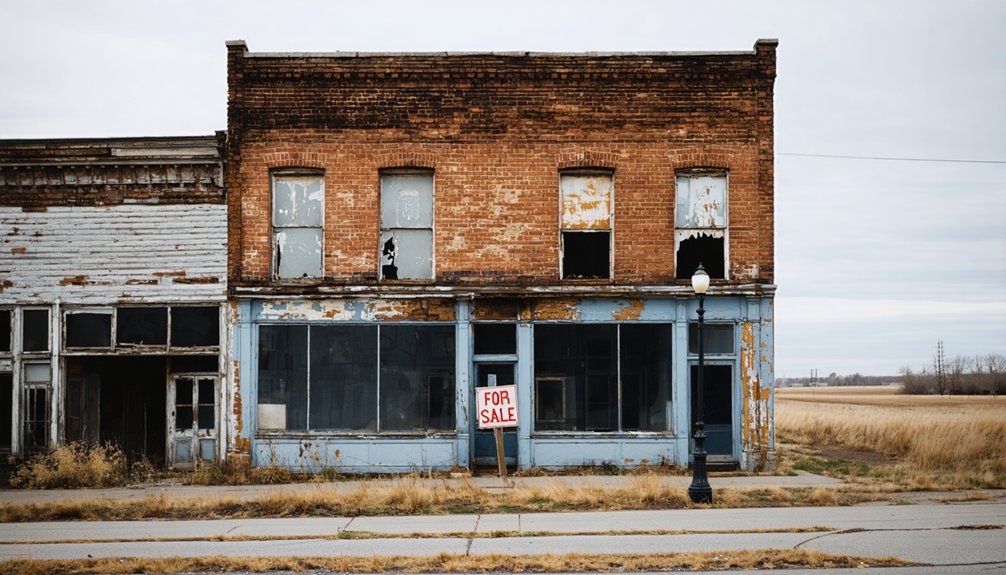
While traditional real estate markets pursue suburban growth corridors, Illinois’s high-vacancy zones present a contrarian investment thesis rooted in historic preservation and adaptive reuse.
East Saint Louis exemplifies this opportunity, where median values of $44,600-$51,700 sit far below the $239,100 state average. Population declines exceeding 28% created zones where ghost town investments operate on fundamentally different economics than conventional markets.
You’ll find opportunities shaped by urban decline:
- 843 vacant homes in ZIP 62206 waiting for preservation-focused developers
- Historic properties under $50K offering entry points impossible elsewhere
- Zombie foreclosures creating acquisition pathways through municipal partnerships
The contrarian play leverages Route 66 tourism infrastructure and adaptive reuse potential.
You’re purchasing distressed assets in communities where restoration dollars generate disproportionate cultural value compared to cookie-cutter developments.
Alternative Illinois Property Options for Ghost Town Seekers
If you’re drawn to the archaeology of abandonment but can’t acquire an entire ghost town, Illinois offers you parallel pathways through its documented inventory of distressed properties.
You’ll find historic mansions awaiting restoration, legally abandoned structures cleared through land bank programs, and unrestricted rural acreage in depopulating regions where entire communities have faded.
These alternatives provide the same preservation challenge and historical depth as ghost towns, with formal acquisition channels through tax sales, foreclosure auctions, and judicial deed transfers.
Historic Mansions With Character
Illinois presents mansion seekers with 2,790 architectural alternatives that echo the grandeur ghost town enthusiasts crave, yet offer the structural stability those abandoned settlements can’t provide.
These properties deliver historic charm through authentic Victorian facades, Queen Anne turrets overlooking Lake Michigan, and Prairie-style estates preserving century-old craftsmanship.
You’ll find mansion restoration opportunities spanning diverse budgets:
- Red Bud’s 10,123-square-foot estate at $499,999 provides seven bedrooms of untapped potential
- Barrington’s 11,653-square-foot property offers eight bathrooms across $1,900,000 of architectural legacy
- Chicago’s Wellington Avenue mansion commands $4,495,000 for 14,000 square feet of preserved grandeur
Lake County’s 321 historic homes and Old House Dreams’ 66-page collection showcase National Register properties, endangered Victorians, and character-rich fixer-uppers.
These estates grant you preservation freedom without bureaucratic ghost town complications.
Vacant Properties Needing Revival
Though authentic ghost towns remain elusive in Illinois, Chicago’s current liquidation of 812 vacant lots through Hilco Real Estate delivers comparable acquisition opportunities for preservation-minded investors seeking undervalored properties with revival potential.
These South and West Side parcels stretch along Lake Street, State Street, and Ashland Avenue—established commercial corridors positioned near transformative developments including the Obama Presidential Library and planned CTA Red Line extension.
The March 7 bidding deadline allows you to acquire individual sites or entire neighborhood clusters for extensive vacant revitalization strategies.
Beyond Chicago, the 56.6-acre Meredosia power plant site offers industrial property redevelopment potential with Illinois River access and existing utility infrastructure.
Federal Treasury auctions present additional options, including 75.06-acre Cherokee County tracts with established utilities, enabling you to circumvent traditional real estate constraints.
Rural Land and Acreage
While genuine ghost towns remain scarce in Illinois, the state’s shifting farmland market presents preservation-focused investors with acquisition opportunities across 26 million agricultural acres that’ve witnessed consistent value transformations.
You’ll find rural land pricing currently favoring buyers, with excellent farmland dropping 2.2% and cash rents declining $15-$20 per acre through 2026. The investment potential strengthens as 64% of managers anticipate continued price decreases, creating entry points for those seeking agricultural preservation projects.
Consider these acquisition scenarios from recent transactions:
- 80-acre parcels in Randolph County selling at $8,000 per acre
- 20-acre tracts in Sangamon County priced at $13,800 per acre
- 101-acre average listings around $1,361,330 statewide
With stabilization projected by 2027, you’re positioned to secure rural land before market recovery begins.
Historic Properties and Preservation Potential
For preservationists seeking authentic pieces of Illinois history, the state’s real estate market offers 89 historic properties averaging $524,716, though savvy buyers can find opportunities well below this threshold.
You’ll discover National Register-listed estates, endangered Victorian homes, and complete historic complexes like the Nauvoo district’s interconnected buildings at $495,000.
Chicago’s vintage market maintains a $341,000 median, while rural fixer-uppers start under $100,000.
The investment potential lies in adaptive reuse projects—turnkey historic inns, time capsule residences, and architecturally significant structures awaiting restoration.
Sites like Old House Dreams and Circa Old Houses catalog these preservation opportunities, emphasizing Craftsman, Prairie-style, and Victorian properties.
You’re not just purchasing real estate; you’re acquiring tangible connections to Illinois’s past, with the freedom to determine their future through thoughtful historic preservation.
The Reality of Buying in Declining Communities
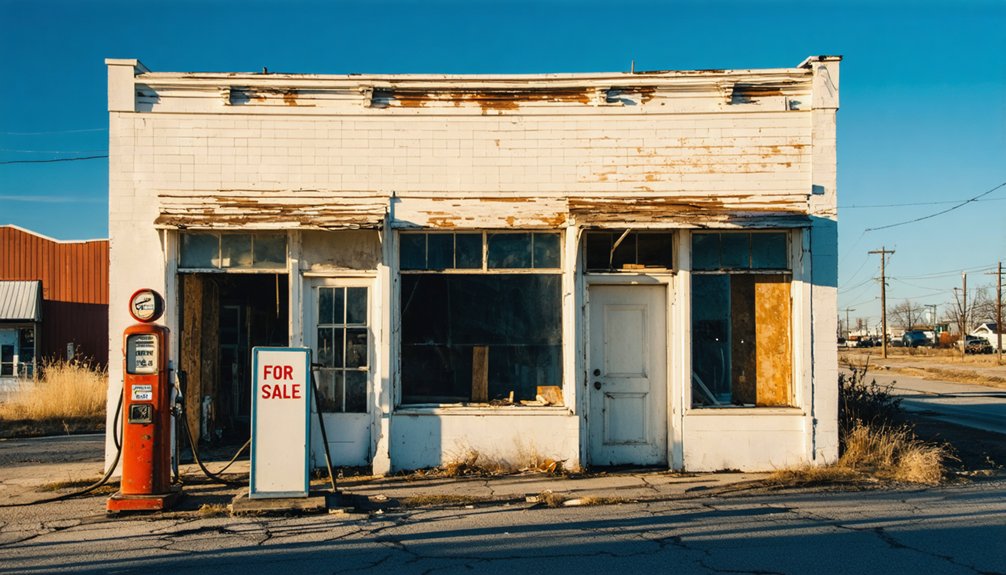
Beyond the romanticized vision of historic preservation lies a stark economic landscape where entire communities are contracting. East Saint Louis’s ZIP codes 62205 and 62206 exemplify this reality, where population plummeted 28.4% and 21.7% respectively between 2010-2020.
You’ll find median home values at $44,600 and $51,700—four to five times below Illinois’s $239,100 average.
The numbers paint a challenging picture for community revitalization:
- 15.1% vacancy rates persist across both ZIP codes, nearly nine times the state average
- 1,298 vacant homes stand empty in just two postal codes
- 70 foreclosures, including 13 zombie properties, perpetuate abandonment cycles
Economic sustainability remains elusive when properties list under $100,000 and entire neighborhoods contract.
You’re not purchasing history alone—you’re inheriting systemic decline requiring extensive intervention beyond individual restoration efforts.
Illinois’s foreclosure crisis has intensified throughout 2025, positioning the state as the nation’s third-worst market with one in every 944 housing units facing foreclosure filings in Q3—a rate nearly 50% higher than the national average of one in 1,402.
Chicago metro led nationally with 3,789 foreclosure starts in Q1 alone, while counties like Marshall, Kankakee, and Will experienced concentrated distress.
Understanding foreclosure trends reveals opportunities and risks: the state’s 1,439 REO properties in H1 represent bank-owned homes potentially abandoned as “zombie” properties.
You’ll find property rehabilitation prospects among these distressed assets, though November’s seventh-highest foreclosure rate signals ongoing deterioration.
With 7,922 foreclosure starts in H1—fourth nationally—independent investors willing to restore neglected properties can reclaim value where institutions have withdrawn, preserving communities others have abandoned.
Frequently Asked Questions
Are There Any Tax Breaks for Purchasing Property in Illinois Ghost Towns?
You’ll find tax incentives through historic property assessments frozen during rehabilitation, reduced Class L assessment rates, and state/federal income tax credits—but you’ll need local government approval and meet strict preservation standards first.
Can I Legally Demolish Historic Structures on Ghost Town Properties?
You can’t legally demolish registered historic structures without compliance with Illinois preservation laws. Even abandoned ghost town properties require demolition permits and historic preservation commission review if they’re designated landmarks or within protected districts.
What Utilities Are Still Available in East St. Louis High-Vacancy Areas?
You’ll find functional electricity and water infrastructure remains operational even in high-vacancy areas, with utilities assessment showing Ameren’s grid modernization and Illinois American Water’s treatment plant actively serving East St. Louis’s entire service territory regardless of occupancy rates.
Do Ghost Town Properties Require Special Insurance or Different Mortgage Types?
After 60 days vacant, you’ll need specialized insurance requirements covering higher-risk perils. Standard mortgage options apply, but lenders require proof of vacant property coverage. Preservation-minded insurers offer policies protecting your autonomy while safeguarding historical structures awaiting restoration.
How Long Does the Foreclosure Purchase Process Take in Illinois?
You’ll navigate Illinois’s foreclosure timeline spanning 12-15 months from default through court processes, with redemption periods and confirmation hearings preserving your opportunity to acquire historically significant properties while protecting previous owners’ rights.
References
- https://www.homes.com/news/illinois-ghost-tour-mansion-wants-its-next-owner-for-600-000/1068306317/
- https://247wallst.com/housing/2024/04/11/americas-modern-ghost-towns-2/
- https://www.ezhomesearch.com/blog/towns-for-sale-in-the-usa/
- https://www.realtor.com/realestateandhomes-search/Illinois/type-farms-ranches
- https://www.land.com/Illinois/recreational-property/
- https://www.landwatch.com/illinois-land-for-sale/undeveloped-land
- https://www.oldhousedreams.com/state/illinois/
- https://oldhousesunder50k.com
- http://cantontornado36.blogspot.com/2017/04/ghost-towns-of-fulton-county-illinois.html
- https://freepages.rootsweb.com/~gtusa/history/usa/il.htm