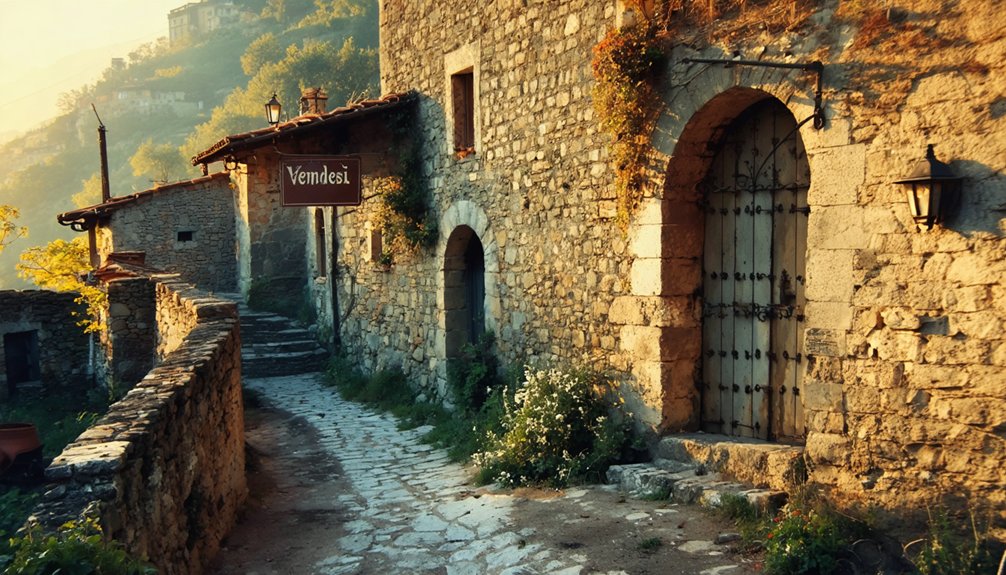
You’ll find multiple ghost towns and abandoned villages for sale across Italy, primarily through 1 euro house programs in Sicily, Tuscany, Abruzzo, and Campania. These initiatives require strict renovation commitments within 2-3 years and surety bonds of €1,000-€5,000. Beyond the 1 euro scheme, entire villages range from €19,000 stone houses to €44 million estates. Platforms like 1eurohouses.com, Renovita.net, and Villageio.com aggregate these opportunities, while direct municipal contact often yields the best results for securing your Italian property investment.
Key Takeaways
- Italy’s 1 Euro Houses initiative offers abandoned properties across Sicily, Tuscany, Calabria, and Abruzzo requiring mandatory renovation within 2-3 years.
- Entire borghi and ghost towns are available through platforms like Villageio.com, with prices ranging from €19,000 to €44 million.
- Over 5,000 Italian borghi face depopulation risk, creating opportunities for buyers seeking restoration projects or turnkey luxury properties.
- Sambuca di Sicilia’s program injected €20 million into local economy, demonstrating successful ghost town revitalization through international buyer participation.
- Municipal programs offer direct property sales with renovation aid covering 20-60% of costs, requiring Italian tax codes and performance bonds.
Understanding the 1 Euro Houses Initiative
Small towns across southern Italy have launched an ambitious €1 house initiative to combat the acute problem of rural depopulation that threatens their survival.
You’ll find these programs operating throughout Sicily, Calabria, Liguria, Abruzzo, Sardinia, and regions around Naples, with more villages joining in 2025.
Property eligibility extends to both Italian citizens and foreign nationals, though you’ll need an Italian tax code if you’re from outside the EU.
The catch lies in strict renovation requirements: you must submit detailed plans within two to twelve months, start work within one to two months of permit approval, and complete renovations within two to three years.
You’ll also post a surety bond between €1,000 and €5,000, guaranteeing project completion while facing tens of thousands in actual restoration costs.
Municipal administration ensures the legality of these sales, which occur between private citizens who grant municipalities the right to sell their properties at the symbolic price.
Towns like Salemi in Sicily have demonstrated how the initiative can successfully attract new residents and revitalize struggling communities.
Sicily’s Leading Role in Abandoned Property Sales
When Gangi and Sambuca di Sicilia launched their €1 house programs, they didn’t just solve local abandonment issues—they created the blueprint that would spread across Italy.
Sambuca’s 2019 viral success injected €20 million into the local economy and transformed neighborhoods abandoned since the 1969 earthquake. You’ll find this Sicilian revitalization model now replicated in Sardinia, Piedmont, Basilicata, and Puglia.
The framework works through strict municipal regulations: you’ll submit renovation plans within 12 months, complete work within 36 months, and post a €5,000 performance bond.
Municipalities like Troina, Piazza Armerina, and Cattolica Eraclea adopted this system starting in 2021.
Sambuca’s demographic shift created “Little America” through concentrated American expat settlement, demonstrating how abandoned properties become engines for economic transformation. The influx of newcomers has sparked community volunteer associations that organize cultural events and facilitate property sales to maintain local engagement. The 2025 Italian Budget Law introduced a 7% flat tax for pensioners relocating to southern Italy, further incentivizing movement to these revitalized areas.
Tuscan Villages Offering Historic Homes
Tuscany’s abandoned property market ranges from Montieri’s €1 houses to the €44 million Poggio Santa Cecelia village, offering you entry points across multiple price tiers.
You’ll find complete villages like the €1 million Lunigiana hamlet spanning 18.8 hectares alongside individual historic properties in Montepulciano, Pienza, and Volterra priced from €115,000 to €680,000.
These properties require varying levels of restoration but provide access to Tuscany’s most sought-after locations between Florence, Siena, and the Apuan coast. Montieri, positioned 700 meters above sea level, has successfully sold about 20 houses since 2016 while promoting slow-paced village life. International buyer inquiries have increased 57% year-on-year, with Americans, Chinese, and Southeast Asians showing strong interest in Tuscan real estate.
One-Euro Property Programs
A decade ago, the mayor of Salemi in Sicily launched what would become Italy’s one-euro house movement, selling earthquake-damaged homes for €1 to incentivize renovations and reverse population decline.
Though Salemi’s project failed due to earthquake-safety concerns and mafia infiltration, it sparked successful community revitalization programs across Italy. Gangi received 1,000 applications and sold 100 houses by 2016, while Ollolai generated 120 worldwide requests by late 2017.
You’ll find one-euro initiatives in Sambuca, Mussomeli, Patrica near Rome, and multiple Tuscan towns including Fabbriche di Vergemoli and Montieri.
Property owners donate homes to municipalities avoiding taxes, while you assume property renovation commitments. Requirements vary—Sicily mandates renovation timelines, while Radicondoli requires 10-year residency. Unlike these one-euro schemes, some villages like Radicondoli offer cash incentives of up to €20,000 for purchasing homes at market value. Renters in Radicondoli benefit from 50% rent coverage for the first two years, reducing monthly payments from approximately €400 to €200.
Applications are available on municipal websites, though documentation appears primarily in Italian.
Premium Historic Tuscan Homes
Beyond the ultra-affordable one-euro schemes, Tuscany’s premium historic property market offers fully restored medieval villages and noble estates priced from €25,000 to multi-million euro investments.
You’ll find 154 stone houses featuring original wood-beamed ceilings, terracotta flooring, and exposed stonework from 16th and 17th-century construction. Traditional Tuscan architecture includes arched windows framing panoramic countryside views across regions like Montieri, Siena, and Lunigiana.
Modern renovation techniques preserve authentic period details while integrating contemporary amenities for maximum comfort.
Properties range from single farmhouses to entire hamlets spanning 18.8 hectares with 5,000 square meters of structures. You can develop these estates as private residences, bed & breakfasts, agriturismo operations, or boutique resorts accommodating up to 80 bedrooms.
Complete restoration projects maintain centuries of architectural tradition while delivering commercial hospitality potential. Many properties showcase original antique characteristics that reflect the artistic heritage of their historic towns. Some estates include vineyards and olive groves that provide high-value agricultural and tourism opportunities.
Abruzzo and Campania Revitalization Projects
Throughout Abruzzo and Campania, strategic revitalization projects are converting abandoned medieval villages into functioning communities through systematic restoration and economic incentives.
You’ll find over 5,000 Italian borghi facing depopulation risks, with municipal programs connecting property owners to restorers through aid funds covering 20-60% of renovation costs.
Daniele Kihlgren’s Santo Stefano di Sessanio transformation demonstrates how rural heritage preservation creates economic opportunities, converting a fortified medieval village into an eco-tourism venture.
Following the 2009 earthquake, Fontecchio’s community-driven initiatives established grocery stores, arts centers, and co-working spaces through crowdfunded cooperatives.
Stone houses available for €19,000 require engineering approvals and council permissions for restoration.
These sustainable development programs offer utility relief and tax incentives, preventing 2,000+ borghi from reaching ghost town status while attracting artists, entrepreneurs, and transplants.
Premium Historic Properties Beyond the 1 Euro Scheme
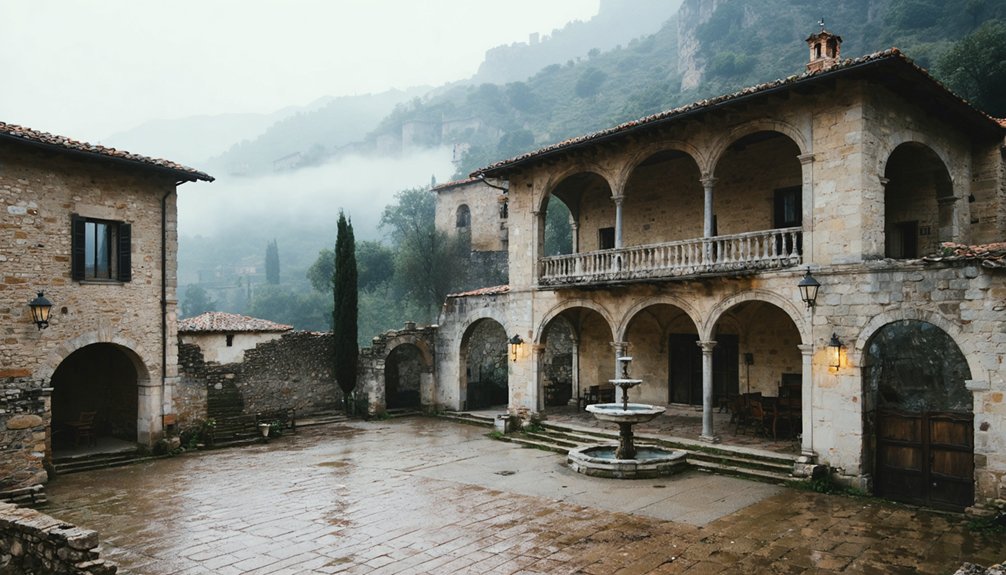
While municipal programs focus on attracting buyers through deeply discounted pricing, Italy’s premium historic property market offers fully restored estates and palatial residences for serious investors seeking immediate occupancy.
These luxury restorations range from €390,000 for a 4-bedroom townhouse in Pienza’s Val d’Orcia to €830,000 for a 246-square-meter property near Città di Castello with 1.16 hectares of land.
Restored Italian estates priced between €390,000 and €830,000 offer turnkey luxury from Tuscan townhouses to Umbrian properties with extensive land.
Investment opportunities include Art Nouveau villas in Torrita di Siena (€720,000) and Barga (€500,000), both featuring original artistic elements and panoramic positioning.
Tuscany and Umbria dominate this segment, offering restored townhouses, historic palazzos, and rural estates.
For those seeking unrestricted property ownership without renovation obligations, these turnkey properties deliver authentic Italian heritage with modern functionality across regions including Marche, Piedmont, and Emilia Romagna.
Platforms and Resources for Buying Italian Villages
Several specialized platforms have emerged to connect international buyers with Italy’s abundance of abandoned properties and municipal revitalization schemes.
1eurohouses.com serves as the primary aggregator, cataloging opportunities across towns including Penne, San Biagio Platani, Valguarnera Caropepe, and Pietramelara.
Renovita.net focuses exclusively on small Italian towns requiring property restoration and redevelopment.
For extensive village listings beyond single-home purchases, Villageio.com specializes in entire borgos and ghost towns available for acquisition.
Exploring historic sites in eastern Australia can offer unique insights into the cultural heritage and architectural styles of the region. From ancient Aboriginal landmarks to colonial-era structures, these sites provide a fascinating glimpse into the past. Visitors often find that each location tells a story, making them essential stops for anyone interested in the history of the area.
The Sambuca Sicily website provides direct access to specific 1 euro and 2 euro properties currently for sale.
You’ll find direct municipal contact options through platforms like Montieri’s mayor’s email (sindaco@comune.montieri.gr.it), which has facilitated 20 sales since 2016.
These resources eliminate intermediaries, connecting you directly with local authorities managing depopulation initiatives across 25 participating municipalities.
Frequently Asked Questions
What Are the Typical Monthly Utility Costs for Restored Homes in Italian Villages?
Breaking free from uncertainty, you’ll face a utility cost breakdown averaging €200-€400 monthly. Your average expense estimates include €70-€150 electricity, €80-€130 heating, €20-€50 water, plus €25-€40 internet in restored Italian village homes.
Can Non-Eu Citizens Participate in the 1 Euro Houses Initiative?
Yes, you can participate regardless of citizenship. The application process welcomes non-EU citizens equally—you’ll submit interest online, provide financial proof, and obtain an Italian tax code post-selection, with no residency requirements.
Are There Restrictions on Reselling Properties Purchased Through These Schemes?
Like chains limiting your options, resale restrictions vary by town—you’ll face renovation deadlines, preservation rules, and use declarations that constrain investment considerations. Each municipality sets different stipulations affecting your property’s future marketability and value.
You’ll need bilingual professionals—notaries, architects, and legal advisors—to navigate language barriers and complex renovation jargon throughout Italy’s approval process. Without Italian fluency, interpreters are essential for signing contracts and communicating with municipal offices effectively.
How Do Property Taxes Compare Between Abandoned Villages and Major Italian Cities?
You’ll find property tax rates considerably lower in abandoned villages through exemptions and incentives. Rural taxation differences include zero IMU on primary residences, startup grants, and income tax breaks unavailable in major cities seeking residents.
References
- https://www.casatuscany.com/property-in-italian-towns-villages-tuscany-umbria-liguria-townhouse-apartment-for-sale/
- https://1eurohouses.com/tag/abandoned-villages/
- https://www.romolini.com/en/lifestyle_en/borgo_villaggio_vendita_en.php
- https://www.housebeautiful.com/design-inspiration/real-estate/g61420190/places-in-italy-to-buy-one-dollar-homes/
- https://www.realtor.com/advice/buy/1-dollar-euro-home-italy/
- https://www.idealista.it/en/news/property-for-sale-in-italy/2025/01/14/192763-1-euro-houses-in-italy-the-villages-still-in-the-spotlight-in-2025
- https://villageio.com
- https://europa.tips/en/europes-abandoned-villages
- https://www.youtube.com/watch?v=YRwu6-jEzTM
- https://dolce-living.com/post/one-euro-home-italy/