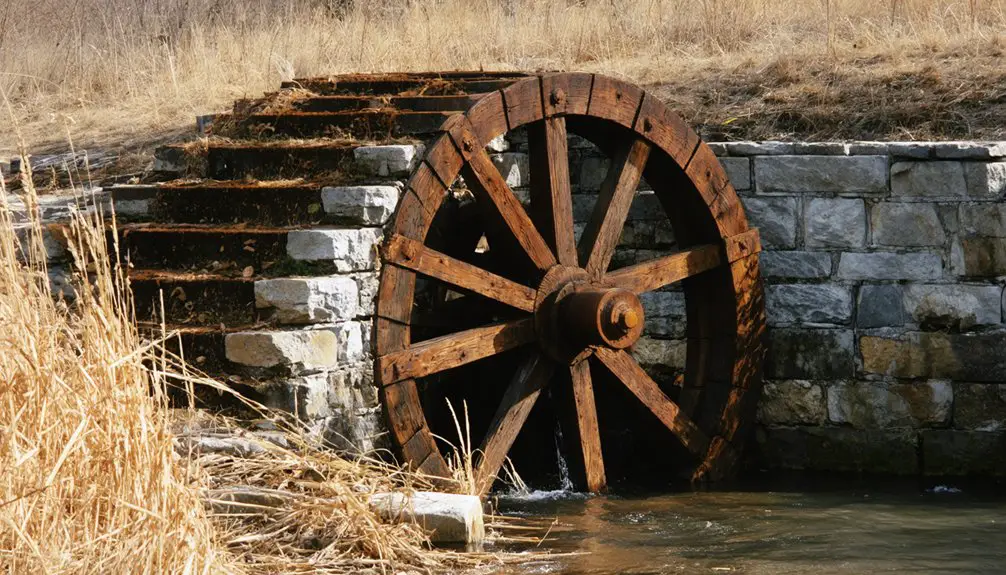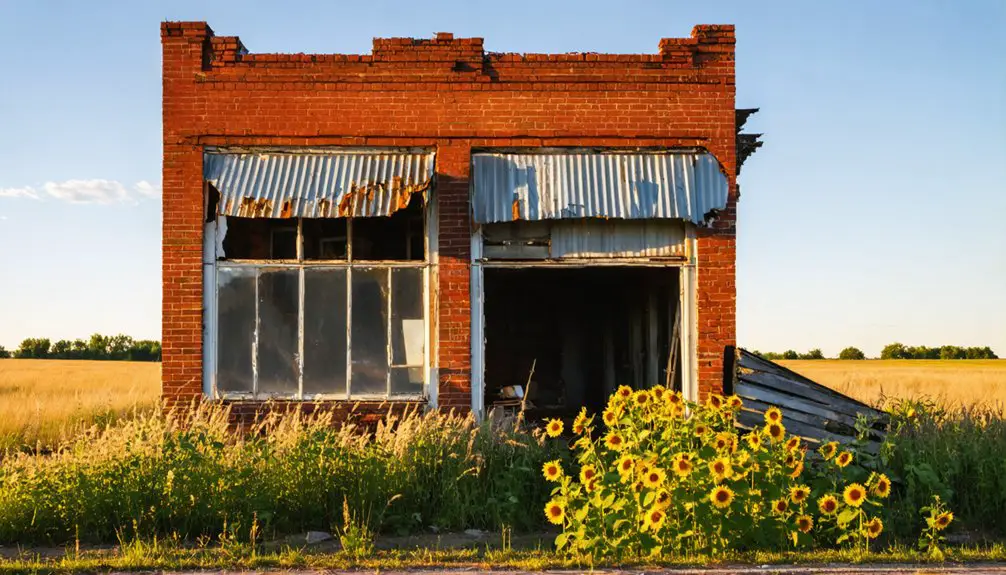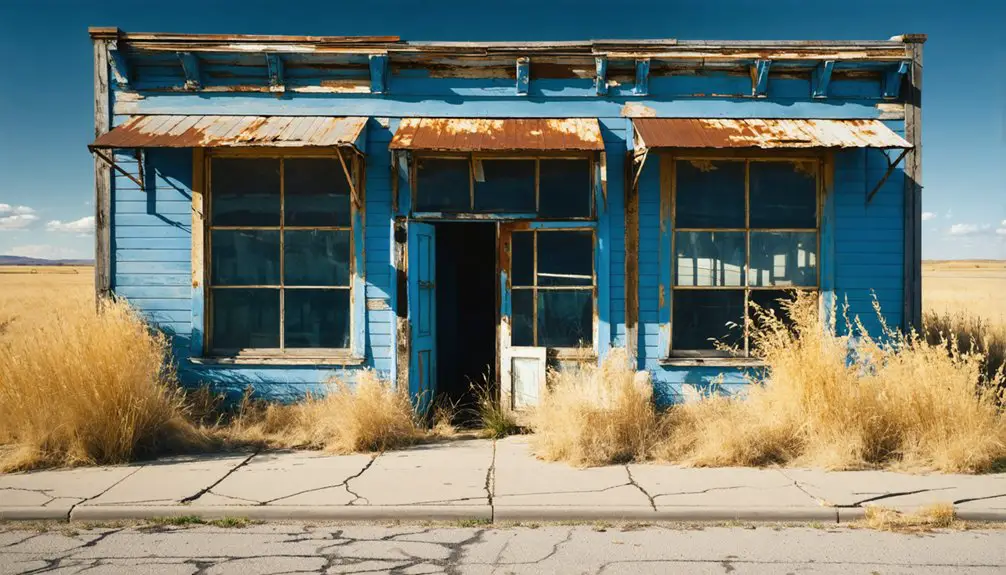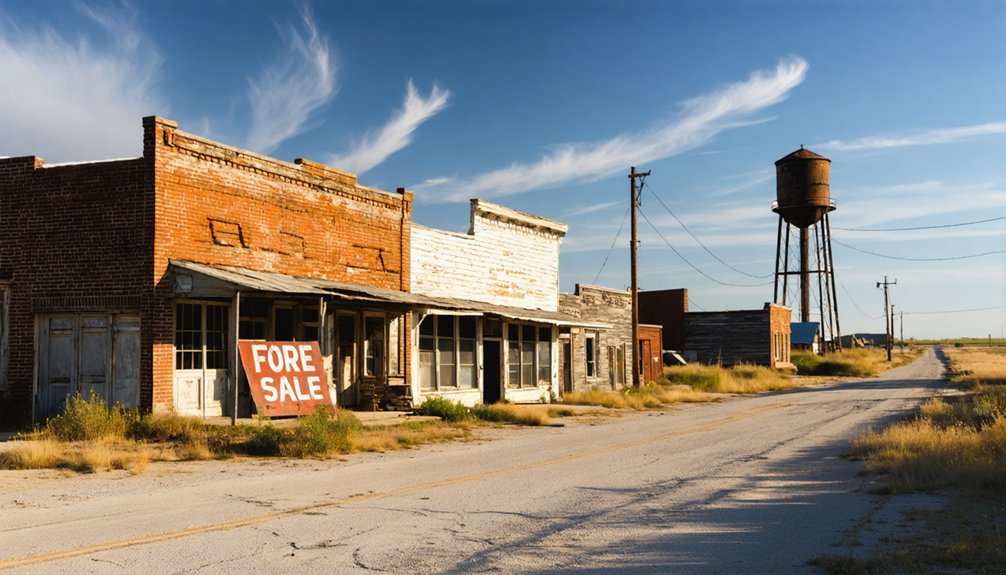
You’ll find entire Kansas settlements available for purchase, with properties in declining towns like Englewood and Protection listed under $75,000—compared to the national median of $439,450. These aren’t modern constructions; they’re architectural time capsules from 1890-1950 featuring solid oak cabinetry, stamped ceiling tins, and hand-dug wells that’ve outlasted the communities surrounding them. Kansas lost population in 80 of 105 counties between 2010-2020, creating unprecedented opportunities to acquire frontier-era buildings with superior engineering principles. The forces that emptied these settlements reveal patterns you’ll recognize across America’s changing landscape.
Key Takeaways
- Englewood and Protection offer homes under $75,000, while old farmsteads range between $50,000 and $85,000 in declining rural areas.
- Historic buildings like the Clements Building are listed at $95,000, significantly below Kansas’s national median property value of $439,450.
- Ghost town structures from 1890 to 1950 feature superior craftsmanship with solid oak cabinetry, stamped ceiling tins, and original fixtures.
- Declining Kansas counties lost residents between 2010-2020, creating affordable real estate opportunities in depopulating frontier regions and abandoned settlements.
- Properties include unique architectural features and self-sufficient elements like hand-dug wells, difficult to replicate with modern construction materials.
The Dramatic Population Decline of Kansas Rural Communities
While Kansas’s overall population inched toward 2.93 million by 2020—falling short of the symbolic 3 million threshold—the state’s rural heartland experienced a demographic collapse that echoed the Dust Bowl exodus of nearly a century prior.
You’ll find 80 of 105 counties lost residents between 2010-2020, with frontier regions dropping 6.9% and rural counties declining 4.9%. Morton County, which peaked in 1930, suffered the state’s steepest losses.
Young adults fled at alarming rates—Kansas ranks 46th nationally in net migration, hemorrhaging 25-29-year-olds faster than any state. Demographer Ken Johnson emphasizes that young people migrate away from rural areas for education and job opportunities.
Kansas leads the nation in losing its youngest professionals, with 25-29-year-olds abandoning the state faster than anywhere else in America.
Despite rural revitalization efforts and community engagement initiatives, shrinking tax bases can’t fund essential services. Small school districts face mounting challenges in recruiting qualified staff as enrollment dwindles. The exodus creates a vicious cycle: depopulation scares remaining residents and businesses, accelerating decline across dozens of counties averaging fewer than ten people per square mile.
Six Kansas Towns Fading Into History
Scattered across Kansas’s windswept plains, six communities represent the state’s most haunting changes from thriving settlements to near-extinction.
These ghost town legends reveal patterns of railroad dependency, lost opportunities, and economic shifts that sealed their fates.
Towns Fading Into Memory:
- Ludell (Rawlins County) – Post office operating since 1881 amid crumbling structures
- Medora (Reno County) – Survived until 1988 with minimal remnants
- Milan (Sumner County) – 56 residents in 2020, post office closed 2011
- Monument (Logan County) – Grain elevators still serving farmers despite official extinction
Sibley lost its future when Cloud County’s seat went elsewhere in 1869.
Bushong’s collapsed gymnasium stands as historical preservation’s challenge.
Technological advancements in agriculture reduced the workforce these settlements needed to sustain themselves.
Diamond Springs began in 1825 as a Santa Fe Trail stop providing fresh water and rest for westward travelers.
Each location marks where opportunity died, leaving freedom-seeking settlers’ descendants to remember vanished prosperity.
What You Can Buy: Property Prices in Abandoned Areas
These vanished communities offer more than historical curiosity—they’ve created Kansas’s most affordable real estate market.
You’ll find property values that defy modern economics: Englewood homes listed under $75,000, Protection’s median hovering around $62,000, and old farmsteads breaking from $50,000 to $85,000.
The Clements Building—a former post office and general store—stands at $95,000, representing one of few remaining structures in its ghost town.
Compare these figures against the national median of $439,450, and the investment potential becomes clear.
These aren’t just abandoned houses; they’re sturdy historic constructions built when craftsmanship mattered. Their unique architectural characteristics reflect construction methods difficult to replicate in modern builds.
The 950 square feet property retains original hardwood flooring and painted tin ceilings from its 1800s construction.
For less than a Tesla Cybertruck’s $99,990 base price, you’re looking at entire properties across southern Kansas’s dying towns—freedom from crushing mortgages included.
Why These Towns Are Disappearing
Behind every abandoned storefront and collapsed farmhouse lies a calculated economic death—these ghost towns didn’t fade by accident.
You’ll find Kansas communities vanished through systematic forces that stripped away their purpose:
- Transportation access determined survival—railroads chose routes based on unpredictable local politics, leaving bypassed settlements to immediate collapse.
- Agricultural mechanization reduced workforce needs from several hands to one operator, emptying rural communities as farms expanded but employed fewer.
- Mineral depletion ended boom cycles—lead, zinc, and coal towns like Treece peaked by 1917, then withered when cheaper deposits emerged elsewhere. Empire City’s population plummeted from 3,000 to 1,000 within a decade as lead deposits diminished in the mid-1880s.
- Environmental catastrophes delivered final blows—tornadoes leveled already-declining mining towns, floods destroyed ferry ports, and lead poisoning forced complete evacuations by 2012. Harlem’s community diminished after the 1951 flood combined with industrialization pressures.
These weren’t gradual declines. They were executions by infrastructure, technology, and geology.
Time Capsule Homes Built to Last Generations
While modern homes deteriorate within decades, Kansas ghost town structures built between 1890 and 1950 endure through engineering principles abandoned by contemporary construction.
You’ll find solid oak cabinetry surviving abandonment without warping—a demonstration of architectural preservation that modern materials can’t replicate. These bungalows feature hand-carved foundation boxes with visible tool marks, proving skilled labor prioritized structural integrity over aesthetics.
Inside, pink tile bathrooms and original fixtures remain intact after seventy years of neglect.
Storm cellars, hand-dug wells, and period-specific appliances document self-sufficient living. The stamped ceiling tins and antique hardware reveal decorative elements that doubled as structural reinforcements. These railroad-dependent communities like Kingsdown near Bloom, Kansas, once thrived with populations of 150 before drought and economic decline forced mass exodus. For vintage renovations under $50,000, you’re acquiring craftsmanship that’s impossible to recreate today.
The heavy oak framing and durable construction philosophy mean you’re restoring foundations built to outlast generations—structures that survived precisely because they couldn’t be cheaply demolished.
Outdoor Recreation and Lifestyle Opportunities in Remote Kansas
Remote Kansas ghost towns anchor recreation zones that contradict the state’s prairie stereotype.
You’ll discover forested waterways, limestone formations, and badlands terrain surrounding abandoned settlements where nature exploration trumps crowds.
These properties position you near:
- Elk City Lake’s 4,500 acres stocked with channel catfish, white bass, and largemouth bass year-round
- Kanopolis State Park’s 30+ trail miles for horseback riding and mountain biking through sandstone country
- Monument Rocks and Little Jerusalem Badlands offering chalk formations and unique geological hiking
- Cheyenne Bottoms Wildlife Refuge where local wildlife populations draw birders and safari-style bison viewing
The Wakarusa and Verdigris river systems blend rocky outcrops with wooded corridors—terrain that’s sustained homesteaders for generations and now offers you unrestricted backcountry access.
Frequently Asked Questions
Are There Legal Restrictions on Purchasing Abandoned Properties in Kansas Ghost Towns?
Yes, you’ll face legal restrictions when pursuing property ownership in abandoned Kansas settlements. You must navigate state unclaimed property statutes, verify clear titles, and understand the legal implications of liens, tax obligations, and potential municipal receivership claims before purchasing.
What Are the Property Tax Rates in These Declining Rural Communities?
You’ll pay property assessment rates at 11.5% for residential and 30% for agricultural land, multiplied by local mill levies averaging 127.866 mills. Tax incentives are minimal, though properties under $85,000 face lower burdens.
Do These Ghost Towns Have Basic Utilities Like Water and Electricity Available?
Utility availability varies notably—you’ll find electricity access disappeared when populations declined, as Bushong’s 1936 sale demonstrates. Water availability depends on natural sources like Diamond Springs, though municipal systems rarely survived abandonment.
How Far Are These Kansas Ghost Towns From Major Cities or Airports?
You’ll find ghost town accessibility varies greatly—Coldwater sits 80 miles from Wichita, while Englewood’s over 130 miles southwest. Distance metrics show Protection and Ashland fall between these ranges, requiring 1-2 hour drives to regional airports.
Can Abandoned Commercial Buildings Be Converted Into Residential Properties Legally?
You’ll love maneuvering through bureaucratic mazes: yes, you can convert abandoned commercial buildings to residential properties, but you’re bound by zoning laws requiring amendments and property renovations meeting strict fire, housing, and building codes for compliance.
References
- https://www.realtor.com/news/trends/dying-kansas-ghost-towns-houses-tesla/
- https://www.youtube.com/watch?v=C6yRUWAhTv0
- https://www.businessinsider.com/home-for-sale-in-a-kansas-ghost-town-costs-95000-2022-12
- https://www.oldhousedreams.com/state/kansas/
- https://thenationaldigest.com/you-can-now-buy-a-home-in-kansas-ghost-towns-for-the-cost-of-a-car/
- https://abandonedks.com/status/for-sale/
- https://www.kcur.org/news/2023-06-06/politicians-say-they-can-stop-rural-kansas-population-declines-but-the-dropoff-continues
- https://www.khi.org/articles/2021-2020-census-data-reveal-a-changing-kansas/
- https://thecounter.org/rural-kansas-depopulation-commodity-agriculture/
- https://kschildrenscabinet.gov/wp-content/uploads/2018/03/Rural-Access-Kansas.pdf