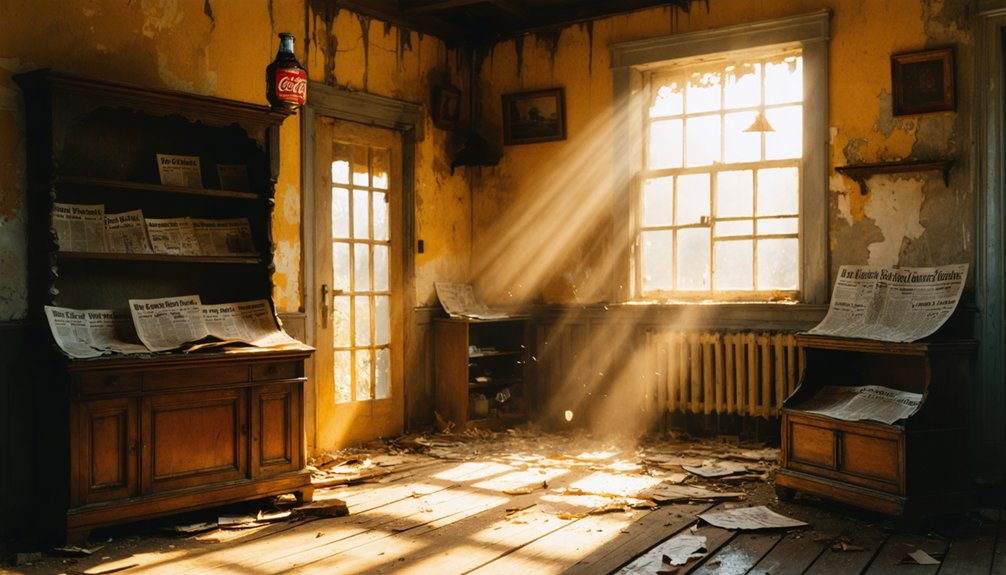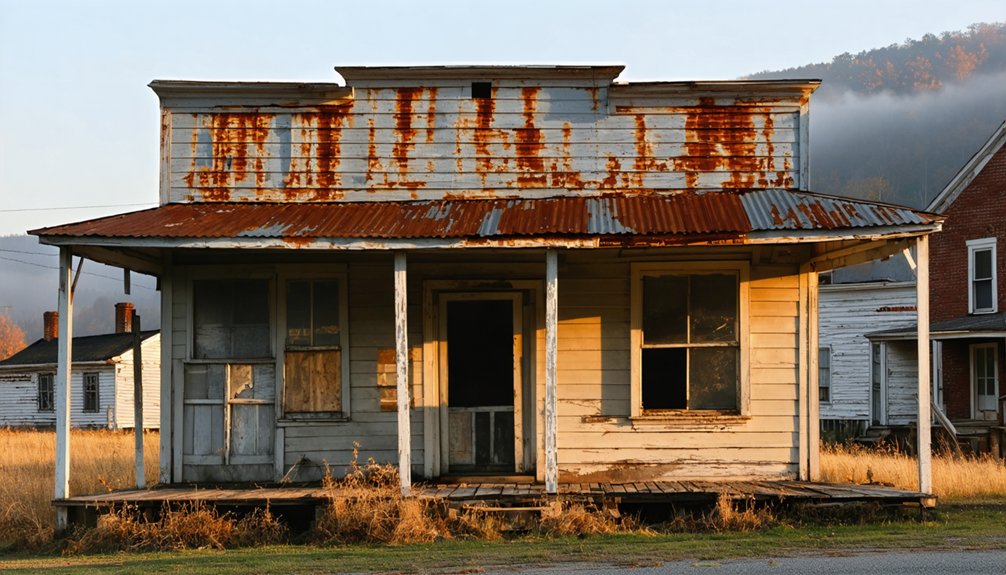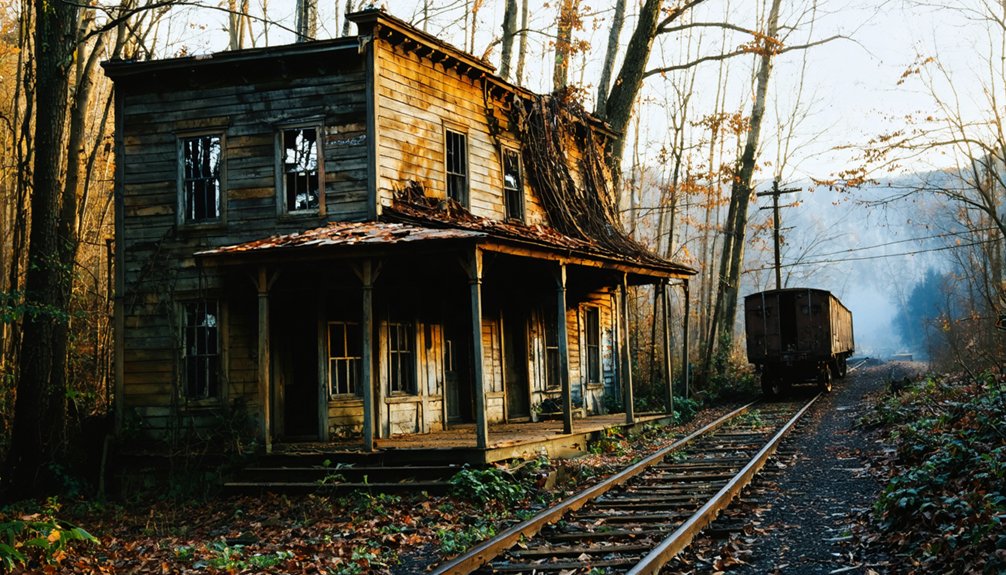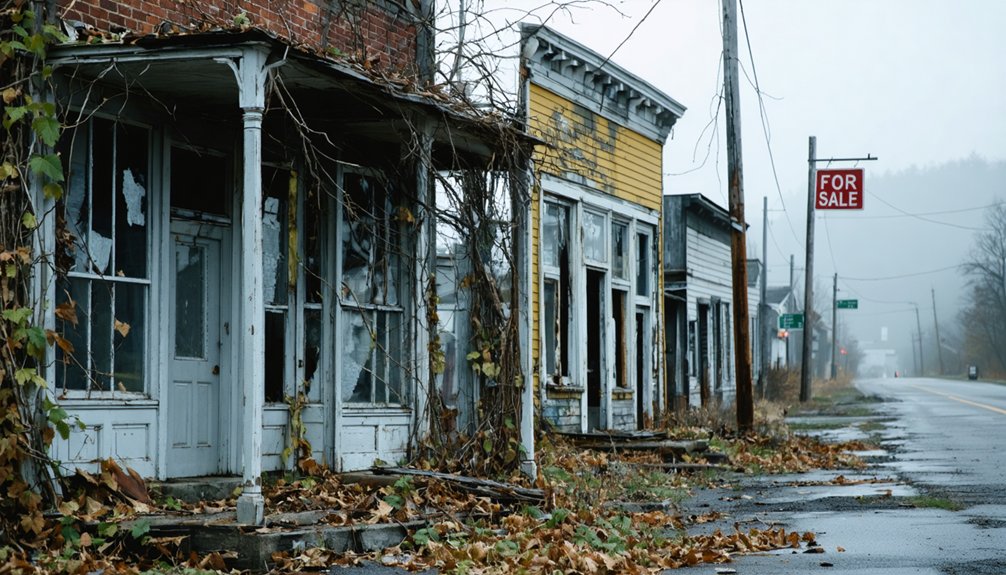
You’ll find Kentucky’s most documented ghost town opportunity in Mount Vernon Village, a 22-acre property featuring ten authentic frontier cabins dating to the 1700s, currently listed at $350,000 after a 36% price reduction from its original $550,000 asking price. The settlement includes preserved commercial structures—a general store, blacksmith shop, and historic church—plus film credentials from hosting “The Devil Below.” Beyond Mount Vernon, Kentucky’s 12.4% vacancy rate has created additional abandoned properties across Clay, Lee, and Floyd Counties, where systematic displacement continues to transform once-thriving communities into investment opportunities for those seeking authentic historical infrastructure with multiple revenue potential.
Key Takeaways
- A 25-acre ghost town property with ten historic cabins from the 1700s is listed at $350,000 in Rockcastle County.
- The property includes commercial buildings like a general store, blacksmith shop, post office, and church with original features intact.
- Previously listed at $550,000, the 36% price reduction to $350,000 attracted buyers, reaching contingent status after 109 days.
- Investment opportunities include vacation rentals, event hosting, and experiential tourism leveraging the site’s horror film production history.
- Traditional financing rarely covers ghost town properties, requiring cash buyers and motivated sellers to overcome market barriers.
Mount Vernon Village: A 22-Acre Historic Settlement
In 1790, five brothers from Virginia established the first permanent settlement at what would become Mount Vernon, building their homestead near the natural spring feature known as Spout Springs. They’d traveled incrementally through counties, passing through Cumberland Gap from North Carolina before claiming this swampland territory.
Originally called White Rock, the settlement earned its new name around 1810 honoring George Washington’s estate. The Wilderness Road’s 1792 routing through the area transformed it into Rockcastle County‘s principal settlement by 1810. The railroad’s arrival in 1868 opened the area for commercial timber trade, establishing the region’s primary economic foundation.
You’ll find this historic preservation opportunity spans 22 acres where rural development first took root after the Revolutionary War. Dr. Thomas Walker called it “Great Wilderness” in 1750—territory these pioneers converted into Kentucky’s administrative and economic foundation. The settlement drew traveling church congregations led by Reverend William Hickman, who promoted Baptist faith throughout the region during the late 1700s.
Property Features and Authentic Structures
Across these 22 to 25 acres in the Renfro Valley Mountains, ten rustic cabins form the settlement’s residential core, each structure bearing authentic architectural elements from Kentucky’s frontier period.
The trapper’s cabin, dating to the 1700s, anchors the collection with original stone fireplaces and exposed beams. You’ll find the Pennington cabin configured with one bedroom, kitchen, and living room—all featuring wood floors and period-correct details.
Beyond residential structures, the property’s rustic charm extends to commercial buildings: a general store with commercial kitchen, blacksmith shop, and post office.
The 1800s church preserves its historic significance through stained glass windows and wooden pews, while the schoolhouse and chapel complete this documented settlement.
Each building was sourced from across Kentucky and restored with antiques, creating opportunities for homesteading, event hosting, or heritage preservation. The property’s location near Cumberland Falls State Resort Park positions it within minutes of a major tourist attraction that draws hundreds of thousands of annual visitors. Buyers should research county zoning regulations to determine permitted uses for the property before purchase.
From Film Set to Real Estate Opportunity
You’ll find this Mount Vernon property‘s $350,000 listing carries documented Hollywood credentials from hosting “The Devil Below” horror film starring Will Patton.
The production transformed ten authentic cabins across 22-25 acres into an abandoned town setting, demonstrating the site’s commercial versatility beyond residential use.
After approximately ten years of the general store’s closure, the property now positions its film history as a marketing asset, attracting investors interested in vacation rentals, event venues, and entertainment industry opportunities.
Kentucky’s Ashfeld Manor in Harrodsburg presents similar restoration potential, with the late 1800s castle going to foreclosure auction at $329,465 before being taken off the market.
While this ghost town seeks new ownership, South Park View appears in Kentucky’s official registry despite having zero residents after airport expansion forced community dissolution.
Hollywood Horror Movie Connection
While Kentucky’s ghost towns evoke naturally eerie atmospheres, their transformation into horror film sets has created an unexpected bridge between cinematic production and real estate markets.
Kentucky filmmakers have documented how counties south of Paducah served as both inspiration and filming locations for multiple horror productions, drawn by authentic haunted attractions and atmospheric qualities.
Horror film locations extended to Horse Cave’s Mammoth Onyx Cave and Hidden River Cave, where crews installed specialized lighting equipment for atmospheric shots.
Henry County communities became bases for thriller productions like *Red Right Hand*, with filmmakers utilizing churches, taverns, and historic architecture.
These production activities generated tangible economic benefits through location rentals, local employment, and business patronage, demonstrating how properties can leverage their cinematic history for increased market value and investment appeal. Computer-generated imaging can enhance filmed scenes, allowing property features to be dramatized for greater visual impact in promotional materials. The region’s historic architecture has similarly attracted major Hollywood productions to Northern Kentucky and Cincinnati, creating additional opportunities for property owners to capitalize on cinematic appeal.
Investment Potential After Filming
When production crews depart and film equipment disappears, the ghost town property shifts from temporary set to permanent investment opportunity with documented revenue potential.
You’ll find multiple investment strategies converge here: vacation rentals across 10 cabins, event hosting through the general store’s commercial kitchen, and experiential tourism capitalizing on the horror film connection.
The $350,000 listing price positions you below comparable ghost town properties while tourism trends favor authentic, story-driven destinations. Film credits provide marketing leverage you won’t need to manufacture—tourists actively seek movie locations.
Your revenue streams diversify through retail operations, accommodation bookings, and themed tours. The property’s contingent status confirms market validation, while existing infrastructure eliminates development delays that drain capital before generating returns.
The 1700s trappers cabin adds historical depth that distinguishes this property from manufactured tourist attractions, creating a tangible connection to Kentucky’s frontier heritage.
Pricing History and Current Market Status
Since entering the market in 2020, Mount Vernon Village has undergone significant pricing adjustments that reflect both seller expectations and buyer resistance to ghost town investments.
You’ll find the original $550,000 listing ($808/sqft) was removed after failing to attract buyers, revealing overvaluation in this niche market. The current $350,000 asking price represents a 36.4% reduction, bringing the property to $514/sqft—a strategic move that generated 35,294 views and 2,849 saves before reaching contingent status after 109 days.
These pricing trends demonstrate market analysis realities: unconventional properties require patience and realistic valuations.
Your investment opportunity exists because traditional financing rarely covers ghost towns, creating barriers that motivated sellers must acknowledge through substantial price corrections to attract cash-ready buyers seeking freedom from conventional real estate constraints. The property’s 10 mountain cabins spread across 25 acres provide multiple revenue streams for investors willing to navigate this specialized market.
South Park View: A Cautionary Tale of Urban Expansion
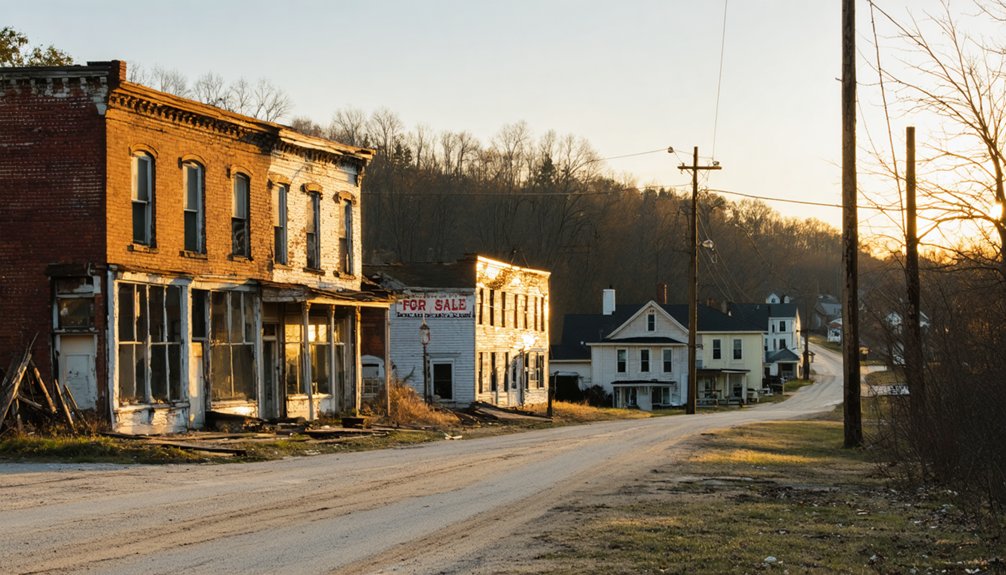
South Park View’s dissolution reveals the economic forces that can erase entire communities from Kentucky’s map.
When Muhammad Ali International Airport announced expansion plans in the early 2000s, you’ll find documented evidence of a systematic buyout that transformed this Jefferson County city from 150 residents to zero within three years.
The airport’s property acquisitions, valued at undisclosed amounts, left behind only thorny woods and a headstone-like marker—while the city remained legally incorporated as a “ghost” in state records until 2024.
Airport Expansion Economic Impact
The 1988 announcement of the Louisville Airport Improvement Program (LAIP) set in motion one of the region’s most consequential infrastructure projects, initiating a transformation that would eventually erase entire neighborhoods from Jefferson County’s map.
The FAA’s 1991 approval mandated relocating over 4,000 residents from 1,581 homes across Standiford, Prestonia, Highland Park, and Tuberose.
By 1998, new parallel runways replaced 1940s-era airport infrastructure, enabling continuous operations throughout construction. The expansion added critical facilities: Kentucky Air National Guard Base, US Postal Service air mail operations, corporate hangars, and an enterprise zone industrial park.
You’ll find South Park View’s former residential land now serves economic revitalization goals. A commemorative bronze plaque acknowledges the sacrificed communities, while airport officials credit these displacements for establishing Louisville’s position as a global cargo hub.
Community Displacement and Demolition
When airport representatives arrived in the early 2000s bearing expansion plans, South Park View’s fate shifted from self-governing municipality to administrative ghost.
The community’s urban identity dissolved through systematic displacement as residents accepted buyouts, leaving behind a once-thriving city reduced to thorny woods and abandoned streets.
The dismantling revealed how fragile community resilience becomes when expansion demands displacement:
- Population dropped from functioning municipality to census-recorded zero by 2020
- Close-knit neighbors with own laws and taxes scattered across Louisville
- Last mayor Eddie Rasnake witnessed forced relocation destroy municipal bonds
- Vandals stripped copper from abandoned homes after exodus
- Headstone-like marker now marks where self-determination once existed
Kentucky Cities Facing Official Dissolution
Across Kentucky, a 2022 legislative initiative by the General Assembly has systematically identified municipalities that exist in name only, lacking functional governments or traceable officials.
You’ll find the Kentucky Department for Local Government conducting administrative pulse checks, requiring every city to submit current officials’ names and contact information. Ghost cities like Poplar Hills, Blandville, Monterrey, South Park View, and Vicco face elimination after multiple unanswered requests.
The dissolution process involves public hearings—though Blandville’s lasted seventeen minutes with zero attendees, and Poplar Hills’ hearing featured legal codes read to empty chairs.
Meanwhile, Bonnieville voters chose their own path, approving dissolution 67-60 to escape city taxes. By December 2024, assets transfer to Hart County, though questions persist about infrastructure maintenance and your community’s autonomy.
Other Abandoned Properties Across the Bluegrass State
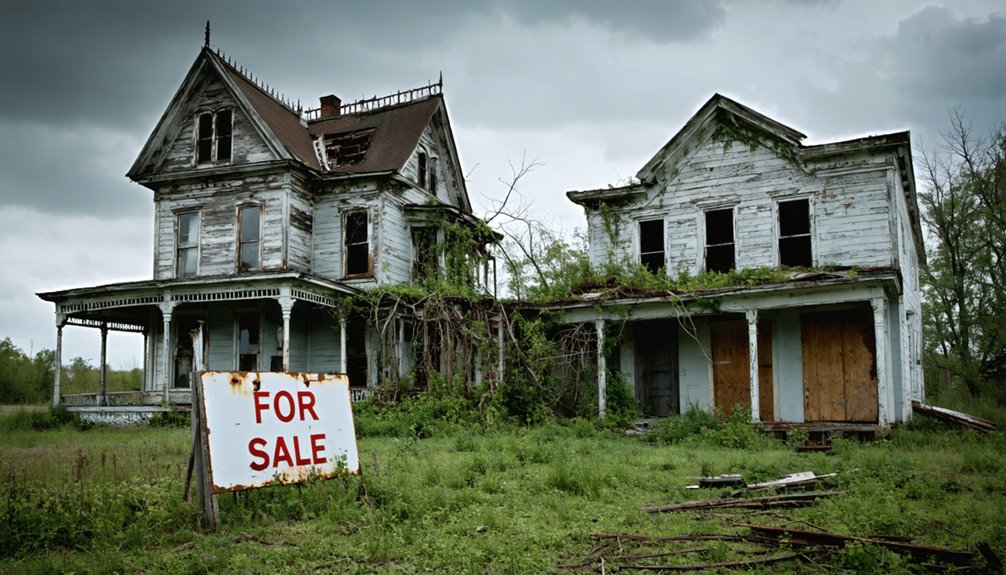
Beyond municipal boundaries, Kentucky’s housing crisis manifests in 242,000 vacant units scattered across 120 counties—a 12.4% vacancy rate that transforms entire neighborhoods into silent corridors of peeling paint and collapsing porches.
Across 120 counties, 242,000 vacant homes stand as monuments to Kentucky’s unraveling communities—silent corridors marking economic collapse.
You’ll find abandoned infrastructure concentrated in Appalachian counties where rural revitalization efforts struggle against population exodus:
- Clay County leads with 44.81% vacancy, where nearly half of all structures sit empty.
- Lee and Floyd Counties each maintain 23.8% abandonment rates among owner-occupied properties.
- Wolfe County shows 54.7% of rental units facing housing problems.
- 49,380 affordable units risk losing federal subsidies by 2020, accelerating abandonment.
- USDA Rural Development portfolio contains 11,440 deteriorating units in chronically vacant properties.
These aren’t investment opportunities—they’re documentation of economic collapse.
Commercial and Residential Potential
While vacancy statistics document Kentucky’s economic decline, properties like the Mount Vernon Village reveal a different archival narrative—one where abandonment creates commercial and residential possibilities priced at fractions of their original investment.
The $350,000 asking price—down from $550,000—demonstrates market correction favoring opportunistic buyers.
Commercial viability centers on restored infrastructure: the general store’s commercial kitchen supports food service operations, while the 1800s church provides a documented venue for wedding revenue streams.
Your cabins generate rental income through platforms capitalizing on the property’s film history.
Residential appeal emerges through adaptive reuse. Ten structures convert into family compounds, preserving Kentucky’s architectural record while establishing private mountain homesteads.
The Pennington cabin’s existing utilities prove residential functionality beyond historical aesthetics.
Understanding Kentucky’s Ghost Town Phenomenon
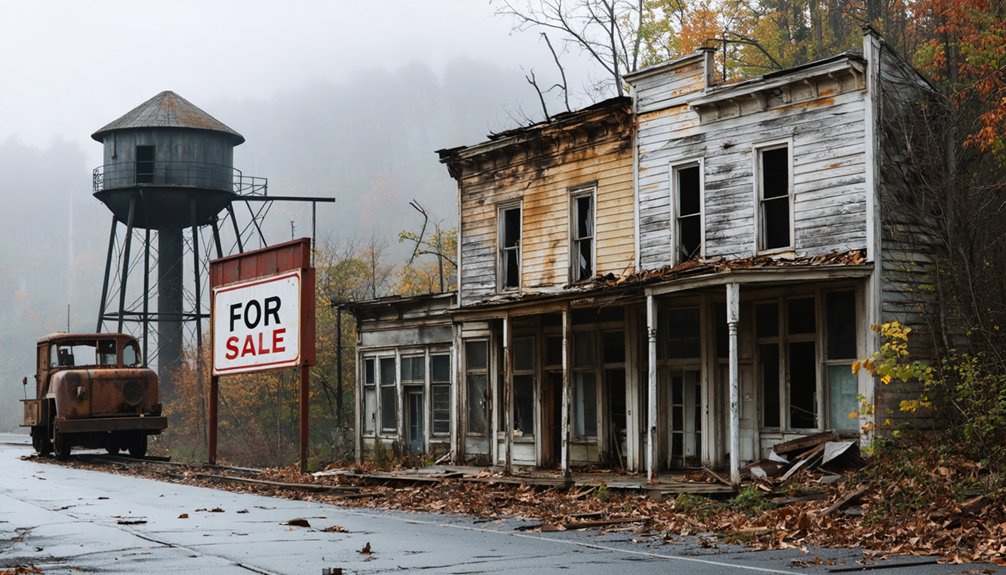
- Coal camps in Muhlenberg and McCreary Counties document worker autonomy before corporate consolidation.
- Ferry crossings like Paradise (Stom’s Landing, 1852) established trade independence.
- Post offices maintained community sovereignty until economic displacement.
- Environmental disasters—1937 floods, air pollution—forced population exodus.
- TVA buyouts systematically erased entire towns between 1960-1970.
You’ll find concentrated clusters along the Cumberland River corridor and Appalachian foothills.
Frequently Asked Questions
What Are the Legal Requirements for Purchasing Abandoned Property in Kentucky?
You’ll need to verify property ownership through title searches, comply with zoning regulations, and follow foreclosure procedures for vacant properties. Adverse possession requires 15 years’ continuous occupation plus tax payments, establishing your claim through documented evidence.
Do Ghost Town Properties Come With Mineral or Water Rights?
Mineral rights and water rights weren’t automatically included with ghost town properties—they’re often severed from surface ownership. You’ll need thorough title research examining historical deeds to determine what extraction and resource access rights you’d actually acquire.
How Do Property Taxes Work for Abandoned or Historic Structures?
Abandoned structures don’t escape taxation—they’re actually penalized. You’ll face 20% additional tax on vacant properties over six months, lose early payment discounts, and navigate complex property assessment requirements while historic designations rarely guarantee tax exemptions.
Can I Get Financing for a Ghost Town Property Purchase?
You’ll find financing options through Non-QM lenders accepting alternative documentation and NACA’s zero-down programs. Ghost town mortgages require 20% down typically, but specialized lenders accommodate unique properties without acreage restrictions, empowering your unconventional investment freedom.
Are There Restrictions on Renovating Historically Significant Buildings in Kentucky?
Like chains on forgotten architecture, you’ll face strict historic preservation restrictions requiring Certificates of Appropriateness for exterior changes, material preservation standards, and adherence to Secretary of Interior’s renovation guidelines before modifying designated properties.
References
- https://www.realtor.com/news/unique-homes/private-kentucky-village-for-sale/
- https://www.lpm.org/news/2023-10-30/kentucky-is-exorcizing-another-jefferson-county-ghost-city-haunting-the-states-books
- https://www.zillow.com/homedetails/893-Hummel-Rd-Mount-Vernon-KY-40456/2079606394_zpid/
- https://103gbfrocks.com/abandoned-kentucky-castle-for-sale-see-inside/
- https://www.sfgate.com/realestate/article/ever-wanted-your-own-town-rustic-kentucky-21058562.php
- https://www.aol.com/articles/10-ghost-towns-us-actually-200604529.html
- https://www.youtube.com/watch?v=_wKW7rMUBIc
- http://www.kenrocky.com/history.html
- https://rockcastlecountyky.com/livingston
- https://en.wikipedia.org/wiki/Mount_Vernon