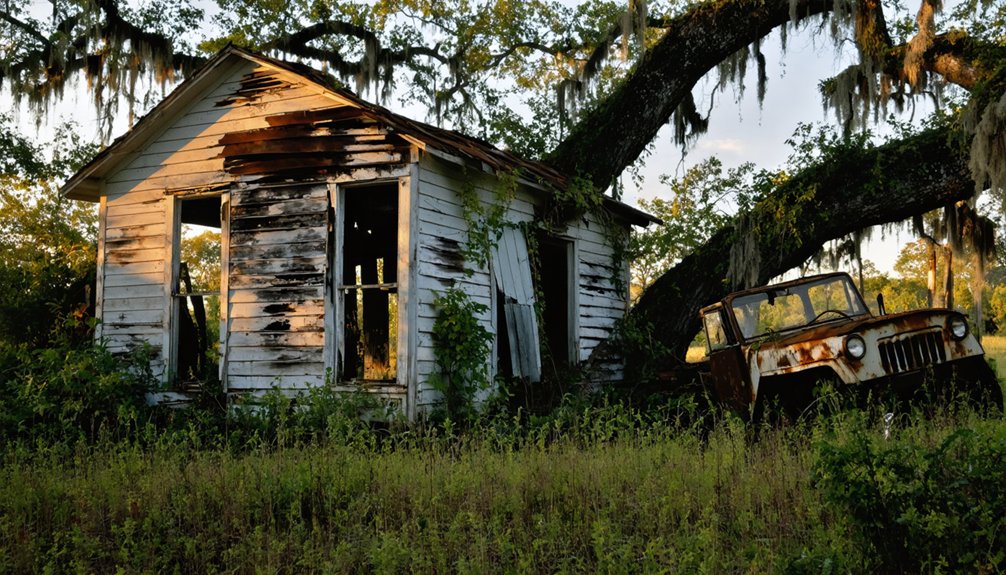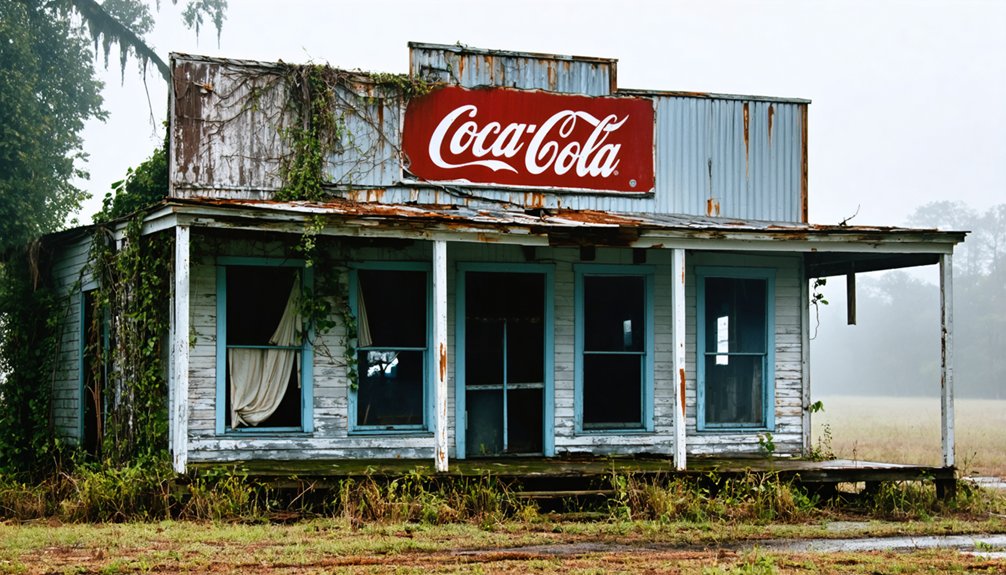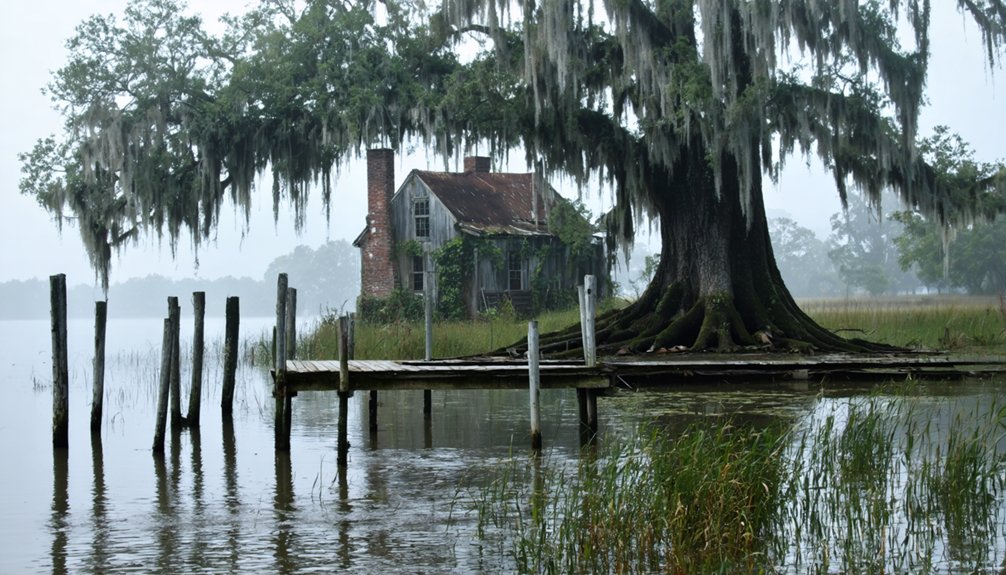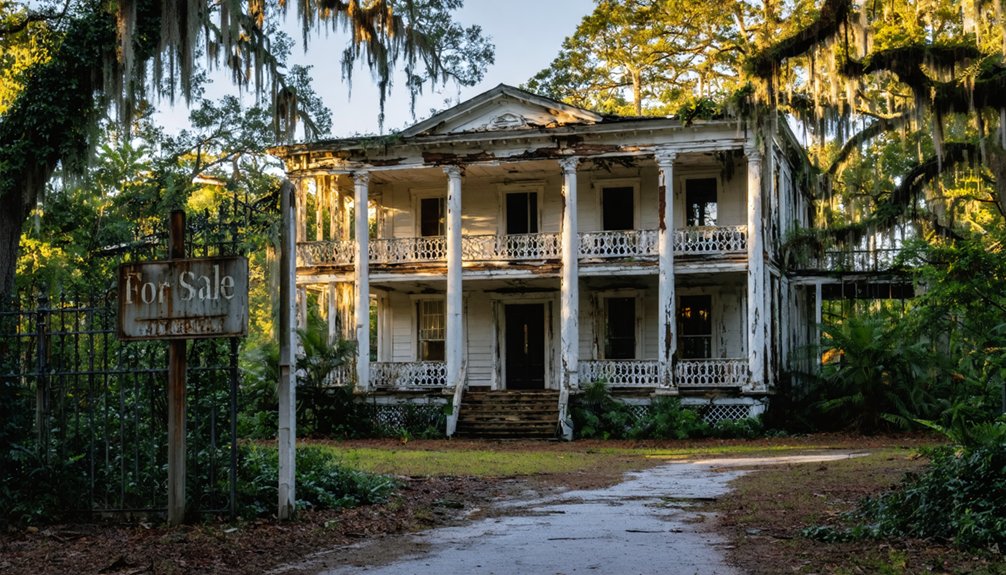
You won’t find Louisiana ghost towns on real estate listings because they’ve met vastly different fates than their Western counterparts. Most have been consumed by Gulf waters through coastal erosion, absorbed into industrial complexes, or claimed by government agencies through tax adjudication before reaching private markets. Unlike abandoned mining towns in the West that attract tourism investors, Louisiana’s settlements—destroyed by hurricanes like those that erased Cheniere Caminada and Ruddock—simply vanished beneath rising tides or were consolidated into contaminated industrial parcels that bypass traditional sales channels entirely. The archival record reveals why these communities remain beyond acquisition.
Key Takeaways
- No Louisiana ghost towns are currently listed for sale, unlike properties available in Western states.
- Hurricanes and coastal erosion erased entire settlements, eliminating most viable properties from the market.
- Distressed properties typically enter government ownership through tax adjudication before reaching private buyers.
- Industrial contamination and land consolidation absorb abandoned sites, preventing traditional real estate listings.
- Alternative investments include agricultural land, industrial properties, and heritage sites with tourism potential.
Understanding Louisiana’s Ghost Town Landscape
Louisiana’s documented ghost towns number nearly 100 according to online registries, though this count likely underestimates the true total due to unrecorded settlements scattered across the state’s 64 parishes.
You’ll find these abandoned communities primarily originated as sawmill operations and rail stops, their fates sealed by logging industry collapse and evolving transportation networks. Vernon, Sabine, Rapides, and Plaquemines parishes hold particularly rich concentrations of these forsaken settlements.
Natural disasters—especially hurricanes—accelerated abandonment rates, with catastrophic events like the 1893 hurricane obliterating communities such as Cheniere Caminada. The hurricane claimed over 2,000 lives and ranks among the deadliest in United States history.
Hurricanes like the catastrophic 1893 storm that destroyed Cheniere Caminada dramatically accelerated Louisiana’s ghost town formation across coastal parishes.
While ghost town preservation efforts remain limited, certain sites like Longleaf’s Southern Forest Heritage Museum demonstrate potential pathways for economic revitalization. The Red River and Gulf Railroad connected various abandoned settlements including Longleaf and Forest Hill, serving as a critical transportation artery for the region’s lumber industry.
These remnants offer you tangible opportunities to reclaim Louisiana’s industrial heritage through private ownership and restoration initiatives.
Why Ghost Towns Are Not Listed for Sale in Louisiana
You’ll find that Louisiana’s ghost towns rarely appear on real estate listings because industrial expansion and petrochemical development have absorbed former settlements through private acquisitions and land consolidation.
Hurricanes, floods, and coastal erosion have physically erased entire communities—leaving no structures to purchase even when property titles remain in public records.
The documentation trail reveals that properties meeting abandonment criteria under R.S. 33:4720.11 and blight certifications under municipal codes become subject to tax adjudication, transferring ownership to political subdivisions rather than entering the private market.
The New Orleans Redevelopment Authority can acquire these properties through purchase, gift, and expropriation, removing them from conventional sales channels entirely.
Properties sold at tax sales in New Orleans face an eighteen-month redemption period when classified as abandoned or blighted prior to the sale, which limits marketability compared to the standard three-year period.
Industrial Encroachment and Redevelopment
When contaminated or blighted properties accumulate in Louisiana, government agencies intercept them before they reach private markets as ghost town sales.
You’ll find the EPA Superfund Redevelopment Program and New Orleans Redevelopment Authority systematically acquiring these distressed properties for industrial redevelopment rather than residential resale.
Gordon Plaza’s transformation from contaminated neighborhood to solar farm exemplifies this strategic shift—2023’s voluntary buyout led to 2025’s demolition, prioritizing public utility infrastructure over private investment opportunities.
The Louisiana Land Trust and NORA have transferred thousands of properties through targeted urban revitalization programs, removing them from open-market circulation.
Lower Ninth Ward’s 882 Land Trust properties demonstrate government-controlled disposition, with only 63% reaching private buyers.
Southern Shipbuilding’s 56-acre site in Slidell, operational since 1919 and added to the National Priorities List in 1986, now functions as a shipyard and industrial park under private equity ownership following decades of cleanup efforts.
New Orleans’ population shrank by over 5% between 2020 and 2023, contributing to increased property abandonment and accelerating the city’s vacancy crisis.
You’re witnessing thorough blight tracking replacing one-off expropriations, effectively blocking ghost town aggregation by freedom-seeking investors.
Natural Disaster Complete Destruction
Beyond administrative redevelopment barriers, catastrophic natural forces have erased entire Louisiana settlements from existence, rendering sale discussions moot.
The 1915 Category 4 hurricane obliterated Ruddock and Frenier in St. John the Baptist Parish with 145-mph winds, killing 58 residents in Ruddock alone as victims clung desperately to trees and boats.
You’ll find only flooded land, wreckage, and vegetation-choked ruins where these communities once stood.
The 1893 hurricane similarly destroyed Cheniere Caminada in Jefferson Parish.
Hurricane impacts proved so complete—schoolhouses ripped apart, docks shattered—that rebuilding became impossible.
Community resilience couldn’t overcome total structural annihilation.
Frenier rebuilt post-hurricane, but Ruddock lost permanently, never recovering from the devastation.
When coastal erosion subsequently submerged Burrwood and La Balize in Plaquemines Parish, these ghost towns evolved from tragic losses to permanently uninhabitable sites beyond commercial transaction.
Flood control projects also submerged towns like Bayou Chene, eliminating them from the landscape entirely.
Laurel Valley Sugar Plantation: A 2,000-Acre Historic Site
You’ll find Laurel Valley Sugar Plantation spanning 5,000 acres along Bayou Lafourche in Thibodaux, documented as the largest surviving 19th-20th century sugar plantation complex in the United States.
The site preserves 60-76 original structures from its peak operation between 1890-1924, when 450 workers processed sugarcane through 15 miles of internal railroad tracks and 43 miles of drainage canals.
This working plantation-turned-museum maintains extensive archival records of its transformation from Joseph W. Tucker’s 1832 purchase through its decline following the 1920s mosaic disease outbreak, with surviving infrastructure including the circa 1845 brick sugar mill ruins and 1910 schoolhouse. The property’s agricultural success stemmed from its rich alluvial soil and natural levees formed when Bayou Lafourche diverged from the Mississippi River approximately 800 years ago. Tucker initially established the operation after purchasing land from Etienne Boudreaux, an Acadian exile, and brought twenty-two slaves from Tennessee to work the property.
Plantation History and Layout
The plantation’s documented origins trace back to a Spanish land grant awarded to Etienne Boudreaux in 1783 or 1785, when colonial Louisiana was still negotiating territorial boundaries along Bayou Lafourche.
Boudreaux’s modest farming operation on 500 acres transformed dramatically under Joseph W. Tucker‘s ownership, expanding to 5,000 acres by 1865. Tucker established a thorough industrial complex centered on sugar processing, with a railroad system connecting fields to the mill and neighboring properties.
The plantation architecture evolved through successive owners—Wormald, Zuberbier, Behan, and finally the Lepines—reaching its zenith with 105 structures housing 450 workers by the early 1900s.
Today, 60 buildings survive across this 2,000-acre property, representing the historical significance of America’s largest intact 19th-century sugar plantation complex.
1920s Sugar Mill Operations
Joseph W. Tucker built the brick sugar mill around 1845, transforming Laurel Valley into a regional sugar production powerhouse.
You’ll find that the mill didn’t just process Tucker’s own crops—it ground cane from Melodia Plantation, tenant farmers, and neighboring operations during harvest season.
The historical significance of this central processing complex expanded dramatically between 1890-1924, when fifteen miles of railroad track connected fields to Bayou Lafourche’s barges bound for New Orleans.
At its peak, the facility employed 450 workers and processed more cane than any competitor in the area.
The operation’s success relied on extensive infrastructure: forty-three miles of drainage canals and over 105 structures supporting workers who lived on-site, creating Louisiana’s most complete surviving plantation village.
Film Location and Tourism
Since preservation efforts began in earnest, Laurel Valley has attracted filmmakers seeking authentic backdrops that can’t be replicated on soundstages.
You’ll find nearly 60 original structures spanning 3,023 acres—slave cabins, a schoolhouse, church, general store, and blacksmith shop that provide period-accurate environments for productions.
This intersection of film tourism and preservation generates revenue supporting ongoing maintenance while documenting the site’s significance beyond Louisiana.
Daily guided tours operate at 10:30 AM and 2:00 PM, requiring 48-hour advance booking.
You can explore the complex where 450 workers once lived across 105 structures during the 1890-1924 prosperity boom.
The general store displays antique harvesting tools and locally made crafts.
These historic locations serve dual purposes: educating visitors about plantation labor systems while providing filmmakers with irreplaceable architectural authenticity.
Taft: From Thriving Community to Industrial Zone
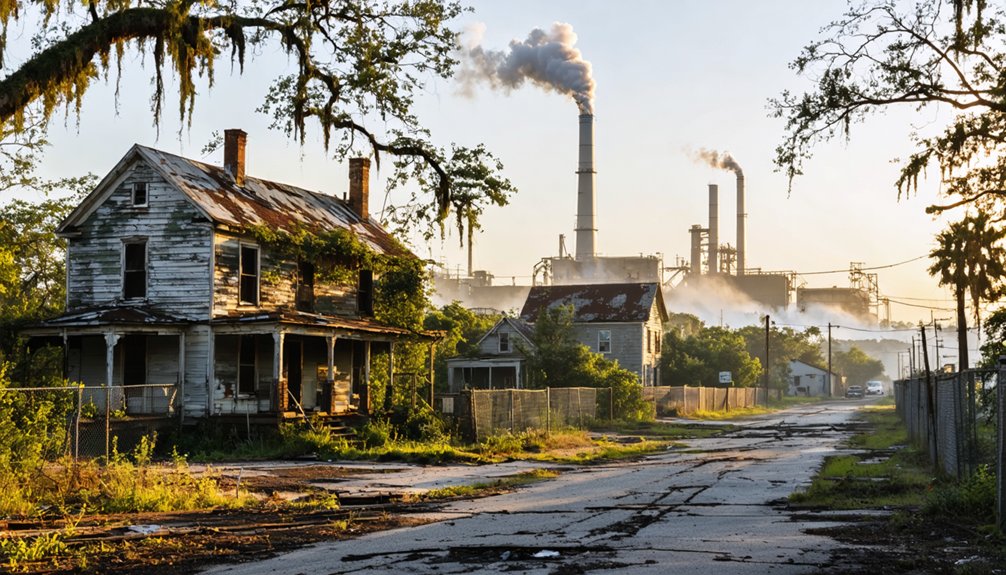
Along Louisiana’s west bank of the Mississippi River, Taft emerged as a small agricultural community in the 19th century, serving dairy farmers and sugar cane operations that dominated St. Charles Parish. By 1905, you’d find 700 residents and a functioning post office under Louis A. Barre’s direction.
Our Lady of the Most Holy Rosary Catholic Church anchored this settlement since 1866.
The community transformation began when industries replaced farmland, concentrating heavy manufacturing along the riverbank. Shell Oil and similar operations enriched the parish treasury while consuming Taft’s residential core.
The industrial impact proved devastating—by 1977, only 36 residents remained in 10 homes. When the post office closed in 1967, Taft’s fate was sealed.
Today, you’ll discover mere industrial zones where families once trapped game and raised cattle.
Ruddock: Hurricane-Ravaged Settlement of St. John the Baptist Parish
Deep within Louisiana’s cypress swamps, Ruddock materialized in the late 1800s as a lumber town perched precariously above dark waters on wooden stilts.
You’ll find this Ruddock history documented through faded records of hundreds of workers who navigated wooden sidewalks connecting their elevated homes.
Catastrophic fires tested the community’s resilience—the 1902 Ruddock mill blaze and 1909 tropical storm both struck hard, yet residents rebuilt.
The hurricane impact of 1915 proved final: 145 mph winds and 15-foot storm surges killed 58 residents, leaving one house standing.
Unlike neighboring Frenier, Ruddock never recovered.
Today you’ll discover only rotted wood remnants submerged beneath moss, marking where an entire community vanished into Louisiana’s unforgiving wetlands—a stark reminder that nature always reclaims its territory.
Comparing Louisiana Ghost Towns to Those Available Across America
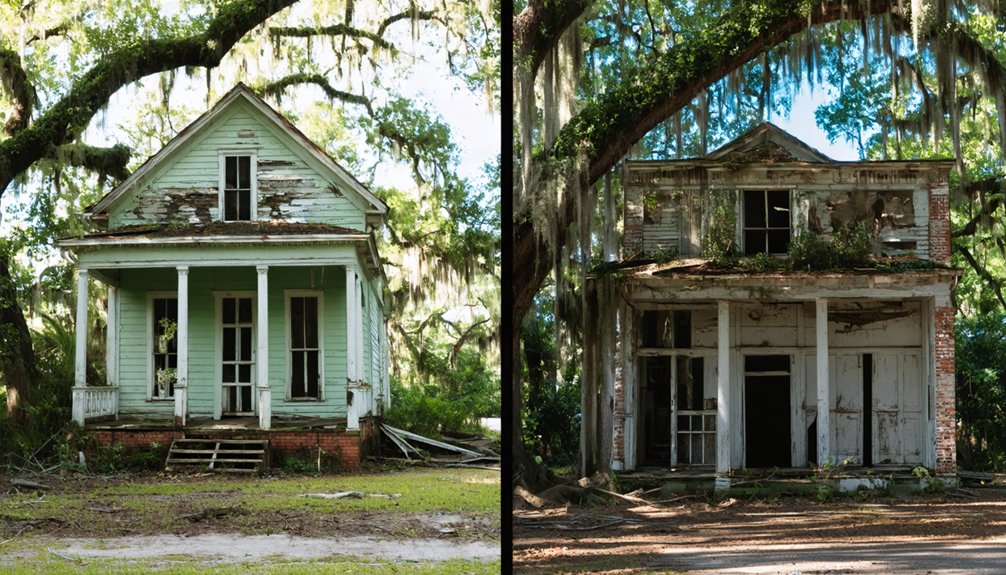
Louisiana’s seventeen documented ghost towns present a stark contrast to the bustling ghost town real estate market you’ll encounter across America.
While you’ll find no Louisiana settlements currently listed for purchase, the American West offers multiple opportunities ranging from Swett, South Dakota’s $250,000 six-acre property to Villa de la Mina’s $1.95 million Texas compound.
Ghost town tourism drives these valuations—Henry River Mill Village capitalized on *Hunger Games* fame, while Frontier Town sold as a Western-themed attraction.
Louisiana’s abandoned settlements face different fates: Laurel Valley stands as ruins despite historical preservation efforts, Taft’s remnants border industrial zones, and Elliot City lies submerged beneath the Morganza Spillway.
The state’s ghost towns succumbed to hurricanes, flooding, and industrial decline rather than the resource depletion that created America’s marketable Western ghost towns.
Alternative Land Investment Opportunities in Louisiana
While Louisiana’s ghost towns remain unavailable for direct purchase, the state’s abandoned settlement zones and surrounding regions offer distinct land investment alternatives that capitalize on similar location characteristics.
You’ll find agricultural parcels in Vermilion, Acadia, and Allen parishes supporting crawfish pond development and livestock operations.
Industrial-zoned properties near former settlements like Taft provide established infrastructure access at reduced acquisition costs.
Heritage properties, including historic plantation structures, generate revenue through tourism potential via entertainment partnerships and cultural preservation initiatives.
Cemetery operations in places like Revilletown maintain steady income through perpetual care contracts.
Undeveloped ghost town parcels offer speculative opportunities, though sites like submerged Elliot City require specialized assessment.
These alternatives preserve the historical character you’re seeking while providing tangible ownership possibilities.
What Remains: Preservation Efforts and Surviving Structures
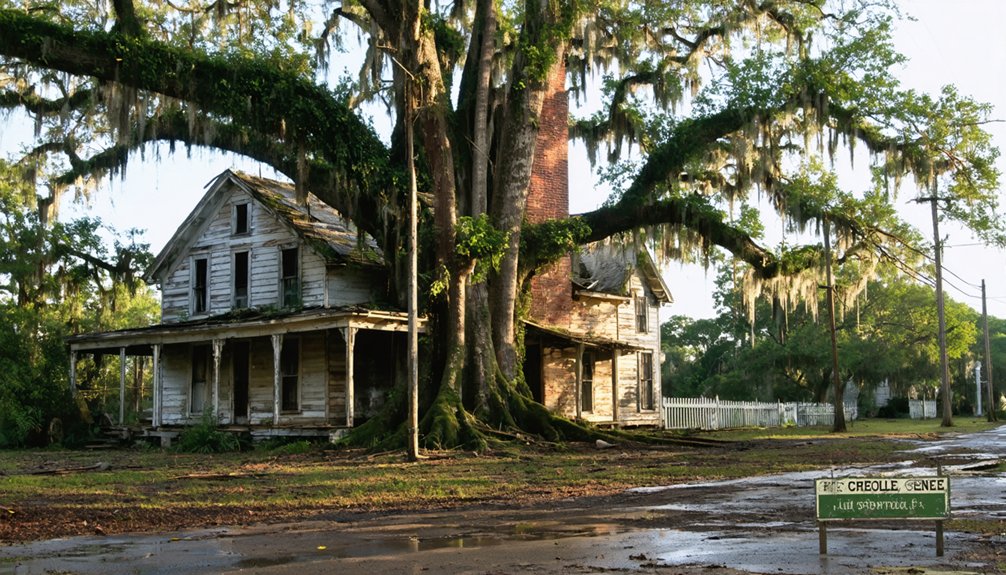
Across Louisiana’s abandoned settlements, preservation organizations have mobilized substantial resources to protect what remains beneath developed land and within vanishing landscapes.
You’ll find the Louisiana Archaeological Conservancy securing sites through easements since 1987, while state agencies allocate billions from Deepwater Horizon settlements toward coastal restoration.
The Troyville site’s 2003 assessment revealed intact archaeological layers beneath Jonesville, defying prior destruction assumptions.
Beneath a modern Louisiana town, 2003 excavations uncovered surprisingly intact archaeological layers that experts had presumed destroyed decades earlier.
Preservation challenges intensified post-Katrina, yet the Division of Historic Preservation expanded rehabilitation efforts using Federal Tax Credits that rescued New Orleans‘ warehouse district.
Organizations like Preservation Resource Center acquired over 100 blighted buildings, transforming owner occupancy rates.
These documented efforts acknowledge historical significance while respecting your autonomy to explore Louisiana’s layered past through surviving structures and protected ghost town remnants.
Factors Behind the Disappearance of Louisiana’s Abandoned Towns
From the Mississippi River’s relentless shifting to economic collapse and violent frontier histories, Louisiana’s ghost towns vanished through forces both gradual and catastrophic.
You’ll find coastal communities like Pointe Aux Chenes succumbing to erosion, their cultural significance drowned beneath rising Gulf waters. NOAA maps document how Buras lost massive shoreline between 1965 and 2012, while NASA imagery reveals entire Plaquemines Parish settlements swallowed whole.
The economic impact devastated inland towns too. Oil City’s population plummeted from 1,400 to under 900 after petroleum reserves dried up, leaving rusting rigs among overgrown streets.
The Neutral Strip’s outlaw havens, once thriving refuges for Jean Lafitte’s pirates and Murrell’s Mystic Clan, disappeared when federal authority finally reached Louisiana’s lawless frontier.
Natural disasters finished what economics and geography started.
Frequently Asked Questions
Can I Legally Explore Abandoned Ghost Town Sites in Louisiana?
You can’t legally explore abandoned ghost town sites without owner permission, as they’re still private property. Ghost town exploration requires careful legal considerations—trespassing charges apply even when properties appear deserted, so you’ll need documented consent first.
Are There Property Tax Benefits for Purchasing Land in Former Ghost Towns?
You won’t strike gold automatically—former ghost town land lacks specific tax incentives unless it’s within designated historic or development districts. Property valuation freezes require documented improvements and district eligibility, not mere purchase of abandoned parcels.
What Permits Are Needed to Restore Buildings on Historic Ghost Town Property?
You’ll need restoration permits and certificates of appropriateness for exterior work if the property’s in a historic district. Building codes require structural renovation permits for foundations, walls, and additions. Local commissions review all applications before construction.
Do Louisiana Ghost Towns Have Mineral Rights Available for Purchase?
Picture dusty courthouse records revealing fragmented ownership chains: you’ll find mineral rights available for purchase, though servitude transfers require meticulous documentation searches. Louisiana’s unique system means you’re acquiring temporary extraction rights, not perpetual ownership stakes.
How Do I Research Ownership Records for Abandoned Louisiana Settlement Land?
You’ll conduct ownership search through parish clerk offices for recorded deeds and chain of title, then access Louisiana’s Historical Records Search for land titles, patents, and tract books documenting original federal grants and subsequent transfers.
References
- https://www.10news.com/ghost-towns-sale-us/
- https://etsn.fm/ixp/33/p/7-louisiana-ghost-towns/
- https://www.loveproperty.com/gallerylist/51810/entire-villages-and-towns-for-sale-that-you-can-actually-buy
- https://www.geotab.com/ghost-towns/
- https://www.zillow.com/la/land/
- https://www.aol.com/articles/10-ghost-towns-us-actually-200604529.html
- https://www.loveexploring.com/galleryextended/223428/ghost-towns-and-abandoned-villages-for-sale-around-the-world
- https://www.oldhousedreams.com/state/louisiana/
- https://710keel.com/discover-70-ghost-towns-from-across-louisiana/
- https://en.wikipedia.org/wiki/List_of_ghost_towns_in_Louisiana