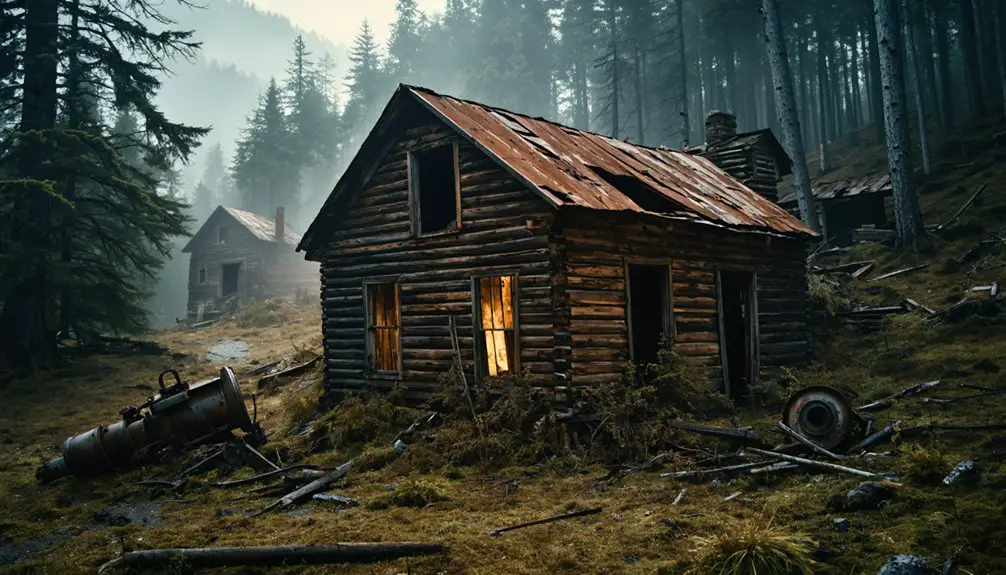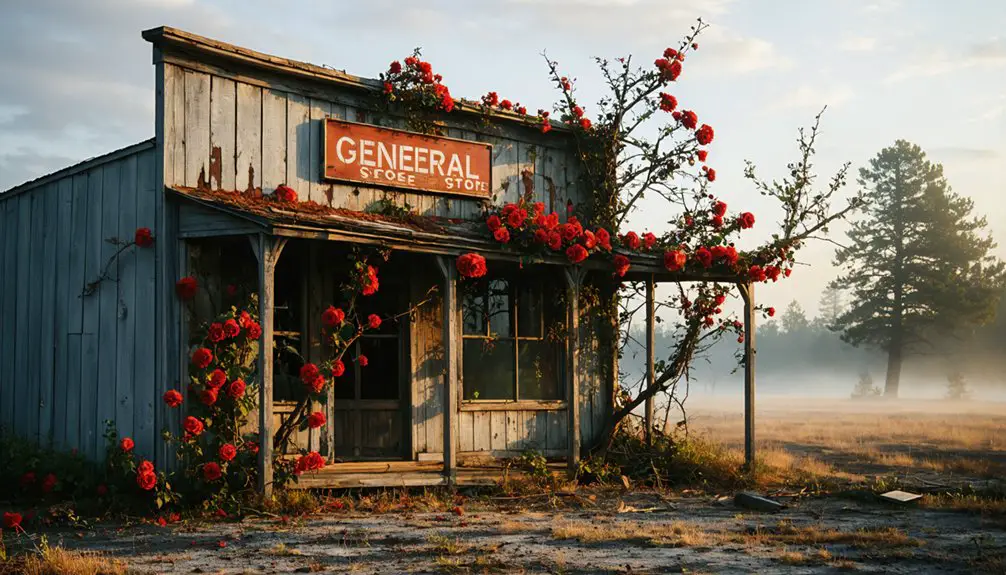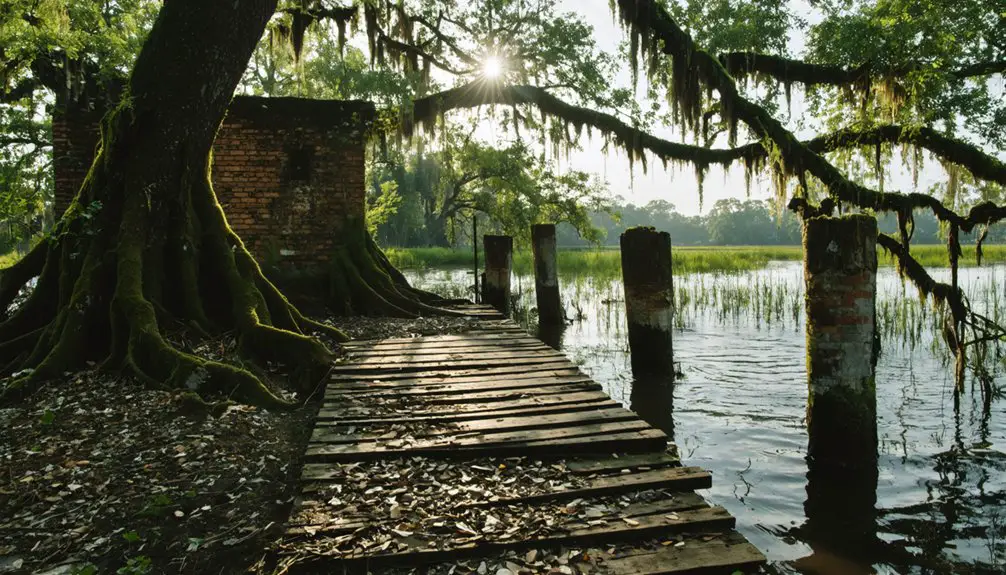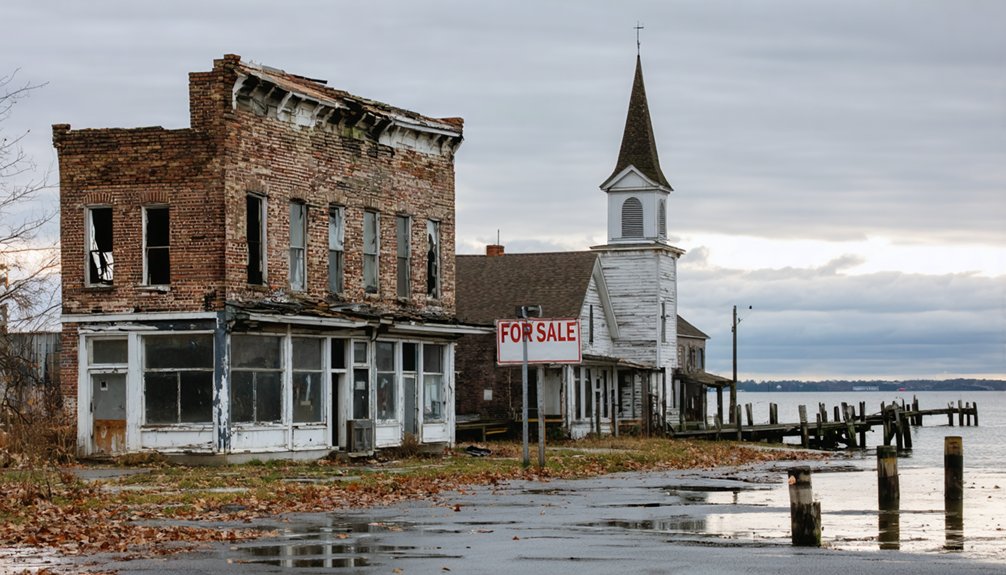
You won’t find complete ghost towns for sale in Maryland like Western properties, but you’ll discover documented alternatives: Baltimore neighborhoods with 16.5-17.4% vacancy rates where homes sell for $69,500-$117,300, historic mill villages like Savage Mill and Jerusalem Mill Village, and foreclosure properties across Baltimore City and Prince George’s County. Maryland’s interconnected infrastructure prevented total abandonment, yet partial ghost towns exist in declining mining areas and former industrial communities. The following sections reveal acquisition strategies, legal requirements, and investment returns from these distressed properties.
Key Takeaways
- Baltimore ZIP codes 21223 and 21217 offer distressed properties from $69,500 to $117,300 with high vacancy rates exceeding 16%.
- Foreclosure listings include affordable land options: 21.96 acres in Brandywine for $90,000 and 3.56 acres near La Plata for $59,900.
- Historic mill villages like Savage Mill and Jerusalem Mill Village present conversion opportunities on the National Register.
- Properties around $19,900 in high-vacancy zones offer significant post-renovation returns for strategic investors seeking phased development.
- Maryland’s tax sale system and receivership laws require careful pre-purchase review of statutory requirements and blighted property designations.
Understanding the Ghost Town Real Estate Market
Anyone exploring ghost town real estate in Maryland will find a market shaped by documented urban decline rather than romanticized Western abandonment.
ZIP 21223 in Baltimore exemplifies ghost town characteristics with 2,156 vacant homes—a 17.4% vacancy rate—while median values sink to $69,500.
ZIP 21223 showcases severe urban decay: 2,156 vacant properties at 17.4% vacancy with median home values plummeting to $69,500.
You’ll encounter population decline of -2.7% over five years, contrasting sharply with comparable ghost areas averaging -6.9% drops.
Urban vacancy trends reveal 75% of these properties qualify as investments, though transaction volumes have fallen over 30% year-over-year.
Days on market now exceed 70 days as inventory swells to 5.5-6.5 months of supply.
You’re witnessing shrinking tax bases and ghost town-like conditions where pending sales dropped 27% and closed sales decreased 33%.
Rental vacancies in distressed Maryland markets mirror patterns seen in struggling Texas towns where vacancy rates have climbed above 20% in areas experiencing economic downturns.
ZIP 21217 in Baltimore contains 2,145 vacant homes at a 16.5% vacancy rate, with over one-third of residents living below the poverty line and median home values at $117,300.
Why Maryland Lacks Traditional Ghost Towns
Maryland’s economic stability and consistently dense population prevented the wholesale abandonment typical of Western ghost towns.
While the state experienced industrial decline and infrastructure-driven displacement—from Daniels’ 1968 mill closure to Wagner’s Point’s late 1990s evictions—these events produced partial abandonments rather than empty settlements.
You’ll find that even Port Tobacco Village, which declined from Maryland’s second-largest town to its smallest incorporated municipality by 2010, retained residents throughout its 300-year contraction.
Resource depletion and transportation changes drove many communities into decline during the industrial era.
Many of Maryland’s abandoned sites have since reverted to pasture land or empty fields, erasing physical evidence of former communities.
Economic Stability Prevented Abandonment
Transportation networks, including the National Road (1806), Baltimore and Ohio Railroad (1842), and Chesapeake and Ohio Canal (1850), prevented regional isolation.
This interconnected infrastructure created self-sustaining economic centers rather than single-industry settlements vulnerable to collapse, ensuring continuous employment and population retention throughout the 19th and 20th centuries. Baltimore’s industrial hub status, featuring factories and shipyards, provided diverse economic opportunities that stabilized communities. The Chesapeake Bay oyster industry experienced dramatic growth during the 1880s, with the peak year of 1884 yielding 15 million bushels, creating additional employment that prevented economic abandonment.
Dense Population Throughout History
Beyond infrastructure advantages, Maryland’s continuously expanding population base fundamentally prevented the formation of traditional ghost towns.
You’ll find historical density records documenting steady growth from 319,728 residents in 1790 to 6,177,224 by 2020—a pattern that left no room for settlement abandonment. The state’s population trends show consistent decadal increases of at least 7% since early censuses, with density rankings holding between 8th and 15th from 1910 to 2020.
This sustained growth intensified after World War II, when suburban expansion around Baltimore and Washington, D.C., converted agricultural land into thriving residential communities. Maryland’s population density climbed from 57.5 people per square mile in 1970 to 93.8 by 2020, reflecting continuous urbanization pressures. The state’s population characteristics further demonstrate this vitality, with 17% foreign-born residents contributing to demographic renewal and economic dynamism.
Counties like Baltimore City maintained densities exceeding 7,241 persons per square mile, while intercensal estimates confirm Maryland’s population rose 11 of 12 years between 2010 and 2022, ensuring settlements remained perpetually occupied.
Historic Mill Villages and Abandoned Communities in Maryland
Along the waterways of Maryland, mill villages once thrived as self-contained industrial communities where textile production, grain processing, and lumber operations formed the economic backbone of rural life from the colonial era through the mid-20th century.
You’ll find documented examples like Savage Mill, established in 1822 along Little Patuxent River, which transformed from water-powered textile operations into artists’ spaces through 1985 renovations.
Jerusalem Mill Village, founded by Quaker David Lee in 1772, supplied flour to Continental Army troops and earned National Register status.
Old Wye Mill from 1682 continues grinding flour as Maryland’s oldest working mill.
Old Wye Mill has operated continuously since 1682, making it Maryland’s oldest functioning grain mill still producing flour today.
These sites represent successful historic preservation efforts, while abandoned lumber mills from the 1840s demonstrate potential for community revitalization.
Many of these structures retain incredible machinery and original equipment despite decades of exposure to moisture and wear.
The mill communities functioned as comprehensive settlements where entire families worked and resided, with companies providing essential services including housing, stores, and utilities.
Each location offers tangible connections to Maryland’s industrial heritage beyond typical settlement narratives.
Foreclosure Properties as Modern Ghost Town Alternatives
Several foreclosure properties across Maryland present acquisition opportunities that parallel the ghost town concept through abandonment and population decline, though operating within contemporary financial systems rather than wholesale community desertion.
Maryland’s foreclosure trends reveal concentrated activity in Baltimore City and Prince George’s County, with 1,899 filings in Q1 2025 marking a 24.3% year-over-year decline.
You’ll find the state ranked 10th nationally in November 2025 at one foreclosure per 3,349 households, demonstrating relative stability compared to July’s third-place ranking.
Property evaluations require examining localized stress patterns—Charles and Kent counties show elevated rates despite statewide improvements.
These distressed holdings offer entry points into markets otherwise constrained by competitive pricing and limited inventory, presenting alternatives for those seeking unconventional acquisition paths.
Vintage Homes and Historic Districts Worth Exploring
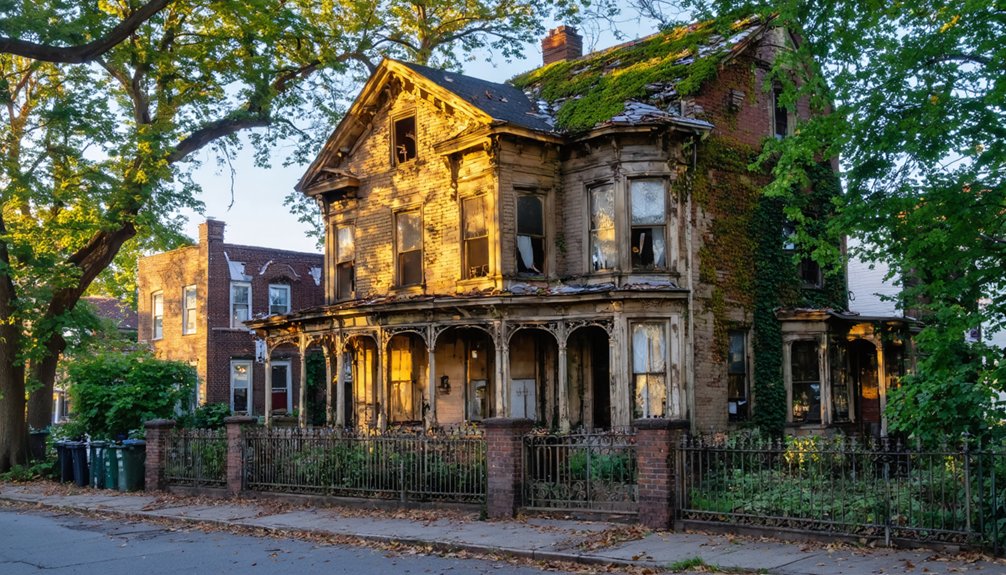
You’ll find several National Historic Landmark districts in Maryland where Victorian and Colonial homes sell for under $100,000, particularly in Port Tobacco Village and surrounding Charles County communities.
The Colonial Annapolis Historic District showcases brick mansions designed by William Buckland, including the Hammond-Harwood House and William Paca House, which exemplify Georgian architecture from the 1770s.
St. Mary’s City offers preserved 17th-century colonial structures alongside the state’s first settlement site, where documented archaeological findings have revealed foundations of Maryland’s original buildings from 1634.
Affordable Historic Properties Under $100K
While Maryland’s market rarely surfaces intact vintage homes under $100K, documented listings from 2025 reveal that affordable entry points exist primarily through vacant land parcels adjacent to historic districts.
You’ll find affordable land like the 21.96-acre Duckett Rd tract in Brandywine at $90,000 and Ripley Rd’s 3.56 acres near La Plata for $59,900—both positioned near communities preserving historic charm.
Talbot County’s Eastern Shore maintains stable pricing where negotiation opportunities emerge for registered properties.
Old House Dreams catalogs brick Colonials and Folk Victorians statewide, though most exceed $100K thresholds.
Your path toward ownership centers on acquiring raw acreage near established historic towns like St. Michaels or Easton, where you can develop alongside preserved agricultural corridors and time-tested architectural character without restrictive municipal constraints.
Victorian and Colonial Architectural Styles
Maryland’s colonial and Victorian architectural legacy concentrates in five documented districts where 17th-through-19th-century structures anchor preservation efforts.
You’ll find colonial architecture exemplified at St. Mary’s City, Maryland’s 1634 capital featuring reconstructed Baroque town plans and 17th-century dwelling artifacts.
Port Tobacco Village preserves early colonial structures amid its decline from Maryland’s second-largest town.
Victorian influences dominate Berlin’s district, where the Calvin B. Taylor House showcases Federal architecture alongside 19th-century Main Street buildings.
Chestertown’s brick-lined streets display 18th-century colonial heritage, including the 1746 Custom House.
Havre de Grace’s Lock House Museum embodies Victorian-era industrial design overlooking the Susquehanna.
These sites offer tangible connections to Maryland’s architectural evolution, documenting colonial settlement through Victorian expansion without modern restrictions.
Unrestricted Land Parcels for Creating Your Own Retreat
For prospective retreat builders seeking maximum creative control, Maryland’s unrestricted land market presents 15 to 17 documented parcels as of current listings, with average prices ranging from $455,447 to $576,147 per property according to LandSearch data.
Per-acre costs average $103,499 to $105,514, enabling strategic land utilization across varied budgets.
Available unrestricted parcels include:
- 40 acres on Slabtown Rd, Hancock at $350,000 for expansive retreat development
- 21.96 acres on Duckett Rd, Brandywine at $90,000 offering rural privacy
- 5 acres on Riverside Dr, Elkton priced at $65,000 for compact builds
- 3.56 acres on Ripley Rd, La Plata at $59,900 representing entry-level opportunity
- 3.42 acres on Evergreen Way, Ellicott City at $99,000 near metropolitan access
Unrestricted zoning eliminates governmental limitations on unincorporated property use, permitting off-grid configurations and custom architectural implementations without regulatory constraints.
Western Maryland’s Declining Mining and Industrial Towns
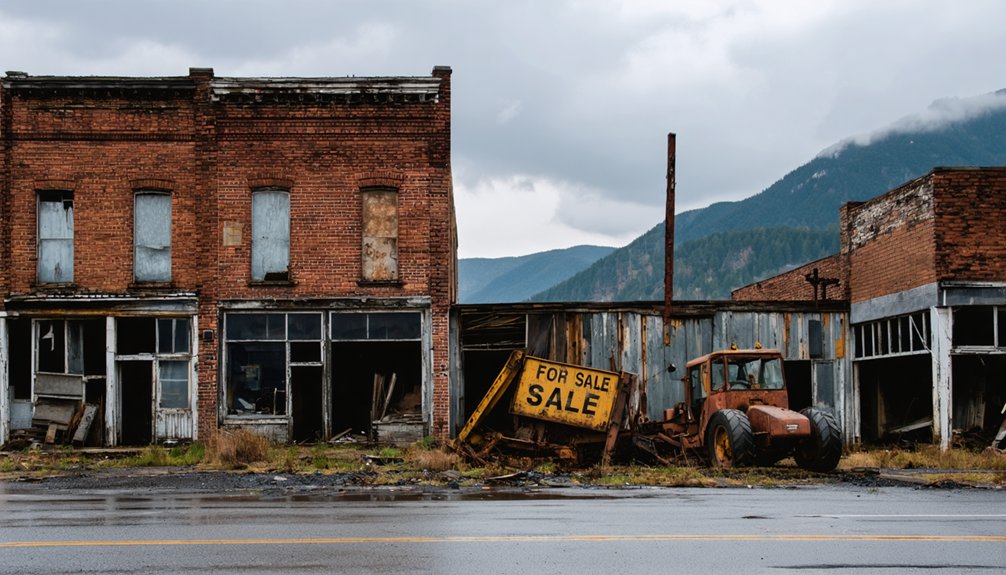
Along the upper Potomac River corridor, vegetation-reclaimed mining settlements mark Western Maryland’s coal industry collapse following the 1920s-1930s closure wave.
You’ll find Vindex history upstream from Bloomington, where Kitzmiller remains viable with 300 residents. Dodson memories linger through one abandoned company house, while Gleason remnants include a brick powerhouse.
Shallmar decline transformed the crown jewel—once 500 residents with manicured hedges—into scattered foundations. George’s Creek operations dominated regional extraction until Big Vein abandonment in 1918.
Eckhart development began Maryland’s mining legacy in 1835, though 2003 employment dropped below 150 workers. Kempton legacy continues discharging 3 million gallons of acid mine water daily into Laurel Run.
Mining artifacts preserved in Lonaconing document this extractive past, offering community restoration insights for freedom-seeking landowners.
Comparing Maryland Properties to Western Ghost Town Sales
The stark contrast between Western ghost town sales and Maryland’s property market reveals fundamentally different investment landscapes.
When examining ghost town comparisons, you’ll find Western properties offering complete communities with multiple structures, while Maryland presents individual parcels or urban vacancies.
Key differences in property uniqueness:
- Western sites deliver 20-24 buildings on 6-62 acres ($250,000-$6.6 million) versus Maryland’s raw land at $350,000 for 40 undeveloped acres.
- Authentic 1900s architecture—saloons, hotels, mines—attracts film studios and tourists out West.
- Maryland’s highest vacancy concentrates in Baltimore ZIP codes (16.5-17.4% vacant) with median values under $120,000.
- No intact Maryland ghost towns exist for sale as bundled properties.
- Western properties include operational infrastructure like water tanks and pools, not found in Maryland’s vacant lots.
Investment Potential in Abandoned or Near-Abandoned Properties
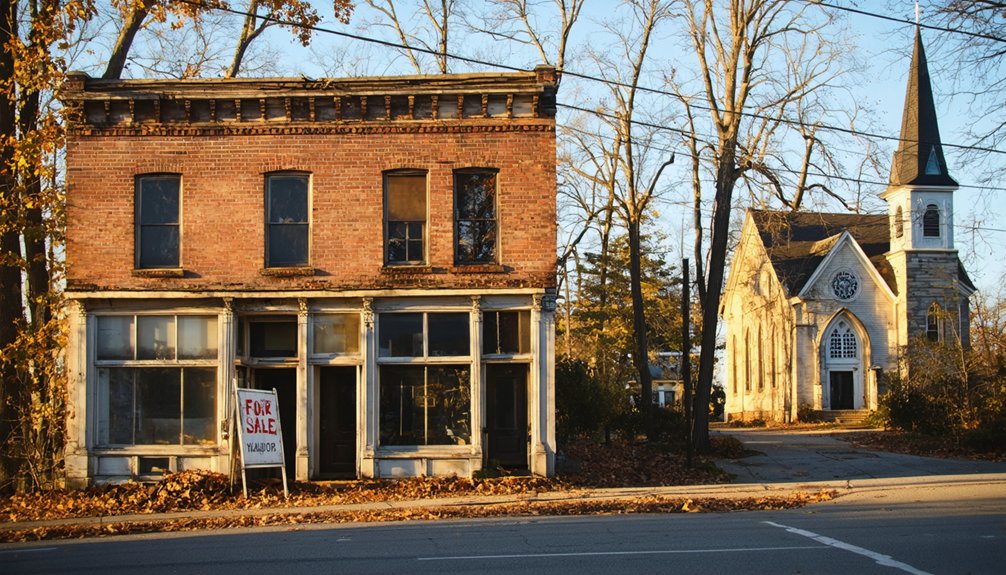
You’ll find investment potential in Maryland’s abandoned properties through straightforward ROI calculations: acquire homes at $69,500 to $117,300 in 16-17% vacancy zones, budget restoration costs against documented median values, and target returns amplified by the state’s $599,000 growth-area benchmarks.
Tourism development opportunities emerge from structures with “spooky spirit” appeal—Halloween-themed conversions or historic preservation projects that capitalize on authentic period features left behind in vacant properties.
Conservation easement models and successful high-end restorations like Riveredge Farm demonstrate how you can leverage Maryland’s preservation infrastructure to stabilize long-term appreciation while converting near-ghost town assets into revenue-generating destinations.
Calculating ROI and Expenses
When evaluating ghost town investments in Maryland, documented market data from Bright MLS reveals purchase prices spanning $59,900 for 3.56-acre parcels to $2,980,000 for extensive estates like the 510-acre Riveredge Farm.
Your ROI strategies must account for multilayered expense management beyond acquisition costs.
Critical cost categories include:
- Structural restoration of 1900s-era buildings requiring specialized craftsmen for authentic architectural details
- Infrastructure development in remote locations lacking utilities, demanding significant upfront capital
- Conservation easement compliance fees that restrict development while preserving long-term legacy value
- Subdivision potential converting multi-acre holdings into profitable smaller lots
- Tourism revenue streams leveraging historic authenticity and natural features
Properties priced at $69,000 or $19,900 offer exceptional percentage returns post-renovation.
Multi-parcel estates enable phased development, optimizing cash flow while maintaining preservation standards that attract freedom-seeking buyers.
Tourism Development Opportunities
Beyond conventional restoration returns, Maryland’s ghost towns generate revenue through heritage tourism ventures that transform abandonment into experiential attractions.
St. Mary’s City demonstrates this model—converting colonial ruins into a state-run historic area with integrated college campus that now draws educational visitors year-round.
The National Park Seminary restoration in Silver Spring proves boarding school conversions attract architectural enthusiasts, while Mallows Bay’s WWI Ghost Fleet supports ecosystem tours merging military history with eco-tourism trends.
Fort Armistead’s graffiti-covered ruins function as local parks, requiring minimal investment while generating foot traffic.
These precedents show you can capitalize on decay itself: Glenn Dale Hospital’s tuberculosis sanatorium sits near affluent suburbs, positioned for heritage tourism conversion.
Historic preservation grants become accessible through Port Tobacco Village’s incorporated status, reducing your capital requirements for tourism infrastructure development.
Legal Considerations When Purchasing Distressed Historic Properties
Maryland’s tax sale system operates under strict statutory requirements that create both opportunities and legal complexities for prospective buyers of distressed historic properties.
You’ll navigate distinct legal frameworks depending on property occupancy status and location. Owner-occupied properties require $750 in combined city liens before sale eligibility, while non-owner-occupied properties face a lower $250 threshold.
Critical pre-purchase considerations include:
- Certificate of sale requirements before filing foreclosure complaints after six months
- Receivership laws in Prince George’s County, Baltimore, and Frederick for vacant properties
- Blighted property designation after four years of habitual vacancy in Frederick
- Conditional use permits for commercial redevelopment in residential zones
- Water bill exclusions from Baltimore City thresholds creating jurisdiction-specific preservation challenges
Baltimore’s special tax sale program packages vacant properties below full lien amounts, demanding quick foreclosure commitments.
Frequently Asked Questions
Can I Restore an Abandoned Maryland Property to Its Original Appearance?
You’re free to pursue historic restoration and property renovation on abandoned Maryland properties, though you’ll need proper permits, documentation of ownership or rights, and compliance with local zoning regulations governing rehabilitation work.
Are There Tax Incentives for Purchasing Historic Properties in Maryland?
Yes, you’ll find substantial tax credits for historic preservation in Maryland. The state offers 20% credits on qualified rehabilitation costs up to $50,000, plus local incentives stack with federal programs for extensive financial benefits.
What Permits Are Needed to Convert Old Maryland Buildings Into Businesses?
You’ll need commercial building permits addressing zoning regulations and building codes, plus trade permits for electrical, plumbing, and mechanical work. Fire Marshal approval, accessibility compliance documentation, and potentially rezoning authorization are also required for conversion.
How Do I Find the Ownership Records of Abandoned Maryland Properties?
Like unearthing buried treasure, you’ll conduct property research through Maryland’s SDAT database using addresses or account numbers, then perform a title search via mdlandrec.net to access recorded deeds and establish true ownership independently.
Can I Buy Multiple Foreclosed Properties Together as a Single Package?
You’ll typically need to negotiate bulk purchases directly with banks or asset managers handling foreclosures, as property auctions usually sell individual properties. The standard foreclosures process doesn’t accommodate package deals, though institutional sellers sometimes consider portfolio offers.
References
- https://www.zillow.com/md/foreclosures/
- https://www.ezhomesearch.com/blog/towns-for-sale-in-the-usa/
- https://www.redfin.com/state/Maryland/vintage
- https://circaoldhouses.com/old-houses-for-sale-in-maryland-md/
- https://www.landsearch.com/unrestricted/maryland
- https://www.land.com/Maryland/all-land/
- https://www.oldhousedreams.com/state/maryland/
- https://oldhousesunder50k.com/category/md/
- https://www.youtube.com/watch?v=JgjAUyeveYc
- https://247wallst.com/special-report/2018/11/02/30-american-ghost-towns-3/