You won’t find complete ghost towns for sale in Michigan as single properties, but you’ll discover individual historic buildings and parcels within these abandoned communities. Michigan has over 70 documented ghost towns, primarily in the Lower Peninsula, stemming from collapsed mining and lumber industries. Your realistic options include purchasing historic homes averaging $561,877, with potential 25% tax credits on rehabilitation costs. The state offers $250,000 in preservation grants to support restoration projects. Continue exploring to understand viable investment strategies in Michigan’s forgotten settlements.
Key Takeaways
- Michigan has over 70 documented ghost towns, primarily in the Lower Peninsula from 19th-century mining and lumber industries.
- Complete ghost town purchases are extremely rare; most opportunities involve individual historic properties or semi-abandoned settlements.
- Historic property investments qualify for 25% state tax credits on rehabilitation costs and $250,000 in preservation grants.
- 357 historic homes average $561,877, ranging from under $100,000 fixer-uppers to grand Victorian estates with tourism potential.
- Successful investment requires significant capital beyond purchase price for structural assessments, restoration, and ongoing maintenance costs.
Current Market Reality for Abandoned Settlements in Michigan
While Michigan’s ghost town market represents a niche segment of the state’s broader real estate landscape, active listings demonstrate genuine acquisition opportunities for buyers with sufficient capital and development vision.
You’ll find these properties concentrated in both Lower Peninsula regions, reflecting historical industrial and mining patterns that once sustained thriving communities.
Current market offerings vary substantially in price and condition, requiring thorough structural assessments before purchase.
Ghost town revitalization demands significant financial commitment beyond initial acquisition costs, as preservation challenges include deteriorating infrastructure and environmental remediation needs.
You’re competing with investors seeking development opportunities and historical enthusiasts pursuing authentic restoration projects.
Northern Michigan concentrations attract particular buyer attention, though geographic accessibility and proximity to established markets ultimately determine your investment’s viability and appreciation potential.
Properties like Arizona’s Ghost Town Museum demonstrate how historic ghost town acquisitions can include National Register listings with authentic period features and museum-quality restoration work.
Ownership responsibilities extend beyond traditional real estate transactions, involving upkeep and activity management similar to stewardship obligations seen in other small-town acquisitions across the country.
Historic Properties as Alternative Investment Opportunities
Michigan’s historic properties present investors with structured financial advantages beyond standard real estate acquisitions.
You’ll access a 25% state income tax credit on qualified rehabilitation expenditures when restoration costs exceed 10% of the property’s State Equalized Value. With 357 historic properties currently available at an average price of $561,877, you’re evaluating tangible assets with built-in preservation benefits that reduce your capital outlay considerably.
The State Historic Preservation Office administers grants totaling $250,000 across six communities, while RAP program funding has generated $9.76 million in capital investment.
You’ll leverage federal Historic Preservation Fund resources for surveys and National Register nominations. Historic investment potential extends beyond tax advantages—these properties offer appreciation through architectural craftsmanship, heritage tourism appeal, and downtown revitalization opportunities that standard acquisitions can’t match. Properties featuring intricate woodwork, stained glass windows, and original architectural details command premium valuations in restored historic districts. Since launching in 2022, the RAP and MCRP programs have supported 238 projects across Michigan communities, demonstrating sustained institutional commitment to historic property development.
Understanding Michigan’s Faded Communities and Ghost Town Heritage
Spanning from the Keweenaw Peninsula’s copper-rich highlands to southeastern timber corridors, over 70 documented ghost towns represent Michigan’s most tangible connection to 19th-century industrial expansion.
You’ll find ghost town origins rooted in single-industry dependence—copper extraction following Douglass Houghton’s 1840 discovery, lumber operations, and iron smelting ventures like Fayette. These communities flourished rapidly, with populations reaching 1,200+ before experiencing dramatic community decline when resources depleted or railroads bypassed their locations.
Classifications range from completely barren sites to semi-abandoned settlements retaining a handful of residents.
Preservation efforts protect significant examples: Fayette operates as a Historic State Park with restored buildings, while Port Oneida’s 2,000 acres constitute the nation’s largest Rural Historic District. The Jackson Iron Company established Fayette with over 500 residents and amenities including a hotel and opera house before the settlement closed after only 24 years of operation.
Nearly 100 Keweenaw ghost towns alone document the copper boom’s extraordinary legacy, offering you direct access to authentic frontier heritage. Port Oneida’s 121 remaining buildings include the old schoolhouse and historic barns available for exploration with maps from the Heritage Center.
Notable Abandoned Towns Across the United States
While Michigan offers unique ghost town opportunities, you’ll find compelling alternatives across the United States that have garnered significant attention in the real estate market.
Bridgeville, California, made headlines when it was listed for sale multiple times between 2002 and 2010, demonstrating the commercial viability of purchasing entire abandoned communities.
Similarly, Henry River Mill Village in North Carolina—a former textile mill town featuring 22 historic buildings—sold at auction in 2017, illustrating how preserved ghost towns can evolve into investment properties with tourism potential.
Texas and California, with their extensive mining and oil booms, contain the highest number of ghost towns in the country, offering diverse opportunities for potential buyers.
These abandoned settlements provide valuable lessons on settlement failures, helping prospective buyers understand the factors that led to their decline before making investment decisions.
Bridgeville and Villa Highlights
Beyond Michigan’s borders, abandoned settlements like Bridgeville, California, and Villa, Michigan, illustrate the diverse patterns of American ghost town formation and modern market potential.
Bridgeville history shows a timber community from the late 1800s that sold for $350,000 in 2017, offering 20 acres with decaying structures and off-grid development opportunities. You’ll find it marketed for private retreats or eco-tourism, though its remote Humboldt County location requires significant investment.
Villa features tell a different story—this 1840s copper mining settlement near Keweenaw Bay exists only as mine shafts, tailings, and foundations on public land. You can’t purchase Villa, but it represents Michigan’s extractive industry heritage. Similar to Fayette, which became a ghost town 24 years after its founding when iron smelting operations ceased in 1891, Villa demonstrates how rapidly industrial settlements could rise and fall in Michigan’s Upper Peninsula. Fayette’s population had peaked at nearly 500 residents, primarily immigrants from Canada and Northern Europe who worked in the iron-smelting operations.
Both sites demonstrate how resource depletion transforms communities into investment opportunities or historical landmarks.
Henry River Mill Village
Deep in North Carolina’s Burke County foothills, Henry River Mill Village stands as one of America’s most cinematically famous ghost towns, where the Aderholdt and Rudisill families established the Henry River Manufacturing Company in 1905 on 1,500 acres of strategically positioned riverfront property.
The self-contained community once employed 450 workers producing yarn for embroidery and fine lace, operating through company-specific currency that kept workers economically bound to the settlement.
After closing in the early 1960s due to overseas competition, the Mill Village found new life as District 12‘s filming location in “The Hunger Games.”
You’ll find this National Register site offering guided tours just one mile south of Hildebran off I-40 exit 119, representing authentic Southern textile culture preserved through community-driven revival efforts.
Unique Historic Homes Available Throughout Michigan
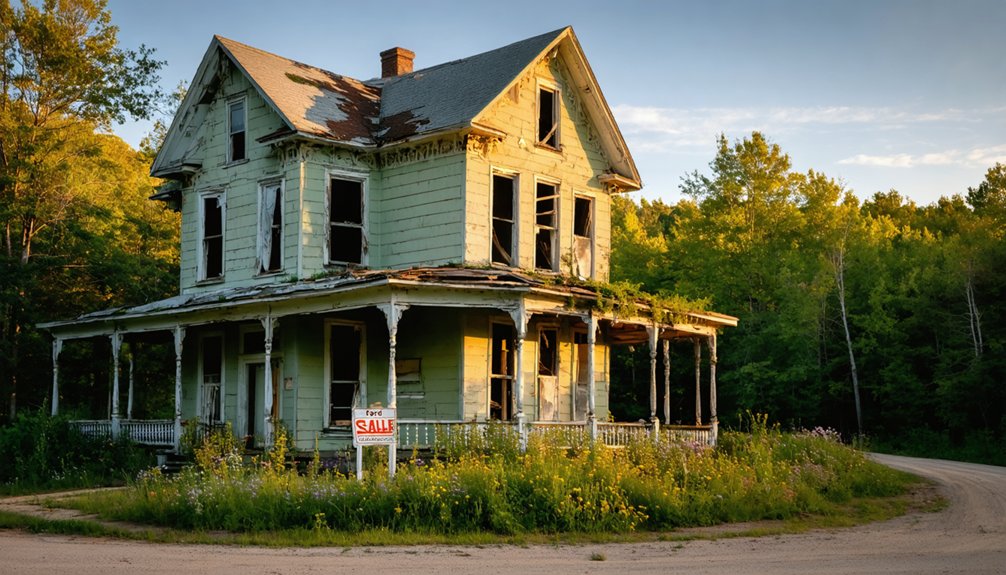
Michigan’s historic property market offers you 357 distinctive homes spanning grand Victorian mansions to budget-friendly restoration projects under $100,000.
You’ll find architectural treasures ranging from Tudor estates with custom woodwork to Queen Anne residences featuring intricate millwork across multiple price tiers.
These properties deliver investment opportunities through both turnkey luxury estates exceeding $1,000,000 and fixer-uppers that reward your restoration efforts with state and federal tax credits.
Grand Estates and Mansions
Throughout Michigan’s landscape, grand estates and historic mansions represent exceptional opportunities for buyers seeking properties that combine architectural significance with substantial investment potential.
Victorian estates in Marquette and Menominee showcase Queen Anne architecture with intricate woodwork and original stained glass, qualifying for preservation tax credits that reduce restoration expenses.
Waterfront mansions along Lake Superior and the Menominee River offer private beaches, stone fireplaces, and breathtaking views—properties constructed during Michigan’s industrial boom as luxurious summer retreats.
You’ll find urban mansions in Detroit’s Corktown district featuring modern updates while maintaining historic character.
With 357 historic properties currently available at an average price of $561,877, you’re positioned to acquire substantial estates that preserve Michigan’s architectural heritage while delivering compelling long-term value.
Affordable Fixer-Upper Gems
While grand estates command premium prices, savvy investors are discovering exceptional value in Michigan’s affordable historic fixer-uppers, where properties priced between $150,000 and $549,900 offer substantial square footage and authentic period details.
You’ll find remarkable fixer upper potential in Ludington’s 2,530-square-foot five-bedroom home at $239,900, or Romeo’s 1,783-square-foot property at $325,000.
Northern Michigan presents compelling opportunities, with Mancelona offering entry-level homes from $150,000 and Wolverine’s waterfront properties showing strong appreciation.
These affordable renovations provide pathways to ownership in markets where buyers are increasingly priced out of premium locations like Petoskey and Traverse City.
With 1,027 historic homes currently listed statewide and inventory tightening expected through 2026, securing these authentic properties now positions you ahead of emerging market shifts while preserving Michigan’s architectural heritage.
Architectural Styles and Eras
From the bold symmetry of 1830s Greek Revival temples to the ornate grandeur of turn-of-the-century Renaissance mansions, Michigan’s historic residential architecture spans nearly two centuries of American design evolution.
You’ll discover properties showcasing remarkable architectural significance—from Ypsilanti’s Craftsman bungalows with exposed rafters to Detroit’s Richardson Romanesque estates built with rusticated polychrome granite.
These structures offer historical context through distinctive features: mortise-and-tenon Greek Revival homes from the 1850s, Victorian-era Stick style residences with patterned cladding, and sprawling Tudor Revival mansions exceeding 30,000 square feet.
Understanding each era’s construction methods and design elements helps you evaluate restoration potential.
Whether you’re drawn to Colonial Revival’s symmetry in Grosse Pointe or Folk Victorian’s decorative trim, Michigan’s diverse housing stock presents unmatched opportunities for architectural preservation and ownership.
Specialty and Unconventional Real Estate Options
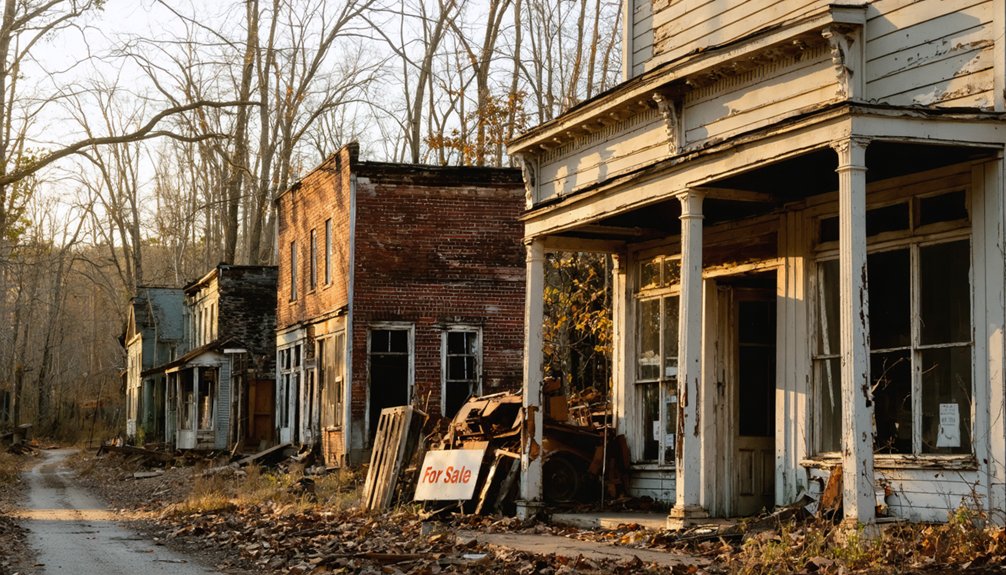
Michigan’s specialty real estate market extends far beyond traditional residential properties, offering investors unconventional opportunities ranging from commercial carwashes to horse stables and private airports.
While dedicated ghost town investments remain scarce in Michigan listings, you’ll find compelling alternatives through niche properties that deliver unique revenue streams.
Consider the 3,866-square-foot carwash at 37521 Green St in New Baltimore, priced at $650,000 with a 3.19% cap rate. Platforms like CityFeet specialize in these unconventional commercial assets, connecting you with opportunities that standard residential markets overlook.
Northern Michigan’s emerging markets complement these specialty investments, with waterfront properties in Wolverine jumping from $200,000 to $600,000.
You’ll discover freedom in diversifying beyond conventional real estate into distinctive properties that match your independent investment vision.
Michigan’s Thriving Markets Versus Forgotten Places
Where does Michigan’s real estate landscape diverge most sharply?
You’ll find Petoskey holding median prices at $576,000 while ghost town parcels languish with depleted values.
Traverse City’s tightening inventory and in-migration from California contrast starkly with abandoned mining relics offering foreclosed properties.
Coastal migrants flood Traverse City’s scarce listings while forgotten mining towns offer distressed properties at rock-bottom prices.
Wolverine’s waterfront homes jumped from $200,000 to $600,000 through market revitalization, while forgotten mill towns remain stagnant.
Boyne City’s festivals and entry-level homes at $150,000-$225,000 showcase active community vibrancy versus empty ghost town tourism potential.
Gaylord attracts buyers seeking affordability without abandonment, featuring lifestyle amenities that resource-depleted sites can’t match.
You’re witnessing Northern Michigan’s regional explosion elevate undervalued areas while ghost towns wait for investors willing to revive forgotten places into unconventional opportunities.
Frequently Asked Questions
What Legal Issues Come With Buying Abandoned Property in Michigan?
You’ll face challenges with property ownership verification, clouded titles requiring extensive title searches, potential environmental assessments for contamination, and maneuvering through zoning regulations that may restrict your intended use or development plans.
How Do You Restore Utilities in a Long-Abandoned Michigan Town?
Utility restoration requires systematic assessment of water, sewage, and electrical systems. You’ll face infrastructure challenges including contaminated groundwater remediation, abandoned well plugging, wastewater system reconstruction, and power grid reconnection—each demanding specialized engineering expertise and regulatory compliance.
Can You Qualify for Historic Tax Credits on Ghost Town Properties?
You’ll likely qualify if your ghost town buildings are National Register-listed, meeting historic preservation standards. Michigan offers 25% tax incentives on rehabilitation costs, while federal programs provide 20% for income-producing properties meeting Secretary of Interior’s Standards.
What Are Typical Annual Maintenance Costs for Abandoned Buildings?
You’ll face annual property expenses of $500-$1,400 per abandoned building for securing, debris removal, and grass cutting. Factor these maintenance costs into your renovation budgeting, as they’ll continue until you complete restoration work.
Do Michigan Counties Offer Incentives for Revitalizing Ghost Towns?
Yes, you’ll find Michigan counties offer substantial revitalization grants—some provide up to $25,000 in matching funds. Through community partnerships with MEDC and local programs, you can access tax incentives, low-interest loans, and federal funding opportunities.
References
- https://www.manisteenews.com/realestate/article/5-for-Friday-the-13th-Spooky-Ghost-Towns-for-Sale-17716649.php
- https://www.aol.com/articles/10-ghost-towns-us-actually-200604529.html
- https://www.youtube.com/watch?v=1gNUS8snxFI
- https://www.zillow.com/mi/historic_att/
- https://www.oldhousedreams.com/state/michigan/
- https://www.cityfeet.com/cont/michigan/specialty-properties-for-sale
- https://cincinnatistate.ecampus.com/michigan-ghost-towns-lower-peninsula/bk/9780934884037
- https://www.realtor.com/news/unique-homes/5-for-friday-the-13th-ghost-towns-for-sale/
- https://www.youtube.com/watch?v=pFuCY7W5_58
- https://www.youtube.com/watch?v=uEA9AgTaiEc