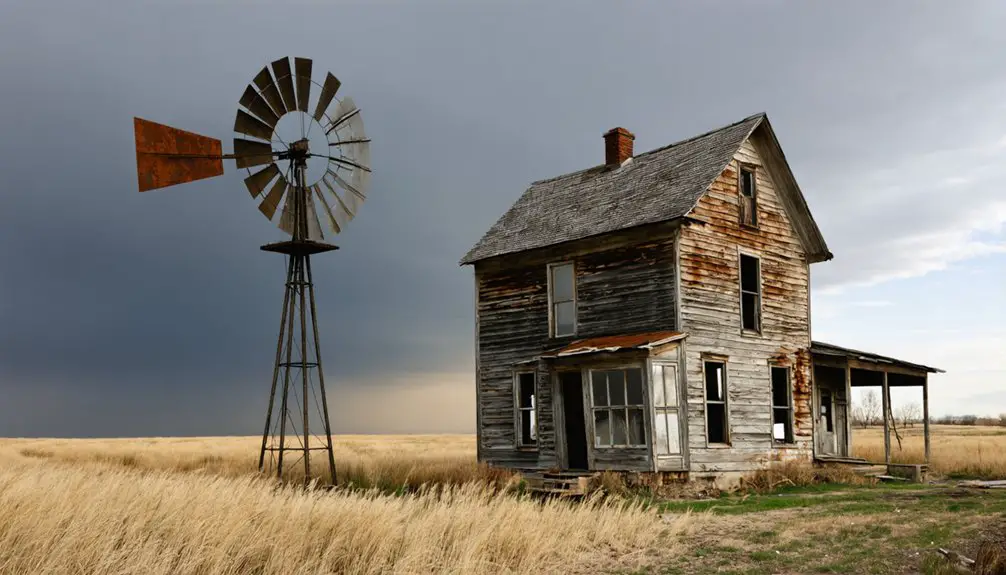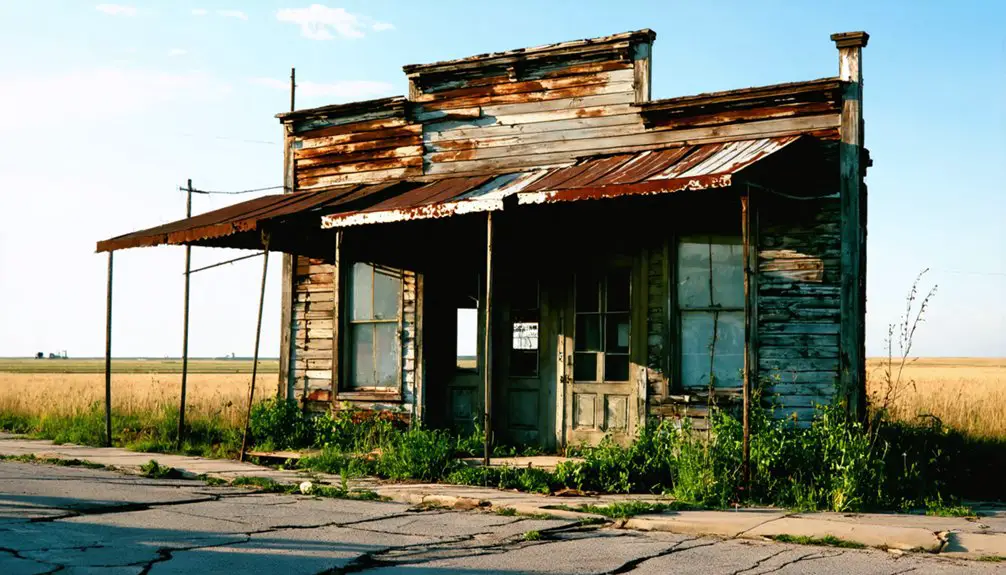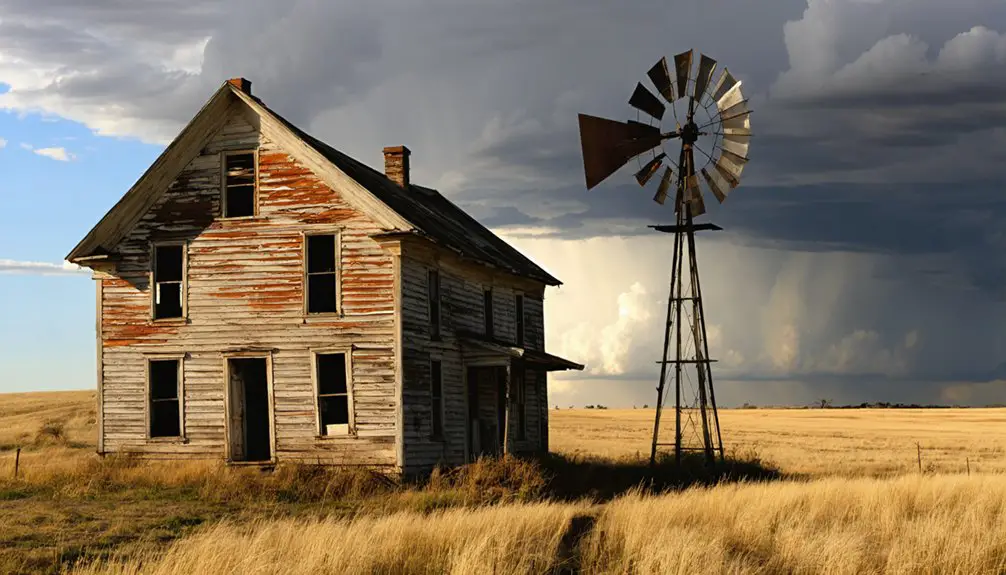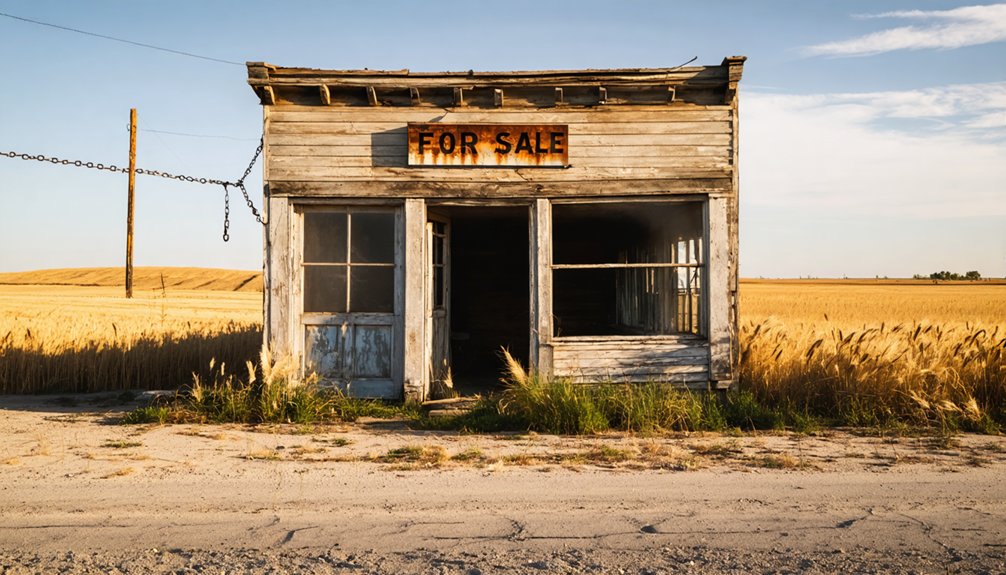
You’ll find ghost towns for sale in Nebraska ranging from complete settlements to individual properties in fading communities. Swett, near the South Dakota border, is the most notable example at $250,000 for six acres including a tavern and multiple buildings. Towns like Humboldt and Verdon offer median home values below $50,000, while Falls City properties start under $50,000. Before purchasing, you’ll need to verify ownership, check for liens, and navigate local zoning regulations that can complicate restoration efforts. The following sections explore specific opportunities and essential legal considerations.
Key Takeaways
- Swett, a ghost town near South Dakota, is available for $250,000, including a tavern, residential house, and multiple empty buildings on 6 acres.
- Ghost town property prices vary widely, from under $50,000 for individual homes to complete town ownership starting at $250,000.
- Southeastern Nebraska towns like Humboldt and Verdon offer extremely low median home values at $48,600 and $32,400, respectively.
- Buyers must verify ownership, check for liens, and ensure compliance with local zoning regulations and Nebraska building codes before purchasing.
- Restoration costs often exceed initial asking prices, with nonconforming buildings requiring permits and compliance with current structural standards.
What Defines a Ghost Town in Nebraska
A ghost town is defined as an abandoned settlement with substantial visible remaining buildings, though debate exists among historians about whether complete desertion or tangible physical remains should be the primary criterion.
When you’re evaluating Nebraska’s ghost town characteristics, you’ll find they encompass everything from standing ruins to foundations and even active towns that’ve lost most of their population, like Aspen.
Nebraska’s ghost towns reveal a spectrum of abandonment—from crumbling structures to struggling communities that lost their economic heartbeat.
The abandoned settlement criteria typically include towns where the original reason for existence no longer applies—think settlements that became economically unviable rather than those destroyed by disasters.
You’ll discover that Nebraska’s ghost towns range from completely deserted railroad stops with visible graded streets to speculative “paper towns” that were platted but never fully constructed, leaving minimal landscape evidence beyond tree groves or cemeteries. Many of these settlements disappeared due to economic changes that fundamentally altered the viability of their original industries.
Swett: The Movie Set Town Near the South Dakota Border
Nebraska’s definition of ghost towns extends beyond the state’s borders, with Swett standing as a prime example just across the South Dakota line. Founded in 1931, this 6.16-acre hamlet sits 2.5 hours from Rapid City, offering a unique investment opportunity at $250,000.
You’ll find a closed tavern, abandoned house, trailer structures, and multiple empty buildings—perfect for a movie set or unconventional venture.
Owner Lance Benson acquired the entire town in 1998, regained it in 2012, and listed it in 2014.
The property’s marketed as a hunting destination near pheasant grounds, complete with “supposedly haunted” appeal. The town’s population has plummeted from approximately 40 in the 1940s to just two residents today.
It’s a rare chance to own an entire municipality that’s evolved from functioning community to ghost town, offering unrestricted possibilities for those seeking extraordinary property investments. Like Nebraska’s Oropo, which attracted settlers purchasing lots in 1858 with grand visions of becoming a major urban center, Swett represents the enduring appeal of frontier town ownership despite uncertain outcomes.
Fading Communities With Rock-Bottom Property Values
While most real estate markets command premium prices, southeastern Nebraska’s fading communities offer properties at values that defy conventional market logic.
Humboldt’s median home value sits at $48,600, while Verdon’s properties average just $32,400. Salem, once boasting over 500 residents in 1900, now teeters near ghost town status with a median value of $36,800.
Even Falls City, featuring historic structures like the Grand Weaver Hotel, commands only $72,900.
These economic factors reflect severe rural decline across Boyd County, where three towns maintain populations under 10.
The combination of abandoned infrastructure, population exodus, and collapsing local economies has created unprecedented opportunities for buyers seeking ultra-low property costs. Many ghost towns resulted from mining or railroad decline, leaving behind vacant buildings and deteriorating infrastructure. Towns like Ardmore, once a thriving frontier railroad hub in the late 1880s, now stand as scattered ruins along the South Dakota border. These rock-bottom valuations represent complete market transformation in communities facing existential challenges.
The Haunted Township Listed at $250,000
Beyond Nebraska’s borders, another struggling prairie settlement showcases the extremes of America’s ghost town market.
You’ll find Swett, South Dakota—a 6.16-acre property that’s been stripped to bare essentials after Lance Benson’s decades-long ownership saga. Originally listed at $399,000 in 2014, the price crashed to $250,000 following failed deals and diminishing interest.
From nearly $400,000 to $250,000—Swett’s decade-long price collapse mirrors the brutal reality of America’s ghost town gamble.
What you’re buying includes a closed bar, several trailers, and an unoccupied house that’s earned its reputation among local legends as genuinely haunted. The bank cleared decaying mobile homes, and fresh bullet hole-free signs now mark boundaries—a telling detail about previous visitors.
Located 2.5 hours from Rapid City near prime pheasant hunting territory, this 1931-established township represents both haunted attractions potential and pure speculation for those willing to gamble on abandoned prairie real estate. The town’s decline accelerated as residents moved to larger communities, transforming what was once a thriving settlement into the ghost town available today. Real estate agent Stacie Montgomery continues fielding inquiries from prospective buyers despite the property sitting on the market for over a year.
Price Ranges and What You Actually Get
Ghost town prices in Nebraska and surrounding markets span from under $50,000 for individual homes in depopulating communities to multi-million dollar complexes with dozens of historic structures.
At the low end, you’ll find median home values of $32,400 in Verdon or $36,800 in Salem, while complete town ownership like Swett, South Dakota starts at $250,000 for six acres with multiple buildings. Communities like Salem peaked at over 500 residents in 1900 but now have populations of just 83, creating opportunities for abandoned property acquisition.
Premium parcels command $800,000 to $3.8 million depending on acreage, building count, and revenue-generating amenities like event spaces or operational hotels. Before committing to a purchase, budget carefully for restoration and maintenance costs that often exceed the initial asking price of the property itself.
Under $50,000: Fading Towns
For buyers working with tight budgets, Nebraska’s fading towns offer surprisingly accessible entry points into property ownership, with median home values dipping well below the $50,000 threshold in several communities.
These locations provide genuine affordable housing opportunities for those embracing rural exploration and unconventional living.
Three Notable Markets Under $50K:
- Verdon – Median home value $32,400, representing the lowest barrier to entry among documented communities.
- Salem – Properties averaging $36,800 in this near-ghost town with historic churches and period homes still standing.
- Humboldt – Median values at $48,600, attracting buyers seeking functional rural housing without premium costs.
Falls City presents additional options, with select properties under $50,000 despite its $72,900 median.
Douglas County lots near Omaha range from $3,750 to $35,500.
250,000: Complete Town Ownership
While most Nebraska properties sell for modest sums, acquiring an entire town—complete with multiple buildings and infrastructure—typically demands six-figure investments ranging from $250,000 to over $1 million.
Swett, South Dakota’s 6-acre property near Nebraska’s border demonstrates this tier, previously listed at $250,000 after foreclosure. You’ll get a tavern and residential house, though town management responsibilities transfer entirely to you.
Bridgeville, California illustrates premium pricing: sold for $1.25 million in 2006 for 74-plus acres with multiple structures. The investment reflects historical preservation potential and development opportunities.
Frontier Town, Montana’s early 2025 sale included operational saloon, guest cabins, and replica jail—turnkey ownership with established infrastructure.
These complete town purchases offer autonomy from bureaucratic oversight, letting you control development, restoration, and future use without municipal interference.
Premium Ghost Town Parcels
Premium ghost town parcels command prices between $250,000 and nearly $2 million, with dramatic variations based on building count, infrastructure, and operational amenities.
Understanding ghost town economics reveals what drives these valuations in property investment markets.
Premium Tier Pricing Breakdown:
- $250K-$500K Range: Swett, South Dakota offers 6 acres with a standing home and abandoned tavern, though it’s languished on market since 2014 despite price reductions from $399,000.
- $1M-$1.5M Range: Bridgeville sold for $1.25 million in 2006, featuring 24 functional buildings designed as movie studio backdrops.
- $1.5M+ Range: A 62-acre property commands $1.95 million with 20 buildings, operational railroad access, mining infrastructure, and documented filming credits.
You’ll notice premium properties maintain prices despite extended market exposure, suggesting limited buyers willing to tackle extensive restoration projects.
Pawnee City’s Revitalization Program as an Alternative
Instead of purchasing an entire ghost town, you’ll find Pawnee City’s Vision 2030 program offers a structured path to rural Nebraska homeownership through its $50,000 down payment incentive.
This Pawnee revitalization initiative delivers modern 2-3 bedroom homes with full basements and two-car garages at approximately $325,000, reducing your total costs by 40% when combined with infill lot savings.
The rural housing program targets income-qualified buyers at or below 120% area median income, structuring the down payment assistance as a zero-interest second mortgage with no required payments.
Construction on 25 new single-family homes began November 2024, with first units available July 2025.
You’ll access complete community infrastructure—schools, medical facilities, recreational amenities—without the financial burden and development challenges of ghost town ownership.
Legal Considerations When Purchasing Abandoned Properties
Before you commit to purchasing abandoned property in Nebraska, you’ll need to verify the seller actually owns the title and has legal authority to transfer it.
This requires searching for all potential lienholders—particularly mortgage lenders who control foreclosure sales—since abandoned properties often involve unpaid debts that cloud ownership.
You must also confirm the property complies with local zoning regulations and building codes, as Omaha’s ordinance can deny your registration if the property has unaddressed violations or lacks a realistic compliance plan.
Title and Ownership Verification
When purchasing ghost towns or abandoned properties in Nebraska, verifying clear title becomes your primary legal safeguard against future ownership disputes. Title verification requires thorough examination of ownership history through county records, revealing any liens, encumbrances, or competing claims that could restrict your property rights.
Your due diligence should include:
- Unclaimed property searches at NebraskaLostCash.nebraska.gov to identify potential rightful owners who’ve been located by the State Treasurer.
- Chain of title review examining all transfers, mortgages, and tax records from original ownership forward.
- Seven-year lookback matching Nebraska’s record retention requirements for unclaimed property reporting.
Title insurance providers won’t issue policies without resolving abandoned property concerns. You’ll need documentation proving previous holders completed required due diligence before the property reached dormancy status.
Zoning and Building Codes
Nebraska’s zoning regulations greatly complicate ghost town acquisitions because most abandoned structures don’t comply with current building codes.
You’ll face strict limitations on nonconforming buildings—structures that existed legally but no longer meet current standards. If damage exceeds 60% of structural value, you can’t restore them without meeting today’s zoning requirements. Buildings damaged less than 60% need building permits within six months and restoration started within one year.
Abandonment creates additional hurdles. Once a nonconforming use stops for twelve consecutive months (eighteen in Jefferson County), you can’t reestablish it. The property must then conform to current district regulations.
You can’t move nonconforming structures to new locations or expand existing ones. Each county enforces these rules differently, requiring careful research before purchase.
Frequently Asked Questions
Can Ghost Towns in Nebraska Qualify for Historic Preservation Tax Credits?
You’ll find that Nebraska ghost towns can potentially qualify for historic tax credits if they meet preservation eligibility requirements, including National Register listing and substantial rehabilitation standards. However, you’ll need to verify specific property qualifications and complete extensive documentation beforehand.
Are There Zoning Restrictions When Converting Ghost Town Buildings to Businesses?
Yes, you’ll face zoning restrictions requiring permits for converting ghost town buildings to businesses. You must obtain zoning permits and business licenses from county authorities, who’ll review your plans against extensive development regulations and nonconforming use standards.
What Utilities Are Typically Available in Abandoned Nebraska Towns?
You’ll find minimal utilities in most abandoned Nebraska towns. Electricity access varies—some locations maintain basic power through tax payments, while water supply often depends on wells or non-existent municipal systems requiring independent solutions.
Do Ghost Town Purchases Include Mineral Rights Beneath the Property?
Typically not—mineral rights are usually severed from surface property ownership in ghost town purchases. You’ll need to verify through title searches whether subsurface minerals are included, as prior owners often retained these valuable rights.
How Do Property Taxes Work for Buildings in Uninhabited Towns?
You’ll pay standard property taxes on uninhabited town buildings since they’re assessed as real property at market value. Property assessment follows normal procedures, though you won’t qualify for tax exemptions unless used for specific charitable or religious purposes.
References
- https://www.10news.com/ghost-towns-sale-us/
- https://www.ezhomesearch.com/blog/towns-for-sale-in-the-usa/
- https://www.realtor.com/news/trends/buy-entire-town-in-nebraska-for-250k/
- https://www.youtube.com/watch?v=E46gHT-bq2s
- https://www.youtube.com/watch?v=h1kE2UXOdxg
- https://www.countryliving.com/real-estate/a64524613/nebraska-small-town-pays-50k-for-moving/
- https://www.oldhousedreams.com/state/nebraska/
- https://www.oldwestrealtyandauction.com
- https://history.nebraska.gov/finding-nebraskas-ghost-towns/
- https://www.onlyinyourstate.com/trip-ideas/nebraska/ne-ghost-towns-road-trip