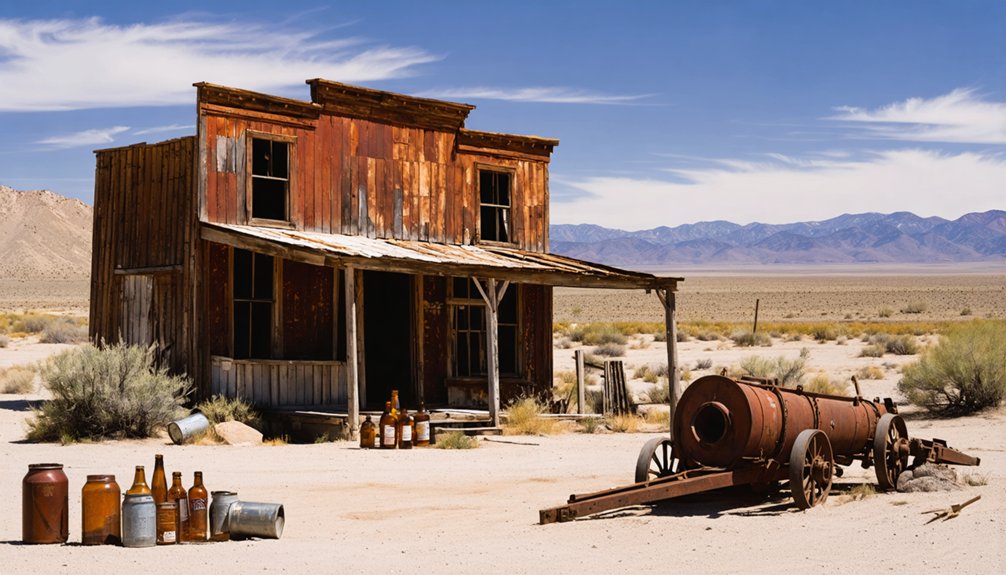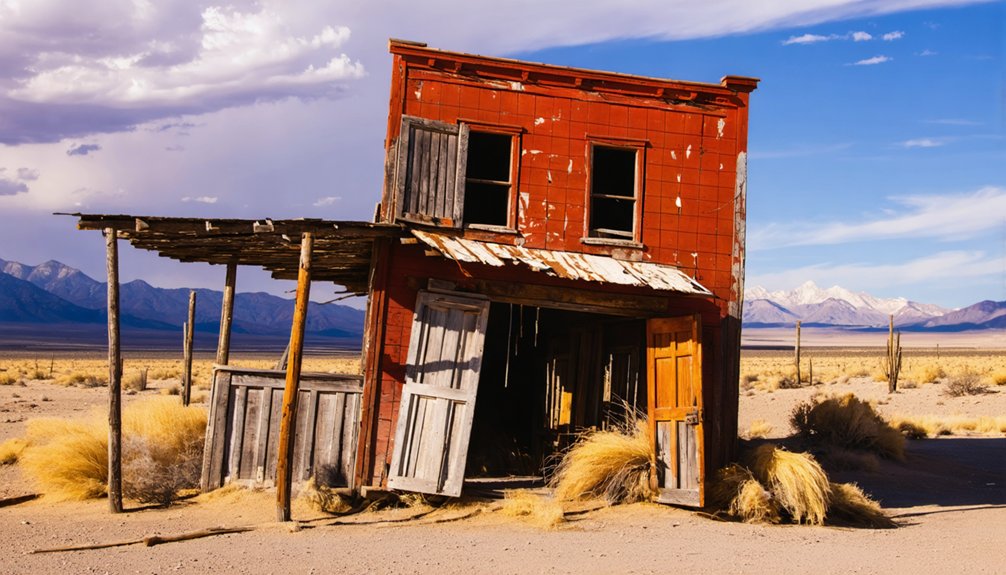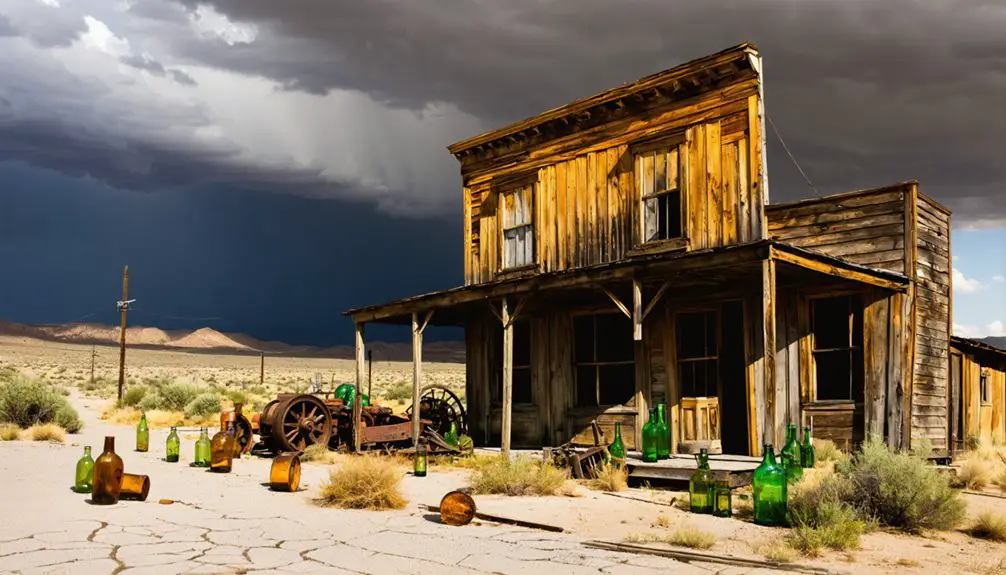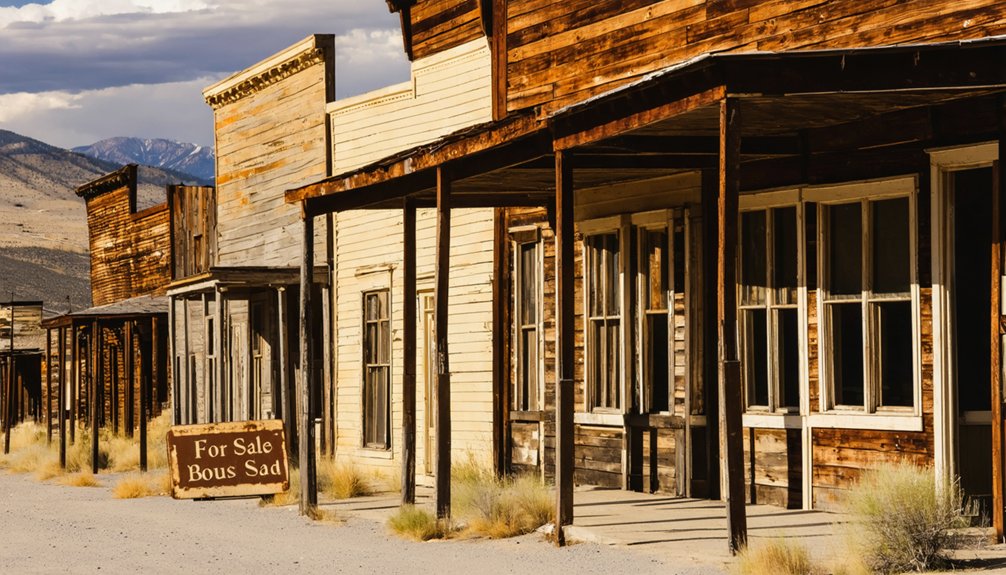
You’ll find over 600 ghost towns for sale across Nevada, with prices ranging from $99,000 for raw desert parcels to $3.9 million for complete mining infrastructure. Notable properties include Hard Luck Castle in Goldfield at $900,000—an 8,000-square-foot fortress with off-grid solar and wind systems—and Villa de la Mina’s 62-acre spread with 20 buildings. Esmeralda County’s sub-800 population exempts properties from mandatory building codes, creating unique development opportunities. The market’s currently buyer-favorable, with prices down 20% since early 2024 and what follows reveals critical investment considerations.
Key Takeaways
- Nevada has over 600 abandoned settlements with properties ranging from $30,000 parcels to $2.4 million estates currently available.
- Hard Luck Castle in Goldfield offers 40 acres with an 8,000-square-foot fortress for $900,000, featuring solar power and Airbnb income.
- Ghost town properties include Villa de la Mina with 62 acres and 20 buildings, priced between $99,000 and $3.9 million.
- Esmeralda County has no mandatory building codes due to population under 800, allowing design flexibility without standard inspections.
- Current market conditions favor buyers with 20% price decreases since early 2024 and vacancy rates at 22-26%.
Understanding Nevada’s Ghost Town Landscape and Market Opportunities
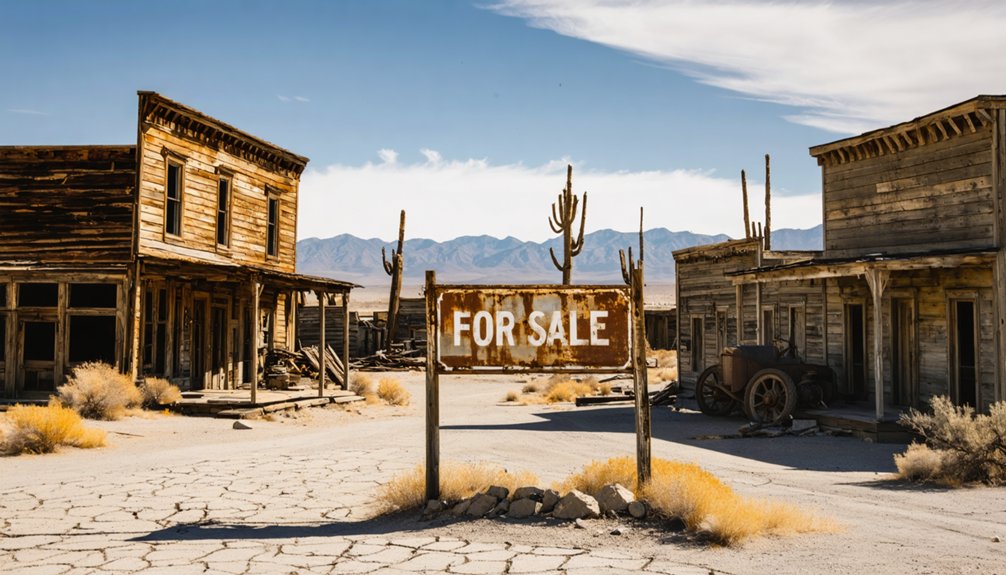
Nevada’s ghost town market presents something remarkable: over 600 abandoned settlements dot the state’s landscape, outnumbering its currently populated towns and creating unprecedented opportunities for investors, developers, and preservation-minded buyers.
Market trends reveal pricing extremes—from $30,000 parcels near Crystal to Virginia City’s $2.4 million estate.
You’ll find properties like Hard Luck Castle spanning 40 acres with dormant gold claims, or Villa de la Mina’s 62 acres and 20 buildings at $1.95 million.
Current conditions favor buyers. Towns like Tonopa and Pio show 22-26% vacancy rates—double urban markets—with prices dropping 20% since early 2024.
Even Carson City faces collapsing demand. These ghost towns offer tangible assets: operational mines, historic architecture, and massive acreage at discounted valuations. Henderson’s market demonstrates stark contrasts, where luxury neighborhoods remain stable while ghost town properties and mid-tier markets struggle with surging inventory and extended listing periods. Many Nevada ghost towns emerged from mining or railroad decline, creating abandoned settlements with existing infrastructure that can be repurposed by creative buyers.
exploring historical sites near Ely Nevada can reveal fascinating remnants of the state’s rich mining heritage. These areas hold stories waiting to be uncovered, and the potential for restoration projects is immense. Visitors and investors alike are drawn to the unique charm and history that these sites offer, making them a compelling addition to Nevada’s landscape.
Hard Luck Castle: A Modern Fortress in Goldfield’s Wilderness
Rising from the desert floor three hours north of Las Vegas, Hard Luck Castle defies conventional real estate categories—it’s an 8,000-square-foot, four-story fortress built atop a century-old gold mine and listed at $900,000.
An 8,000-square-foot fortress rising from Nevada’s mining past, where century-old gold mines become four-story desert sanctuaries.
This 16-inch thick cinder block structure sits on 40+ acres at 1 Bonnie Clair Road in Goldfield, where mining legacy meets modern off-grid living.
The castle history begins with the Hard Luck mine beneath its foundation, transforming abandoned mineral wealth into habitable space.
You’ll find complete energy independence through wind and solar systems, backed by a 3,000-gallon propane tank and 300-gallon water storage.
Currently operating as an Airbnb hosting 10+ guests, this property generates income while offering escape from conventional society—a functional investment in Nevada’s most unusual real estate frontier.
Architectural Features and Self-Sustainable Living Systems
Hard Luck Castle’s architectural design centers on a 3,000-square-foot structure built with reinforced concrete and steel, featuring tower elements that rise above the desert floor.
You’ll find the property operates completely off-grid through solar panel arrays generating electricity and a well system providing water access without municipal connections.
The castle’s self-sustainable infrastructure includes backup generators, water storage tanks, and septic systems that allow year-round occupation in Nevada’s remote terrain without external utility dependence.
The completed structure spans 8,000 square feet, incorporating multiple levels with a theater, game room, two kitchens, and four bedrooms designed for comfortable desert living.
The location sits along Highway 95, positioned between major Nevada cities in a region historically known for mining activity and remote desert settlements.
Castle Construction and Design
Since 2000, Randy has transformed 40 acres of isolated Nevada desert into an 8,000-square-foot architectural anomaly that defies conventional homebuilding expectations.
The nearly completed four-story structure rises from the former Hard Luck Mine and Emerson claim properties, featuring castle aesthetics that include a cylindrical central granite column and forest-green roofing crowned by an American flag.
You’ll find design inspiration drawn from unconventional sources—two grandiose pipe organs fill entire walls, while barking dogs greet visitors at the entrance.
The interior houses four bedrooms, two kitchens, plus a theater and game room.
No moat surrounds this desert fortress, which stands starkly against sagebrush and cinder cones.
The structure’s cylindrical granite tower echoes the architectural style of Stokes Castle, another Nevada landmark built from local stone in 1896.
Like Rhyolite’s concrete structures, this desert castle was built to create a lasting architectural presence that would endure beyond typical wooden construction.
It’s accessible via State Route 265 from Mina, complementing nearby mining ruins.
Off-Grid Power and Water
When you’re evaluating ghost town properties in Nevada’s remote expanses, understanding off-grid power and water systems becomes essential to determining actual livability and operating costs.
Solar installations dominate energy solutions here, backed by Nevada’s Renewable Energy Bill of Rights and abundant sunshine. You’ll need battery storage for nighttime power and proper permits before installation.
Water presents steeper challenges—acquiring rights proves complex and expensive, while rainwater harvesting remains limited to non-potable uses. Some municipalities mandate connection to public water if available, restricting your independence.
Towns like Belmont operate entirely off-grid, requiring residents to establish complete utility systems. No electric lines currently serve Belmont, a constraint that has persisted throughout its transition from mining hub to ghost town. Effective water conservation through greywater systems becomes critical in Nevada’s arid climate, directly impacting your property’s long-term sustainability and self-sufficiency potential. These properties often feature architectural styles from the mining era that reflect the construction techniques and materials available during Nevada’s boom periods.
Regulatory Advantages of Building in Esmeralda County
Esmeralda County’s population under 800 exempts it from Nevada’s mandatory building code requirements that apply to counties exceeding 100,000 residents.
You’ll find no standardized online permitting systems, hourly inspection fees, or PDF submission protocols that burden developers in urbanized counties like Douglas or Elko.
This regulatory vacuum creates case-by-case approval processes through direct official contact, eliminating the state-level plan reviews and inspections mandated under NAC 341.045 for government facilities.
No Building Code Restrictions
Unlike most of Nevada, Fish Lake Valley in Esmeralda County operates without enforced building codes—a regulatory vacuum that stems directly from the county’s population of under 800 residents.
Nevada’s NRS 278.581 mandates construction and energy codes only for counties exceeding 100,000 people, leaving Esmeralda entirely exempt.
You won’t find a building department here, nor will you navigate permit applications for private construction. This building flexibility translates to immediate advantages: design your structure without dimensional constraints, skip inspections, and bypass the bureaucratic delays plaguing regulated jurisdictions.
However, construction freedom doesn’t mean zero obligations. You’ll still need a septic permit regardless of building codes, and water rights enforcement remains strict near Chiatovich Creek.
Consider the 12-inch frost depth for foundations and implement radon mitigation through elevated floors, though no authority compels compliance.
Enhanced Development Freedom Opportunities
The regulatory vacuum extends beyond absent building codes to encompass zoning ordinances—Esmeralda County maintains no zoning regulations whatsoever.
You’ll face no predetermined land use categories restricting your property decisions. This absence eliminates typical development barriers found across Nevada’s urban counties.
Your development flexibility expands through NRS 278.0201, which permits customized state development agreements.
You can negotiate specific regulatory frameworks directly with the governing body, tailoring ordinances to your project rather than conforming to rigid municipal standards.
Without subdivision regulations, you’ll simplify property division processes considerably.
The county’s 2011 Master Plan confirms this minimal regulatory environment while outlining development direction.
However, environmental permitting remains mandatory.
Air emissions, wastewater discharge, and waste generation require compliance through Nevada’s Business Environmental Program—contact 775-485-6309 for assessment guidance before commencing operations.
Minimal Governmental Oversight Benefits
Operating within Esmeralda County’s administrative framework delivers distinct advantages stemming from limited bureaucratic infrastructure.
You’ll find fewer regulatory layers compared to Nevada’s urban counties, though specific zoning leniency varies by district. The county’s small administrative staff means permit processes follow straightforward procedures without extensive review committees.
Building applications typically encounter minimal delays, as the county lacks the multi-departmental approval chains found in larger jurisdictions. You won’t navigate complex design review boards or extensive environmental impact assessments for most projects.
This administrative simplicity reflects the county’s 873-person population and vast land area. The trade-off involves fewer county services and infrastructure support.
You’re fundamentally operating in a jurisdiction where governmental capacity remains intentionally minimal, creating opportunities for independent development decisions within Nevada’s baseline regulatory framework.
Comparable Ghost Town Properties Across the American West
Across the American West, ghost town properties command prices ranging from $99,000 for raw desert parcels to $3.9 million for extensive acreages with mining infrastructure.
You’ll find Texas offering Villa de la Mina’s fortress walls near Big Bend, while California’s Cerro Gordo delivers 24,000 square feet of 1860s Wild West history at $925,000.
Montana’s Garryowen connects you to Little Bighorn battlefield tourism, and Arizona’s Pearce provides move-in ready quarters at $1.1 million.
Ghost town investments span functional operations like New Mexico’s Gabriella—a film-ready replica with 24 buildings—to South Dakota’s Swett at $250,000.
Historical restoration opportunities exist in Utah’s 706-acre Woodside, complete with gold mines and Butch Cassidy lore.
These comparable properties demonstrate established market valuations for similar Western acquisitions.
Current Nevada Housing Market Conditions in Remote Areas
While Las Vegas metro properties command median prices of $375,000-$500,000 with steady 4-6% appreciation, remote Nevada markets face divergent trajectories shaped by water access, California migration patterns, and income-price disconnects.
Nevada housing in rural corridors shows projected declines through mid-2026:
- Fernley: 2.3% decrease as California influx slows
- Pahrump: 1.6-6% correction from affordability pressures
- Carson City: 1.4-4% drop amid rising inventory
These ghost town investment opportunities emerge from stalled migration equilibrium.
Remote work’s popularity initially drove demand, but federal land restrictions and water allocation concerns now constrain growth.
Inventory rises while demand softens, creating negotiation advantages for cash buyers seeking alternative properties beyond conventional markets.
You’ll find distressed pricing where income-price disconnects force corrections.
Investment Considerations for Off-Grid Historical Properties
Beyond conventional distressed properties, Nevada’s ghost towns present a distinct asset class where off-grid infrastructure directly impacts valuation models.
You’ll find investment strategies here differ sharply from traditional real estate—Hard Luck Castle’s independent power systems and self-sustainable design reduce operational dependencies that plague grid-connected properties.
Market trends show average pricing at $53,866 per acre across historic listings, with complete ghost towns ranging from $925,000 to smaller parcels at $4,995.
Your due diligence must account for restoration costs against 19th-century structures requiring significant maintenance across 24,000 square feet of buildings.
Remote locations—187 miles from Las Vegas, 325 miles from Reno—increase logistics expenses while potentially offering dormant mining claims with documented gold content.
Self-sustainability features ultimately reduce long-term costs while preserving exit strategies through tourism or resale value.
Frequently Asked Questions
What Financing Options Exist for Purchasing Ghost Town Properties in Nevada?
You’ll find seller-financed deals with 0% interest, hard money loans funding within 7-10 days, creative financing through private activity bonds, and investment partnerships pooling capital—like Cerro Gordo’s $1.4 million group purchase.
Are Property Taxes Lower for Ghost Towns Versus Traditional Nevada Real Estate?
You’ll pay lower absolute taxes on ghost town properties due to minimal property assessments, not special tax exemptions. Rural parcels average $54-$1,197 annually versus urban medians near $1,798, using identical rate structures.
How Do Water Rights Work for Off-Grid Properties in Nevada?
You’ll navigate Nevada’s water ownership through prior appropriation—first in time, first in right. Off-grid regulations permit domestic wells pumping 2 acre-feet annually without permits, covering household needs and livestock watering independently.
Can Ghost Town Properties Generate Income Through Tourism or Filming?
Yes, you’ll find tourism potential and filming opportunities exist. Nevada’s tourism industry generated nearly $100 billion in 2024, though ghost towns require marketing investment. Remote locations attract film productions seeking authentic western backdrops for revenue.
What Insurance Coverage Is Available for Historic Off-Grid Nevada Structures?
You’ll find specialized insurance policies through National Trust Insurance Services and Castle Rock Agency that cover off-grid historic structures, though you’ll need guaranteed replacement cost coverage using period-correct materials and robust fire protection systems for historic preservation compliance.
References
- https://www.10news.com/ghost-towns-sale-us/
- http://www.ghosttownforsale.com
- https://www.youtube.com/watch?v=uXBUCY3ZSyI
- https://www.realtor.com/news/reality-tv/hgtv-christmas-destination-ghost-town-nevada-virginia-city/
- https://www.youtube.com/watch?v=mEjb9dGwgtg
- https://travelnevada.com/ghost-town/
- https://www.outwestlandsales.com/properties-by-state/nevada/
- https://www.youtube.com/watch?v=7POcLW_rzyc
- https://www.youtube.com/watch?v=rwPiSlPRK0s
- https://newschannel20.com/news/offbeat/isolated-self-sufficient-fortress-in-nevada-desert-listed-for-900k