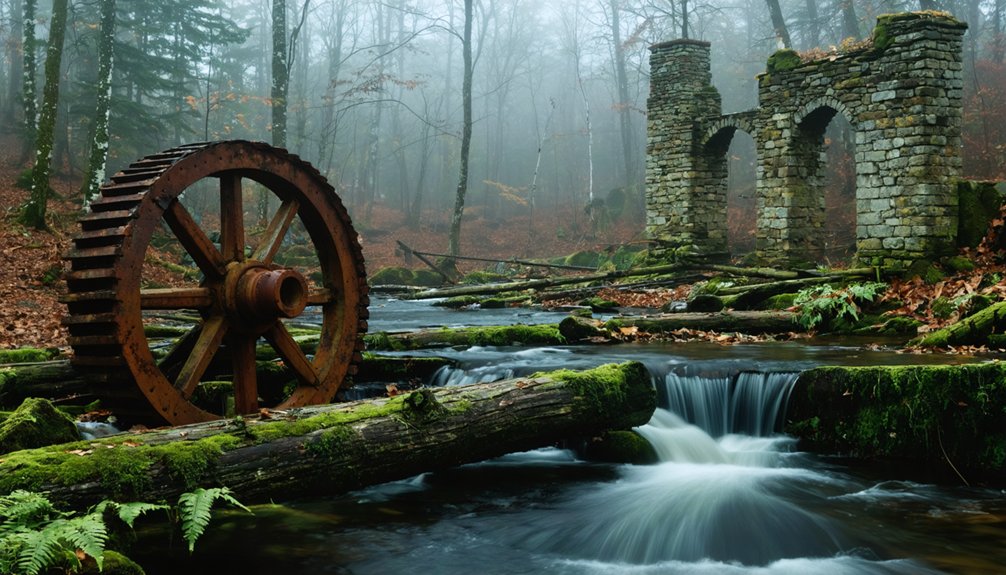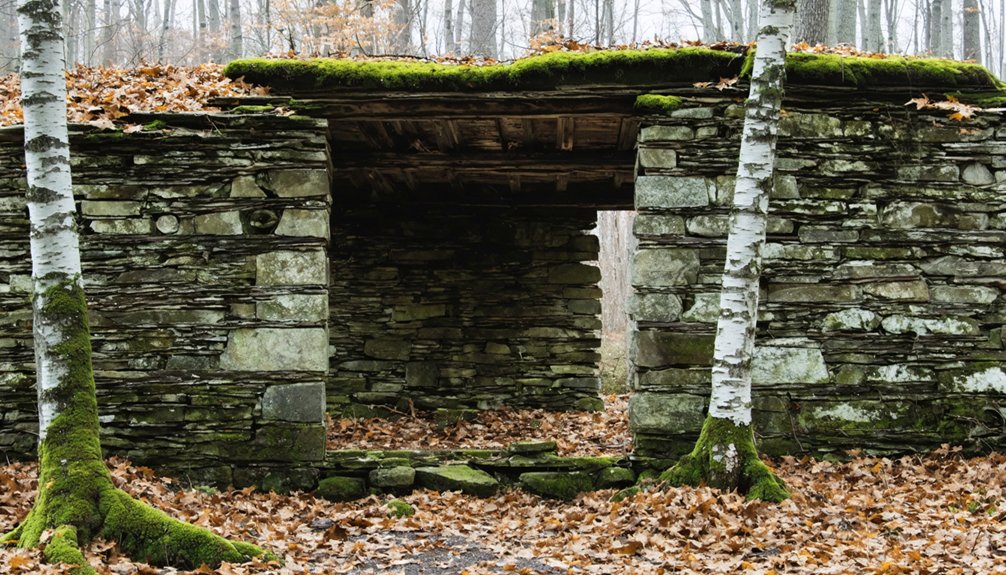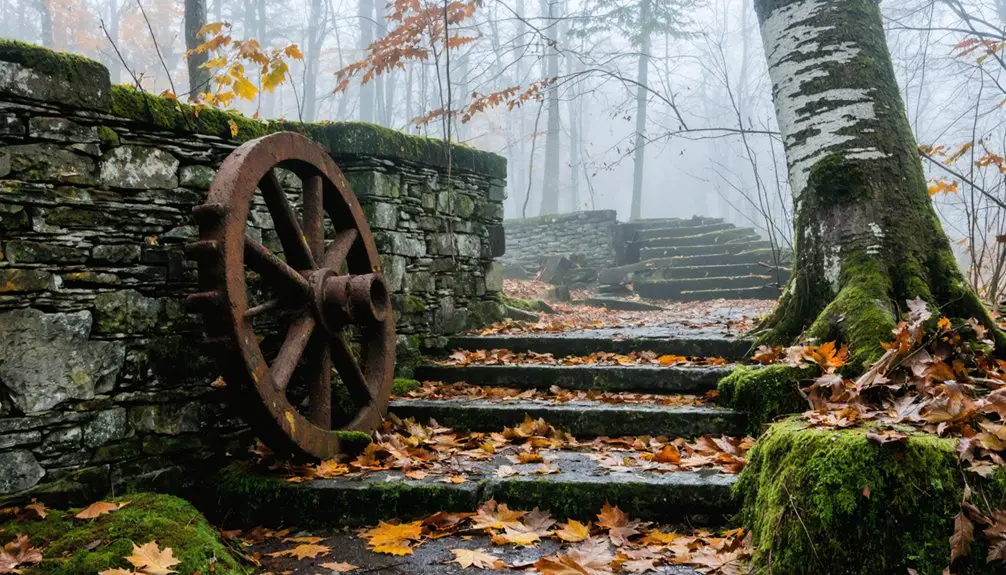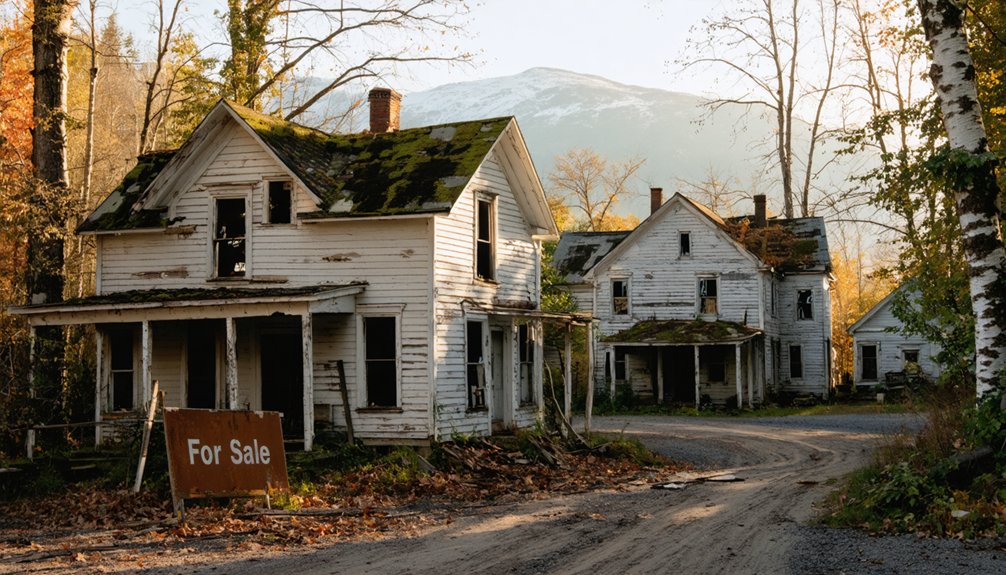
You won’t find complete ghost towns listed for sale in New Hampshire, but you can acquire distressed parcels in former logging communities like Livermore, where nearly 200 residents once lived. These remote properties start around $150,000 and feature remnants of old settlements—stone foundations, railroad grades, and cellar holes marking vanished communities. The state’s 600+ abandoned sites in the White Mountains region offer off-grid potential on forest-reclaimed land. Our analysis below reveals specific pricing, legal considerations, and investment opportunities in these historically significant wilderness areas.
Key Takeaways
- Distressed New Hampshire parcels average $1,133,780, with individual lots under $250,000 and remote per-acre costs reaching $45,909.
- Livermore ghost town features sawmill ruins, railroad remnants, and stone foundations available for historical restoration and development.
- Forest-encroached sites near Lincoln, Woodstock, and Mount Washington offer privacy with proximity to White Mountains recreation areas.
- Entry-level distressed properties start at $150,000, while complete ghost town assemblages can reach $6.6 million in value.
- Buyers must conduct extensive title searches, verify ownership, and ensure compliance with current zoning regulations and building codes.
The Rich History of Livermore Ghost Town
In 1876, the Saunders family—Harvard-educated Boston lawyers from Massachusetts—established Livermore as a logging town to support the booming timber industry in New Hampshire’s White Mountains. They invested $150,000 in mill development and named the settlement after New Hampshire senator Samuel Livermore, a family relation.
The Grafton County Lumber Company, incorporated in 1874, operated the sawmills that drove the community’s economy. By 1900, Livermore’s population peaked near 200 residents, with 18 residences, a school, post office, and blacksmith shop supporting daily life. The timber industry generated $44,000 in lumber sales that year alone.
However, a devastating 1920s flood destroyed the mill and railroad infrastructure. Operations ceased in 1928, and by 1930, only 23 residents remained. The state revoked Livermore’s charter in 1951. According to the 2020 census, Livermore is recognized as New Hampshire’s least populated town with just two residents. Today, the ghost town is easily accessible via Route 302 and Sawyer River Road, where visitors can explore overgrown masonry remnants scattered along both sides of the dirt road.
Vanished Lumbering Communities of the White Mountains
Livermore wasn’t alone in its rise and fall. The White Mountains harbor dozens of vanished settlements, each reflection of New Hampshire’s brutal lumbering history.
The White Mountains hold the bones of forgotten towns—each one a testament to timber’s boom-and-bust cycle.
You’ll find over 600 cellar holes scattered through the National Forest—evidence of communities that thrived, then disappeared when the timber ran out.
Key vanished communities worth your ghost town exploration:
- Thornton Gore – 1,100 cleared acres with mills, church, and school, abandoned post-Civil War
- Johnson Town – Produced 150 million board feet before a 1915 fire ended operations
- New Camp 22 – 1930s-40s logging camp, now just peavey heads and sled runners in birch clearings
- 600+ unidentified sites – Most remain undocumented, intentionally obscured to prevent vandalism
These weren’t purchased for preservation—lumber companies bought them at tax sales purely for trees, leaving buildings to rot.
The railroad expansion in the late 19th century transformed timber harvesting, replacing river transport and enabling the emergence of these remote lumbering communities.
Many settlers left these mill towns for homesteads in the West or traded uncertain logging wages for steady factory work in southern textile mills.
What Caused New Hampshire Towns to Disappear
New Hampshire’s ghost towns didn’t vanish for a single reason—they collapsed under converging forces that made survival impossible.
Meanwhile, ghost towns around Hawaii Volcanoes tell a different story, reflecting the impact of volcanic activity on settlements. These abandoned places serve as reminders of the power of nature and the fleeting nature of human habitation. Visitors often explore these remnants, captivated by the juxtaposition of lush landscapes and the scars of past eruptions.
Environmental factors struck first: flooding destroyed Hill’s center repeatedly between 1875 and 1941, while Monson’s harsh weather and poor soil crushed agricultural dreams before political greed blocked basic infrastructure. The October 1875 flood alone raised water levels thirty feet above the Pemigewasset River’s normal flow.
Economic decline followed predictably. Livermore’s sawmill exploded, then burned, then flooded—each disaster stripping away employment until only two residents remained by 1951.
Federal land seizures accelerated abandonment, with the government claiming Hill for Franklin Falls Dam and purchasing cutover timber lands across the White Mountains. Monson was abandoned by 1770 after just 30 years of settlement, with the land eventually divided between Hollis and Milford.
You’ll find these patterns repeated throughout New Hampshire’s abandoned settlements: natural disasters eliminated stability, economic collapse removed opportunity, and government intervention sealed their fate.
Exploring the Remnants of Abandoned Settlements
When exploring these ghost towns, you’ll encounter:
- Cellar holes and stone walls along overgrown trails at Monson Center’s 17,000-acre site
- Sawmill ruins and railroad bridge remnants scattered across Livermore’s landscape
- Foundation stones and tool debris marking Thornton Gore’s 22 former farms
- Cemetery markers and dam foundations throughout Zealand’s logged-over terrain
Monson Center’s preservation through 325 combined acres demonstrates how private ownership protects historical sites better than government management.
The Lost City of East Weare stands among New Hampshire’s documented abandoned settlements, offering another glimpse into the state’s forgotten communities.
Livermore once supported 160-200 lumberjacks and families before declining due to deforestation, floods, and fire that led to mill closures in 1928.
You’re free to hike these locations independently, connecting with authentic American pioneer history.
Off-Grid Properties Near Historic Ghost Town Sites
Beyond the preserved ruins of New Hampshire’s logging legacy, several remote townships offer off-grid property opportunities within miles of these historic abandonment sites.
Temple’s forested acreage and Fitzwilliam’s 1773-founded isolation provide access to ghost town legends while maintaining minimal infrastructure.
Hart’s Location in the White Mountains positions you near Zealand, Beebe River, and Carrigain’s vanished lumber communities, where abandoned architecture now surrenders to forest reclamation.
You’ll find 5-7 distressed properties statewide averaging $45,909-$72,174 per acre, concentrated near these historic zones.
Gorham’s proximity to logging remnants and Deering’s rural positioning near abandoned settlements deliver bank-owned parcels with substantial land.
Thornton Gore’s cellar holes and Pike’s whetstone works remain accessible from neighboring towns where run-down sites support your off-grid acquisition strategy near New Hampshire’s documented abandonment corridors. Livermore’s sawmill foundations, hidden in the White Mountains forest, mark the 1874 logging hub that declined before its 1951 disincorporation. Explorers discover stone walls and cemeteries marking former settlement boundaries throughout these forest-reclaimed ghost town sites.
Distressed Properties Available in Remote Locations
New Hampshire’s distressed property market concentrates five to seven available parcels across remote territories where ghost town histories intersect with current acquisition opportunities.
You’ll find bank-owned real estate and handyman specials averaging $1,317,686, though acreage costs reach $72,174 per acre in isolated locations.
These properties attract investors seeking property restoration projects with urban exploration potential:
Distressed New Hampshire parcels merge historical restoration potential with urban exploration opportunities for investors targeting unconventional property development.
- Stone foundations and abandoned infrastructure provide historical development frameworks
- Forest-encroached sites near settlements like Livermore offer privacy and isolation
- Debris-covered landscapes require significant clearing but maintain lower acquisition costs
- White Mountains positioning delivers proximity to Lincoln, Woodstock, and Mount Washington
You’re examining run-down properties where logging-era remnants meet modern investment strategies.
Remote positioning that caused original abandonment now appeals to freedom-seekers prioritizing seclusion over convenience.
Pricing and Investment Opportunities for Secluded Land
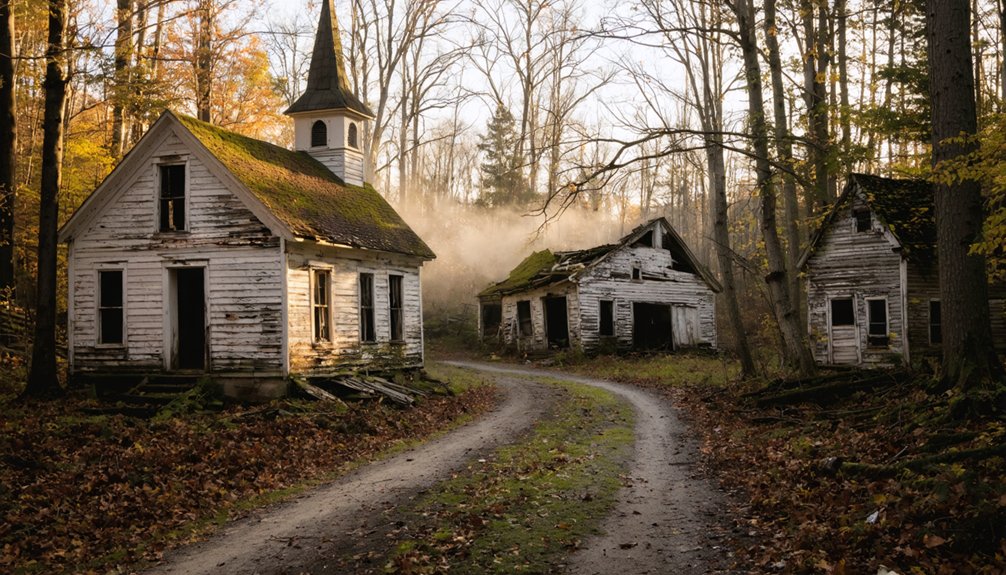
You’ll find distressed property listings in New Hampshire averaging $1,133,780, with per-acre costs reaching $45,909 for remote parcels.
Off-grid land values vary dramatically across the state, from 5.5-acre rustic plots to a 346-acre wilderness estate with mountain views.
The market presents stark contrasts—compare $355,312 median prices in Groton against $707,966 in Center Harbor, while Vermont’s bordering Northeast Kingdom offers 238-acre retreats at competitive rates.
Distressed Property Market Analysis
Distressed property pricing in New Hampshire’s secluded land market starts at $150,000 for entry-level parcels like the 5.46-acre lot at 639 Bog Road in Enfield, positioning the state’s rural offerings below the national ghost town average.
These distressed property trends reflect abandoned settlements where economic collapse—mill closures, devastating floods, population exodus—left physical remnants now consumed by forest regrowth.
You’ll find rural land opportunities shaped by these factors:
- Historic structures: Ruins of schools, stores, and sawmills from settlements like Livermore
- Natural reclamation: Stonewalls, cemeteries, and farm equipment overtaken by vegetation
- Market positioning: Individual lots priced considerably below $250,000-$6.6 million ghost town assemblages
- Revenue potential: Historical narratives and tourist-driven attractions create unconventional income streams
New Hampshire’s 917 land listings emphasize acreage over preserved buildings, contrasting Western ghost towns’ saloon-focused preservation.
Off-Grid Land Values
Off-grid properties in New Hampshire’s secluded markets average $337,874 across 16 active listings, translating to $7,047 per acre—a pricing structure that positions these disconnected parcels well above the state’s $150,000 distressed property entry point but below the $388,939 average for undeveloped land statewide.
Land valuation metrics reveal significant opportunity variance: you’ll find 82 lots under $50,000, including $29,999 parcels in Wakefield and $38,000 in Moultonborough.
Market trends demonstrate premium pricing for larger holdings—Barrington’s 36-acre tract commands $1,600,000, while Alexandria’s 39-acre retreat and a 346-acre mountain sanctuary target investors seeking complete autonomy.
Current use penalties apply when accessing properties via unmaintained Class VI roads, though recreational value remains high across Grafton, Carroll, and Coos counties where expansion potential through additional buildable lots enhances long-term investment returns.
Acreage Cost Comparisons
Current land valuations in New Hampshire’s secluded markets reveal stark pricing disparities tied directly to parcel size and location. Understanding acreage valuation methods helps you identify genuine opportunities versus inflated listings.
Price-per-acre analysis across NH’s remote properties:
- Danbury’s 233-acre tract costs just $2,725/acre—ideal for large-scale land investment strategies.
- Campton’s 58-acre parcel commands $9,482/acre despite similar seclusion.
- Alexandria listings average $7,340/acre for mid-sized parcels.
- Distressed properties range from $45,909 to $72,174/acre, often bank-owned.
These variations mirror historical patterns—19th-century investors acquired White Mountains land at pennies per acre through tax sales and abandoned farmland purchases.
Today’s market still rewards those who research thoroughly. Larger parcels consistently deliver lower per-acre costs, while smaller, accessible tracts carry premiums despite comparable isolation.
Historic Farmhouses and Antique Homes on the Market
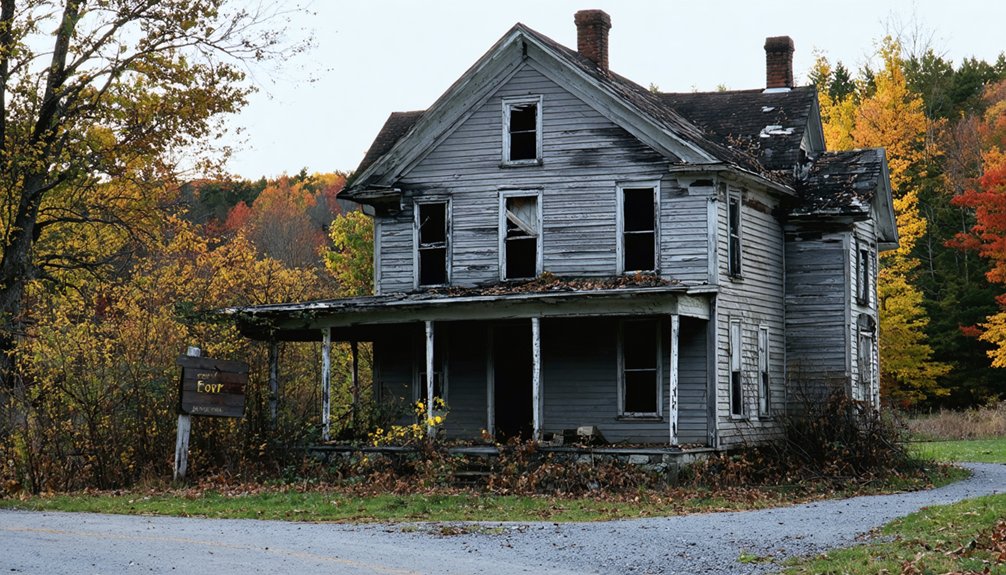
New Hampshire’s historic farmhouse market spans 290 active listings, with prices ranging from $427,529 entry-level properties in Laconia to the $9,850,000 Meredith waterfront estate.
You’ll find 1,107 vintage homes statewide, including properties from the 1700s featuring antique architecture like Cape Cods, Georgians, and Greek Revivals with original details intact.
The average farm listing costs $835,452, with land priced at $39,142 per acre.
Southern New Hampshire and the Lakes Region concentrate most inventory, while specialized brokers like CIRCA Old Houses and Tate & Foss Sotheby’s handle pre-1900 properties.
Historic renovations vary widely—from Hadley Hill Farm’s 1794 Colonial on 270 acres at $3,950,000 to modest stone farmhouses.
These properties typically offer 3-5 bedrooms across 1,914-4,854 square feet, blending period features with modern functionality.
Legal Considerations for Purchasing Abandoned Property
Before you purchase abandoned property in New Hampshire, you’ll need to conduct an extensive title search to verify ownership and identify liens, particularly since escheatment laws require holders to remit unclaimed property to the state after dormancy periods.
You must also examine adverse possession claims, as squatters may have acquired legal rights to properties left vacant for extended periods.
Your purchase further requires verification that the property complies with current zoning regulations and building codes, as abandoned structures often face demolition orders or mandatory renovation requirements.
Title Search Requirements
Three critical statutes define title search requirements when you’re investigating abandoned property in New Hampshire, with RSA 471-C serving as the primary framework for intangible assets presumed abandoned after five years of inactivity.
Your title search must verify property ownership through multiple channels:
- State Treasury Database: Search unclaimed property records for dormant accounts, uncashed checks, and insurance proceeds.
- County Registry: Examine deeds and liens at the local registry for tangible real estate claims.
- DMV Documentation: For vehicles, verify ownership through RSA 261:10 bonded title procedures requiring surety bonds at 1.5 times value.
- Holder Records: Review last known addresses and transaction dates from financial institutions or insurance companies.
You’ll need to consult beyond RSA 471-C since certain property types have specific statutes governing abandonment classifications and recovery procedures.
Adverse Possession Laws
Understanding property ownership records becomes particularly important when abandoned properties may have unclear chain of title due to adverse possession claims.
In New Hampshire, someone occupying land continuously for 20 years without permission can claim ownership rights under RSA 508:2. You’ll need to verify no squatters have met the strict requirements: hostile use, open occupation, continuous possession, and exclusive control throughout the entire period.
The burden falls on adverse possession claimants to prove their case, and courts scrutinize such claims carefully. You can protect your interests by conducting thorough title searches revealing any potential claims.
If you discover unauthorized occupants, file trespass actions immediately—waiting risks losing ownership rights. Government properties remain exempt from these laws, providing additional security for certain abandoned municipal holdings.
Zoning and Building Codes
When you’re evaluating abandoned properties in New Hampshire, zoning regulations and building codes can make or break your investment—particularly because many ghost town structures predate current ordinances.
Older buildings often qualify for nonconforming use protection, shielding you from retrospective zoning changes. However, understanding the limitations is critical:
- Abandonment triggers loss of status if properties remain unused beyond specified time periods set by local ordinances.
- Structural modifications require strict compliance—you’ll need building permits for foundation work exceeding 24-inch sill height increases.
- Destroyed buildings must be rebuilt within one year to retain nonconforming protection.
- Use changes demand special exceptions from the Zoning Board of Adjustment.
Without nonconforming lot protection, you can’t obtain building permits or sell individual parcels, making due diligence essential before purchase.
Living Off the Grid in New Hampshire’s Wilderness
New Hampshire’s vast wilderness areas present compelling opportunities for off-grid living, though the state’s rapid forest loss complicates long-term planning.
You’ll find over 100,000 acres of protected forever-wild land across the state, with forests covering four-fifths of New Hampshire’s territory. However, annual forest loss exceeds 13,000 acres due to development pressure.
The state ranks 28th nationally for off-grid feasibility, scoring 50.99 out of 100. You’ll benefit from encouraged legal status and moderate regulations supporting sustainable living.
Western and central regions offer ideal isolation, while biomass resources support wilderness survival—wood heats one in sixteen households, nearly five times the national average.
With 18% renewable electricity generation and extensive conservation areas adjacent to the Appalachian Trail, you’ll discover viable options for self-sufficient living.
Frequently Asked Questions
Can You Actually Buy an Entire Ghost Town in New Hampshire?
You can’t currently find entire ghost town ownership opportunities in New Hampshire. While distressed properties and off-grid retreats exist, complete abandoned settlements aren’t available. Historical preservation efforts mean former lumbering towns like Livermore have vanished entirely.
Are There Mineral Rights or Water Rights Issues With Ghost Town Property?
Buyer beware: you’ll face mineral ownership complications from century-old mining claims and potential water access restrictions near contaminated Superfund sites. New Hampshire’s ghost town properties carry historical legal baggage requiring thorough title searches before purchase.
What Utilities Are Available in Former Ghost Town Locations?
You’ll find virtually no utility infrastructure in ghost town cores due to their historical significance as abandoned settlements. Livermore residents use individual hookups, while Savage has limited public water connections from Superfund remediation.
Do Ghost Town Properties Require Special Insurance or Liability Coverage?
You’ll hit a brick wall with standard homeowners policies since ghost town properties trigger vacancy clauses after 30-60 days. You’ll need specialized ghost town insurance with mandatory liability coverage, regular inspections, and security measures to protect against elevated risks.
How Do Property Taxes Work for Abandoned Town Parcels?
You’ll face assessment based on property valuation even for abandoned parcels, with 18% annual interest compounding on unpaid taxes. Tax exemptions rarely apply to delinquent properties, and municipalities can seize ownership after redemption periods expire.
References
- https://wokq.com/ghost-town-of-livermore-new-hampshires-smallest-town/
- https://www.nhfinehomes.com/off-grid-homes-for-sale-new-hampshire/
- https://www.zillow.com/nh/farm_att/
- https://vanessastonere.com/upper-valley-nh-historic-homes-for-sale/
- https://www.landsearch.com/distressed/new-hampshire
- https://www.oldhousedreams.com/state/new-hampshire/
- https://www.suebradley.com/properties-by-type/lakes-region-antique-homes/
- https://www.whitemountainhistory.org/abandoned-towns
- https://www.oddthingsiveseen.com/2015/09/die-and-less-ghost-town-of-livermore.html
- https://www.whitemountainhistory.org/abandoned-towns/livermore