You won’t find traditional ghost towns for sale in Ohio like Western properties, but you’ll discover entire neighborhoods functioning as modern equivalents—with three-bedroom historic homes available under $50,000 in high-vacancy ZIP codes. Cleveland’s 44108 reports 16% vacancy rates, while Toledo’s 43604 offers properties at $50,400 median values amid 15.7% vacancy. Mahoning County’s Land Bank provides acquisition pathways through sheriff sales and deed-in-escrow programs, with up to $28,000 in down payment assistance available. The sections below explain specific ZIP codes, pricing structures, and purchase mechanisms for these distressed communities.
Key Takeaways
- Ohio has abandoned mining communities like San Toy, deserted since 1931, though actual ghost towns for sale are rare in the state.
- Toledo’s 43604 ZIP code has 15.7% vacancy and $50,400 median home values, offering distressed property investment opportunities instead of ghost towns.
- Cleveland’s Glenville neighborhood shows 16% vacancy rates, with historic homes under $50,000 available for renovation rather than complete ghost towns.
- Mahoning County’s Land Bank offers distressed properties through foreclosure sales and rehabilitation programs, not traditional ghost town purchases like western states.
- Historic Ohio homes from the 1920s provide genuine preservation opportunities at lower costs than western ghost towns like Swett, South Dakota.
Understanding Ohio’s Abandoned Mining Communities
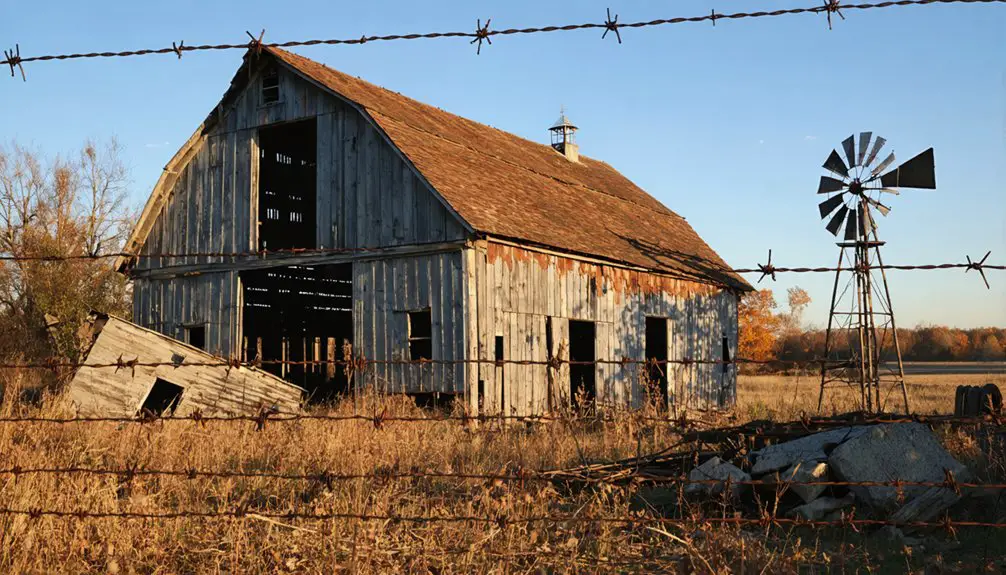
Between 1850 and 1950, Ohio’s coal mining industry transformed rural landscapes into bustling industrial centers before abandoning them just as quickly.
You’ll find communities like San Toy, once home to nearly 1,000 residents, completely abandoned by 1931 after mine closures. Mining companies extracted over 3.6 billion tons of coal, then departed immediately—pulling up railroad tracks and leaving no economic alternatives.
The early regulatory vacuum meant no reclamation laws existed until 1947, leaving hundreds of thousands of acres scarred.
Today, these ghost towns represent unique opportunities for community revitalization. In Tablertown, approximately $1 million in state and federal funding has been secured to reclaim a former mine site. You can explore mining heritage sites featuring preserved architecture, like Haydenville’s 1852 brick homes on the National Register. Haydenville Mining and Manufacturing Company entirely owned this last company-owned town established in 1852.
However, contaminated groundwater, unstable land, and hazardous mine features require careful assessment before investment.
High-Vacancy Urban ZIP Codes as Modern Ghost Towns
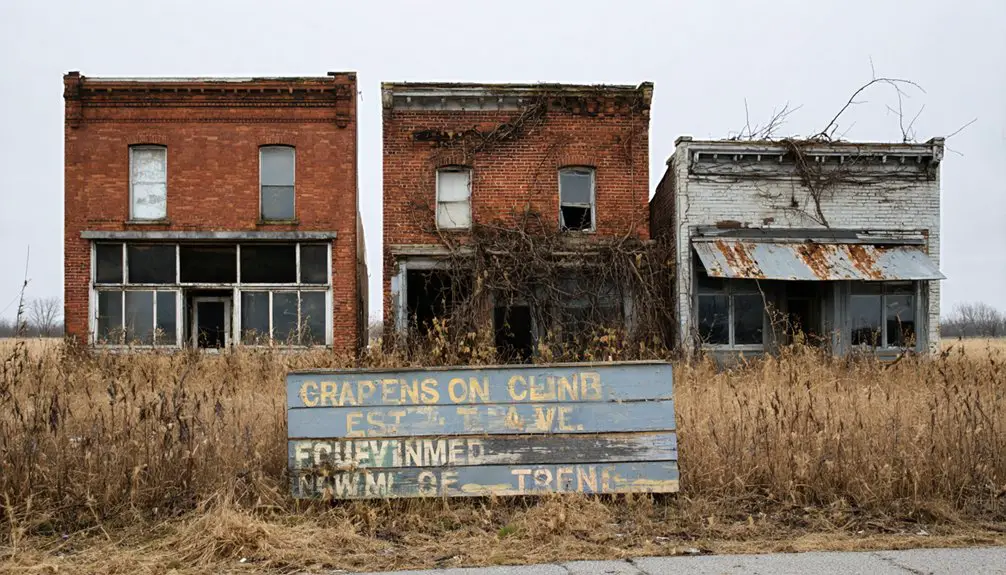
While Ohio’s 19th-century mining towns emptied overnight, today’s urban ghost towns drain gradually through market forces that leave neighborhoods dotted with vacant properties.
Dayton leads U.S. metros with a 5% home vacancy rate, representing a 4% surge from pre-pandemic levels despite home prices jumping from $158,000 to $236,000. These abandoned neighborhoods reveal urban decay through mismatched inventory and falling buyer demand.
Dayton’s 5% vacancy surge defies a $78,000 price increase, exposing fundamental disconnects between housing supply and actual market demand.
Statewide rental vacancies hit 5.8% in 2024, with nearly 80,000 empty units.
Multifamily properties show similar patterns: Toledo and Columbus metros reached 7.3% vacancy while Dayton-Kettering posted 6.4%.
Central Ohio lost over 62,000 affordable units since 2019, creating a 202,000-unit shortage. The rental vacancy rate improved to 7.2% by the end of 2024, suggesting a potentially less competitive market.
You’ll find investment opportunities where high vacancy meets strong fundamentals—Dayton’s healthcare sector, Canton-Massillon’s 10.7% cap rates, and Cleveland’s persistent renter demand. The state’s median gross rent of $870 per month remains 10% higher than a decade ago, signaling sustained rental income potential even in high-vacancy markets.
Toledo’s 43604: Affordable Properties in Decline
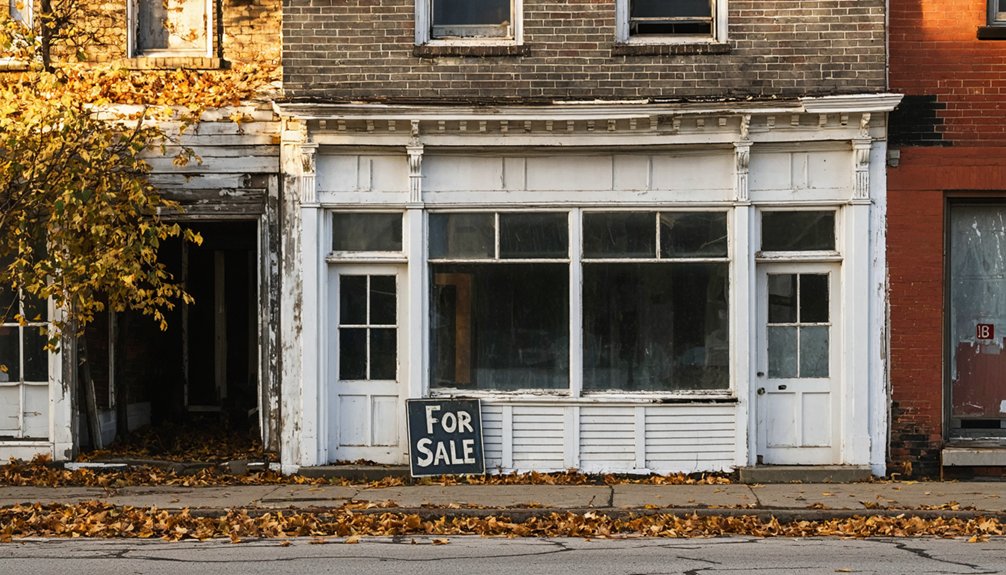
Toledo’s 43604 ZIP code presents a stark example of urban decline, with 199 vacant homes comprising 15.7% of total housing stock in Q4 2023.
The median home value of $50,400 sits 72.5% below Ohio’s statewide median of $183,300, creating potential entry points for investors willing to navigate a distressed market.
This combination of high vacancy rates and severely depressed property values reflects a population that’s dropped 8.9% over the past decade, signaling both risk and opportunity in Toledo’s downtown core.
The area’s struggles mirror trends across the Midwest and Rust Belt, where economically depressed areas account for the majority of ZIP codes with the highest vacancy rates in the nation.
Despite these challenges, Toledo maintains a professional hockey presence with the Toledo Walleye ECHL team, offering residents and visitors entertainment options even amid economic decline.
High Vacancy Rate Analysis
The 43604 zip code in Toledo presents a cautionary tale for property investors, with its vacancy rate standing 4.8 points above the national average despite an affordability index of 1.
You’re facing a market where affordability doesn’t guarantee demand—a critical insight for economic implications assessment.
Consider these vacancy trends shaping the landscape:
- Citywide vacancy reached 30.2% in 2025, far exceeding the national 20.9%
- Population projected to decline 3% by 2030, dropping to 9,108 residents from 9,386 in 2020
- Excess inventory of 176 units anticipated by 2030, despite falling demand
- Average household income sits at $32,856, limiting purchasing power
While Toledo’s rental vacancy improved from 11.3% to 6.0% since 2010, the 43604 area’s fundamentals remain challenged by demographic contraction and economic constraints.
The population forecast shows a brief uptick to 9,595 by 2025, representing a 2.2% increase, before the anticipated decline materializes by decade’s end.
Toledo’s broader apartment market shows vacancy at 4% in H1 2024, yet the Central Business District and student housing segments struggle with rates exceeding 6%.
Median Home Value Drop
Despite Toledo’s citywide median home values rising 5.3% annually to $126,352, the 43604 zip code tells a starkly different story with average home values plummeting 5.4% over the past year to just $61,221.
You’ll find this decline creates unusual market fluctuations when compared to the October 2025 median sale price of $272,000 in the same area, revealing significant volatility in individual transactions.
The home value trends show you can access properties here at less than half the citywide median, though this affordability comes with risk.
Recent month-over-month price drops of 6.25% signal continued downward pressure.
With 38.3% of listings experiencing price reductions and inventory surging 46% year-over-year, sellers face mounting challenges in this declining market segment.
Properties are moving quickly despite the price declines, with homes averaging just 34 days on market, suggesting buyers are capitalizing on the discounted opportunities.
This pattern contrasts sharply with Toledo’s overall projection of 4% home price increases by 2026, highlighting the disconnect between this struggling zip code and the broader market’s strength.
Investment Opportunities Available
While Toledo grapples with population decline and aging housing stock, you’ll find the 43604 zip code presents a complex investment landscape where rock-bottom prices intersect with significant risk factors.
Investment trends reveal median prices around $140,000—substantially below the national $441,000 average—but investor performance here contradicts typical market behavior.
Your purchase decisions should account for:
- Lower permit activity: Investors pull building permits at reduced rates compared to owner-occupants
- Absentee ownership issues: Over 25% of properties owned by out-of-state investors correlate with higher eviction rates
- Maintenance challenges: Aging housing stock requires substantial capital investment
- Community revitalization initiatives: HUD-approved NRSAs targeting Old South End, Englewood, and Junction neighborhoods
You’ll need thorough due diligence balancing acquisition costs against renovation requirements and neighborhood stability concerns.
Dayton’s 45402: Foreclosure Opportunities Abound
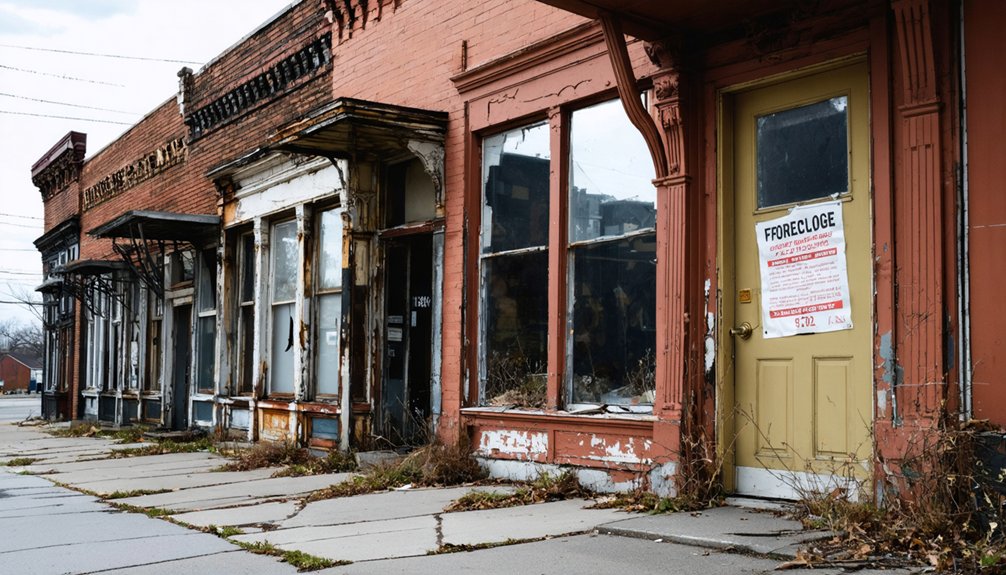
Foreclosure filings in Dayton’s 45402 zip code reached alarming concentrations in 2020, with one filing recorded for every 264 housing units—the fourth-highest rate nationally that July.
You’ll find median foreclosure prices around $74,641 in this area, offering significant value compared to Dayton’s overall median of $179,000. These foreclosure trends create clear entry points for investors seeking distressed properties.
Foreclosure properties in Dayton offer investors substantial discounts, with median prices nearly 60% below the city’s overall market average.
Ohio’s statewide foreclosure rate stands at one in every 3,079 housing units as of October 2025, with 1,842 total foreclosed homes available.
Multiple acquisition pathways exist through platforms like Zillow, Redfin, and specialized foreclosure bidding sites. Montgomery County’s clerk maintains daily mortgage foreclosure reports, enabling you to track new filings.
Smart investment strategies focus on economically stressed neighborhoods where properties range from $34,000 to $268,000.
Cleveland’s 44108: Highest Vacancy Rates in the State
Cleveland’s Glenville neighborhood in ZIP code 44108 stands as Ohio’s most vacant residential area, with nearly 16% of its housing stock sitting unoccupied—more than three times the state average.
This Housing Crisis stems from discriminatory lending practices that’ve blocked African American homeowners from accessing mortgages and improvement loans, forcing property walkaways.
The vacancy landscape reveals stark disparities:
- 44108 Glenville: 16% vacancy leading the state
- 44112 East Cleveland: 15.3% vacancy rate
- 44127: 14% unoccupied properties
- 44105 Garfield Heights: 13% vacancy
You’ll find opportunities here where Cuyahoga County’s 4,500-resident population drop created abandoned structures.
Yet without new developments or accessible financing, any Glenville Revival remains stalled despite rock-bottom acquisition costs.
Mahoning County Land Bank Acquisition Programs
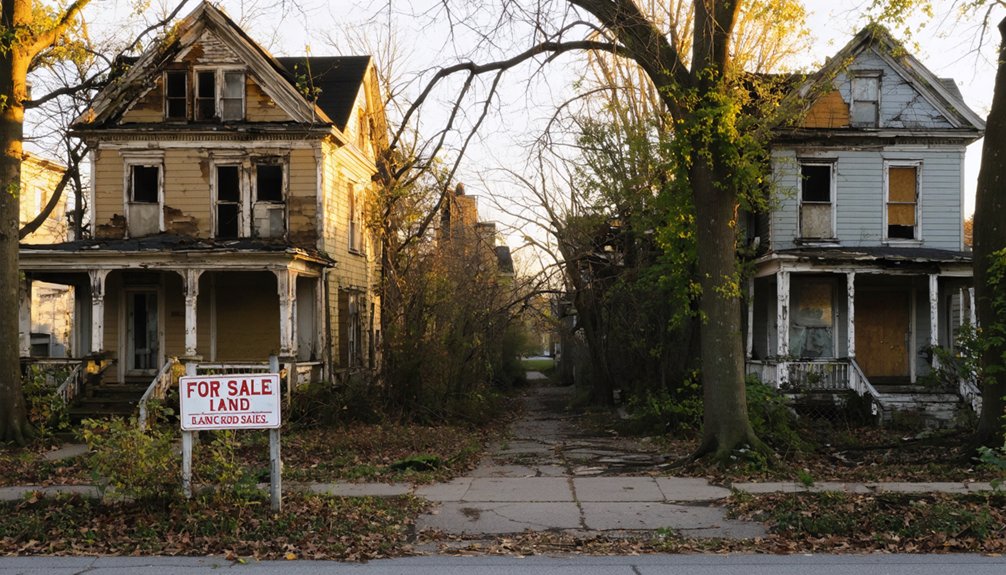
Since 2014, Mahoning County’s Land Bank has transformed Youngstown’s distressed property landscape through strategic acquisition of tax-delinquent and abandoned homes, securing over $14 million in demolition grants and $7.4 million in new construction funding.
You can access properties through three channels: sheriff tax foreclosure sales, county auditor forfeited land sales, and gift-in-lieu-of foreclosure donations.
The land bank strategies prioritize unmarketable and distressed properties in shifting areas.
The Deed-in-Escrow Program lets you purchase properties at modest prices for property rehabilitation. If you’re an owner-occupant or investor, you’ll need the purchase price plus $5,000 or the auditor’s land value.
Qualified buyers earning 80 percent or below area median income can secure up to $28,000 in down payment assistance through combined programs.
How to Buy Vacant Properties Through Side Lot Programs
Expanding your property footprint in Ohio becomes remarkably affordable through side lot programs that let adjacent homeowners acquire vacant parcels for as little as $1.
Ohio’s side lot programs transform vacant parcels into property expansion opportunities for neighboring homeowners at unprecedented low costs.
You’ll need to own and occupy adjacent property, maintain current property tax status, and share a common boundary of at least 50-75% with the vacant lot.
Side lot benefits include:
- Purchase prices from $1 (Shaker Heights) to $150 (Lucas County)
- Converting tax-delinquent parcels into productive property
- Expanding yards or building garages without restrictive HOA oversight
- Immediate property value increases while returning lots to tax rolls
Submit your application first-come, first-served with building plans.
You’ll consolidate parcels through surveying ($1,000-$3,000) and face five-year resale restrictions.
Property tax implications shift from delinquent status to active contribution.
Comparing Ohio Ghost Town Prices to National Sales

When you compare Ohio’s vacant property market to national ghost town sales, you’ll find stark differences in pricing structures and what’s actually available.
National ghost towns like Swett, South Dakota ($250,000 for 6 acres) or Villa de Serafina, New Mexico ($1.95 million for 62 acres with 20 buildings) offer complete settlements with existing infrastructure, while Ohio’s market centers on unrestricted land parcels averaging $11,128 to $13,508 per acre without developed townscapes.
Understanding these price-per-acre benchmarks and property configurations helps you evaluate whether Ohio’s fragmented vacant lots or out-of-state turnkey ghost towns align better with your investment goals.
National Ghost Town Benchmarks
Ghost town prices across the United States vary dramatically based on location, size, and commercial potential, providing essential context for evaluating Ohio’s market.
Understanding these national benchmarks reveals how ghost town history and economic impacts shape valuations:
- Prairie properties like Swett, South Dakota dropped from $399,000 to $250,000, representing entry-level pricing for abandoned settlements.
- California coastal towns such as Bridgeville commanded $1.25 million in 2006, though values fluctuated post-sale.
- Southwestern destinations including Villa de Serafina’s 62 acres listed at $1.95 million before settling at $1.2 million.
- Revenue-generating villages like Story, Indiana reached $3.8 million based on operational hotel and event income.
These benchmarks demonstrate that functional infrastructure and income potential greatly outweigh nostalgic appeal in determining market value.
Ohio’s Vacant Property Values
Unlike the national ghost town market where entire settlements command six-figure premiums, Ohio’s closest equivalents exist as scattered vacant properties in high-vacancy municipalities rather than packaged communities for sale.
You’ll find typical home values in areas like Fairfield hovering around $94,900, with specialized listings offering old houses under $50,000. These vacant property trends reflect Ohio’s 2025 housing slowdown, characterized by price cuts and surging inventory in blue-collar hubs and suburbs.
The investment potential differs markedly from national benchmarks. While South Dakota’s Swett lists at $250,000 for six acres with a tavern, you’re accessing individual Ohio properties at fractions of that cost.
However, monthly carrying costs from mortgages, taxes, and utilities continue depressing values. Ohio’s southeastern coal towns remain dormant without active tourism infrastructure that drives national ghost town sales.
Price Per Acre Analysis
Actual ghost town transactions reveal stark per-acre pricing tiers that expose Ohio’s absence from this niche market.
Ghost town pricing varies dramatically based on development potential and tourist appeal. National sales establish clear property valuation benchmarks you won’t find in Ohio’s listings:
- Basic Prairie Towns: Swett, South Dakota’s 6 acres commanded $41,667 per acre with minimal infrastructure.
- Mining Operations: Villa de Serafina’s 62 acres sold at $31,452 per acre despite extensive buildings and mineral rights.
- Revenue-Generating Venues: Story, Indiana’s 17-acre hotel village reached $223,529 per acre through commercial viability.
- eBay Experiments: Bridgeville, California’s $1.25 million sale demonstrated online marketability for unconventional properties.
These transactions prove a legitimate market exists nationwide, yet Ohio contributes zero comparable sales data to these established pricing patterns.
Historic Homes Under $50K Worth Preserving
While Ohio’s ghost town properties often command higher prices, the state’s real estate market still features genuine historic homes priced under $50,000 that offer preservation opportunities.
You’ll find circa 1922 three-bedroom handyman specials listed under $52,000 and circa 1912 three-bedroom homes available below the $50,000 threshold. These properties represent authentic historic preservation projects without the premium pricing of established ghost town sites.
Historic homes from the early 1900s offer authentic preservation opportunities at accessible price points below typical ghost town premiums.
The market includes 51 distressed properties statewide, averaging $247,380, though individual listings fall well below this median.
Bank-owned real estate and neglected homes with land provide entry points for affordable renovations. Time capsule homes from the 1920s era, brick Italianates, and foursquares offer character-filled spaces worth restoring.
You’re getting architectural details and timeless charm at prices that enable hands-on restoration work.
Frequently Asked Questions
What Are the Legal Requirements for Buying Abandoned Property in Ohio?
You’ll need court findings confirming abandonment through two qualifying conditions before pursuing property ownership. Essential legal documentation includes registration filings, ownership verification, point-of-sale inspections, and payment of outstanding fees totaling $5,000-$15,000 depending on building size.
Do Ohio Ghost Town Properties Come With Mineral or Water Rights?
You’ll need to verify each property’s title individually. Water rights typically transfer with surface ownership, but mineral rights are often severed in older Ohio properties and require separate investigation through title searches.
Can Foreigners Purchase Vacant or Abandoned Properties in Ohio?
Maneuvering Ohio’s property regulations isn’t quite walking through a minefield—yet. You’ll face foreign ownership restrictions if you’re from adversarial nations or buying near critical infrastructure, though nonresidents purchasing under $100,000 generally can proceed freely.
What Insurance Options Exist for Properties in High-Vacancy Neighborhoods?
You’ll find vacant property insurance specifically designed for high-vacancy neighborhoods, though it’s 50-60% costlier than standard policies. High risk coverage addresses vandalism and theft concerns, with premiums reduced through security systems and regular inspections.
Are There Tax Incentives for Rehabilitating Abandoned Homes in Ohio?
You’ll find multiple tax incentives for rehabilitating abandoned Ohio homes, including the Historic Preservation Tax Credit offering 25% back on qualified expenses, Welcome Home Ohio property grants up to $100,000, and local tax deductions through abatement programs.
References
- https://www.10news.com/ghost-towns-sale-us/
- https://247wallst.com/housing/2024/04/11/americas-modern-ghost-towns-2/
- https://wrkr.com/ohio-ghost-towns/
- https://www.aol.com/articles/10-ghost-towns-us-actually-200604529.html
- https://www.ezhomesearch.com/blog/towns-for-sale-in-the-usa/
- https://www.youtube.com/watch?v=-DWy3xcpqj8
- https://oldhousesunder50k.com
- https://mahoninglandbank.com
- https://www.realtor.com/news/unique-homes/5-for-friday-the-13th-ghost-towns-for-sale/
- https://www.ohio.edu/news/2025/11/tablertown-reclaims-its-name-how-voinovich-school-partnering-invigorate-abandoned