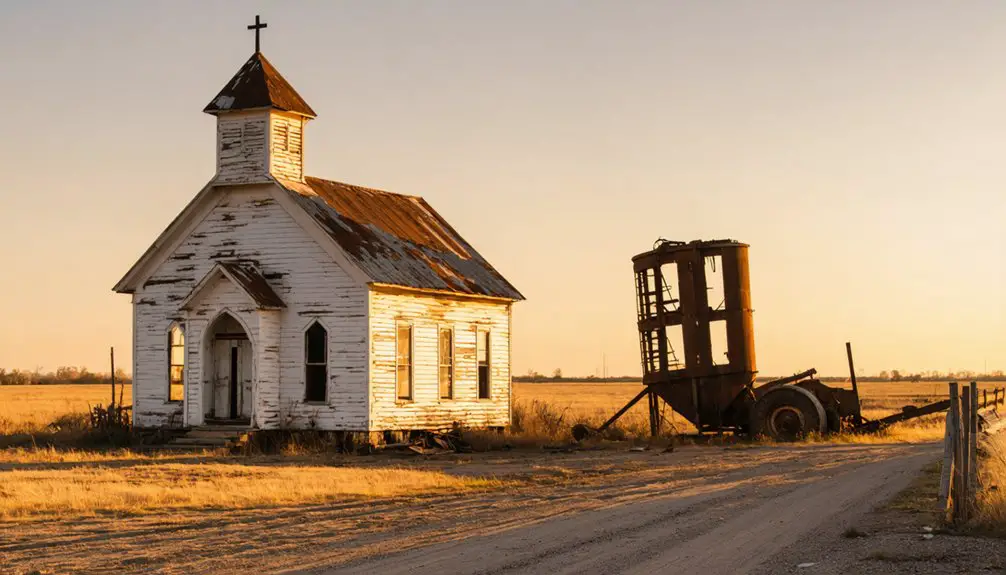
You’ll find Oklahoma’s ghost town real estate market offers limited opportunities, with individual properties ranging from $6,000 for southeastern coalfield parcels to $315,000 for metro-adjacent abandoned estates. Complete town purchases remain largely unavailable due to environmental contamination—particularly in former mining communities like Picher, designated an EPA Superfund site—scattered private ownership, and complex legal frameworks requiring adverse possession claims or quiet title proceedings. The state’s documented ghost towns face preservation challenges from structural instability and decades of industrial damage that continue shaping available inventory.
Key Takeaways
- Complete ghost towns rarely appear on the market; individual properties in abandoned areas are more commonly available for purchase.
- Entry-level ghost town land starts around $6,000 in southeastern Oklahoma, with Panhandle properties averaging $165,000.
- Ownership can be claimed through adverse possession (15 years), Fence Law (5 years), quiet title lawsuits, or Title 42 proceedings.
- Environmental contamination and structural hazards make some ghost towns like Picher legally uninhabitable despite potential availability.
- Preservation challenges include private ownership barriers, subsidence risks, and lack of infrastructure in historically significant abandoned communities.
Understanding Oklahoma’s Mining Town Legacy
Oklahoma’s coal mining industry transformed from modest beginnings in the mid-1870s into a formidable economic force that shaped the settlement patterns and architectural landscape of eastern Oklahoma.
You’ll find that production exploded from 150,000 tons in 1881 to nearly six million tons by peak years, creating thriving communities across twelve thousand square miles of coalfields. This mining heritage birthed towns like McAlester, Krebs, and Hartshorne, where companies controlled entire infrastructures and paid workers in scrip.
Despite harsh conditions—including deadly explosions that claimed dozens of lives—you’ll discover remarkable community resilience among mining families who sustained these settlements for over a century. Meanwhile, the Tri-State Lead and Zinc District emerged as the world’s largest zinc-producing region by 1915, generating over $1 billion in mineral wealth between 1850 and 1950. The Miami-Picher area served as the center for lead and zinc production until operations ceased in 1970, contributing to Oklahoma’s dominance of U.S. zinc production from 1918 to 1945.
Picher: America’s Most Toxic Ghost Town
If you’re examining Oklahoma’s most notorious ghost town, Picher’s records tell a stark story of environmental catastrophe.
Federal documents from 1983 designated the area an EPA Superfund site after tests revealed 34-35% of children had elevated lead levels, while the 2006 Army Corps of Engineers report determined 86% of structures faced collapse from mine subsidence. The Picher field generated over $20 billion in ore between 1917 and 1947, making it one of the most productive mining operations in American history.
The community’s population plummeted from 1,640 in 2000 to zero following a federal buyout that prompted complete evacuation. Today, visitors can still explore the main streets and abandoned buildings, though the landscape is dominated by toxic chat piles and unstable ground marked with spray-painted warnings.
Environmental Contamination and Warnings
While most Oklahoma ghost towns emptied due to economic decline, Picher stands apart as a cautionary tale of environmental devastation so severe that the EPA deemed it uninhabitable.
Designated the nation’s largest Superfund site, the contamination effects here reveal decades of unchecked industrial damage. After mining ceased in 1967, 76,800 acre-feet of toxic water accumulated underground, later seeping into Tar Creek with lead, zinc, cadmium, and arsenic.
By 1994, 34% of children showed elevated blood lead levels—a stark environmental justice failure. Windborne lead from chat piles continues contaminating air at rates 2–5 times higher than Tulsa’s.
Despite $300 million spent, only 10 million of 120 million tons of chat’s been removed. Full remediation requires another 50 years. The town that once produced $20 billion in ore and housed nearly 20,000 miners at its 1920s peak now stands as a testament to the long-term costs of unregulated industrial expansion. Water contamination is expected to persist for up to 100 years, making meaningful recovery unlikely within multiple generations.
Population Decline and Abandonment
Between 1926 and 2015, Picher’s population collapsed from 14,000 residents to zero—a demographic extinction driven by economic failure, environmental catastrophe, and natural disaster.
Economic factors triggered the initial exodus:
- Mining industry collapse (1930s-1967): The Great Depression rendered operations economically unviable, forcing complete cessation by 1967 and reducing population migration to approximately 2,000 residents by the 1970s.
- Accelerated decline (1980-2010): The population plummeted from 2,000 to just 20 people—a 99% decrease reflecting widespread abandonment of contaminated properties.
- Tornado devastation (2008): An EF-4 tornado killed six, injured 150, and flattened half the town. Federal buyout plans replaced reconstruction aid, forcing remaining residents out.
The town’s origins traced back to Harry Crawfish’s discovery of lead and zinc ore in 1913, which sparked the rapid development that would eventually lead to its tragic decline.
Environmental contamination compounded the crisis: The EPA designated Picher as a Superfund Site in 1983, classifying it as the number one environmental disaster area in America due to toxic mine waste and collapsing shafts.
Oklahoma officially disincorporated Picher on September 1, 2009, completing America’s most dramatic urban abandonment.
Environmental Hazards and Safety Warnings
Oklahoma’s ghost towns often harbor invisible threats that persist long after residents depart, and Picher stands as a stark example of environmental catastrophe.
You’ll find collapsing mine shafts created giant sinkholes that undermined 86% of buildings by 2006, prompting mandatory EPA evacuation. Contaminated water from 1,400 abandoned mineshafts turned Tar Creek red with lead, zinc, cadmium, and arsenic—pollution expected to persist for a century.
Massive chat piles released airborne lead across neighborhoods, poisoning 34% of children tested in 1994. Without proper environmental monitoring or safety regulations during mining operations, toxic tailings were repurposed as playground sand and road gravel.
The 1983 Superfund designation couldn’t reverse decades of damage, leaving behind documentation of what happens when profit supersedes protection. Over 50% of lead and zinc used in World War I came from the Picher Field, fueling wartime production before the environmental costs became apparent. This geographical location encompasses multiple distinct areas that share the same name, requiring careful distinction when researching historical records.
Why Mining Communities Became Ghost Towns
When lead-zinc deposits beneath Picher sustained 248 mills and a population of 14,252 in 1926, the town’s prosperity seemed permanent—until resource exhaustion in the 1930s exposed the fragility of single-industry economies.
Mining economics created predictable collapse patterns across Oklahoma’s extractive communities:
Single-resource dependence guaranteed economic devastation when extraction became unprofitable—a cycle repeated across dozens of Oklahoma mining towns.
- Resource depletion forced mill closures throughout the Tri-State district, eliminating employment that sustained entire populations.
- Structural instability from 14,000 abandoned shafts undermined Picher’s business district, making rebuilding impossible after cave-ins destroyed foundations.
- Toxic contamination from 100 million tons of chat tailings poisoned groundwater, culminating in 1983’s Tar Creek Superfund designation.
Community resilience couldn’t overcome physical uninhabitability.
When the EPA declared Picher hazardous in 2006, families abandoned what mining economics had already destroyed—leaving populations to drop from 1,640 to zero.
Historic Architecture and Remaining Structures
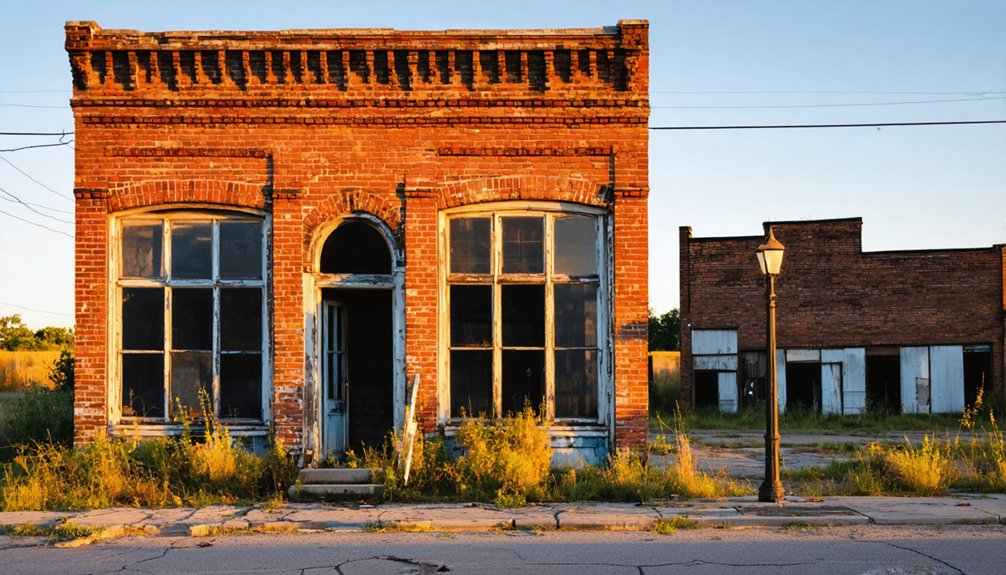
You’ll find Oklahoma’s ghost towns preserve distinct architectural records from different economic eras, with Texola’s 1930 Magnolia Gas Station and Foss’s 1894 Baptist Church representing polar ends of the state’s development timeline.
The structural integrity varies dramatically—while Skedee’s abandoned school retains original furniture and educational materials from 1909, Picher’s EPA-mandated demolition between 2011-2014 erased nearly all physical evidence of the town’s existence.
These remaining buildings serve as tangible documentation of Oklahoma’s mining boom, railroad expansion, and Route 66 commerce, with each structure’s condition reflecting the specific circumstances of abandonment.
Original Mining Era Buildings
Among Oklahoma’s ghost towns, Picher’s mining remnants provide the most dramatic evidence of industrial-era architecture’s fragility in contaminated landscapes.
You’ll find minimal structures surviving among overgrown street grids and building foundations, with toxic chat piles defining the town’s perimeter. The historic preservation efforts face unique challenges here:
- Tri-State Mining Museum – Housed in the former Zinc and Lead Ore Producers Association building until arson destroyed it in 2015
- Christian Church – Originally a one-room schoolhouse, lost to fire in 2017
- Residential Holdouts – Six homes remained in 2011, though owners rejected relocation despite subsurface instabilities
These structures’ architectural significance extends beyond aesthetics—they document an industrial era where over 14,000 mine shafts and 100 million tons of tailings fundamentally compromised the landscape’s stability.
Preservation and Structural Integrity
Despite Oklahoma’s extensive preservation framework—including annual Most Endangered Places listings since 1992 and protective HP/HL zoning districts—the state’s ghost towns present documentation challenges that extend far beyond conventional architectural conservation.
Picher’s structural resilience varies dramatically: the 1889 Frisco Depot remains stable enough for National Register consideration, while most buildings succumbed to the 2008 EF4 tornado and relentless elemental exposure.
You’ll find preservation challenges compounded by underground instability—14,000 abandoned mine shafts create unpredictable subsidence patterns that compromise foundations without warning.
The federal buyout program eliminated reconstruction possibilities, leaving eligible structures vulnerable. Early 1900s masonry walls and high-ceilinged designs that once regulated temperature now stand exposed, their original shake roofs and operable transoms deteriorating rapidly.
Private ownership stalls nominations despite confirmed eligibility.
Current Market Listings and Price Ranges
When searching for ghost town properties in Oklahoma’s current market, you’ll find that complete town listings remain exceptionally rare, with no verified entire-town packages actively advertised in statewide or national inventories as of recent documentation.
Instead, you’ll encounter individual parcels and abandoned structures across depopulated areas:
- Entry-level Oklahoma land starts at $6,000 for small acreage in southeastern counties like Gans, scaling to $72,000 for 24-acre Watson parcels.
- Panhandle ghost town properties in Cimarron, Texas, and Beaver counties average $165,000 amid tornado-damaged settlements sold as-is.
- Metro-adjacent abandoned estates near Oklahoma City command $315,000 medians, while larger western parcels reach $120,000 for 79-acre tracts.
Cloud Chief and Picher remain documented ghost towns without active pricing.
Comparing Oklahoma Properties to Other Western Ghost Towns

Oklahoma’s ghost town inventory differs markedly from other Western properties in both historical trajectory and current market positioning.
You’ll find Oklahoma comparisons reveal approximately 2,000 abandoned settlements—proportionally exceeding many Western states—driven by unique land run dynamics and oil-cattle economies rather than gold rushes.
Ghost town characteristics here emphasize agricultural reversions and complete erasures like Beer City, where structures vanished into working farmland.
Unlike preserved mining camps in Montana or Nevada, Oklahoma sites often leave minimal physical evidence.
Picher’s toxic superfund designation contrasts with commercially viable Western properties.
The Panhandle’s lawless liquor towns parallel Wyoming outposts, while Ingalls’ outlaw heritage mirrors Arizona’s frontier mystique.
Documentation remains sparse compared to California’s well-archived settlements, challenging buyers seeking authenticated historical narratives for investment or preservation purposes.
Tourism and Business Development Opportunities
Across Oklahoma’s 236 mapped ghost towns, you’ll discover untapped tourism infrastructure rooted in quantifiable heritage assets—from Kenton’s operational post office and museum serving just 17 residents to Meers’ zero-population hamburger destination drawing regional visitors.
Heritage tourism enables economic revitalization through three documented pathways:
- Cultural attraction development in All-Black towns like Taft (population 174), preserving Black cowboy history and America’s first Black woman mayor.
- Regional tourism circuits utilizing Pushmataha County’s 13 ghost towns or 11 sites within 25 miles of Norman for accessible day-trip markets.
- Adaptive reuse strategies converting structures like Boynton Depot’s abandoned rail facilities and Willow’s churches into visitor amenities.
This mirrors national models where Dust Bowl-era ruins and mining remnants generate sustainable tourism revenue across Great Plains states.
Legal Considerations Before Purchasing Abandoned Properties

While tourism potential drives initial interest in Oklahoma’s abandoned properties, you’ll need to navigate four distinct legal pathways before securing ownership: adverse possession, fence law claims, quiet title actions, and Title 42 abandonment proceedings.
Standard adverse possession demands 15 years’ continuous occupation plus five years of property taxes payments—impractical for most investors.
Oklahoma’s Fence Law accelerates this to five years when you’ve erected boundary fencing and maintained tax obligations.
Quiet title lawsuits through district courts offer faster resolution, requiring three weeks’ public notice to identify potential ownership disputes.
Title 42 proceedings provide the quickest route at 30 days, utilizing state-provided forms accessible through county tax assessors.
Rural properties face fewer monitoring obstacles than urban holdings, though government-owned land remains permanently off-limits regardless of location.
Frequently Asked Questions
Can You Legally Live in a Ghost Town You Purchase in Oklahoma?
Yes, you can legally live there once you’ve secured property rights and resolved ownership through quiet title proceedings. However, you’ll need to navigate existing zoning regulations and guarantee the land meets habitability standards for permanent residence.
What Utilities Are Typically Available in Oklahoma Ghost Towns for Sale?
Utility availability in Oklahoma ghost towns varies dramatically—you’ll find minimal ghost town amenities in most locations. Boise City maintains high utility ratings, while older sites like Whizbang lack infrastructure entirely, requiring independent systems.
Do Oklahoma Ghost Towns Require Special Insurance Due to Environmental Contamination?
You’ll need specialized pollution liability insurance covering contamination liability from mining waste and heavy metals. Standard policies exclude environmental hazards, requiring environmental assessments before purchase and ongoing monitoring documentation for any ghost town near Superfund sites.
How Do Property Taxes Work for Abandoned Ghost Town Properties in Oklahoma?
You’ll pay property assessments on abandoned ghost towns unless documented tax exemptions apply. County records reveal taxation persists despite dereliction—property ownership demands payment. Oklahoma’s framework favors fiscal responsibility over abandonment, preserving your purchasing power through transparent assessment processes.
Are There Grants Available for Restoring Historic Ghost Town Buildings in Oklahoma?
You’ll find restoration funding through Oklahoma’s Heritage Preservation Grant Program if you’re representing a municipal government or nonprofit organization. Grant eligibility requires proper registration and projects must directly support collections, exhibits, or historic preservation efforts.
References
- https://www.10news.com/ghost-towns-sale-us/
- https://www.ezhomesearch.com/blog/towns-for-sale-in-the-usa/
- https://www.islands.com/1977293/americas-most-toxic-ghost-town-border-kansas-oklahoma-abandoned-mine-town-picher/
- https://www.youtube.com/watch?v=YnGRMCblRAg
- https://savingplaces.org/guides/ghost-towns-on-route-66
- https://www.aol.com/articles/10-ghost-towns-us-actually-200604529.html
- https://abandonedok.com
- https://z94.com/what-comes-next-oklahoma-2026/
- https://www.kaypratt.com/cloud-chief-oklahoma-ghost-town/
- https://www.okhistory.org/publications/enc/entry?entry=MI042