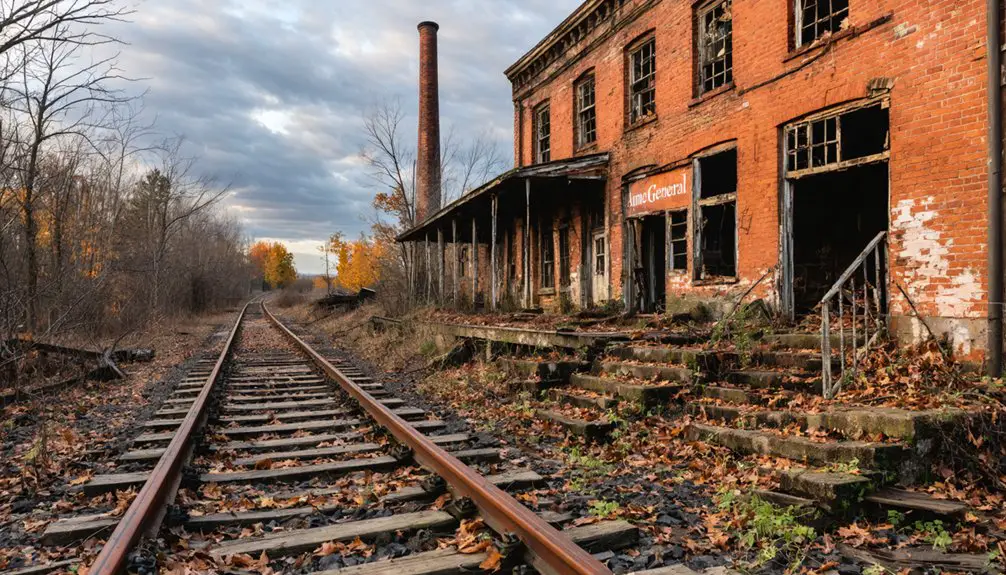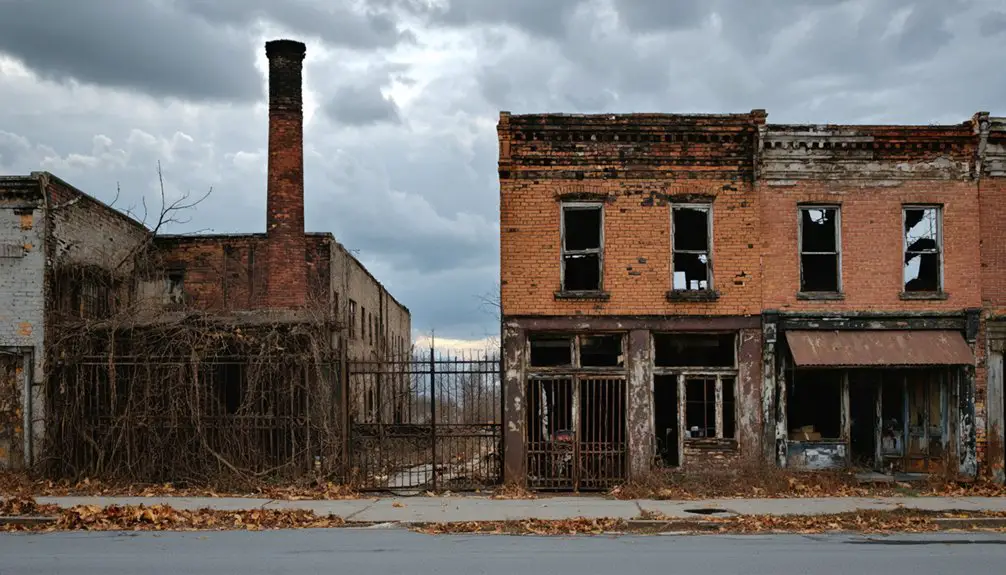
You’ll find limited ghost towns actively listed for sale in Pennsylvania, with Reduction Village in Westmoreland County representing the most documented opportunity at $1.5 million for 75 acres of preserved company town infrastructure. Unlike smaller Western parcels, Pennsylvania’s abandoned communities require assuming responsibility for deteriorating water systems, subsiding foundations from coal mining, and strict preservation obligations under state historical commission oversight. The investment extends far beyond purchase price into thorough infrastructure rehabilitation that demands careful evaluation of regulatory requirements and authentic restoration standards.
Key Takeaways
- Pennsylvania ghost towns reflect 19th-century industrial and coal mining heritage, offering unique tourism and investment opportunities in abandoned communities.
- Reduction Village, a 75-acre company town in Unity Township, is currently listed for $1.5 million with intact infrastructure.
- Buyers must budget for complete water, sewer, and electrical system replacements plus road repairs due to deteriorated infrastructure and mining subsidence.
- Pennsylvania Historical Museum Commission oversight requires documented restoration plans, court approvals, and adherence to strict preservation standards for historic properties.
- Investment requires extensive due diligence for infrastructure gaps, regulatory compliance, and ongoing maintenance costs averaging thousands annually per property.
Understanding Pennsylvania’s Abandoned Communities
Pennsylvania’s abandoned communities stand as tangible records of the Commonwealth’s industrial past, documenting cycles of rapid growth and precipitous decline that reshaped entire regions between the 1820s and mid-20th century.
You’ll find these settlements scattered across coal regions, former industrial corridors, and resource extraction zones where economic opportunities vanished as suddenly as they appeared.
From Rausch Gap’s 1828 establishment to Centralia’s ongoing mine fire crisis, these locations reveal how quickly prosperity can dissolve.
Ghost town tourism now offers you unfiltered access to this heritage—Yellow Dog Village and Eckley Miners’ Village provide legal exploration opportunities.
Pithole exemplifies this dramatic transformation, growing from its founding in May 1865 to a population of 20,000 by December of that year, only to decline to less than 250 by 1870.
The Eckley Miners Village represents a rare preservation success, having been saved from destruction by a movie that brought attention to its historical significance.
Understanding these abandonment patterns proves essential whether you’re pursuing historical preservation, community revitalization projects, or seeking authentic remnants of Pennsylvania’s unvarnished economic history.
Reduction Village: A Westmoreland County Opportunity
You’ll find Reduction Village documented in Westmoreland County records since its 1948 transfer from a Pittsburgh couple to the current family ownership.
This 75-acre property along Nine Mile Run retains infrastructure from its company town origins, when American Reduction Company built worker housing near their garbage processing plant.
The asking price of $1.5 million reflects both the site’s industrial heritage and the ongoing maintenance costs of preserving Depression-era structures on challenging hillside terrain.
The property sits in Unity Township, formed in 1789 from part of Mt. Pleasant Township, where hillside terrain once considered unfit for agriculture later supported lumber and coal industries.
Westmoreland County’s history of collective action dates to May 16, 1775, when residents approved the Hannas Town Resolves in response to tensions with British rule.
Historic 75-Acre River Property
Since 1948, a 75-acre river property known as the Village of Reduction has remained in single-family ownership, its deed traced through Westmoreland County records to a Pittsburgh couple who recognized the land’s significance along historic Forbes Road.
You’ll find this parcel positioned where Raystown Path intersects the Catawba Trail, routes that shaped British military movements and settler migration patterns.
The property’s historic significance extends beyond colonial transportation corridors—it occupies ancestral lands of the Adena, Hopewell, Delaware, Monongahela, Osage, Shawnee, and Seneca-Cayuga tribes.
Dense hardwood forests frame the riverbanks, preserving the landscape’s eighteenth-century character. The local economy historically relied on agriculture and home manufacturing, with settlers practicing self-reliance in an era of limited currency and external trade. Westmoreland County, officially formed on February 26, 1773, became the first county established entirely west of the Allegheny Mountains.
This listing represents rare access to Westmoreland County’s cultural heritage, offering stewardship of terrain that witnessed Forbes’s 1758 expedition and Revolutionary-era conflicts that defined regional independence.
Infrastructure and Maintenance Realities
Owning a historically significant property brings immediate responsibility for deteriorating infrastructure that hasn’t received systematic upgrades since the mid-twentieth century.
You’ll face infrastructure challenges that previous owners couldn’t afford to address, requiring substantial capital investment before any adaptive reuse becomes viable.
The maintenance costs demand realistic assessment:
- Water and sewer systems dating to early industrial operations need complete replacement
- Electrical infrastructure fails to meet modern code requirements or safety standards
- Road access requires rehabilitation after decades without municipal oversight
- Structural assessments reveal foundation issues from mining subsidence
You’re not just purchasing land—you’re acquiring crumbling systems that demand immediate attention.
Westmoreland County has demonstrated commitment to site readiness through strategic demolition of deteriorated structures at locations like New Kensington Advanced Manufacturing Park, revealing the scale of investment required to transform abandoned industrial properties into viable development opportunities.
Recent Commonwealth Financing Authority approvals totaling over $2.6 million for water and sewer projects throughout Westmoreland County underscore the magnitude of infrastructure costs that communities struggle to fund even with state assistance.
These realities separate genuine preservation opportunities from financial catastrophes. Your freedom to develop depends entirely on confronting deterioration honestly, not romantically.
Investment Value at $1.5M
At $1.5 million, Reduction Village represents a scale of investment that distinguishes it from smaller Pennsylvania ghost town parcels while remaining below the multi-million threshold of more developed historic properties.
You’ll need to evaluate this opportunity against limited public documentation—a reality that demands extensive due diligence beyond typical real estate assessments.
Ghost town demographics reveal minimal current population, which impacts both development costs and regulatory requirements.
Your investment strategies should account for infrastructure gaps, historical preservation obligations, and Westmoreland County’s zoning frameworks.
Without thorough market comparables or established revenue models for similar properties, you’re entering territory where traditional valuation metrics prove insufficient.
The price point suggests significant land holdings, but determining actual value requires primary research into property conditions, easements, and restoration costs.
Westmoreland County’s industrial heritage included major operations like the H.C. Frick Coke Company, which shaped the region’s development patterns and left behind properties that now define its ghost town landscape.
Price Ranges for Ghost Town Properties Nationwide
While Pennsylvania’s ghost towns command attention for their historical significance, understanding the broader national market reveals dramatic price variations that reflect each property’s unique preservation challenges and potential.
Ghost town pricing nationwide shows remarkable range:
- Under $500K: Midwest properties like Swett, South Dakota (6 acres, $250K) and small Montana towns offer entry-level property investment opportunities.
- $500K-$1M: Mid-range holdings include Lake City, Colorado’s mining town ($925K) and California’s Bridgeville (83 acres, $1.2M).
- $1-2M: Premium sites like Connecticut’s Johnsonville ($1.9M) feature preserved Victorian infrastructure. Villa de la Mina in Terlingua, Texas commands $1.95 million for its 62-acre property with 20 standing buildings and the largest mine in the area.
- $2M+: Exceptional properties reach stratospheric values—Eagle Mountain, California sold for $22.5M in 2023.
Your investment returns depend on condition, location, development potential, and historical authenticity rather than mere acreage.
The Financial Reality of Maintenance and Upkeep
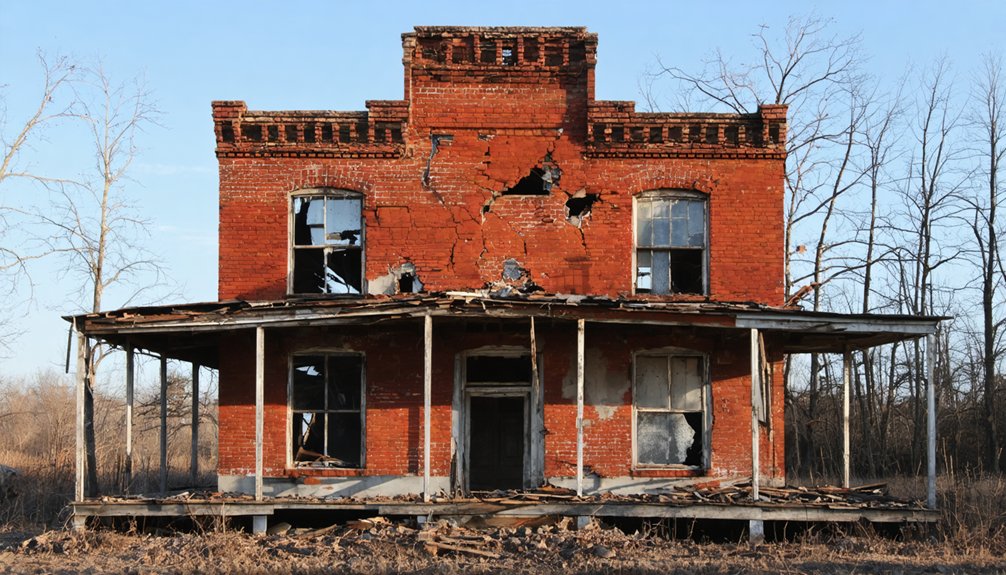
Beyond the initial purchase price, ghost town ownership demands substantial ongoing financial commitment that transforms romantic preservation dreams into concrete budget realities.
You’ll face maintenance costs averaging $1,500 per mile annually for basic trail upkeep, while emergency repairs—like the $400,000 storm damage repair—strain even well-funded operations.
Labor expenses run $7-$9 hourly for seasonal and full-time staff, with specialized tasks like mowing consuming hundreds of hours yearly.
Surface restoration cycles every 9-17 years add major capital outlays.
Smart funding strategies include user fees—63.7% of visitors accept annual charges, with 55.2% supporting $10 contributions.
Grant programs covering 65% of operational costs through abandoned mine systems offer essential relief, though you’ll shoulder administrative responsibilities that elevate total ownership expenses markedly.
Historical Architecture and Preservation Considerations
When you’re evaluating Pennsylvania’s abandoned settlements, you’ll encounter structures that embody distinct industrial-era architectural styles—company towns featuring standardized worker housing, coal patch typologies, and utilitarian commercial blocks that document labor history.
These buildings demand strict adherence to state and federal preservation regulations, including Section 106 review processes and potential National Register compliance if you accept certain funding sources.
You must compile thorough documentation of original construction methods, materials, and floor plans before initiating any restoration work, as these records prove essential for maintaining historical integrity and satisfying preservation authorities.
Industrial-Era Building Styles
Pennsylvania’s abandoned industrial sites preserve distinct architectural typologies that reflect the Commonwealth’s manufacturing hierarchy and socioeconomic stratification.
When you explore these ghost towns, you’ll encounter industrial architecture ranging from massive coal breakers to cramped worker housing, each structure telling stories of labor and capital.
Key building types you’ll discover include:
- Blast furnaces with crumbling stone walls from charcoal-fired operations like Greenwood Furnace (1834-1904)
- Coal breakers featuring multi-story processing complexes where children sorted slate from coal
- Company housing from Gothic Revival mansions to concrete duplexes and drafty laborers’ dwellings
- Lumber mills with associated railroad stations, company stores, and barrel-stave operations
Historic preservation efforts at sites like Eckley Miners’ Village and Bethlehem Steel Stacks demonstrate how these structures document economic systems that shaped communities.
Restoration Requirements and Regulations
Before you purchase a ghost town property in Pennsylvania, you’ll need to navigate a complex regulatory framework that balances preservation mandates with practical rehabilitation goals.
Exploring ghost towns to visit in Pennsylvania can also provide valuable insight into the region’s history and cultural heritage. These forgotten places often reveal the stories of those who once thrived in the area, making them fascinating destinations for history enthusiasts. Additionally, understanding the restoration challenges faced in these towns can inspire innovative ideas for sustainable development.
Historic designations trigger Pennsylvania Historical Museum Commission oversight, requiring court approval before sale execution. You’ll face restoration challenges including documented blighting conditions—three of nine criteria must coexist for twelve months minimum.
Conservators submit rehabilitation plans with estimated expenses, maintaining detailed records throughout construction. Financial hierarchies prioritize court costs, then government liens, before conservator claims.
Preservation grants may offset expenses, though historic properties demand “sense of place” maintenance standards. The 2014 amendments streamlined adjacent property consolidation, addressing speculator-owned parcels.
You can petition for lien reductions when arrears make projects impractical, balancing preservation requirements with economic viability.
Original Structure Documentation
Understanding a ghost town’s architectural heritage requires systematic documentation that captures both physical structures and their historical imprints. Your building documentation should employ multiple archival methods to reconstruct complete architectural history:
- Sanborn fire insurance maps from the 1780s onward reveal original footprints and building materials.
- Aerial photographs and city directories track construction-to-demolition trajectories.
- Deeds, censuses, and genealogical records establish ownership patterns and usage timelines.
- Architectural drawings and newspaper archives provide visual evidence of lost structures.
You’ll find physical remnants tell stories too. Stone bridge abutments from the 1860s, forty-foot tavern foundations, and structural outlines on adjacent buildings preserve what’s vanished.
These imprints matter—they’re your evidence when official records fail. Photograph everything systematically, measuring dimensions and noting materials before nature reclaims what human demolition missed.
From Mining Towns to Manufacturing Hubs: Pennsylvania’s Industrial Heritage
Throughout the 19th and early 20th centuries, Pennsylvania’s mountainous terrain concealed a vast industrial empire that transformed raw materials into the building blocks of modern America.
Hidden among Pennsylvania’s rugged peaks, furnaces and mines forged the steel spine of a rising industrial nation.
You’ll discover iron furnaces like Greenwood operated from 1834-1904, supporting company towns with 130 buildings. Coal mining villages such as Eckley housed workers extracting fuel that powered the nation’s growth.
Steel mills like Carrie Furnaces produced materials for skyscrapers and bridges until 1982. Lumber boom towns like Lopez flourished briefly before resource depletion triggered abandonment.
Today’s industrial heritage preservation efforts convert these sites into museums and landmarks, offering community revitalization opportunities.
Sites like the Carrie Furnaces and Eckley Miners’ Village now stand as monuments to Pennsylvania’s industrial dominance, awaiting investors who’ll honor their historical significance.
Business Models for Ghost Town Investment
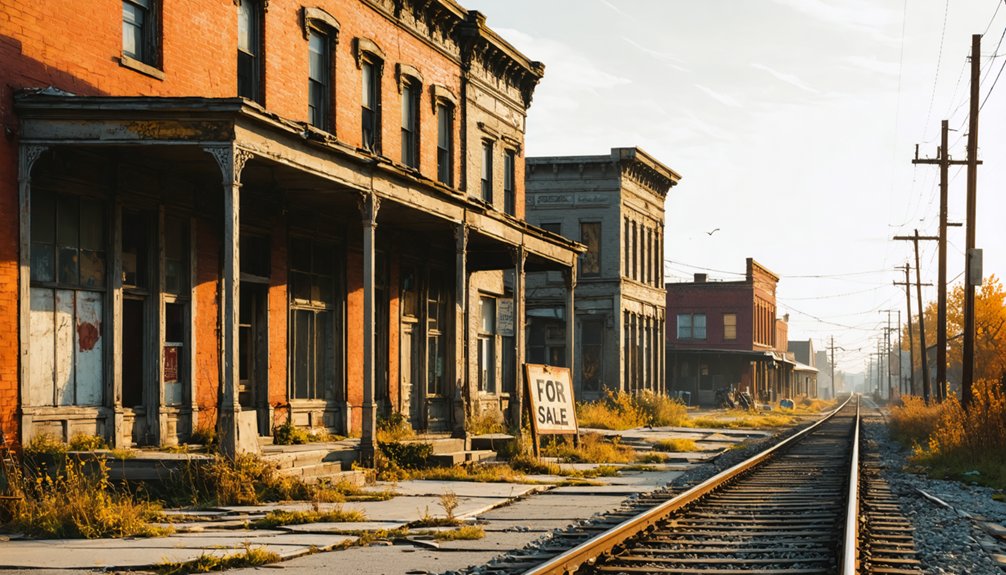
Pennsylvania’s abandoned industrial sites won’t revitalize themselves—you’ll need concrete financial strategies that transform liability into asset.
Land Value Taxation models from Harrisburg demonstrate proven community revitalization results, reducing vacant structures by 90% through higher taxes on idle land than improvements. Your investment strategies should leverage multiple funding streams:
- Historic tax credits: Secure up to $500,000 commercially through Pennsylvania Works! while federal incentives funded $82 million in three-building conversions
- Market Value Analysis: Identify “G” and “H” markets where investor activity exceeds 25% of purchases, signaling opportunity
- Themed business clusters: Develop antiques, entertainment, or tourism-focused enterprises that attract repeat visitors
- Performance venues: Follow Seton Hill’s model where theaters catalyze Main Street retail traffic
You’ll navigate preservation standards while capturing tax abatements automatically through LVT frameworks.
Evaluating Property Condition Before Purchase
Before committing capital to Pennsylvania’s deteriorating structures, you’ll require systematic condition assessments that quantify both rehabilitation costs and legal liabilities.
Professional property assessment evaluates exterior envelope integrity, structural soundness, and code violations—critical data when considering buildings vacant for extended periods.
Pennsylvania’s conservatorship statutes define blighting conditions through specific criteria: vandalism, fire hazards, substantial rehabilitation needs, and debris accumulation persisting twelve months minimum.
You’ll need photographic evidence documenting these deficiencies. Understanding buyer responsibilities means obtaining municipal inspection reports detailing legal use parameters and existing violations.
Cities like Allentown mandate presale inspections within five days of listing. These assessments protect your investment by revealing true rehabilitation scope—whether you’re facing cosmetic repairs or complete structural intervention requiring hundreds of thousands in remediation expenditures.
Pennsylvania vs. Western Ghost Towns: Regional Comparisons
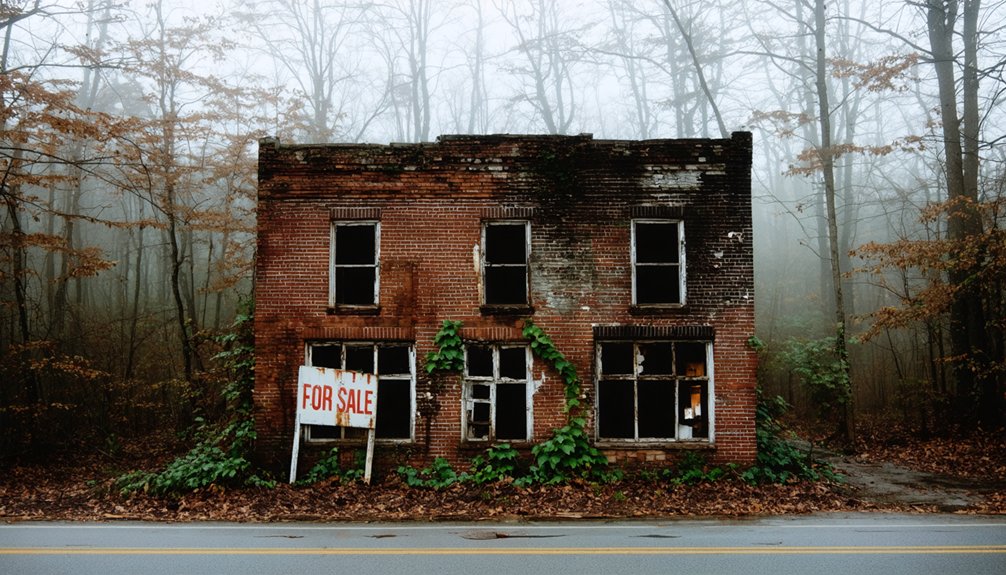
While Pennsylvania’s ghost towns carry price tags averaging $220,000 to $1.5 million for multi-structure settlements, their Western counterparts present broader market variability—from South Dakota’s Swett at $250,000 for modest tavern-and-house combinations to California’s Campo commanding $6.6 million with hot springs infrastructure.
Your choice between regions hinges on distinct value propositions:
Regional ghost town investments offer fundamentally different advantages depending on whether you prioritize accessibility and heritage or authentic frontier character and tourism appeal.
- Pennsylvania sites cluster near Pittsburgh with highway accessibility, offering coal-mining heritage from Armstrong and Westmoreland counties.
- Western properties dominate Nevada, Colorado, and Montana with authentic 1800s saloons and remote mountain settings.
- Ghost town tourism potential varies—Western locations attract visitors seeking frontier nostalgia, while Pennsylvania towns serve regional nostalgia markets.
- Structural authenticity differs: Western parcels preserve banks and general stores from railroad booms; Pennsylvania features company housing and schoolhouses.
Western remoteness contrasts sharply with Pennsylvania’s proximity to metropolitan areas, affecting restoration logistics and visitor accessibility.
Frequently Asked Questions
What Zoning Regulations Apply to Ghost Town Properties in Pennsylvania?
You’ll find ghost town properties subject to local zoning classifications that determine property usage—whether residential, commercial, or historical preservation. Check county ordinances controlling development rights, permitted uses, and conditional requirements that’ll protect your autonomy while ensuring compliance.
Can Individual Buildings Be Purchased Separately From the Entire Ghost Town?
You’ll find it’s not all or nothing—individual building options exist, like Pennsylvania’s $24,000 schoolhouse. However, most ghost towns sell as complete parcels, requiring separate purchase inquiries to determine if owners will subdivide their historic properties.
Are There Tax Incentives for Restoring Historically Significant Ghost Town Properties?
You’ll find federal historical preservation tax credits available for National Register properties, though Pennsylvania-specific incentives aren’t documented for ghost towns. Yellow Dog Village’s owner faced tax liens without relief, highlighting limited state support for restoration projects.
What Utilities Are Still Functional in Abandoned Pennsylvania Communities?
Most abandoned Pennsylvania communities have zero functional utilities—you’ll find disconnected infrastructure conditions requiring complete restoration. Utility access disappeared decades ago when populations left, though some sites retain deteriorating water lines and electrical poles as historical markers of former civilization.
Do Ghost Town Purchases Include Mineral or Water Rights?
Ghost town purchases typically don’t automatically include mineral rights or water rights—you’ll need to verify each property’s deed carefully. Pennsylvania often separates subsurface mineral ownership from surface land, requiring independent negotiation for complete control.
References
- https://6abc.com/post/ghost-town-for-sale-with-a-real-wild-west-history/3613127/
- https://www.ezhomesearch.com/blog/towns-for-sale-in-the-usa/
- https://patch.com/pennsylvania/newtown-pa/entire-town-pennsylvania-sale-asking-price-1-5-million
- https://www.youtube.com/watch?v=u1KkAEZYqZY
- https://www.zillow.com/pa/hunting_att/
- https://www.oldhousedreams.com/state/pennsylvania/
- https://www.aol.com/articles/10-ghost-towns-us-actually-200604529.html
- https://www.mossyoakproperties.com/property/gastown-rd-armstrong-county-260-acres-armstrong-pennsylvania/86804/
- https://www.mossyoakproperties.com/property/ghost-town-acres-cambria-pennsylvania/46000/
- https://www.realtor.com/news/unique-homes/ghost-towns-for-sale/