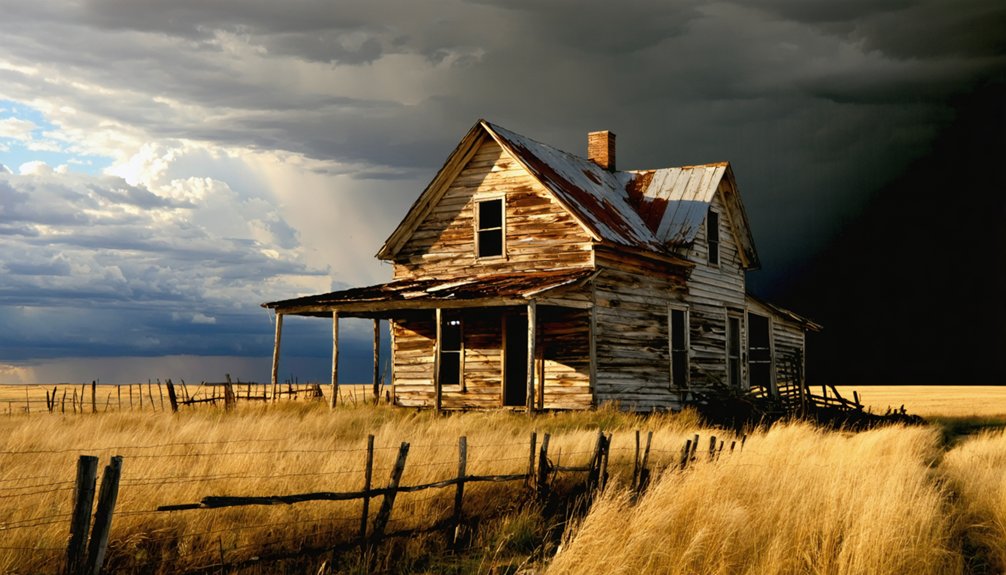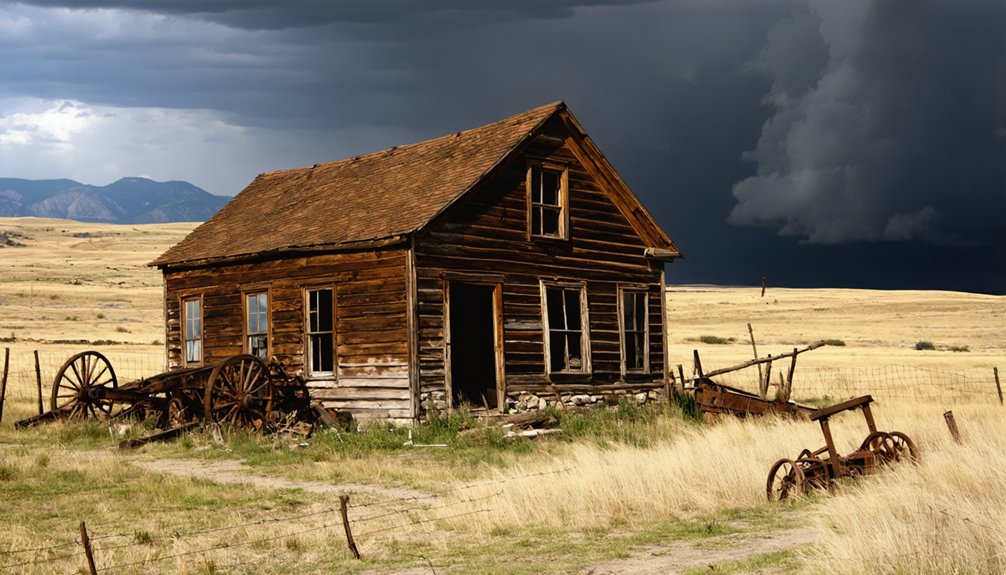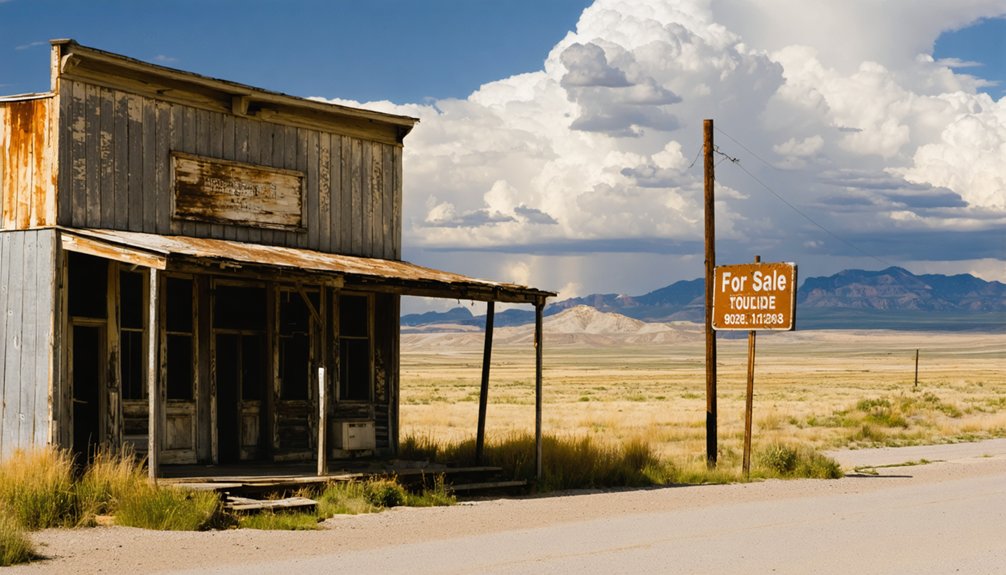
You can buy entire South Dakota ghost towns for $250,000 to $800,000—often less than a typical suburban home. Swett’s 6.16 acres with multiple buildings sold for $250,000 after a price reduction, while Scenic fetched $799,000 in 2011. These abandoned settlements include structures like taverns, dance halls, and railroad depots, though restoration costs typically exceed purchase prices due to infrastructure overhauls and environmental remediation. Financing options include specialized rural development loans, and successful revitalization strategies range from tourism ventures to cultural preservation projects that capitalize on the state’s mining heritage.
Key Takeaways
- Swett, South Dakota is available for $250,000 on 6.16 acres with buildings including a tavern and auto body shop.
- Ghost town prices range from $250,000 to $800,000 depending on acreage and number of standing structures included.
- Restoration costs often exceed purchase prices due to infrastructure overhauls, environmental remediation, and connectivity requirements.
- GROW South Dakota offers direct loans up to $300,000, while USDA 502 Direct Loans provide rural financing options.
- Lawrence County contains the highest concentration with 93 documented ghost town sites available for potential purchase.
Swett: An Affordable Entry Point to Town Ownership
For $250,000—less than the national average home price—you can purchase the entire town of Swett, South Dakota, a 6.16-acre property located approximately 2.5 hours west of Rapid City.
This affordable investment includes an abandoned house, the defunct Swett Tavern with its stage and party room, three trailers, and an auto body shop.
Town ownership represents an unconventional real estate opportunity that’s attracted diverse buyers—from off-grid seekers to production companies scouting filming locations.
The property’s price dropped from its initial $399,000 listing in June 2014 after several deals collapsed due to buyers’ financial constraints.
Current owner Lance Benson, who regained the property in 2012 following a complex ownership history involving divorce and bank foreclosure, now offers this entire incorporated township at a markedly reduced rate. The state of South Dakota provided a new town sign to replace the previous one damaged by bullet holes.
The town was established in 1931 by a farmer named Swett, who originally operated a store and post office before the community’s eventual decline.
Scenic: The Badlands Gateway That Found New Owners
The town of Scenic, South Dakota, situated along Highway 44 near Badlands National Park, sold in 2011 for $799,000 to a Filipino Christian group that envisioned transforming the abandoned settlement into a religious retreat center.
You’ll find this badlands gateway flourished temporarily when needed for regional development infrastructure, then faced abandonment as its purpose diminished. The sale included a dance hall, railroad depot, and several deteriorating structures offering scenic views of the surrounding landscape.
Towns born from necessity often die when their purpose fades, leaving only crumbling monuments to forgotten ambitions.
However, ownership challenges emerged when the church group’s retreat vision never materialized. The property’s remote location and crumbling buildings required substantial investment beyond the purchase price. Like many gold rush settlements in the Black Hills from the 1870s, Scenic tells the story of a once-thriving community that faded when its original purpose ended.
This transaction demonstrates how acquiring ghost towns involves complexities beyond initial costs, particularly when restoration plans clash with harsh economic realities. Ghost town hunters often rely on early maps and geological surveys to trace such historical localities and uncover their forgotten stories.
Rockerville: Black Hills Mining History Meets Tourism Potential
You’ll find Rockerville’s transformation from 1870s gold rush camp to modern development opportunity offers unique investment angles in South Dakota’s Black Hills tourism corridor.
The town’s $150,000 first-season gold yield in 1877 and subsequent decline into abandonment created a property landscape where mining history now fuels hospitality ventures along Highway 16 between Rapid City and Hill City.
Current redevelopment efforts center on leveraging the ghost town’s established tourist appeal—complete with mining relics and false-front buildings—into commercially viable restaurant and lodge operations.
Following the 2016 safety fire that destroyed remaining historical structures, preservation discussions have shaped new tourism initiatives focused on balancing heritage with commercial development.
The settlement’s origins trace back to Wm. Keeler’s February 1877 gold discovery, when his first pans yielded $1.52 and sparked the rush that built Rockerville into a several-hundred-person mining camp by year’s end.
Historic Mining Town Origins
When gold seekers flooded the Black Hills in the 1870s, they transformed a rocky gulch into Rockerville—a mining camp that would capture national attention for over a decade.
You’ll find the town’s name came from the “rockers” miners used to separate placer gold from stream gravel. These mining techniques evolved as deposits depleted—by 1880, operators shifted from placer to hard rock methods.
The Black Hills Placer Mining Company constructed a 20-mile flume from Sheridan, supporting hydraulic operations that defined the boom period. Most mines closed in the early 1900s as costs exceeded profits.
The community overcame devastating fires and economic challenges that threatened to end the settlement entirely. The discovery of gold in French Creek near Custer during the 1874 expedition initially drew prospectors to that area before mining expanded to other locations like Rockerville. Today, ghost town preservation efforts include the Rockerville Jail Museum and historic flume trail, where you can walk the original 1880s flume bed and examine remaining tunnels and artifacts.
Current Property Development Opportunities
Rockerville’s location along Highway 16, just 13 miles south of Rapid City, positions it as a prime candidate for heritage tourism development that capitalizes on proximity to Mount Rushmore traffic.
You’ll find limited documented property listings currently available, but the town’s infrastructure improvements through recent highway corridor projects enhance accessibility for potential investors.
Property zoning regulations in Pennington County allow mixed-use development that could accommodate both commercial tourism ventures and residential properties.
Tourism initiatives in the Black Hills region continue expanding, creating opportunities for mining history interpretation centers, heritage lodging, and authentic Old West experiences.
The corridor experiences consistent traffic growth throughout the year, with summer months bringing additional tourism-related traffic that could benefit heritage-focused developments.
Developers should consider mixed-use corridors that combine commercial and residential elements, as comprehensive planning trends increasingly favor this approach along major arterial routes.
The challenge lies in securing detailed ownership information and maneuvering through rural development regulations.
You’ll need to contact local county offices directly for current property availability and development feasibility assessments.
Understanding the Ghost Town Phenomenon in South Dakota
South Dakota’s landscape holds the remnants of 245 abandoned settlements, each representing a chapter in the state’s turbulent economic history.
You’ll find ghost town origins rooted in railroad expansion, mining booms, and agricultural speculation from the late 1800s through the early 1900s. Settlement decline accelerated when railroads bypassed communities, mines depleted their resources, and droughts devastated farming operations.
Lawrence County contains 93 ghost towns—the state’s highest concentration—mostly clustered around exhausted Black Hills mining sites. Towns like Lowry and Verdon experienced dramatic population crashes, dropping from 1940s peaks to single-digit residents by 2020.
You’re looking at properties where economic adaptation meant survival, and failure meant abandonment. Transportation shifts, particularly highway construction that isolated rail-dependent towns, sealed many communities’ fates within a single decade.
What Drives Pricing in the Ghost Town Market
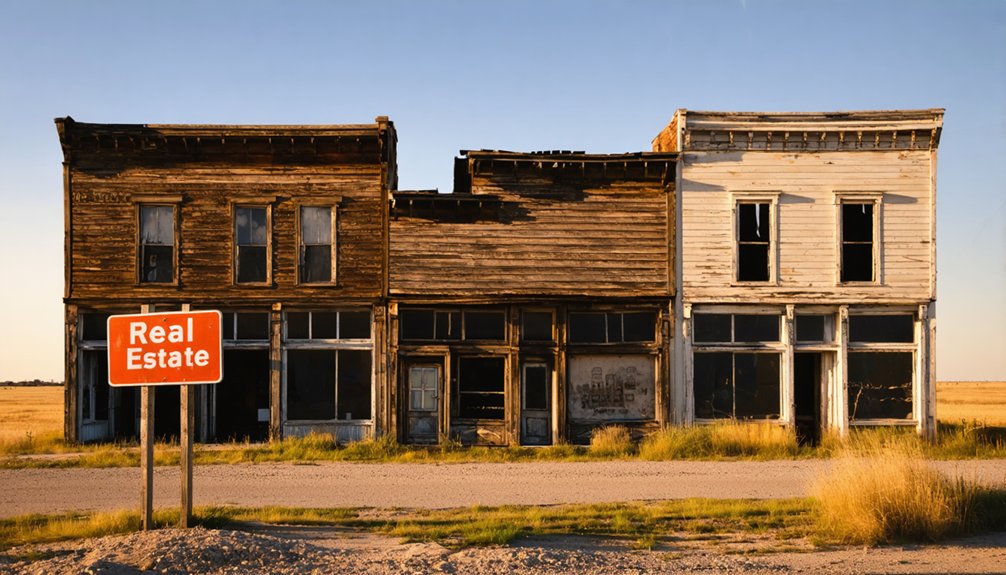
When you’re evaluating ghost town properties in South Dakota, acreage and the number of standing structures form the primary pricing foundation—a 6-acre parcel with multiple buildings typically starts around $250,000, while a 46-acre property can command $700,000 or more.
The condition of existing infrastructure directly impacts your total investment, as functional buildings like taverns with working bars and houses with intact fireplaces hold substantially more value than completely deteriorated structures requiring full reconstruction.
You’ll need to calculate not just the asking price but the restoration costs, since bank-owned properties often reflect aggressive pricing that accounts for significant DIY work ahead.
Acreage and Structure Count
Ghost town pricing defies simple formulas, with comparable six-acre properties ranging from $250,000 to $800,000 depending on multiple market factors. Acreage valuation alone doesn’t determine your investment threshold—structure significance dramatically alters final pricing.
Consider these market realities:
- Swett’s 6.16 acres with tavern and house commanded $250,000, establishing baseline pricing.
- Rocky Bar’s 8.9 acres included hotel, jail, mine infrastructure, and mineral rights for identical $250,000 asking price.
- Five-acre Pray, Montana reached $1.4 million due to Yellowstone proximity and tourism potential.
- Multi-structure properties with authentic Old West architecture justify premium valuations beyond land value.
- Building count without revenue potential fails to increase prices—Grove’s multiple structures sold for just $200,000.
You’re purchasing income potential, not just square footage.
Condition and Infrastructure Costs
Infrastructure restoration expenses dwarf initial purchase prices in South Dakota’s ghost town market. You’ll face water and electrical system overhauls, sanitary sewer installations, and SCADA upgrades that transform seemingly affordable properties into financial quagmires.
Environmental remediation from mining operations frequently exceeds your original investment.
These infrastructure challenges multiply when you factor in connectivity requirements. Fiber installation costs $16,000 to $60,000+ per mile, with granite boring substantially increasing expenses in regions like the Black Hills.
South Dakota’s $600 million ARPA allocation for water infrastructure demonstrates the magnitude of these restoration costs—Huron alone received $4.8 million for water system upgrades.
Insurance premiums remain elevated for abandoned properties, while legal complexities extend timelines.
You’re not buying property; you’re assuming responsibility for extensive municipal reconstruction.
Financing Your Ghost Town Purchase
Although ghost towns typically sell for less than conventional real estate, securing financing for these unique properties requires maneuvering specialized loan programs and understanding lender requirements.
GROW South Dakota offers direct loan financing up to $300,000 for existing home purchases, while USDA 502 Direct Loans provide rural property options with minimal down payment requirements for qualifying buyers.
Your loan eligibility depends on income levels and property location within designated rural areas. Here are your primary financing options:
- USDA Rural Development loans: Zero down payment for low-income applicants
- GROW SD direct financing: Up to $300,000 with down payment assistance programs
- State GOED programs: Working capital and low-interest loan options
- Local bank relationships: Established lenders throughout South Dakota
- Asset requirements: Higher-asset applicants may need partial down payments
Processing times vary based on funding availability and application volume.
Creative Ways Buyers Are Revitalizing Abandoned Communities

Once you’ve secured financing for your ghost town purchase, you’ll need a clear revitalization strategy to transform your abandoned property into a viable asset.
South Dakota’s successful transformations demonstrate proven approaches: tourism-driven development works where you’re positioned near attractions like Mount Rushmore, as Keystone and Rockerville achieved.
Proximity to established tourist destinations like Mount Rushmore can drive successful ghost town revitalization through strategic tourism-based development.
You can pursue cultural preservation through authentic restoration—Mystic maintained working-class structures without commercial compromise while joining the National Register of Historic Places.
Alternative strategies include agricultural adaptation, like Hershnshaw Farms’ mushroom operations in former coal caverns, or renewable energy integration following SEVA WV’s model.
Community restoration requires local empowerment—research shows Centralia’s $55 million regeneration succeeded through worker enfranchisement and resident decision-making authority, not external control dictating development direction.
Frequently Asked Questions
What Are the Ongoing Property Tax Obligations for Owning a Ghost Town?
You’ll pay annual property taxes based on 85% of market value, face May 1st and November 1st deadlines with compounding interest penalties, and handle all ownership responsibilities including assessment disputes and potential tax certificate sales if delinquent.
Do Ghost Towns Include Mineral or Water Rights With the Purchase?
Ghost town purchases don’t automatically include mineral rights or water rights—you’ll need to investigate each property individually. Like Rockerville’s unspecified mineral status, most historical listings require thorough due diligence before you’ll secure complete resource ownership.
Are There Zoning Restrictions That Limit Commercial Development in Ghost Towns?
Yes, you’ll face zoning regulations that restrict commercial viability in ghost towns. Most require conditional use permits, environmental assessments, and infrastructure upgrades. Historic preservation covenants and contamination limitations often prevent development entirely, constraining your freedom.
What Insurance Challenges Exist When Covering Historic or Deteriorating Structures?
Like traversing a minefield, you’ll face insurance valuation disputes over replacement costs, inadequate liability coverage for deteriorating structures, and potential denial based on building condition—especially without modern safety systems meeting underwriting standards.
Can Individual Buildings Be Sold Separately After Purchasing an Entire Town?
You’ll face significant legal hurdles selling individual buildings separately. Subdivision requires surveying, title separation, and county approval. Building renovations often exceed resale potential in remote markets, making unified development more economically viable than piecemeal sales.
References
- https://toptenrealestatedeals.com/weekly-ten-best-home-deals/home/south-dakota-ghost-town
- https://clui.org/newsletter/summer-2004/unusual-real-estate-listing-2764
- https://www.bobvila.com/articles/towns-for-sale/
- https://www.ezhomesearch.com/blog/towns-for-sale-in-the-usa/
- http://www.techinsider.io/cheap-south-dakota-town-for-sale-2015-11
- https://www.youtube.com/watch?v=V-ApY-PSeJA
- https://www.atlasobscura.com/places/scenic-ghost-town
- https://fortune.com/2015/12/01/abandoned-south-dakota-town/
- https://www.smithsonianmag.com/smart-news/sale-haunted-ghost-town-180957430/
- https://www.foxnews.com/travel/haunted-south-dakota-ghost-town-on-the-market-for-250g