You won’t find traditional ghost towns for sale in Vermont like you would out West, but the state offers 75 distressed historic properties averaging $453,217 that capture similar forgotten-settlement appeal. These include National Register listings, abandoned farmsteads from defunct agricultural communities, and fixer-uppers with original Greek Revival and Georgian architecture. Properties under $50,000 exist through targeted searches, with 796 land parcels available where entire villages once thrived before Vermont’s economic shift left them behind. The complete landscape of these opportunities reveals surprising alternatives.
Key Takeaways
- Vermont offers 75 distressed properties averaging $453,217, including abandoned farmsteads and fixer-uppers in former agricultural communities.
- Properties under $50,000 exist, with notable listings like a $76,500 Greek Revival in Danby featuring six bedrooms.
- 578 undeveloped land parcels totaling 20,735 acres are available, averaging $325,715 per property across multiple counties.
- Historic structures from the 1800s-1900s require research on zoning laws and preservation requirements before purchase.
- Vermont lacks true ghost towns but features economically-shifted rural properties near tourism destinations and ski resorts.
Understanding Vermont’s Unique Real Estate Landscape
While Vermont’s real estate market doesn’t feature the abandoned mining settlements or frontier outposts found in the American West, the state possesses its own distinct category of distressed properties that share characteristics with traditional ghost towns.
You’ll find fixer-upper homes scattered throughout rural Vermont that represent remnants of once-thriving agricultural communities. These properties connect directly to Vermont history, reflecting economic shifts from farming to tourism-based economies.
Unlike western ghost towns, Vermont’s abandoned properties typically consist of individual homesteads rather than entire settlements.
When you’re considering ghost town preservation in this region, you’re examining a different historical narrative—one rooted in New England’s agricultural decline and population migration patterns. Understanding this context helps you identify genuine opportunities within Vermont’s unique real estate landscape. Ownership of these properties often revolves around the concept of preservation rather than immediate development plans.
Before pursuing any Vermont property, research state zoning laws and county regulations to ensure your intended use aligns with local requirements.
The Jamaica Tiny House Property: Vermont’s Closest Alternative
Among Vermont’s limited inventory of properties resembling ghost town characteristics, a 265-square-foot farmhouse-inspired tiny house in Jamaica stands as the state’s most accessible alternative to traditional western ghost town real estate.
Listed at $225,000, this property delivers immediate rental income potential, currently commanding upward of $250 per night.
You’ll find 15 acres of territorial freedom in the Green Mountain National Forest at 2053 Pikes Falls Road.
The tiny house features a loft bedroom, modern kitchen with butcher-block countertops, and cathedral ceilings with skylights.
Cathedral ceilings with skylights illuminate butcher-block countertops and loft sleeping quarters, maximizing every square foot of this 265-square-foot investment property.
Previous coverage on A&E’s “Living Smaller” validates its market appeal.
The property’s compact 265-square-foot design maximizes functionality while minimizing maintenance requirements.
Jamaica positions owners within an artist community celebrated for its creative culture and Green Mountain vistas.
Located five minutes from Jamaica’s downtown core and twenty minutes from multiple ski resorts, you’re positioned to capitalize on Vermont’s tourism economy while maintaining mountain solitude.
Comparable Ghost Town Opportunities Across America
Across America’s landscape, over 4,500 abandoned settlements present acquisition opportunities that dwarf Vermont’s limited ghost town inventory, with asking prices ranging from South Dakota’s $250,000 six-acre Swett property to Texas’s $1.95 million Villa de la Mina complex.
You’ll find Kansas farmsteads priced at $50,000–$85,000 in towns facing population collapse, while Connecticut’s 62-acre Johnsonville Victorian village lists for $1.9 million.
These ghost town investments concentrate in Western states—Nevada, Colorado, Montana, California—where mining, railroad, and lumber declines left authentic 1800s-1900s structures intact.
You’re acquiring time capsules with original architecture, from saloons to general stores, though preservation challenges include zoning restrictions, infrastructure decay, and economic isolation.
Successful buyers transform properties into vacation rentals, film sets, and micro-resorts despite regulatory hurdles.
Johnsonville’s properties include a covered bridge, barn, former bank, post office, general store, and multiple houses available for adaptive reuse.
California’s Bridgeville, an 83-acre town established in 1875, made history as the first town sold on eBay in 2002 before reselling for $1.25 million in 2006.
Vermont Fixer-Uppers and Historic Properties Worth Exploring
You’ll find Vermont’s historic property market offers documented listings under $50,000 through specialized platforms like Old House Dreams and Cheap Old Houses, featuring center-chimney Capes, Georgian residences, and National Register properties.
These inventories span fixer-uppers to endangered structures, with 796 land parcels on Zillow providing development opportunities for historic-style builds.
The market includes under-$100k options alongside premium examples like the $225,000 Jamaica tiny farmhouse, demonstrating price ranges that accommodate both preservation projects and turnkey investment properties generating $250 nightly rental income. Notable listings include a Greek Revival in Danby priced at $76,500 with 6 bedrooms on 0.79 acres.
Before purchasing, consider exploring Vermont apartments for rent as an alternative to assess the area and local amenities while planning your historic property investment.
Affordable Vermont Fixer-Uppers
While the American West dominates the ghost town market with properties in Nevada and Montana, Vermont’s landscape offers a different category of opportunity through historic fixer-uppers and abandoned properties that share similar architectural appeal at accessible price points.
You’ll find Vermont renovations typically range from $250,000 to $800,000, mirroring western ghost town pricing while offering established infrastructure and proximity to active communities.
These properties feature authentic 19th-century New England architecture—mills, farmhouses, and commercial buildings with historical significance tied to Vermont’s agricultural and industrial heritage.
Unlike remote western parcels, you’re investing in structures near existing towns, reducing development costs while maintaining period authenticity.
The combination of architectural integrity, established utilities, and tourism infrastructure creates immediate revenue potential without frontier isolation.
The current market includes 50 fixer-upper homes available across Vermont, with some properties qualifying as Hot Homes that attract quick buyer interest.
Historic Homes Under $500K
Vermont’s historic property market currently features several documented listings under $500,000 that combine architectural preservation potential with immediate habitability.
You’ll find Victorian, Gothic, and Colonial structures alongside center-chimney Capes and Georgian residences through various real estate channels.
The Townshend Historic Chalet exemplifies accessible opportunities at $384,900, offering 28.9 wooded acres with period features including wood-burning fireplace and sauna.
Vergennes markets seven properties under your budget threshold, while Woodstock provides single-family options through Bassette Real Estate Group.
Maple Sweet Real Estate specializes in Vermont farmhouses featuring exposed beams and mountain views that deliver authentic farmhouse charm.
These historic renovations range from National Register properties to practical fixer-uppers with wide-plank floors, allowing you to claim architectural heritage without corporate development restrictions or homeowners association limitations.
Many properties showcase multiple architectural periods in a single structure, blending Georgian elements with Federal additions or Greek Revival updates that document Vermont’s economic evolution through the 18th and 19th centuries.
Log Cabins and Rustic Retreats in the Green Mountains
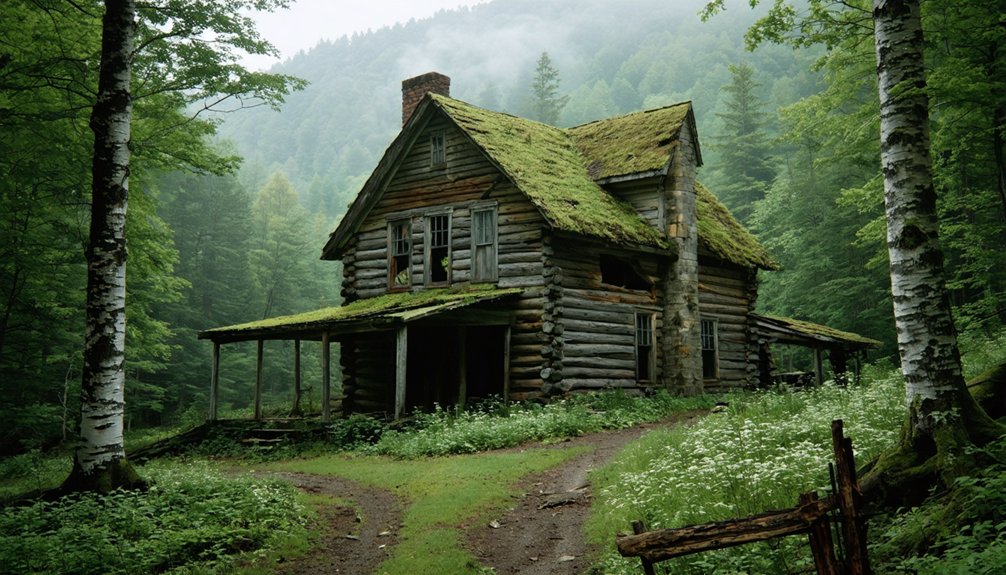
Rustic log cabins and off-grid retreats dot Vermont’s Green Mountain region, offering parcels ranging from intimate 3-acre plots to expansive 87.25-acre wilderness estates.
You’ll find log cabin retreats priced from $270,000 to over $6 million, with rustic properties concentrated in Rutland, Windsor, and Addison counties.
The 3-acre Stockbridge parcel provides gently rolling terrain ideal for custom cabin construction, while established off-grid sites near rivers and state land guarantee seclusion.
This gentle Stockbridge terrain offers the perfect canvas for your custom cabin while neighboring state lands ensure complete privacy.
Several parcels include pre-approved septic systems and maintained road access despite their remote settings.
The 55-acre Enosburg woodland and 87.25-acre forest tract with pond frontage exemplify large-scale retreat potential.
Most properties connect directly to VAST/VASA snowmobile trails, and you’ll access thousands of adjacent state acres for extended wilderness exploration without neighbors.
Building Your Own Vermont Legacy: Land and Restoration Options
You’ll find Vermont’s land market offers distinct opportunities through both raw parcels and historic structures requiring rehabilitation, though actual ghost towns remain undocumented in state records.
Available properties range from undeveloped acreage in regions like the Northeast Kingdom to abandoned farmsteads and deteriorating 19th-century buildings scattered across former mill communities.
These fixer-upper prospects demand careful assessment of restoration costs, zoning restrictions, and historical preservation requirements before you commit to establishing your Vermont legacy.
Available Land Parcels Statewide
Across Vermont’s landscape, 578 undeveloped land parcels spanning 20,735 acres currently await prospective buyers seeking to establish their own homesteads or investment properties.
You’ll find available land averaging $325,715 per property, with 12 unrestricted parcels offering maximum autonomy at $330,142 average pricing. These investment opportunities concentrate in counties like Windham, Orleans, and Rutland, where zoning regulations remain minimal.
Specific parcels range from 110.5 acres along Calendar Brook Road in Burke to 56-acre tracts on abandoned roads near Blood Brook. Unrestricted properties cost between $9,238 and $10,921 per acre, providing affordable entry points for those escaping conventional development constraints.
Many sites feature timber resources, off-grid potential, and proximity to state forests, offering the seclusion and self-sufficiency freedom-seeking individuals prioritize when building legacy homesteads.
Historic Fixer-Upper Opportunities
Vermont’s fixer-upper market presents 75 distressed properties averaging $453,217, offering preservation-minded buyers direct access to architectural heritage spanning the late 1800s through early 1900s.
You’ll discover center-chimney Capes, Georgian homes, and wide-plank farmhouses maintaining their architectural significance despite decades of neglect.
The State Register of Historic Places database documents endangered structures awaiting historic restoration, while specialized platforms refresh inventory every 15 minutes.
Properties under $100,000 remain available through targeted searches, with land costs averaging $8,849 per acre.
National Register listings provide enhanced restoration resources and documentation support.
You’re not purchasing deteriorating buildings—you’re acquiring documented architectural artifacts with authentic details that modern construction can’t replicate.
These structures represent tangible connections to Vermont’s settlement patterns, offering autonomy through owner-directed preservation rather than developer-controlled neighborhood restrictions.
Frequently Asked Questions
What Zoning Restrictions Apply to Ghost Town Properties in Vermont?
Maneuvering Vermont’s regulatory maze, you’ll encounter zoning laws governing setbacks, lot sizes, and density limits based on property classifications. Municipal permits, Development Review Board approvals, and overlay district standards control your ghost town’s redevelopment possibilities.
Are Ghost Town Purchases Eligible for Historic Preservation Tax Credits?
You’ll find tax credit eligibility depends on meeting historic preservation requirements: structures must be National Register-listed or district-contributing, pre-1936, with certified rehabilitation work qualifying for Vermont’s 25% state credit plus 20% federal credit.
How Do Property Taxes Compare Between Ghost Towns and Standard Vermont Real Estate?
You’re comparing apples and oranges here. Property tax rates depend on municipal location, not ghost town status. Ghost town valuation typically runs lower due to minimal infrastructure and services, potentially reducing your overall tax burden considerably.
What Insurance Challenges Exist When Buying Abandoned or Historic Ghost Town Buildings?
You’ll face vacancy exclusions after 30-60 days, limited coverage for vandalism and theft, liability concerns from trespasser injuries, and elevated insurance premiums due to fire risks, criminal activity, and Vermont’s low flood insurance availability in abandoned properties.
Can Ghost Town Properties Be Converted Into Commercial Tourist Attractions Legally?
You’ll navigate Dickensian complexities, but yes—converting ghost towns into commercial tourist attractions requires municipal zoning approval, conditional use permits, Act 250 environmental review for larger sites, and compliance with tourism regulations governing attraction development, historic preservation standards, and safety codes.
References
- https://www.ezhomesearch.com/blog/towns-for-sale-in-the-usa/
- https://www.realtor.com/news/unique-homes/tiny-house-vermont-investment-land-sale/
- https://www.aol.com/articles/10-ghost-towns-us-actually-200604529.html
- https://www.hickokandboardman.com/vermont/special-markets/vermont-log-cabins-sale.html
- https://www.redfin.com/state/Vermont/fixer-upper
- https://www.oldhousedreams.com/state/vermont/
- https://www.zillow.com/vt/land/
- https://www.verani.com/vt-real-estate/jamaica/tiny-home
- https://redcottage.com/property/foxglove-tiny-house/
- https://www.youtube.com/watch?v=OCh2j5jvfIc