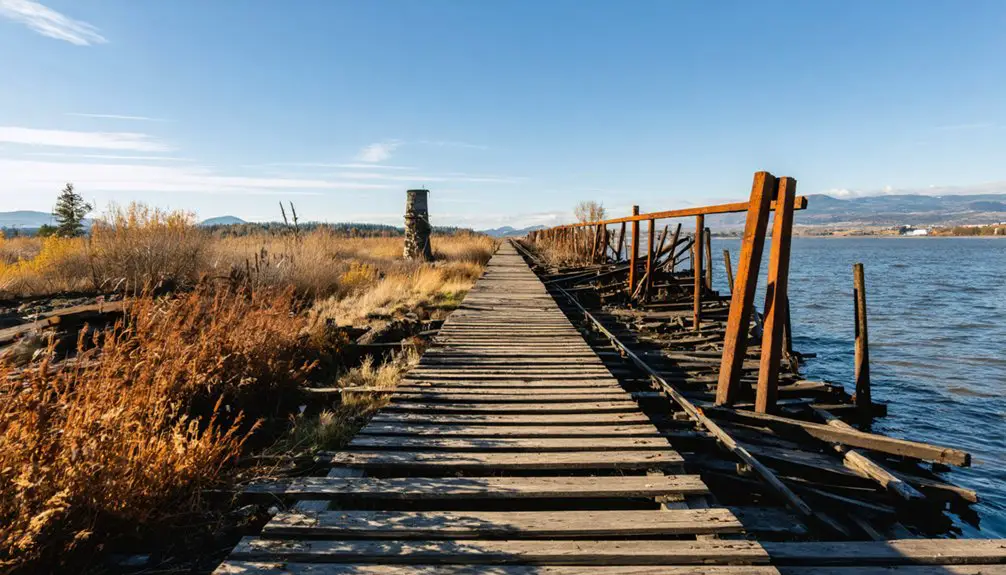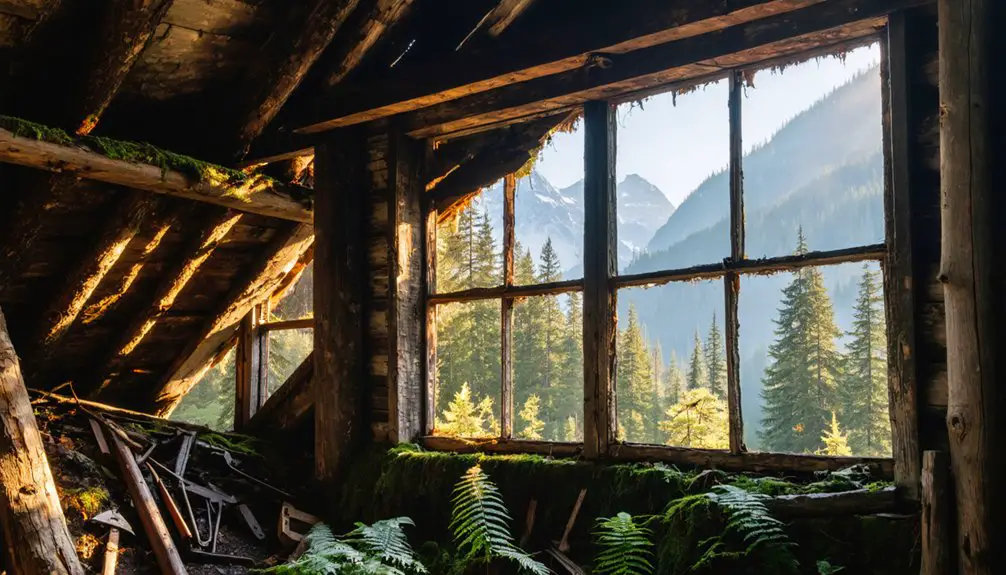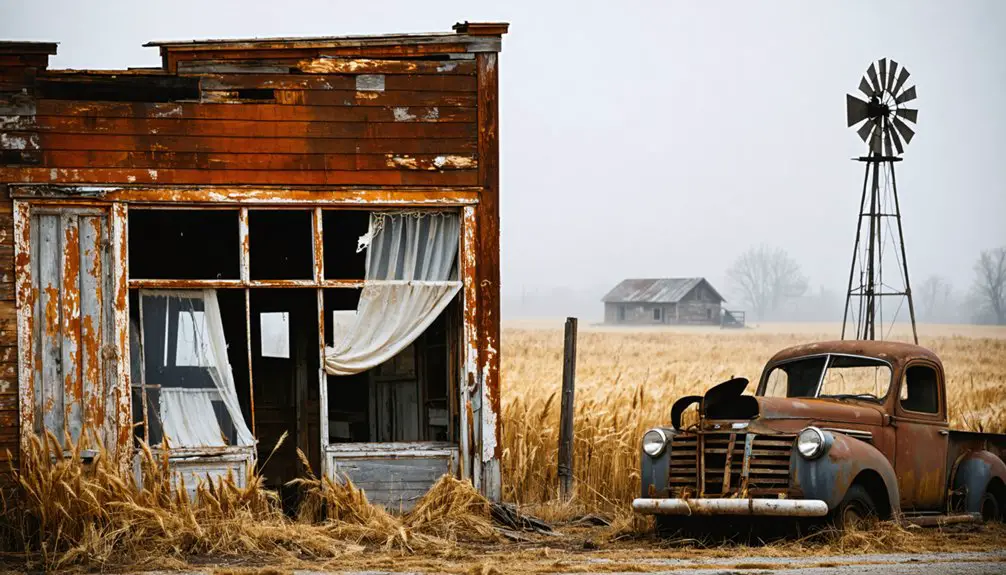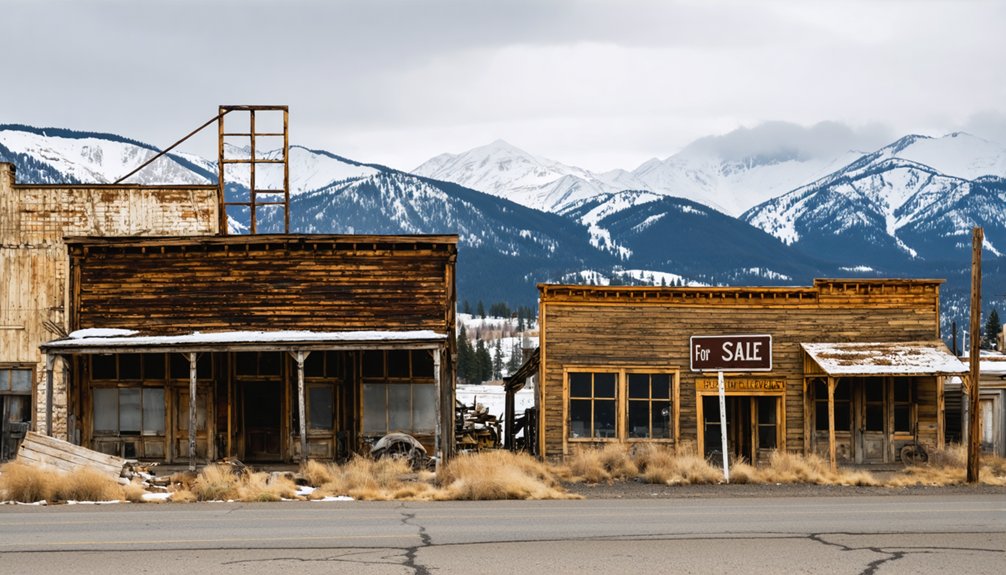
You’ll find limited ghost town properties currently for sale in Washington, with the most notable being the Woodinville Ghost Town Estate at $1.8 million—featuring authentic period structures including a saloon, jail, and grocery store on five acres. Other opportunities include the historic Concrete High School from 1952 and Sherman’s 1888 church with schoolhouse near Highway 2. Washington’s wet climate has left only 130-151 documented ghost town sites, most in decay, making available properties rare compared to drier neighboring states. Below, you’ll discover specific listings and investment strategies.
Key Takeaways
- Woodinville Ghost Town Estate offers a complete ghost town with saloon, jail, and grocery store for $1.8 million near Seattle.
- Sherman Ghost Town features an 1888 church and historic schoolhouse, located 15 minutes northeast of Govan off Highway 2.
- Concrete High School, a 1952 building featured in film, attracts restoration developers with unique architectural design and gymnasium.
- Washington has 130-151 documented ghost town sites, though most face decay from wet climate and remote mountain locations.
- Ghost town properties provide existing infrastructure and development potential for tourism venues, events, and home-based businesses.
Woodinville Ghost Town Estate: A Million-Dollar Western Experience
A rare opportunity awaits just 30 minutes from downtown Seattle, where $1.8 million buys you more than a three-bedroom log home—it delivers an authentic 1800s Western ghost town on five pristine acres in Woodinville.
Originally known as Silvana, this western heritage site includes genuine period structures: a saloon, jail, and grocery store arranged across wooded acreage bisected by Little Bear Creek.
Step through history with authentic Western structures—saloon, jail, and grocery store—scattered across creek-side acreage in this rare heritage property.
The 1933 log home offers modern comfort with recent roof, heating, and cooling upgrades, while a seven-car garage accommodates 40+ vehicles.
The property potential here exceeds typical residential boundaries. You’ll find wine tasting venues, event hosting capabilities, and artist studio possibilities within the historic buildings. The property is zoned for home-based business with favorable tax rate at 7.8% in unincorporated Snohomish County.
Flowering gardens, wooded trails, and natural water features create multiple zones for commercial ventures or private recreation—your escape from conventional living. Windermere Real Estate agent Kari Haas manages the listing for this distinctive property.
Concrete High School: Leonardo DiCaprio’s Film Location Now Available
When Leonardo DiCaprio’s film crew needed an authentic Pacific Northwest backdrop, they found it in Concrete’s 1952 high school—and now you can own this architecturally distinctive piece of cinema history.
This concrete structure spans Superior Avenue like a bridge, creating a tunnel where buses once sheltered students from weather—a feature that caught Hollywood’s attention.
Your investment includes the main building plus the 1923 wooden gymnasium, funded by mill worker Mike Moore’s bequest.
The property’s Film Legacy attracts restoration developers and cinema enthusiasts alike, while its proximity to Devil’s Tower and the annual Ghost Walk connects you to Concrete Hauntings tourism.
Near North Cascades gateway, this 800-resident town offers authentic ghost town atmosphere with modern accessibility—perfect for commercial development or unique residential conversion. The Concrete Theatre serves as a cultural anchor, screening classic films and hosting community events that keep the town’s entertainment tradition alive.
The area’s position between Seattle and Vancouver in Skagit County provides strategic access to major metropolitan markets while maintaining its remote character.
Sherman Ghost Town: Church and Schoolhouse Near Highway 2
You’ll find Sherman’s 1888 white country church and historic schoolhouse just 15 minutes northeast of Govan off Highway 2, accessible via a dirt road cutting through Lincoln County farmland.
The church sits perched on higher ground with its original steeple intact, while the schoolhouse—shuttered since the 1940s—remains visible nearby alongside a small cemetery with gravestones dating to the 1880s.
These structures represent some of Washington’s most photographed ghost town remnants, offering you tangible pieces of the homesteading era that shaped eastern Washington’s agricultural landscape.
The cemetery contains generations of families who worked the surrounding farmland, their simple graves overlooking the rolling fields they once cultivated.
Sherman’s population declined as new roads attracted residents to larger towns like Spokane, leaving behind these creepy remaining structures in the wide-open terrain.
Historic Structures Still Standing
Sherman’s white country church stands prominently on higher ground, its steeple piercing the sky as a tribute to the Presbyterian or Lutheran settlers who built it during the 1880s homesteading boom.
You’ll find this structure remains in remarkable condition—a symbol of historic preservation and the area’s dedication to maintaining its heritage. The church features stained glass windows that capture attention upon entry, reflecting the spiritual significance of this hilltop sanctuary. Behind the church, a small cemetery holds multiple generations, including a Civil War veteran, while offering sweeping views of Lincoln County’s rolling farmland.
The original schoolhouse, where local great-grandmothers once taught, collapsed decades after closing in the 1940s but still attracts photographers. Picnic tables and maintained fences throughout the site indicate ongoing care for Sherman despite its abandonment in the 1990s.
Located 15 minutes northeast of Govan off Highway 2, these structures represent tangible investment opportunities for those seeking authentic community engagement with Washington’s pioneer past.
Wide-open terrain allows unrestricted exploration of these homesteading-era remains.
Location and Access Details
The journey to Sherman begins just a few miles off US Highway 2, where a small dirt road cuts through Lincoln County’s sloping farmland like a natural gully.
You’ll pass weathered homesteads and barns before reaching the white country church perched on higher ground—one of eastern Washington’s most photogenic ghostly landmarks. The site sits north of Wilbur and south of Brodie, positioned where farmland meets mountains in a landscape that reveals why settlers once saw opportunity here.
Access Considerations:
- The dirt access road remains passable year-round but requires vehicles capable of handling rural terrain
- Sherman’s proximity to Highway 2 makes it ideal for ghost town road trips between Govan and other hidden treasures
- The elevated church location provides commanding views of Lincoln County’s rolling agricultural expanse
- Visitors will also find a historic cemetery alongside the church and schoolhouse, completing the preserved community structures
The town name refers to multiple locations across the United States, so travelers should confirm they’re navigating to the correct Sherman ghost town in Lincoln County, Washington.
Molson: Pioneer Artifacts in Okanogan County
Nestled 15.1 miles east of Oroville in Okanogan County, Molson stands as Washington’s best-preserved ghost town, offering investors and history enthusiasts a rare glimpse into frontier mining life.
Founded in 1898 with $170,000 from Canadian brewing heir John W. Molson, this settlement boomed to 700 residents before mines dried up in 1901. The Molson history includes a bitter land feud forcing the town’s 1909 relocation half-mile north—residents even moved their bank on skids.
Today’s Old Molson Ghost Town Museum showcases authentic pioneer heritage through preserved buildings, mining tools, and artifacts.
You’ll find the original bank, schoolhouse, and Hotel Tonasket standing free to explore year-round during daylight hours.
Located just 1.7 miles from modern Molson at 3,708 feet elevation, this property-rich area represents untapped development potential near the Canadian border.
Monte Cristo: Remote Mining Town Accessible by Trail
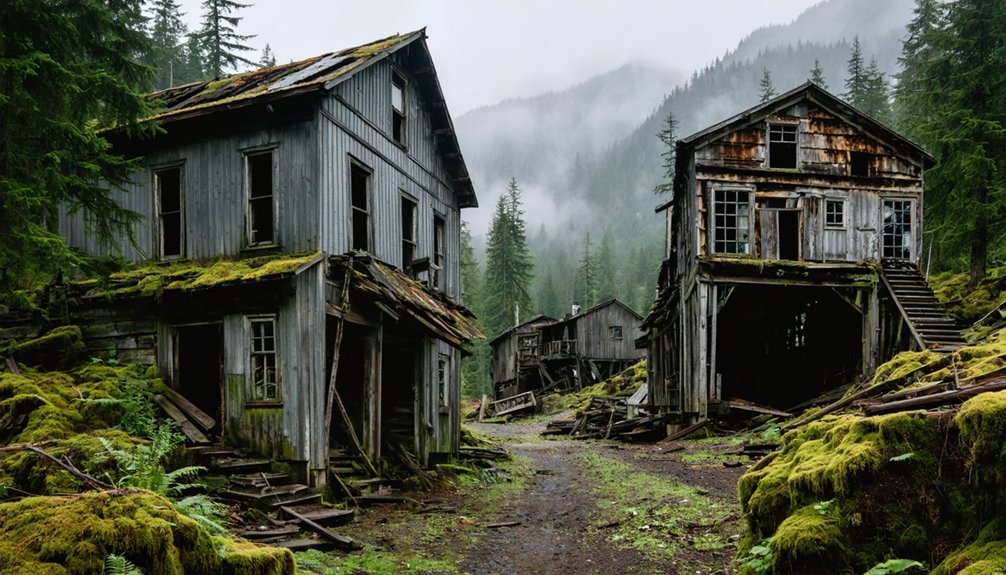
You’ll reach Monte Cristo via an 8-mile round-trip hike from Barlow Pass, following a closed road that once served this remote mining camp in eastern Snohomish County.
The trail delivers you to Washington’s first live mining operation on the west slopes of the Cascades, where 13 mines and 211 claims once attracted investors like Rockefeller’s syndicate between 1889 and 1907.
This isn’t a drive-up ghost town—it’s a backcountry trek that reveals rusted equipment, labeled building sites, and interpretive signs documenting the boom-and-bust cycle that defined Monte Cristo’s turbulent history.
8-Mile Hike Access
Reaching Monte Cristo requires a commitment to an 8-mile round-trip hike along a closed road that floods periodically washed out in 2003 and 2006.
You’ll start from Barlow Pass trailhead, following the largely level route along South Fork Sauk River. While the trail’s well-graded for families, expect downed trees and occasional snow patches.
The Monte Cristo Preservation Association handles trail maintenance, including the log crossing with rope handrail that grants river access. Don’t worry—hiking safety concerns about this crossing are often exaggerated.
Key Access Points:
- CERCLA access road sits 0.75 miles east of Barlow Pass on the highway’s south side
- Biking works on this route despite obstacles, with bike racks available in town
- No Northwest Forest Pass required under certain agency allowances
Push past the red train station to reach the actual ghost town.
Abandoned Mining Site History
Once you arrive at the townsite, you’re standing in what was the first live mining camp on the west slopes of the Cascade Range—a settlement that exploded from silver ore discovery in 1889 to a population exceeding 1,000 by 1894.
The mining legacy here reveals ambitious infrastructure: a five-story concentrator, aerial tramways, and the Everett and Monte Cristo Railroad completed in 1893.
John D. Rockefeller’s syndicate acquired controlling interest, while Frederick Trump operated a hotel.
Yet the boom lasted barely a decade—erratic ore bodies, devastating 1897 floods, and harsh winters forced abandonment by 1907.
Today, remnants of saloons, hotels, and mine structures remain scattered throughout the valley, where ghost stories echo through collapsed timber frames and rusted machinery.
Distressed Properties and Forgotten Structures Across Washington
Washington’s ghost towns represent a unique category of distressed properties where history, abandonment, and untapped potential converge across diverse landscapes.
You’ll find forgotten structures scattered from the Okanogan Highlands to Mount Rainier’s foothills, each offering distinct investment possibilities.
Sherman’s standing church and schoolhouse provide tangible assets near Highway 2, while Monte Cristo’s remote mining remains attract adventurers willing to hike eight miles.
Franklin’s sealed mine shafts and coal cart tracks along Highway 410 preserve industrial heritage, and Ruby’s stone foundations mark where six general stores once thrived.
Key property characteristics across Washington’s ghost towns:
- Remote locations offer privacy and escape from urban regulation
- Existing infrastructure (roads, trails, foundations) reduces development costs
- Historic designations can reveal grants and preservation funding
Historic Homes: From Black Diamond to Seattle Waterfront
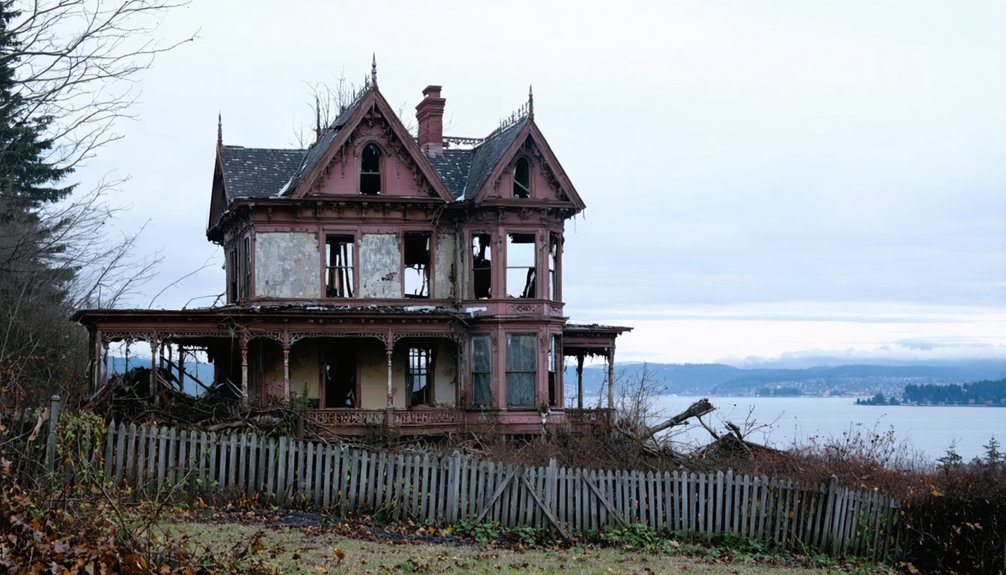
The architectural legacy of Black Diamond’s coal-mining era presents tangible investment opportunities where century-old structures still command Main Street and residential blocks.
You’ll find properties like the 1893 Post Office Building—complete with walk-in vault and second-floor residence—recently acquired for restoration.
The 1926 Ancito Magnani House on Merino Street offers three stories with wraparound porch potential, while the circa-1896 Luigi and Aurora Pagani House preserves Italian immigrant cultural heritage.
These heritage properties deliver authentic immigrant narratives alongside structural integrity—cultural capital that translates directly into market differentiation and premium valuations.
Even modest 1910 miner’s cabins on former company land have achieved landmark status.
The restored Railroad Depot proves architectural preservation pays off—transformed from abandoned freight station to functioning museum.
These aren’t decorative relics; they’re income-generating assets with protected historical designation that shields your investment from arbitrary development restrictions.
Why Washington Ghost Towns Are Rare Compared to Neighboring States
While neighboring states showcase hundreds of well-preserved mining camps and frontier settlements, Washington’s ghost town inventory tells a different story—you’ll encounter roughly 130-151 documented sites, but most amount to foundations, rusted equipment, or empty clearings where communities once thrived.
Washington’s wet climate and dense forests accelerate structural decay, contrasting sharply with arid Nevada or California where ghost town preservation naturally extends decades longer. The state’s mining boom impacts proved fleeting—Monte Cristo collapsed by 1907, while railway shifts depopulated towns like Govan when Spokane-bound roads redirected commerce.
Key factors limiting Washington’s ghost town market:
- Remote mountain locations demand challenging hikes, deterring preservation investment
- Military action erased Hanford completely in 1943, removing acquisition opportunities
- Southwest competitors offer intact structures from 1880s rail expansion, attracting freedom-seeking buyers
Turning Abandoned Properties Into Tourism and Event Venues
Ghost town properties transform into revenue-generating assets when you develop clear tourism or event strategies before acquisition.
Washington’s ghost town tourism opportunities differ from neighboring states due to limited available properties, making strategic planning essential. You’ll need to assess whether free-access models like Molson’s drive sufficient foot traffic or if admission fees better match your financial goals.
Event venue conversion opportunities leverage authentic 1800s architecture for weddings and film productions.
Properties like Woodinville’s Western-style buildings demonstrate how period-specific environments command premium pricing. You’ll want infrastructure supporting parking, utilities, and seasonal operations.
Consider diversifying income through commercial rentals and vacation units. Properties near natural attractions maintain year-round visitor interest, reducing seasonal revenue fluctuations.
Restoration costs require balancing historic preservation standards with modern accessibility requirements.
Frequently Asked Questions
Can You Live Full-Time in a Purchased Ghost Town Property?
Yes, you can achieve full-time residency in Washington ghost towns if they meet local building codes and zoning requirements. Properties like Silvana offer modern amenities within a ghost town lifestyle, blending historic charm with practical living.
What Permits Are Needed to Operate Commercial Events at Ghost Towns?
You’ll need event permits from your county for commercial activities, following commercial regulations specific to your ghost town’s location. Requirements vary by jurisdiction, but expect applications for insurance, liquor licenses, and safety inspections before hosting.
Are Ghost Town Properties Eligible for Historic Preservation Tax Credits?
You’ll likely find preservation eligibility elusive since most ghost towns lack National Register status, but if yours qualifies, historic tax incentives could slash your renovation costs by 20%—turning ruins into revenue-generating freedom.
How Do Utilities and Road Access Work for Remote Ghost Towns?
You’ll face significant challenges: most remote ghost towns lack existing utilities, requiring costly off-grid solutions. Road maintenance falls on you, often involving gated Forest Service routes or washed-out trails needing permits and substantial utility installation investments.
What Are Typical Annual Maintenance Costs for Abandoned Historic Structures?
Your maintenance expenses will hit $10,000-$50,000 yearly for basic security, weather protection, and code compliance. Restoration challenges multiply without intervention—a Toledo-sized property averages $1.4 million in emergency services alone, threatening your investment’s viability.
References
- https://www.businessinsider.com/washington-home-ghost-town-backyard-for-sale-photos-2021-7
- https://stateofwatourism.com/ghost-towns-of-washington-state/
- https://www.ezhomesearch.com/blog/towns-for-sale-in-the-usa/
- https://seattledreamhomes.com/abandoned-high-school-for-sale-in-washington-state/
- https://www.zillow.com/wa/historic_att/
- https://nerdist.com/article/western-ghost-town-washington-state-listing/
- https://www.landsearch.com/distressed/washington
- https://www.usa.gov/real-estate-sales
- https://www.foxnews.com/story/wash-town-put-itself-up-for-sale-5-years-ago-still-hasnt-found-buyer
- https://www.abandonedwashingtonstate.com