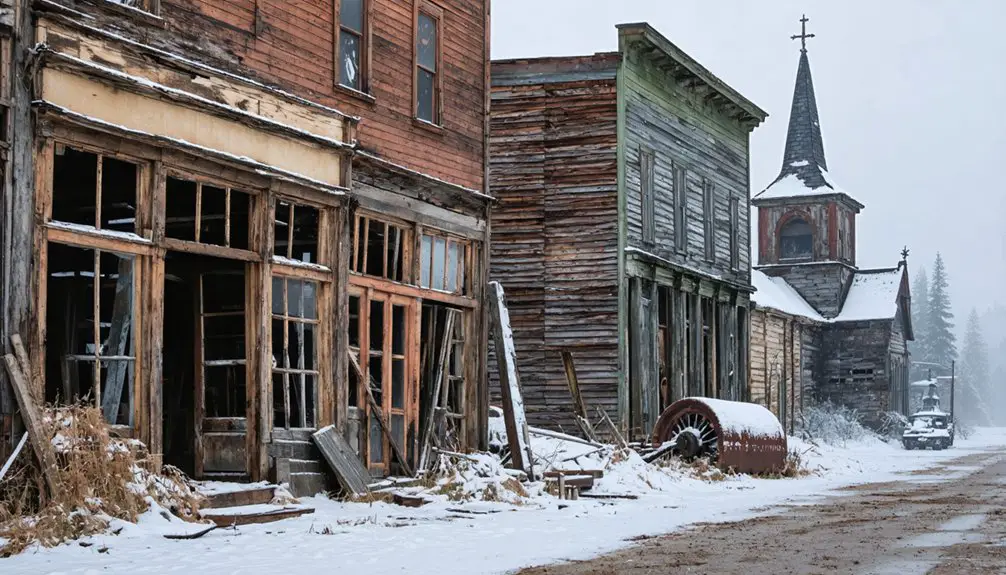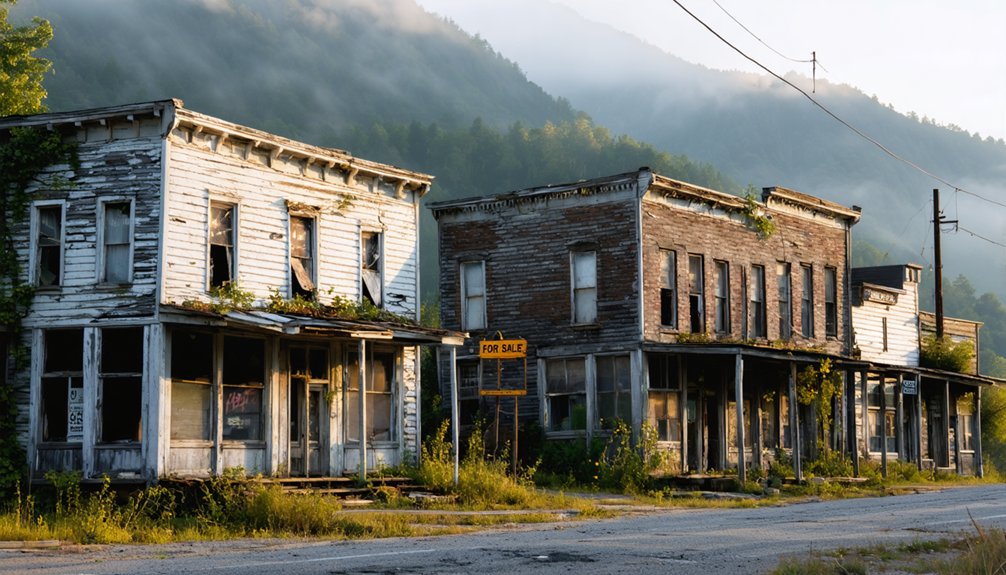
You can purchase entire ghost towns in West Virginia for surprisingly modest prices, with properties like the former Cold War naval base at Sugar Grove (sold for $4 million in 2017) and historic mining communities like Borgman available on the market. These abandoned settlements offer unique investment opportunities in Appalachian heritage, though you’ll need to navigate significant challenges including infrastructure failures, environmental concerns, and hidden costs that can exceed $150 million for demolition and restoration. The following sections explore specific properties, legal complexities, and potential redevelopment strategies.
Key Takeaways
- Several ghost towns are available, including Sugar Grove, Borgman, Thurmond, and the historic Itmann Company Store with unique features.
- West Virginia ghost town properties average $147,854, with land prices at $16,134 per acre, below typical market rates.
- Buyers face hidden costs beyond purchase price, including demolition expenses and infrastructure repairs for abandoned structures and utilities.
- Zoning regulations and municipal codes require careful navigation, with potential fines and mandatory preservation requirements affecting renovations.
- Restoration opportunities exist for tourism development, particularly Airbnb conversions and cultural heritage attractions in preserved historic buildings.
When the Naval Research Laboratory selected a remote Pendleton County site in 1955, they envisioned a 600-foot radio telescope that would pierce the depths of space.
Instead, construction beginning in 1960 birthed something far different: a sprawling Cold War listening post. By 1969, two massive Wullenweber arrays—each 1,000 feet across—intercepted Soviet communications as America’s primary east coast HF receiving site.
The historical significance runs deep. This wasn’t just another military installation; it operated as part of ECHELON’s global surveillance network, staffed by 130 personnel operating from a 60,000-square-foot underground facility. The facility’s location within the National Radio Quiet Zone, established in 1958, ensured freedom from electromagnetic interference across 13,000 square miles. The facility intercepted all international communications entering the eastern United States during its operational years.
After closure in 2015, the investment potential beckons. The 123-acre lower base sold for $4 million in 2017, offering infrastructure that once supported complete self-sufficiency within the National Radio Quiet Zone‘s protected boundaries.
Borgman: Own an Entire Historic Mining Town
Long before coal transformed the Appalachian economy, German immigrants John Nicholas Borgman, Gerald H. Korte, Garret Arns, and Herman Greaser established their settlement in 1840.
They purchased land in Preston County, Virginia, cleared it for farming, and constructed log cabins—including one dedicated as a church.
This Borgman history evolved dramatically when the Borgman Coal Company developed the area into a bustling mining community.
At its peak, the coal mines employed over 200 individuals before ceasing operations in the 1980s.
Today, you’ll find this entire town listed for sale—a first for Preston County.
The mining legacy remains visible through retention ponds from strip mining operations.
Current listings include four homes in the Borgman Tunnelton area, with median prices around $235,000.
The 41.46-acre parcel offers young timber stands, diverse wildlife, and opportunities for hunting, hiking, or building your retreat in authentic West Virginia mountain country.
For those seeking a larger historic property, the Pocahontas Fuel Company headquarters in Itmann represents one of the finest examples of coal-industry architecture available in the state.
Thurmond: The Abandoned Railroad Ghost Town
You’ll find Thurmond clinging to the New River’s edge, once the busiest freight depot on the entire Chesapeake & Ohio mainline—handling more cargo than Richmond and Cincinnati combined while serving 95,000 passengers annually.
The 1949 switch to diesel locomotives eliminated the need for coal towers and water stops, rendering the rail yard obsolete and reducing the population from hundreds to just five residents by 2020.
The town’s wild reputation earned it the nickname “Dodge City of the East”, with the Dunglen Hotel hosting the longest-running poker game in history—a continuous 14-year marathon that became legendary among gamblers.
At its peak in 1910, the railroad depot generated $4.8 million in freight revenue, representing 20% of the entire Chesapeake & Ohio Railroad’s total income.
While the National Park Service now operates the rehabilitated depot as a visitors center, entrepreneurs have transformed one of the remaining historic structures into an Airbnb, offering guests overnight stays in this remarkably preserved railroad ghost town.
Railroad Hub History
Though Captain W. D. Thurmond acquired 73 acres along the railroad in 1873, it wasn’t until the 1888 depot construction that the town truly awakened. The completion of the New River bridge that same year catalyzed rapid railroad expansion.
By 1893, the Loup Creek branch line reached Glen Jean, ultimately serving 26 mines and becoming C&O’s busiest spur.
You’d witness unprecedented freight operations by 1910—Thurmond handled more cargo than Richmond and Cincinnati combined. Nearly 95,000 passengers passed through annually while 18 train crews and over 150 railroad workers kept operations running around the clock.
The 100-foot turntable turned locomotives, coal towers fueled them, and dispatchers coordinated the relentless flow of black diamonds from southern West Virginia’s seams to industrial America’s furnaces. The 1904 train depot that still stands today served as the nerve center of these operations, a structure that would later transition into both a visitor center and an Amtrak flag stop.
The town’s prosperity attracted the Armour Meatpacking Plant, which operated from 1905 to 1932, supplying the thriving railroad community before eventually burning down in 1963.
Current Airbnb Opportunity
The diesel revolution that rendered Thurmond’s infrastructure obsolete has paradoxically created its modern value proposition.
You’ll find a ghost town with just five residents sitting within New River Gorge National Park & Preserve, where vacation rentals capitalize on adventure seekers drawn to rafting and hiking.
The abandoned 1925 coaling tower and preserved National Bank building from 1917 anchor historical tourism opportunities that transform decay into revenue streams.
Annual reunions create seasonal demand spikes you can leverage for short-term stays.
Active CSX tracks remind visitors they’re experiencing authentic railroad heritage, not manufactured nostalgia.
The train station functions as an information center managed by the National Park Service, providing visitors with historical context while maintaining Thurmond’s educational tourism infrastructure.
During its peak from 1900 to 1920, Thurmond processed 15 trains daily, establishing the commercial foundation that today’s experiential businesses exploit.
With limited commercial activity and strategic gorge access, you’re looking at experiential lodging potential—glamping sites and private retreats where history enthusiasts pay premium rates to inhabit America’s industrial past.
Itmann Company Store: A National Historic Landmark Property
When Isaac T. Mann founded Pocahontas Fuel Company‘s operations in 1916, he created more than a mining town—he established a self-contained community along the Guyandotte River.
The Itmann history centers on this remarkable complex, where Italian immigrant stonemasons hand-cut native sandstone from nearby cliffs and hauled it across the river to construct architect Alex B. Mahood’s masterpiece between 1923-1925.
The architectural significance of this Classical Revival structure earned National Historic Landmark status in 1990.
You’ll find four buildings that once housed everything miners’ families needed: company offices, post office, poolroom, barbershop, doctor’s office, and a complete store selling goods from clothing to burial caskets.
This isn’t just another abandoned property—it’s your chance to own tangible American industrial heritage, where independence-minded immigrants built their futures in West Virginia’s coalfields.
Distressed Properties: Affordable Investment Options Across the State
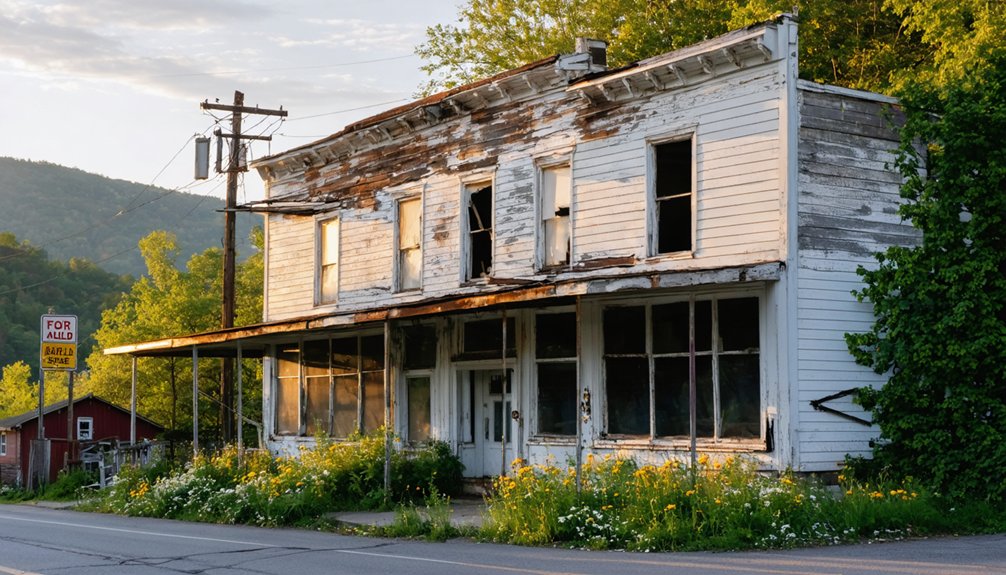
Beyond National Historic Landmarks like Itmann’s company store, West Virginia’s real estate market holds seventeen distressed properties averaging $147,854—bank-owned foreclosures and neglected homesteads where financial hardship has created unexpected opportunities.
You’ll find land priced at $16,134 per acre, considerably below market rates for comparable terrain. These distressed properties offer genuine investment potential for those willing to restore what others abandoned.
From Buckhannon lots at $49,900 to 54-acre parcels near West Union for $92,000, you’re looking at frontier economics: acquire undervalued assets, apply sweat equity, and claim territory others couldn’t hold.
Frontier economics in practice: acquire what others surrendered, apply labor, claim undervalued territory as your own.
The Simmons Farmstead’s 75 acres with deteriorating log structures exemplify this pattern—decay creating access points for those seeking autonomy outside conventional real estate channels. Financial distress becomes your advantage.
Abandoned Properties Through the Land Bank Team
Since 2014’s enabling legislation, West Virginia’s land bank system has transformed how municipalities reclaim properties that defeated previous owners—over 20,000 buildings statewide requiring immediate demolition, remnants of population decline that converted housing abundance into structural liability.
The West Virginia Land Stewardship Corporation operates as your statewide gateway to these abandoned properties, issuing grants for demolition and rehabilitation in communities under 15,000 population.
You’ll find acquisitions starting at $1,000 through the Land Bank Team’s streamlined processes, targeting vacant structures burdening local governments after natural resource economy collapse.
From Nitro’s downtown mixed-use districts to Morgantown’s former ordnance works, land banks prepare blighted properties for redevelopment—teaching buyers how to navigate acquisition while facilitating productive reuse of what previous generations abandoned.
What You Need to Know Before Buying a Ghost Town
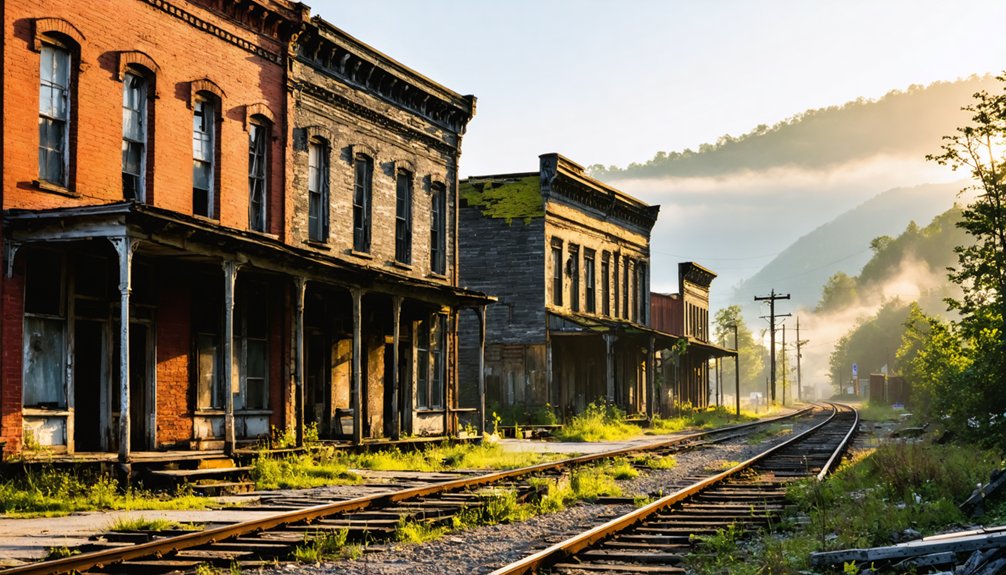
Before you commit to purchasing a ghost town in West Virginia, you’ll need to navigate three critical barriers that have derailed countless would-be preservationists since the 1980s coal collapse.
Legal restrictions often mandate strict renovation timelines—typically two months to begin work and three years to complete it—while properties listed on the National Register carry additional preservation requirements that dictate everything from exterior materials to structural modifications.
You must also account for infrastructure deficits and financial realities that extend far beyond the purchase price, as traditional mortgage financing remains unavailable and renovation costs routinely exceed initial estimates by factors of five to ten.
Legal Considerations and Restrictions
When you contemplate purchasing a ghost town in West Virginia, you’re not simply acquiring abandoned buildings—you’re inheriting a complex web of municipal codes, county ordinances, and state regulations that govern every structure on the property.
Counties wield authority to declare dilapidated structures public nuisances, compelling you to repair or demolish buildings threatening public safety. Property maintenance requirements demand immediate attention to abandoned refrigerators, unsecured structures, and vehicles left beyond five days.
Zoning regulations vary by municipality, with enforcement agencies authorized to obtain administrative search warrants for inspections. You’ll face potential fines up to $200 and six months’ imprisonment for violations.
Farming exemptions exist for agricultural buildings on active farmland. Before committing capital, examine existing ordinances governing your prospective ghost town—ignorance provides no defense against code enforcement actions.
Infrastructure and Utility Assessment
Abandoned coal towns across West Virginia present a deceptive facade—weathered storefronts and intact structures mask catastrophic infrastructure failures that transformed these settlements into economic graveyards.
You’ll encounter crumbling roads requiring million-dollar repairs, septic systems serving scattered mobile homes, and electrical grids so unreliable that generators become necessities.
McDowell County exemplifies these infrastructure challenges—no cell signal reaches Welch, water supplies carry acid mine drainage contamination, and sewer systems desperately need replacement.
The $5 billion reclamation estimate for 173,000 acres of pre-1977 mining damage reveals the scope of utility upgrades you’re confronting.
Subsidence threatens roads, abandoned highwalls create hazards, and 80% population drops left maintenance systems completely overwhelmed.
Freedom from municipal codes comes with freedom from functional utilities.
Financial Requirements and Hidden Costs
While property acquisition costs might appear negligible in West Virginia’s ghost towns—sometimes mere thousands of dollars for entire blocks—you’ll confront financial obligations that dwarf initial purchase prices.
Demolition represents the most significant financial pitfall: statewide estimates exceed $150 million for 8,000 structures requiring removal. Even pilot programs charging $100 monthly per property won’t address your immediate needs.
You’ll inherit tax-delinquent liabilities that multiply through municipal liens, decreased property values, and compounding back taxes. Properties assessed under $50,000 trigger land bank interventions, while unredeemed tax sale properties face deed forfeiture within three years.
Hidden expenses include escalating fire and police protection costs from abandoned structures. Historic rehabilitation demands 50% cash matches exceeding $1,000 minimum thresholds—financial realities that transform bargain purchases into burdensome commitments.
Transforming Ghost Towns: Potential Uses and Development Ideas
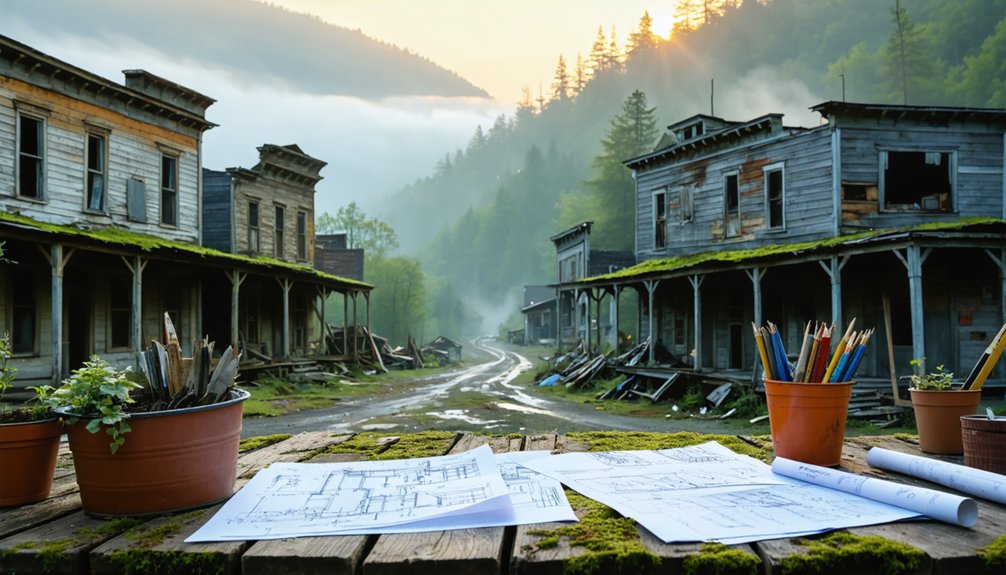
West Virginia’s ghost towns present distinct redevelopment opportunities shaped by their original industrial functions and remaining infrastructure.
You’ll find adaptive reuse possibilities in sites like Sugar Grove’s former naval base, which contains gymnasiums, fire stations, and preschools ready for transformation.
The Itmann Company Store demonstrates how cultural tourism can revitalize historic properties through National Register designation.
National Register designation transforms abandoned company stores into heritage tourism anchors that generate economic value while preserving community history.
Consider these development pathways:
- Heritage Tourism Operations: Convert saloons, banks, and general stores into immersive 1800s experiences near Hatfield-McCoy Trails
- Secure Technology Facilities: Leverage remote locations without cell service for cyber security operations
- Mixed-Use Communities: Transform mining towns with original log cabins into modern residential developments
Your investment can preserve coal-era architecture while creating economically viable enterprises that honor these communities’ authentic industrial heritage.
Frequently Asked Questions
What Are the Typical Property Tax Rates for Ghost Town Properties?
You’ll face West Virginia’s standard 0.51%–0.69% effective rates on ghost town properties, though property assessment methods and available tax exemptions vary by county. Historical structures might qualify for preservation incentives, reducing your annual burden while maintaining ownership freedom.
Can Foreign Investors Purchase Ghost Town Properties in West Virginia?
No, you can’t if you’re from China, Russia, or other designated foreign adversaries. West Virginia’s 2025 foreign ownership law blocks these parties from purchasing any real estate under strict investment regulations.
Are There Restrictions on Commercial Activities in Former Mining Towns?
You’ll face zoning regulations and historical preservation requirements in former mining towns, particularly those on the National Register. However, National Park oversight has relaxed since prohibition-era bans ended, though restoration work remains strictly controlled to preserve period-specific character.
What Insurance Coverage Is Available for Abandoned or Historic Properties?
You’ll find Historic Replacement Cost coverage and property liability protection for structures listed on registers or built pre-1950. Historic preservation easements mandate authentic restoration using period-correct materials, though premiums run 20% higher than standard policies.
How Long Does the Purchasing Process Take for Entire Towns?
Town acquisition buying timelines typically span 10+ years through government channels, as Thurmond’s 1985-1995 process demonstrates. You’ll find private purchases lack documented precedents, since ghost town transfers remain extraordinarily rare, complex transactions requiring patient negotiation.
References
- https://www.zillow.com/wv/free-gas_att/
- https://www.youtube.com/watch?v=T8Ep1C0_r9o
- https://www.youtube.com/watch?v=5WU-h9HhU9M
- https://www.wvnews.com/prestoncountynews/news/preston-town-for-sale/article_0d9b3410-0853-11ed-ade5-afe1c82ad0b5.html
- https://landbankuniversity.org/west-virginia/
- https://foxfirenation.com/listings/the-historic-itmann-company-store/
- https://www.landsearch.com/distressed/west-virginia
- https://www.oldhousedreams.com/state/west-virginia/
- https://coldwar-c4i.net/Sugar_Grove/history.html
- https://theclio.com/entry/65422