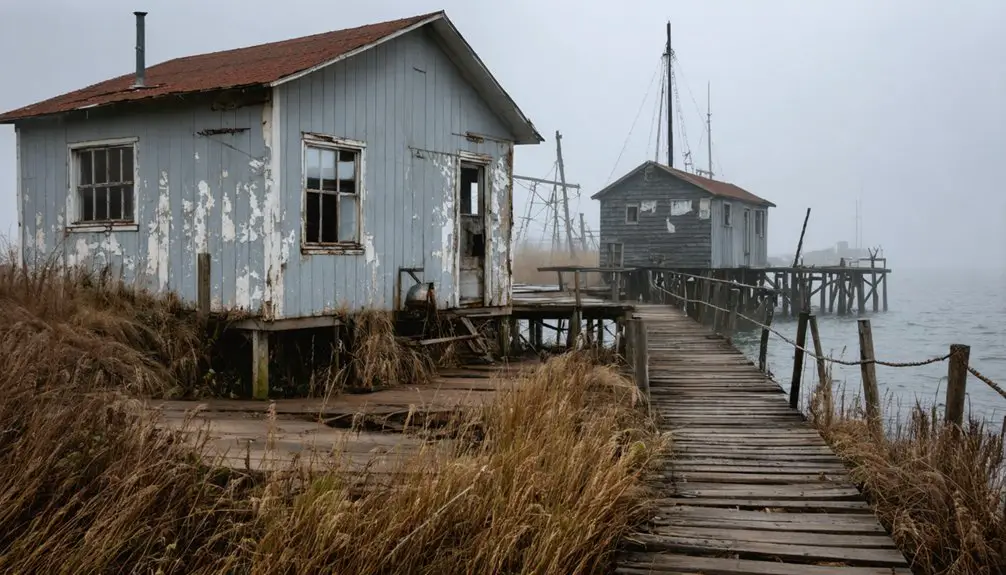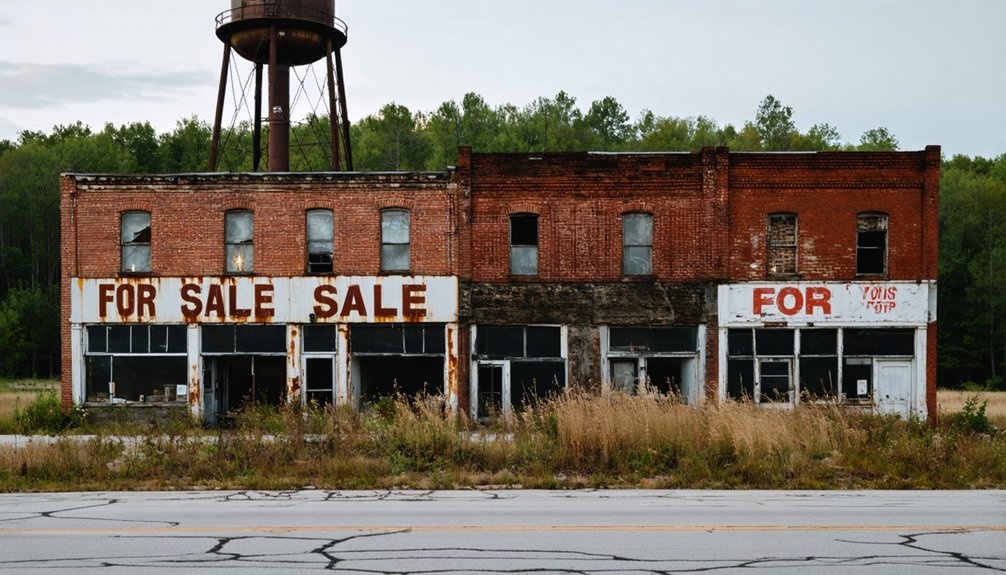
You won’t find entire Western-style ghost towns for sale in Wisconsin, but you’ll discover dozens of distressed properties and surplus land parcels in depopulating communities like Rhinelander, Wausau, and Stevens Point where demographic decline has created unique preservation opportunities. Properties range from $7,381-per-acre rural land to government surplus parcels once priced at $14,000-$59,000, with nearly 100 rural listings featuring outbuildings. These emerging “ghost conditions” stem from the 2025 housing bubble collapse, which left abandoned listings and rising vacancy rates across former vacation markets. Understanding Wisconsin’s specific zoning regulations and structural assessment requirements will help you navigate these historically significant investment opportunities.
Key Takeaways
- Wisconsin offers nearly 100 rural land listings with outbuildings, requiring structural and environmental assessments before purchase.
- Unrestricted parcels average $260,076, while government surplus lands historically ranged from $14,000 to $59,000 in northern counties.
- Towns like Rhinelander, Wausau, Stevens Point, and Marshfield show depopulation patterns with stagnant sales and rising vacancy rates.
- Investment opportunities include tourism businesses, agricultural development, and community revitalization projects in declining rural areas.
- Challenges include extensive repairs, complex zoning regulations, limited utilities, and environmental concerns requiring thorough research.
Understanding Wisconsin’s Emerging Ghost Town Phenomenon in 2025
While Wisconsin lacks the abandoned mining camps and dusty storefronts characteristic of Western ghost towns, the state faces a subtler form of depopulation in 2025.
You’ll find ghost town dynamics manifesting through lingering listings and persistent price cuts that fail to attract buyers. These population shifts evade major headlines, yet they’re reshaping Wisconsin’s smaller communities.
The housing bubble’s effects contribute to these quiet demographic changes, with some towns showing early signs of emerging ghost conditions. Unlike the dramatic Western abandonments, Wisconsin’s transformation happens incrementally—through unsold homes and departing families.
Rising inventory levels compound the market stress as weak demand fails to absorb available properties. You won’t find complete towns listed for sale here, but the underlying market stress signals a preservation challenge that demands attention before these communities fade from Wisconsin’s landscape entirely. Before considering any distressed property investment, thorough research on zoning laws and county regulations is essential to understand what development or restoration projects are legally permissible.
Top Wisconsin Towns Experiencing Depopulation and Housing Decline
You’ll find Wisconsin’s declining towns share patterns documented across the Upper Midwest since 2006, when building permits and occupied housing units began their sustained retreat.
The 2025 housing bubble burst accelerated existing depopulation trends, transforming communities with soaring vacancy rates and untouched listings into case studies of regional demographic shifts.
These towns now mirror national examples like St. Louis and Detroit, where residential vacancies persist beyond two years despite price reductions. Specific communities like Rhinelander, Walau, Stevens Point, and Marshfield face stagnant sales as homes linger on the market with repeated price cuts failing to attract buyers. Madison stands apart with a homeowner vacancy rate of 0.3%, making it the least likely city to face ghost town conditions.
Economic Shifts Driving Abandonment
When the 2025 housing bubble burst, Wisconsin’s smaller communities experienced a dramatic reversal from seller’s markets to abandoned listings, fundamentally altering the state’s rural landscape.
This economic transformation stripped away buyer urgency overnight, leaving vibrant towns like Stevens Point and Marshfield struggling with untouched properties. Price reductions failed to revive momentum as hesitation replaced demand.
Key factors driving this shift:
- Vacation property markets near Petenwell Lake and Lake Holcombe collapsed as recreational buyers vanished.
- Community resilience deteriorated when 16.7% vacancy rates became permanent fixtures rather than seasonal fluctuations.
- Population declines of 8.5% to 14.7% accelerated post-bubble, creating depopulation spirals.
- Median home values stagnated while carrying costs mounted for property owners.
- Investment properties dominate vacancy statistics in areas like Arkdale and Danbury, where second homes sit empty year-round.
- Ownership increasingly revolves around maintaining operations rather than pursuing development in communities where schedules no longer dictate activity.
Your window for acquiring these properties at historic lows narrows as markets stabilize.
Rural Communities Facing Decline
Across Wisconsin’s rural landscape, demographic forecasts paint a sobering picture for communities already grappling with vacancy rates that exceed seasonal norms.
You’ll find Milwaukee, Green Bay, Wausau, and Superior regions projected for massive population drops by 2100. The Upper Midwest documented 13.8 percent more declining zip codes between 2006-2009 compared to previous periods, with housing unit losses concentrating throughout Michigan, Minnesota, and Wisconsin corridors.
These patterns demand rural revitalization strategies that preserve community identity while adapting to shrinking populations.
You’re witnessing decline spreading beyond urban centers into suburban and rural territories, creating clusters of abandonment across the Great Plains and Midwest. Wisconsin joins the broader national crisis as nearly 15,000 U.S. cities face noticeable depopulation before the century’s end.
Researchers from the University of Wisconsin note a lack of housing in small towns, compounding the challenges these communities face. Without community engagement initiatives rooted in self-determination, Wisconsin’s small towns risk joining the 92 American communities that’ve lost fifty percent of their residents since 2010.
Housing Market Warning Signs
Milwaukee’s population trajectory reveals Wisconsin’s most alarming urban decline, with the city losing over 15,000 residents between 2021 and 2023 alone.
These population shifts signal deeper housing trends affecting your property values and community stability. Forecasters predict Milwaukee will shrink to 560,555 by 2025, down from 577,897 in 2020.
The housing market’s warning signs extend beyond Milwaukee:
- Janesville faces projected housing unit decline from 66,070 in 2025 to 65,647 by 2035
- Kenosha and Racine anticipate steady population decreases through 2035
- Milwaukee County lost 14,300 residents in 2022 alone, accelerating depopulation
- Wisconsin projects losing 279,000 residents over 25 years, threatening property demand
You’re watching communities transform as decreased household formation and declining birth rates reshape Wisconsin’s urban landscape. Despite Milwaukee’s 560,124 population in 2025, the city continues experiencing a negative growth rate of -0.6% from the previous year. Milwaukee’s decline rate is tied with Rockford, Illinois as the worst among the region’s largest cities.
Abandoned Properties and Land Currently Available Across Wisconsin
You’ll find abandoned properties scattered across Wisconsin’s rural landscape, from deteriorating farmsteads with original outbuildings to vacant acreage along forgotten county roads.
The Brice Prairie area and similar developments contain lots where earlier settlement attempts left behind structures now requiring documentation of their historical context before demolition or restoration.
These parcels represent physical evidence of demographic shifts, with each abandoned building serving as an artifact of Wisconsin’s evolving settlement patterns since the late 1800s.
Rural Buildings and Outbuildings
Wisconsin’s abandoned property market currently features nearly 100 listings of rural land with outbuildings and derelict structures, representing a significant inventory of buildings that stand as tangible records of the state’s agricultural and settlement patterns.
These properties demand your attention to structural integrity and environmental remediation before implementing rural revitalization strategies. You’ll find abandoned property renovations require specialized assessment of foundation stability, roof decay, and potential contamination from historical farming operations.
Key considerations for rural outbuilding acquisition:
- Unrestricted parcels average $260,076 statewide, offering zoning-free development potential
- Structural documentation preserves architectural heritage while planning modern adaptive reuse
- 23+ acre farms like River Falls’ $165,000 tear-down provide extensive acreage for thorough redevelopment
- Government surplus lands historically ranged $14,000-$59,000 across northern counties
Brice Prairie Development Lots
Located within the Town of Onalaska’s Rivendell Subdivision, Brice Prairie’s development lots represent a shifting landscape where agricultural designations meet suburban expansion pressures documented in La Crosse County’s ongoing land use planning.
You’ll find parcels like Lot 70 on Rivendell Court offering 0.65 acres at $97,400, alongside similar Huntington Court offerings. These quarter-acre to half-acre tracts maintain agricultural zoning despite residential lot development intentions, creating administrative tensions between preservation advocates and growth proponents.
The Town’s thorough plan attempts balancing this friction, acknowledging redevelopment opportunities while warning against unplanned expansion eroding rural character. Access via County Road ZB past Red Pines positions these lots near Lake Onalaska’s recreational amenities.
Annual taxes remain minimal—$1.56 on parcel #010003232000—though concerns persist that accelerated Brice Prairie subdivision could fundamentally alter community identity and fiscal obligations for existing residents.
County Road Property Listings
Beyond individual subdivision tracts, Wisconsin’s broader landscape of available county road properties reveals a complex network of surplus government holdings, foreclosed residential parcels, and landlocked rural acreage that collectively document shifting economic and demographic pressures across the state.
Your search through property listings uncovers abandoned homesteads along forgotten routes, where highway expansion projects displaced communities and left behind scattered parcels.
Sheriff foreclosure sales in Columbia County happen Mondays at 11am, while WisDOT surplus land requires contacting regional coordinators.
BCPL properties span from Douglas County’s $59,000 Bennett parcel to landlocked Rusk County swampland.
Available County Road Property Categories:
- Government surplus parcels from highway projects (structures, houses, buildings)
- Foreclosed residential properties scheduled for courthouse auction sales
- Landlocked rural acreage (92% lowland wooded swamp hardwood)
- Bank-owned properties listed below market value statewide
Featured Listings: Brice Prairie and La Crosse Area Opportunities
The Rivendell Subdivision on Brice Prairie presents six documented vacant land parcels ranging from 0.59 to 0.65 acres, with Lot 70 on Rivendell Court and Unit 1946177 representing preserved subdivision infrastructure from the town of Onalaska’s expansion period.
These properties maintain original access routes via County Road ZB and Lake Park Drive, connecting to established trail systems near Lake Onalaska’s historic boat landing.
Adjacent Huntington Court parcels (Lots 51 and 56) offer 0.61 to 0.64-acre tracts at $97,400 each, reflecting the area’s planned development from La Crosse’s outward growth.
Lake Park Drive Lot 81’s 1.24-acre parcel at $179,900 preserves larger subdivision layouts from the region’s settlement patterns.
Current market data shows 11 available land parcels across Brice Prairie, with median pricing at $267,450.
Investment Potential in Wisconsin’s Declining Rural Communities

As Wisconsin’s rural communities weathered the 2025 housing bubble collapse, investors discovered dormant markets where traditional buyers had vanished entirely.
Stevens Point and Marshfield exemplify hesitant markets where investment strategies focus on long-term community revitalization rather than quick returns. Properties like the 38.6-acre Webster parcel at $7,381 per acre demonstrate accessible entry points for those willing to address demolition and rebuilding challenges.
Critical Considerations for Rural Investment:
- Structural and environmental assessments prevent costly surprises in neglected properties
- Renovation projects transform eyesores into community assets while building equity
- Recreational land near trails and waterways offers diversified use beyond residential development
- Early positioning in declining markets captures opportunities traditional investors overlook
Thorough research remains essential, as unverified listing conditions and safety hazards require experienced evaluation before commitment.
What to Consider Before Purchasing Abandoned Wisconsin Properties
Before committing capital to Wisconsin’s abandoned properties, you’ll need to navigate Wisconsin Statute Section 893.25‘s adverse possession requirements and understand the state’s foreclosure framework under Wis. Stat. § 846.102.
The Carson decision mandates swift sales of abandoned foreclosed properties, often at severely depressed prices through sheriff’s auctions.
Investment risks multiply when you’re evaluating structures with boarded windows, terminated utilities, and trash accumulation—common indicators of abandonment. Severe disrepair from squatters, animal infestations, and vandalism greatly increases restoration costs beyond initial purchase prices.
You’ll face redemption periods ranging from six months for nonresidential properties to one year for owner-occupied residences.
Municipal regulations vary considerably; Brookfield, Douglas County, and Schofield each maintain distinct requirements for abandoned property transactions, demanding thorough due diligence before acquisition.
How Wisconsin Compares to Classic Western Ghost Town Sales
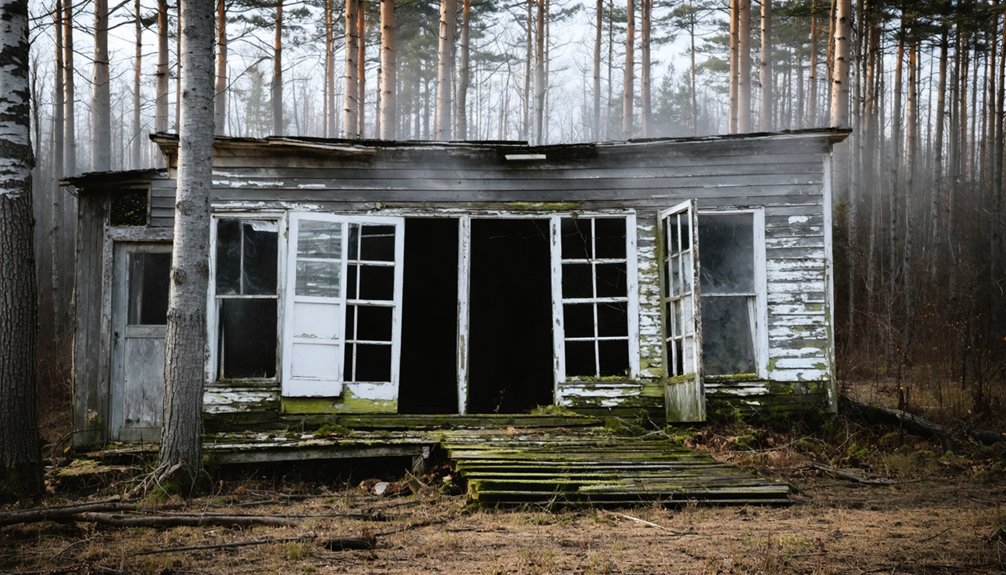
Wisconsin’s abandoned properties differ fundamentally from Western ghost towns in origin, scale, and market positioning. You won’t find 1800s-era mining settlements with saloons and jails here. Instead, Wisconsin’s vacancy stems from 2025’s housing bubble collapse rather than resource depletion.
Western properties command $250,000 to $6.6 million with established tourist potential and historical significance, while Wisconsin offers modern abandoned structures on parcels like Webster’s 38.6 acres at $284,900.
Western ghost towns fetch premium prices for heritage value, while Wisconsin’s affordable acreage reflects recent economic collapse rather than frontier history.
Ghost town economics reveal stark contrasts:
- Western sites preserve authentic frontier architecture from mining and railroad eras
- Wisconsin’s decline reflects contemporary market failures, not century-old abandonment
- Classic ghost towns attract buyers seeking preservation and heritage tourism
- Wisconsin properties lack the romanticized historical narratives that drive Western ghost town valuations
Your investment choice depends on whether you prioritize authentic Western heritage or affordable Midwestern acreage.
Frequently Asked Questions
Can I Legally Live Full-Time in a Purchased Wisconsin Ghost Town Property?
You’ll face absolutely mountains of paperwork, but yes—you can legally establish full-time residency if you navigate zoning regulations and property easements correctly. Your freedom hinges on verifying the land’s legal status and securing necessary permits beforehand.
What Utilities and Services Remain Available in Wisconsin’s Declining Rural Areas?
You’ll find utility availability varies considerably—electricity often remains through rural cooperatives, while water/sewer service accessibility depends on proximity to functioning systems. Municipal services payments don’t guarantee preservation of declining area infrastructure, requiring independent verification before purchase.
Are There Tax Incentives for Revitalizing Abandoned Properties in Wisconsin?
You’ll find Wisconsin’s Supplemental Historic Preservation Tax Credit offers 20% rehabilitation coverage for qualifying properties. However, extensive tax benefits and property grants require researching municipal ordinances, community development programs, and federal incentives applicable to abandoned structures.
How Do I Obtain Clear Title for Long-Abandoned Wisconsin Buildings?
Like clearing fog from forgotten ruins, you’ll pursue quiet title action through Wisconsin Circuit Court after conducting thorough deed research and title search, proving twenty years’ open possession or establishing color of title with continuous occupancy.
What Financing Options Exist for Purchasing Distressed or Ghost Town Properties?
You’ll find specialized rural property loans through local Wisconsin banks, USDA Section 524 site loans, private lenders experienced in unconventional properties, and crowdfunding platforms that support historic preservation ventures requiring patient capital.
References
- https://discoverthestate.com/top-10-wisconsin-towns-turning-into-ghost-towns-after-the-2025-bubble/
- https://www.ezhomesearch.com/blog/towns-for-sale-in-the-usa/
- https://www.aol.com/articles/10-ghost-towns-us-actually-200604529.html
- https://www.homes.com/property/0-rivendell-ct-brice-prairie-wi-unit-1946177/d6q56xj62vl35/
- https://land-wi.com/abandon-buildings-for-sale-wisconsin.html
- https://www.oldhousedreams.com/state/wisconsin/
- https://www.timberghostrealty.com/idx/index.php?pageNum_this=1&state=WI&view=all
- https://oldhousesunder50k.com
- https://www.youtube.com/watch?v=_rrrbHH1Wz8
- https://thelandman.net/wisconsin-land-for-sale-cities-towns-villages.html