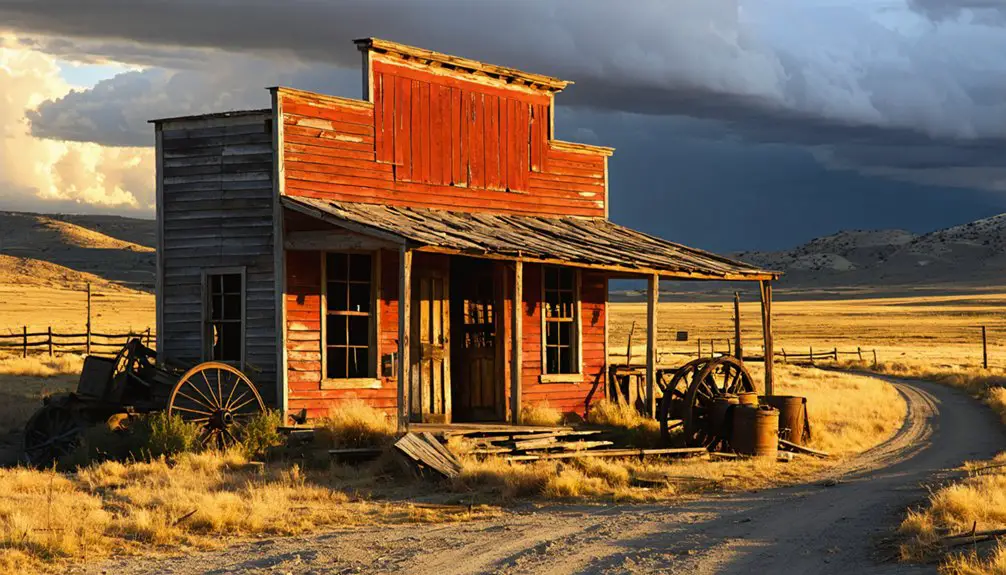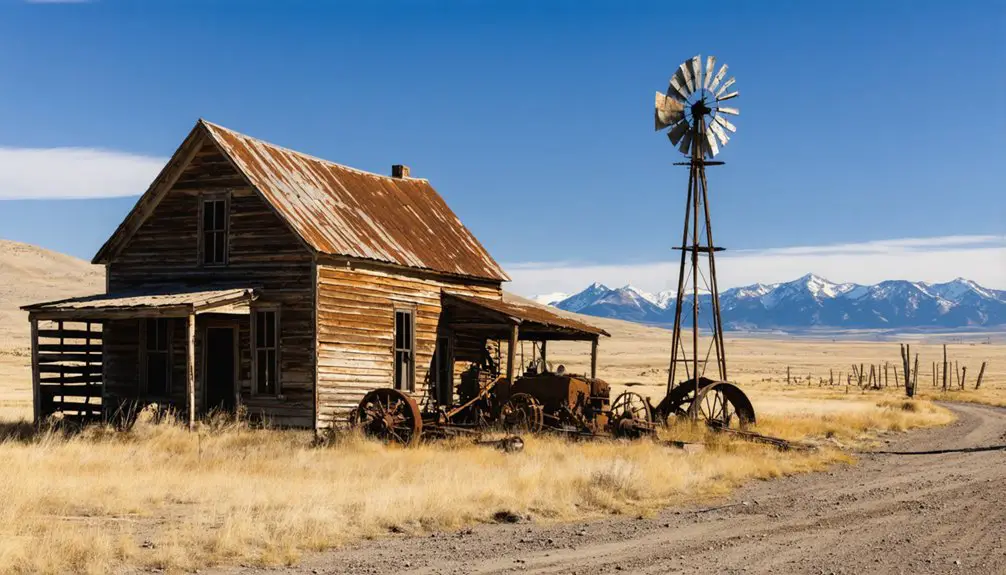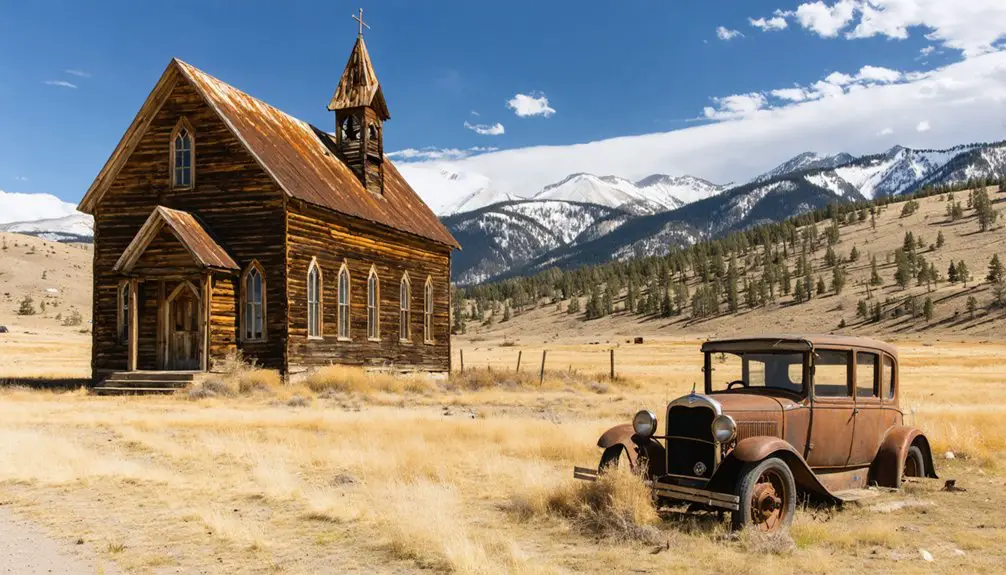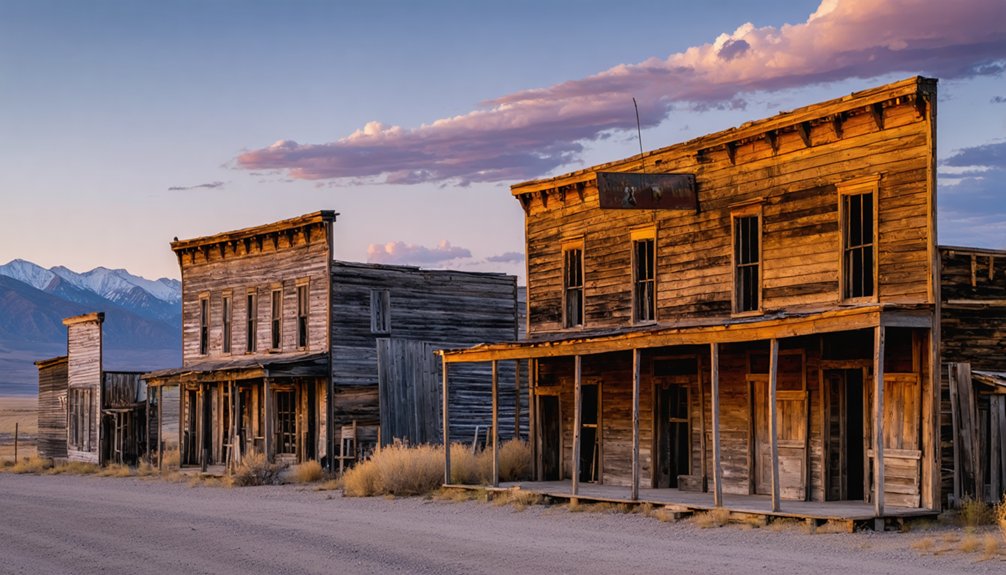
You’ll find Wyoming ghost towns rarely hit the market, though Aladdin made headlines when the Brangle family offered the entire town for $1.5 million in July 2014. The package included fifteen historic buildings, an 1896 general store, and a wooden coal tipple from the late 1800s. Most other ghost towns like South Pass City and Kirwin remain under state or federal ownership, while Sunrise entered private hands in 2011 with potential tourism development opportunities. Understanding the legal frameworks and valuation factors will help you navigate these unique investment possibilities.
Key Takeaways
- Aladdin was offered for sale in July 2014 for $1.5 million, including fifteen historic buildings and an 1896 general store.
- Wyoming ghost town valuations typically range from $250,000 to $6.6 million depending on structures and assets included.
- Municipal property sales in Wyoming require public advertising for properties valued at $500 or more before any transaction.
- Public auctions or sealed bidding processes are mandatory for ghost town sales, with limited exemptions under state law.
- Revenue opportunities for ghost town buyers include tourism operations, vacation rentals, mining claims, and heritage tourism ventures.
Aladdin: A Fully Operational Town With Historic Charm
When the Wyoming and Missouri River Railroad reached this remote corner of northeastern Wyoming in the late 1800s, Aladdin transformed from empty prairie into a bustling coal mining town.
Coal operations launched in 1898, drawing 500 residents before production declined by 1911.
You’ll find remarkable historic preservation efforts here, particularly the wooden coal tipple from the late 1800s—one of the West’s last remaining structures of its kind.
The tipple’s upper gabled structure served as a coal bin, where coal was loaded before running down a chute into waiting railroad cars below.
The Brangle family offered town ownership in July 2014 for $1.5 million, including the 1896 general store and surrounding properties.
Today, fewer than 20 people call Aladdin home.
You can visit fifteen historic buildings, grab homemade pie at Cindy B’s Cafe, or stay at the Aladdin Motel while exploring this authentic frontier remnant.
The tipple site features a walking path and informational signage, though a barbed wire fence surrounds the structure for safety.
South Pass City: Gold Rush Glory Frozen in Time
South Pass City preserves one of Wyoming’s most significant gold rush settlements, where the 1867 Carissa Lode discovery sparked a population boom to 2,000 residents by 1869.
You’ll find authentic structures from the mining era still standing in this canyon town, including the original stamp mill built in 1903 that processed over 2,000 ounces of gold during the Carissa’s revival period.
The town’s preserved buildings and mine sites offer you tangible connections to an operation that extracted approximately 21,000 ounces of gold before market forces and ownership disputes triggered rapid decline by 1872. The Bullion Lode, discovered in 1876, briefly revived mining activity and helped establish the nearby Lewiston boomtown with families and processing mills.
Wyoming purchased the historic site in 1967 and ongoing restoration efforts have preserved the town’s remaining buildings with period items reflecting life in the early 1900s.
Peak Mining Era History
Rumors of gold along the Sweetwater River had circulated through mountain men and emigrant camps since the 1840s, but the discovery of the Carissa Lode in June 1867 transformed speculation into stampede.
By spring 1868, the gold rush brought 2,000 fortune-seekers to South Pass City, Wyoming’s second incorporated city.
The peak mining era delivered remarkable results:
- Three cities—South Pass, Atlantic, and Hamilton—materialized overnight in 1868
- The Carissa Mine became the district’s largest producer with 40 ounces yielding $740.06 fineness
- Bullion Mine extracted 21,000 ounces during its heyday
- Placer operations in Carissa Gulch generated thousands until summer 1869
Partnerships like the one formed in 1868 by John Johnson and six prospectors worked claims rich in free gold about two miles east of South Pass City.
Mining challenges emerged quickly.
Worked-out placers, difficult vein extraction, and Indian raids forced the first bust by late 1869, ending the boom as abruptly as it began.
The initial gold boom lasted only a couple of seasons, yet it laid the foundation for Wyoming’s broader economic development.
Preserved Canyon Town Structures
Though the boom ended abruptly in 1869, South Pass City stands as Wyoming’s most authentic gold rush preservation site, with over 30 original structures from the 1860s-1870s meticulously restored along its historic walkways.
Since Wyoming acquired the site in 1966, state agencies and private groups have employed careful restoration techniques to maintain landmarks like the 1896 Smith-Sherlock General Store, Carissa Saloon, and E.A. Slack Cabin.
You’ll find 30,000 artifacts displayed throughout these buildings, representing 35 years of dedicated artifact preservation work.
Walk through seventeen accessible structures staffed by volunteers, pan for gold in Willow Creek, or take the 90-minute Carissa Gold Mine tour on weekends.
The town’s self-guided booklet details each building’s significance, while ongoing projects like the Sherlock House guarantee this freedom-minded frontier settlement remains authentically preserved. The Continental Divide National Scenic Trail passes directly through South Pass City, offering hikers a unique opportunity to experience both natural beauty and frontier history.
At its peak during the mining boom, the town grew rapidly to 3,000 residents and served as the Carter County seat while part of the Dakota Territory.
Kirwin: Remote Mining Camp in the Wilderness
You’ll find Kirwin 38 miles southwest of Meeteetse at the headwaters of Wood River, where a late 1800s gold and silver rush created a mining camp that peaked at 200 residents by 1905.
The February 1907 avalanche that killed three people and destroyed buildings ended the mining boom abruptly, leaving inhabitants to flee with only their clothes.
The community maintained strict regulations, prohibiting saloons and brothels within town limits, with only unmarried women permitted to reside there, primarily serving as schoolteachers.
Today, the U.S. Forest Service maintains this stabilized ghost town within Shoshone National Forest, accessible via Forest Service Road 200 to off-roaders and tour groups visiting the preserved buildings and rusted mining tools. Visitors report hearing mysterious voices in the old saloon and other structures, contributing to the town’s haunted reputation among ghost hunters.
Historic Mining Town Origins
Deep in Wyoming’s Absaroka Mountains, volcanic forces created the geological foundation that would draw prospectors to Kirwin’s remote wilderness.
Molten lava formed layered deposits that later intrusive rocks pushed through, mineralizing gold, silver, copper, and molybdenum throughout the formation.
William Kirwin discovered gold here in 1885 while deer hunting, launching a mining era that shaped ghost town preservation efforts today.
By 1891, the Wood River Mining District officially formed with these developments:
- 144 patented claims staked across mineral-rich terrain
- Mining techniques evolved from surface prospecting to 600-foot tunnels
- Population peaked at 200 residents supporting multiple commercial operations
- $1-4 million invested by major companies in early 1900s operations
You’ll find this high-elevation camp exemplifies authentic frontier enterprise untouched by modern constraints.
Current Access and Condition
Reaching Kirwin requires traversing 38 miles of progressively challenging terrain from Meeteetse, Wyoming, where paved highways give way to gravel roads, creek crossings, and steep grades that demand a four-wheel drive vehicle.
The access challenges intensify as you navigate river fords that become impassable during certain seasons, making timing essential for any visit.
At 9,500 feet elevation, you’ll find abandoned buildings still standing despite over a century of harsh mountain winters and the devastating 1907 avalanche.
Site conditions reflect decades of neglect—rusted mining equipment lies scattered among decaying structures overtaken by vegetation, while beetle-killed trees surround the property.
You can explore freely among the remnants, though preservation efforts are underway.
The Meeteetse Museum sponsors annual August treks for those seeking this authentic wilderness experience.
Eadsville: High-Altitude Mining Settlement
Perched at 7,800 feet on Casper Mountain, Eadsville stands twelve miles south of modern-day Casper as a tribute to Wyoming’s boom-and-bust mining era.
Charles W. Eads established this mining claim in 1891, platting a town that promised fortune from gold, silver, lead, and copper deposits. The Eadsville history reflects wild speculation—exaggerated reports claimed 5,000 residents in 1892, though actual population reached only fifty souls.
Today’s mining legacy includes:
- Scattered cabin foundations marking where prospectors once lived
- A small grave as sole evidence to former inhabitants
- Eadsville Trail winding through the abandoned settlement
- Twenty acres of freedom-seeking dreams turned to ruins
Economic ore bodies never materialized.
Piedmont: Railroad Era Remnants
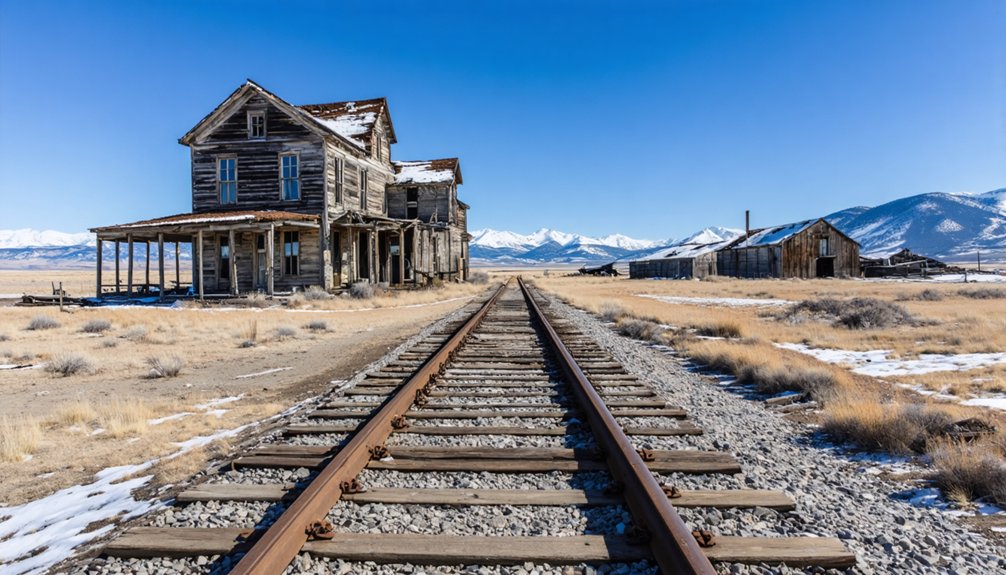
Twenty-three miles northeast of Evanston, Piedmont emerged in 1867 as an essential Union Pacific Railroad support town established by the Byrne and Guild families.
Moses Byrne constructed five beehive-shaped charcoal kilns producing fuel from local aspen and pine, while the settlement developed critical infrastructure including water tanks, engine sheds, and sidings for helper locomotives tackling steep inclines.
The Piedmont Kilns became central to railroad operations, shipping charcoal across the Union Pacific system. At its peak, you’d find four saloons, a school, and numerous homes serving railroad workers.
However, railroad history shifted dramatically around 1910 when the 1.5-mile Aspen Tunnel bypassed Piedmont entirely. The rerouted line eliminated the town’s purpose, triggering rapid decline.
Today, three kilns remain standing alongside foundations, cemeteries, and coal dumps—accessible via I-80 Exit 24 in Uinta County.
Sunrise: Iron Mining Heritage Under Private Preservation
While Piedmont’s railroad-era remnants tell one chapter of Wyoming’s industrial past, Sunrise represents a different narrative—one of extensive iron mining that spanned eight decades. Founded in 1899 by Colorado Fuel and Iron Company, this 225-acre property extracted 40 million tons of ore before operations ceased in 1980.
The archaeological significance here is extraordinary. You’ll find evidence of mining spanning 13,000 years, including North America’s oldest red ochre mine with Paleoindian artifacts dating back 12,800 years.
Community history comes alive through remaining structures:
- Wyoming’s first YMCA building from 1917
- Foundations from homes that housed 1,500 residents
- Hospital and schoolhouse remnants
- Original mining infrastructure
Since 2011, private ownership has positioned this National Register site for potential tourism development.
What to Consider Before Buying a Wyoming Ghost Town
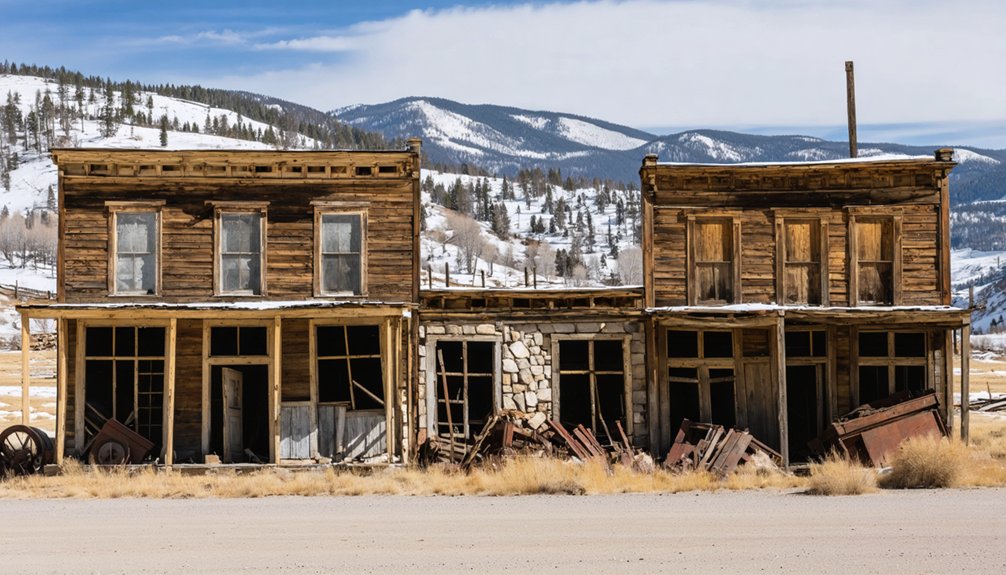
Purchasing a Wyoming ghost town requires maneuvering complex legal frameworks that govern municipal property sales.
You’ll encounter mandatory public advertising requirements for properties valued at $500 or more, with publications running weekly for three consecutive weeks. State law mandates public auctions or sealed bidding processes, though exemptions exist through public hearings.
Property valuation considerations span $250,000 to $6.6 million based on acreage, structures, and business assets. Aladdin’s $1.5 million listing included 30 acres with operational businesses and $160,000 in inventory.
Legal compliance extends to zoning reviews, abandoned property protocols, and trust fund requirements.
Revenue opportunities include tourism monetization, vacation rentals, mining claims, and heritage tourism.
You’re investing in authentic 1800s structures with modern amenities, requiring budgets for infrastructure maintenance and historic preservation efforts.
Frequently Asked Questions
Can I Relocate Residents When Purchasing an Inhabited Ghost Town?
Thinking you can force residents out? You can’t legally mandate relocation as a private buyer. Relocation challenges require voluntary negotiations with occupants, not government authority. Serious legal considerations demand Wyoming property attorneys before pursuing inhabited ghost towns.
What Zoning Restrictions Apply to Ghost Towns in Wyoming?
Zoning laws for ghost towns depend on the county’s regulations governing property usage. You’ll need to verify existing classifications with local authorities, as unincorporated areas may have minimal restrictions, offering greater development freedom than established municipalities.
Are There Property Tax Incentives for Preserving Historic Ghost Towns?
Don’t put all your eggs in one basket—Wyoming lacks statewide property tax incentives specifically for historic preservation of ghost towns. However, you can pursue local credits for improving abandoned properties through HB0066, effective July 2025.
How Do Mineral Rights Work When Buying Former Mining Towns?
You’ll likely find mineral rights weren’t included in historical mining town sales, as federal patents reserved subsurface ownership. Before purchasing, you’ll need a mineral title search to identify current owners and negotiate separate ownership transfer if minerals are privately held.
What Insurance Options Exist for Deteriorating Historic Structures?
You’ll love paying 20% higher premiums for deteriorating buildings. HO-8 policies and Historic Property Insurance offer specialized coverage, though insurers often deny applications lacking security systems or proper maintenance—limiting your options considerably.
References
- https://globalnews.ca/news/3492478/wyoming-town-of-15-people-goes-on-sale-for-1-5m/
- https://cowboystatedaily.com/2024/02/04/3-7-million-in-colorado-gets-you-a-ranch-with-its-own-old-west-town/
- https://travelwyoming.com/blog/stories/post/5-wyoming-ghost-towns-you-need-to-explore/
- https://www.ezhomesearch.com/blog/towns-for-sale-in-the-usa/
- https://www.realtor.com/news/trends/would-you-buy-a-ghost-town/
- https://www.atlasobscura.com/things-to-do/wyoming/ghost-towns
- https://www.aol.com/articles/10-ghost-towns-us-actually-200604529.html
- https://www.youtube.com/watch?v=aSK2VRA6SXA
- https://www.atlasobscura.com/places/aladdin-coal-tipple
- https://www.wyohistory.org/field-trips/aladdin-coal-tipple