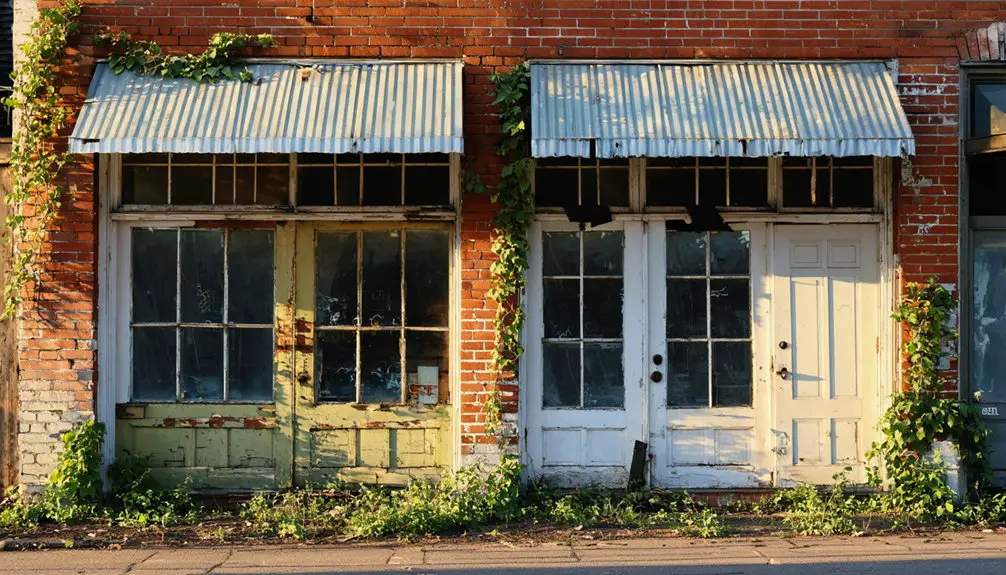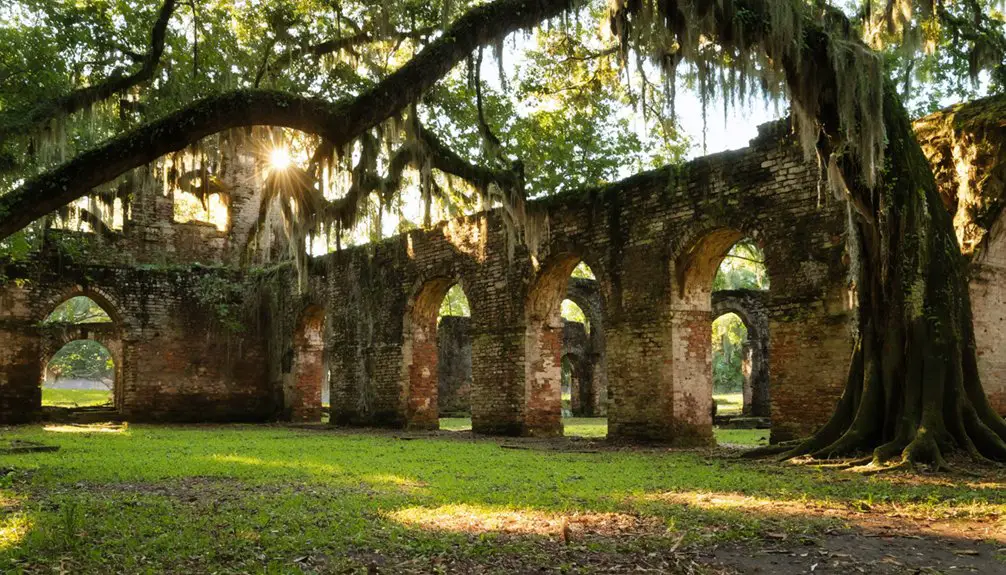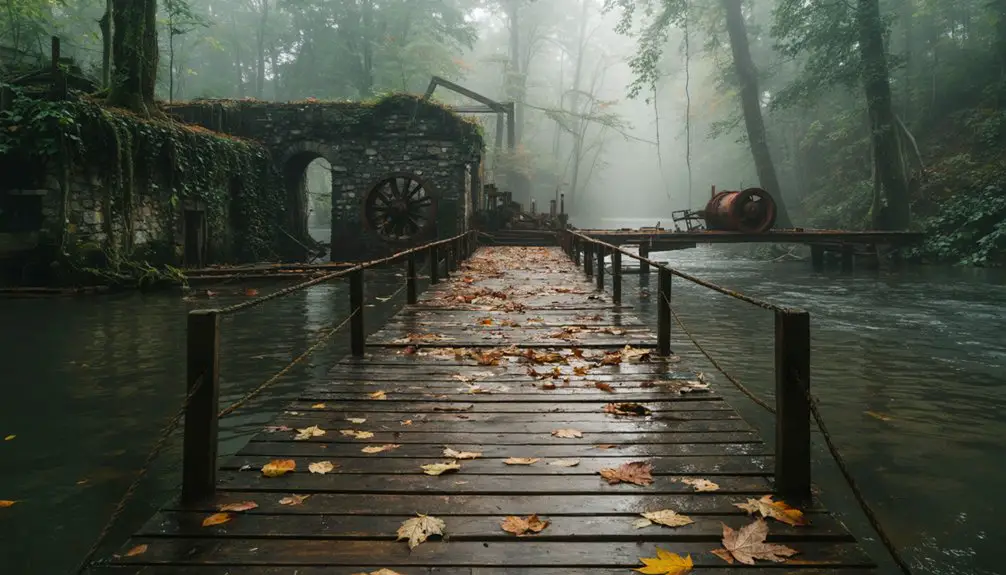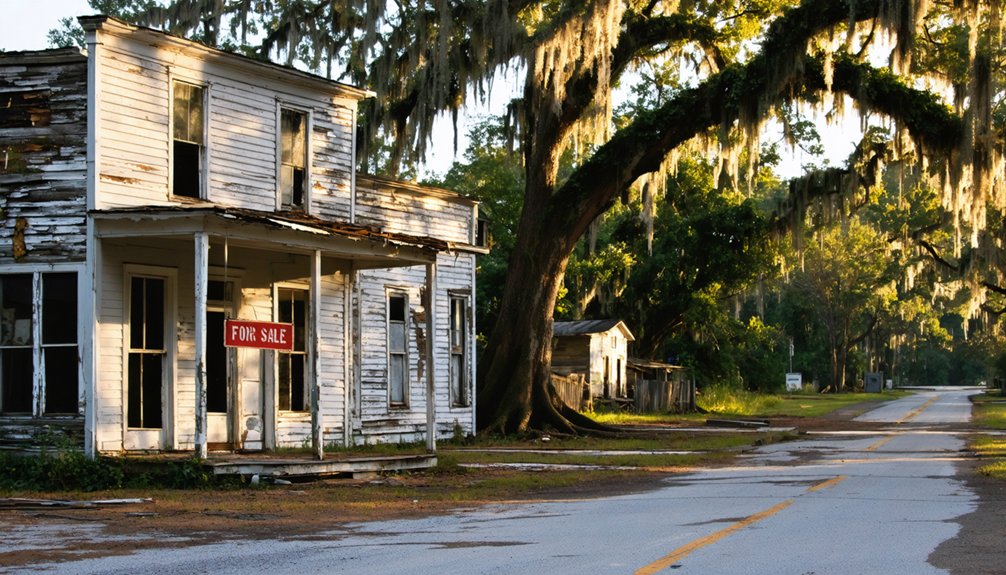
You’ll find several North Carolina ghost towns currently on the market, ranging from historic mill villages like Henry River (famous for The Hunger Games) priced around $360,000 to Maggie Valley’s Ghost Town Village at $6.4 million. Mill village properties typically cost $262,000-$533,000, with median prices at $224 per square foot. However, renovation costs often exceed purchase prices, and you’ll need to navigate historic preservation covenants. Investment requirements vary greatly based on location, restoration status, and infrastructure—factors that determine whether these properties become profitable ventures or financial burdens.
Key Takeaways
- North Carolina ghost town properties range from $250,000 for small settlements to $6.4 million for larger sites like Ghost Town Village.
- Mill villages feature restored 1890s houses priced at $262,000 to $533,000, with median rates of $224 per square foot.
- Renovation costs typically exceed purchase prices, with fixer-uppers averaging $200,000 compared to standard homes at $436,250 median.
- Properties span mountain, coastal, and Piedmont regions, each offering distinct natural amenities and varying infrastructure access levels.
- Active acquisition opportunities expected in 2024-2025, with conservation groups and developers competing for historic and tourism properties.
Historic Mill Villages Available for Purchase
North Carolina’s Piedmont region contains several intact mill villages now entering the real estate market, with price points ranging from $262,000 to $533,000 depending on location and restoration status.
Glencoe Village north of Burlington represents one of the state’s most complete examples, featuring approximately 30 restored houses from the 1890s era. Mill operations ended in 1954, and Preservation North Carolina acquired the property in 1997, establishing historic preservation covenants that protect architectural integrity while permitting modern renovations.
Properties carry a median price of $224 per square foot.
Mill village properties in North Carolina’s Piedmont region average $224 per square foot, reflecting their historic character and preservation requirements.
The Grog Creek estate in Cleveland County offers a different ownership model—a 20-acre property combining a 1919 grist mill with contemporary residential construction. The property features original stones inside the historic mill structure alongside a custom-built home completed in 2015.
You’ll navigate historic preservation agreements alongside covenant restrictions, but gain exclusive access to architecturally significant structures unavailable through conventional real estate channels. In Reidsville, an entire historic district comprising five workers’ houses from 1912 is available for $179,000, originally built to house black workers employed by the American Tobacco Company.
Lower Ghost Town in Chimney Rock
Beneath the 400-foot cliffs of Hickory Nut Gorge, a defunct 1970s Western-themed amusement park called Silver City has transformed into North Carolina’s most significant climbing access acquisition in recent history.
The Carolina Climbers Coalition and Access Fund secured 16.5 acres at Lower Ghost Town for $125,000, ending decades of development threats that nearly converted the site into 40 housing units.
You’ll find over 50 established routes here, including The Bad (5.14b) and potentially the state’s hardest climb, the unsent Ugly project.
The climbing community negotiated this purchase after developers subdivided the property in 2023. The acquisition also protects all boulder fields in the area, securing critical terrain for the sport.
While trail construction limits current access until spring 2026, the acquisition protects North Carolina’s largest crack collection and connects to the Hickory Nut Gorge State Trail network.
The purchase was funded through the Access Fund Climbing Conservation Loan and a Great Trails State Grant awarded in 2025.
Henry River Mill Village: A Hunger Games Legacy
While most ghost towns fade into obscurity, Henry River Mill Village gained international recognition as District 12 in the first Hunger Games film—a cinematic afterlife that’s reshaped its marketability since the 2012 release.
Located one mile south of Hildebran off I-40, this 1905 cotton yarn manufacturing complex housed 450 workers at peak operation. The Aderholdt and Rudisill families built 35 worker houses, a boarding house, company store, and three-story brick mill on 1,500 acres. The waterpower-driven operations continued until 1914, when the village transitioned to steam power and electricity.
At its height, this sprawling 1,500-acre textile operation employed hundreds of workers across dozens of company-owned buildings and homes.
The mill closed in the 1960s, and lightning destroyed the main building in 1977. Final residents departed by the early 2000s.
Its Hunger Games Film Legacy transformed abandoned structures into tourist attractions. The village now hosts events year-round, including the Mill Village Fest in May, haunted tours in October, and Santa meet-and-greets in December. Listed on the National Register of Historic Places in 2019, you’ll find authentic Carolina textile history without modern utilities—a preserved company town that Hollywood made famous.
Ghost Town Village in Maggie Valley
You’ll find Ghost Town Village perched at 4,650 feet atop Buck Mountain in Maggie Valley, a defunct Wild West theme park that opened in 1961 and attracted up to 10,000 daily visitors during its heyday.
The $1 million attraction—featuring four replica towns, an incline railway, and North Carolina’s longest chairlift—became the region’s premier destination before closing amid financial troubles, natural disasters, and competition from Dollywood.
At its peak, the park drew over 620,000 visitors annually, making it the largest attraction in Western North Carolina and significantly impacting local businesses and tourism in Maggie Valley.
The park’s construction required over 200 local participants who used 300,000 feet of lumber, 200,000 feet of plywood, and 20,000 pounds of nails to build the 40 replica structures designed by Russell Pearson.
As of March 2023, the abandoned property remains entangled in ongoing litigation with no confirmed sale, though its 35-acre mountaintop location continues to draw interest from investors and urban explorers alike.
Amusement Park History
R.B. Coburn’s vision transformed Buck Mountain into North Carolina’s mile-high theme park when Ghost Town Village opened May 1, 1961.
You’ll find 40 replica Western buildings constructed with 300,000 feet of lumber, served by a double incline railway climbing 3,300 feet at slopes up to 77 degrees.
The park’s 1962 chairlift became North Carolina’s longest, while hourly gunfights and TV Western stars drove amusement park nostalgia throughout the 1960s.
Theme park evolution brought fierce competition from Silver Dollar City and eventually Dollywood, which drained Ghost Town’s visitor base.
At its peak, Ghost Town attracted over 400,000 visitors each season, rivaling major regional attractions.
The park sat at approximately 5,000 feet above sea level, offering breathtaking panoramic views of the surrounding Smoky Mountains.
The 2008 financial crisis accelerated its decline, compounded by high maintenance costs and natural disasters.
Today, it sits abandoned, entangled in ongoing litigation while deteriorating animatronics haunt the vacant structures.
Current Listing Details
The property sits at 890 Soco Road atop Buck Mountain at 4,650 feet elevation, spanning 285 acres professionally appraised by Palmer Company at $6.4 million.
You won’t find it on the open market yet—sole owner Jill McClure’s negotiating with a Florida buyer who operates an entertainment venue. The proposed use includes country music, rodeos, conventions, and festivals while maintaining a family-friendly atmosphere.
McClure inherited the park from her aunt Alaska Presley in 2022 and now holds full discretion after legal maneuvering. She’s committed to selling for entertainment purposes that’ll boost Maggie Valley tourism, not residential development.
The western town structures will likely remain. Access runs through U.S. Highway 19, though the site’s been SBNO since 2016 with ongoing litigation as of March 2023.
Investment Requirements and Property Valuations
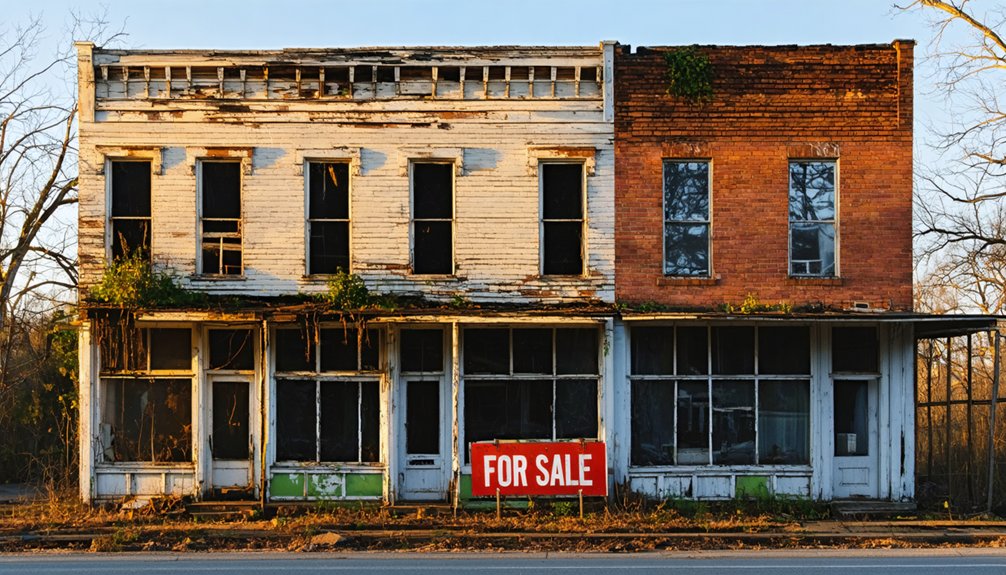
Before committing capital to a North Carolina ghost town, investors must navigate property valuations that span from $250,000 for small settlements to $6.6 million for extensive sites—figures that represent only the entry point.
Property assessments reveal renovation costs frequently exceed purchase prices, while investment risks compound in remote locations lacking modern infrastructure.
Consider these financial realities:
- Median fixer-uppers at $200,000—less than half the $436,250 median for standard homes
- Historic villages requiring millions in preservation before generating revenue
- Environmental remediation bills for contaminated mining town properties
- Insurance premiums escalating due to structural deterioration and isolation
- Infrastructure repairs potentially costing $3.5 million for single commercial buildings
You’ll face hard money loans and personal capital requirements, with no quick-flip opportunities available in this preservation-focused market.
Architectural Features and Restoration Status
Beyond purchase prices and financing hurdles, North Carolina’s ghost town properties present distinct architectural inventories that directly impact restoration timelines and ultimate project costs.
Portsmouth Village’s 21 structures maintain architectural integrity through National Seashore oversight, while Henry River Mill Village‘s 20+ cottages show surprising resilience despite decades of vacancy.
You’ll find Coleridge’s Romanesque Revival mill office and Victorian-tower brick mill offer solid foundations for commercial conversion. The late 1800s coastal houses feature hand-carved newel posts and wainscoting, though mid-1960s apartment conversions complicate restoration.
Hot Springs properties face severe restoration challenges—caved porches, hurricane damage, and structural compromise from tree growth. Buildings with boarded windows and intact glass present lower initial costs than those requiring complete envelope reconstruction.
Architectural documentation status affects permit timelines considerably.
Geographic Settings and Natural Amenities
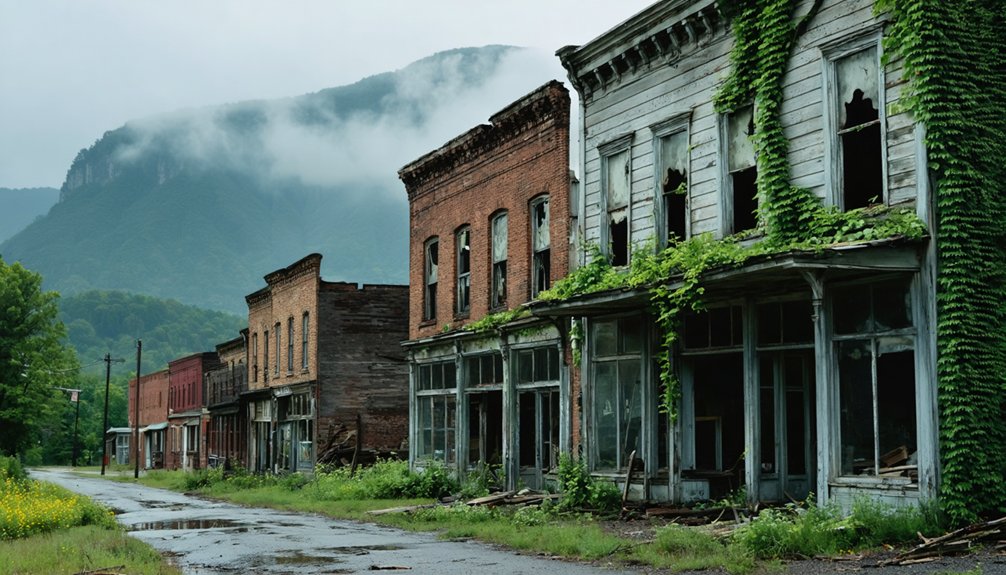
North Carolina’s ghost town inventory spans four distinct geographic zones, each delivering specific natural amenities that shape accessibility, restoration logistics, and long-term property viability.
Mountain settings like Cataloochee and Lost Cove occupy 350-acre parcels in Pisgah National Forest, surrounded by peaks that eliminated electricity infrastructure.
Isolated mountain parcels reveal how terrain shaped abandonment—steep peaks made electrification costs prohibitive, sealing these settlements’ fate.
Coastal features define Portsmouth and Cape Lookout Village—barrier island properties requiring boat access but offering Atlantic exposure.
Submerged sites present unique challenges: Judson lies beneath Fontana Lake while Buffalo City’s 3,000-resident footprint disappeared under Dare County swamps.
Geographic Amenities:
- Wilson Creek threading through Mortimer’s deep woods ruins
- Cape Fear River banks framing Brunswick Town’s colonial street grid
- Lake Glenville’s eastern edge preserving Glenville’s relocated remnants
- Nolichucky River gorge below Lost Cove’s roadless timber acreage
- Henry River’s current powering 20-house mill village amid forest decay
Current Operations and Revenue Potential
Following years of dormancy, Ghost Town Village in Maggie Valley presents a commercial paradox—285 acres appraised at $6.4 million yet generating zero revenue since its amusement park closure.
You’ll find a Florida buyer proposing transformation from rides to revenue models centered on country music, rodeos, and festivals—targeting event-based income rather than traditional gate receipts. This pivot reflects evolved tourism strategies addressing Maggie Valley’s documented visitor decline.
Sole proprietor Jill McClure maintains full discretion following co-owner Wood’s 2024 death, willing to open-market the property if current negotiations fail.
Local businesses anticipate economic revival through convention hosting and festival traffic, expanding beyond amusement park demographics. The western town infrastructure remains intact, offering latent commercial value despite prolonged shutdown.
Ownership Transitions and Acquisition Opportunities
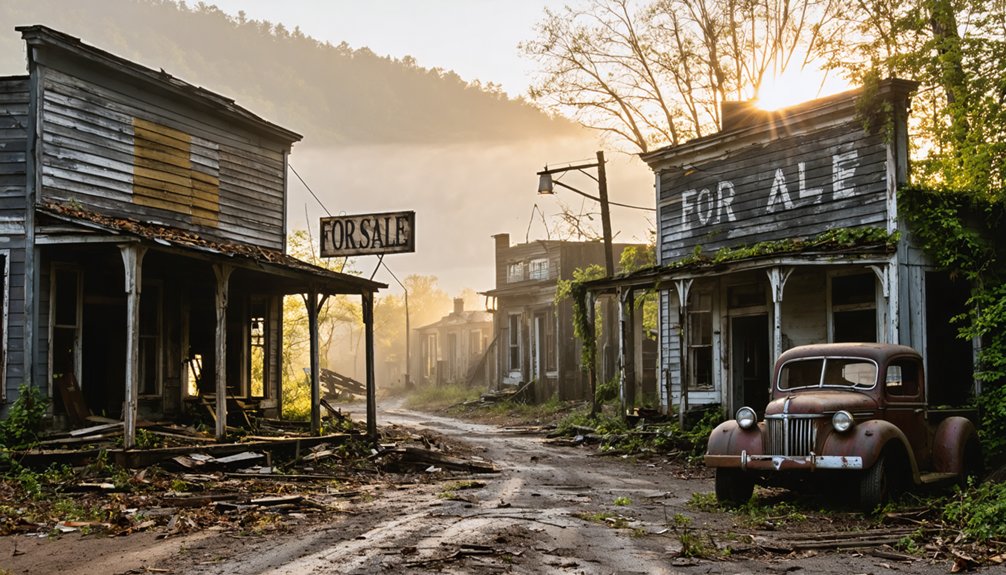
You’ll find ghost town ownership in North Carolina follows distinct patterns—from foreclosures and family sales to conservation acquisitions and private investments.
The Henry River Mill Village‘s journey from a $1.4 million listing to a $360,000 sale demonstrates how market values fluctuate based on restoration potential and revenue streams.
Conservation groups like the Carolina Climbers Coalition now compete with developers and tourism investors, creating multiple acquisition pathways depending on your intended use.
Conservation Partnerships and Funding
When ghost towns shift from private hands to public ownership, conservation partnerships become the financial engine driving acquisition deals across North Carolina.
You’ll find coalitions like the Carolina Climbers Coalition securing 16.5 acres at Lower Ghost Town cliffs through partnership strategies involving Access Fund and Great State Trails Coalition.
Mainspring Conservation Trust leveraged private donors and Atira Conservation for quick conservation funding on Panthertown Valley’s 94-acre inholding.
These partnerships respond rapidly—the Ghost Town acquisition followed Chimney Rock Glamping‘s 2023 purchase threat.
Strategic elements include:
- Private donors closing deals before development interests strike
- Local land trusts coordinating with U.S. Forest Service transfers
- Community coalitions raising funds for structure removal and stewardship
- Multi-organization networks targeting regional ecological preservation
- Corporate sponsors backing statewide programming against environmental threats
You’re witnessing market-driven conservation protecting access before commercial interests lock you out.
From Industry to Tourism
Ghost Town Village’s foreclosure trajectory illustrates how distressed amusement properties become acquisition targets for specialized buyers.
You’ll find American Heritage Family Parks secured the property in May 2010 for $12.1 million—covering SunTrust’s $7 million claim, BB&T’s $5 million debt, and $100,000 in back taxes.
Despite ownership disputes between 50% stakeholders Jill McClure and Frankie Wood LLC, the property’s tourism potential attracted investors willing to navigate legal complexities.
Brunswick County’s ghost communities followed similar patterns, where single investors recognized economic revitalization opportunities in abandoned developments.
These changes demonstrate how distressed properties shift from creditor control to investment-driven futures.
You’re seeing defunct sites repositioned as adventure destinations, marking transformation from operational failure to speculative opportunity in North Carolina’s evolving tourism landscape.
Current Market Listings
North Carolina’s ghost town properties entered active acquisition phases in 2024-2025, presenting distinct investment models for buyers targeting distressed tourism assets.
Current trends reveal diversification beyond traditional amusement operations, with Maggie Valley’s Ghost Town Village ($6.4 million, 285 acres) pivoting toward country music venues and rodeo events.
Market analysis demonstrates conservation groups successfully competing against commercial developers, evidenced by Carolina Climbers Coalition’s Lower Ghost Town acquisition securing 50 climbing routes.
Active Acquisition Models:
- Florida investor examining shuttered western-themed amusement park with complete operational infrastructure
- Conservation coalition completing 25-year campaign to secure climbing crags and trail systems
- 285-acre mountain property supporting conventions, festivals, and performance venues
- Appraised valuations establishing baseline pricing for distressed tourism assets
- Single-owner discretion enabling streamlined negotiations after previous legal entanglements
You’ll find ownership changes accelerating as sole proprietors gain transaction authority following partnership dissolutions.
Frequently Asked Questions
What Are the Property Tax Rates for Ghost Town Properties in North Carolina?
Property tax rates for ghost town properties in North Carolina depend on their county location, ranging from 0.73% statewide average to over 1% in high-tax counties. You’ll pay based on assessed value per local jurisdiction.
Do Ghost Town Purchases Include Mineral and Water Rights?
Ghost town purchases sometimes include mineral rights, but they’re often severed from surface ownership. You’ll need a thorough title search to verify what’s actually included, since water rights and mineral ownership frequently remain with previous holders.
Are There Zoning Restrictions for Commercial Development on Ghost Town Properties?
Yes, you’ll face zoning laws and commercial permits that can freeze your plans—Maggie Valley’s Ghost Town learned this when aldermen blocked rezoning requests. Your property’s freedom depends on maneuvering through local regulations and obtaining proper approvals first.
What Insurance Requirements Apply to Restored Historic Ghost Town Buildings?
You’ll need specialized historic property insurance covering replacement-in-kind restoration costs, which run 50% higher than standard construction. Expect premiums 20% above modern buildings, plus mandatory ordinance coverage for code upgrades and separate flood insurance.
Can Ghost Town Properties Qualify for Historic Preservation Tax Credits?
Yes, you can access historic preservation tax credits for ghost town properties if they’re listed on the National Register. Federal tax incentives cover 20% of rehabilitation costs, while North Carolina offers additional state credits.
References
- https://www.accessfund.org/latest-news/carolina-climbers-coalition-and-access-fund-purchase-lower-ghost-town
- https://www.ezhomesearch.com/blog/towns-for-sale-in-the-usa/
- https://wlos.com/news/local/ghost-town-village-for-sale-listed-at-595m
- https://hiddenhistorian.com/adventures/f/hunger-games-district-12-village-for-sale—own-a-ghost-town?blogcategory=Book
- https://carolinaclimbers.org/node/1284
- https://piedmonthistorichomes.com
- https://www.whitetailproperties.com/hunting-land/north-carolina/cleveland/cleveland-20-ac-yelton
- https://raleighrealty.com/apex/old-mill-village
- https://www.weichert.com/NC/Wake/Apex/Old_Mill_Village/
- https://www.realtor.com/realestateandhomes-search/Old-Mill-Village_Wilsons-Mills_NC