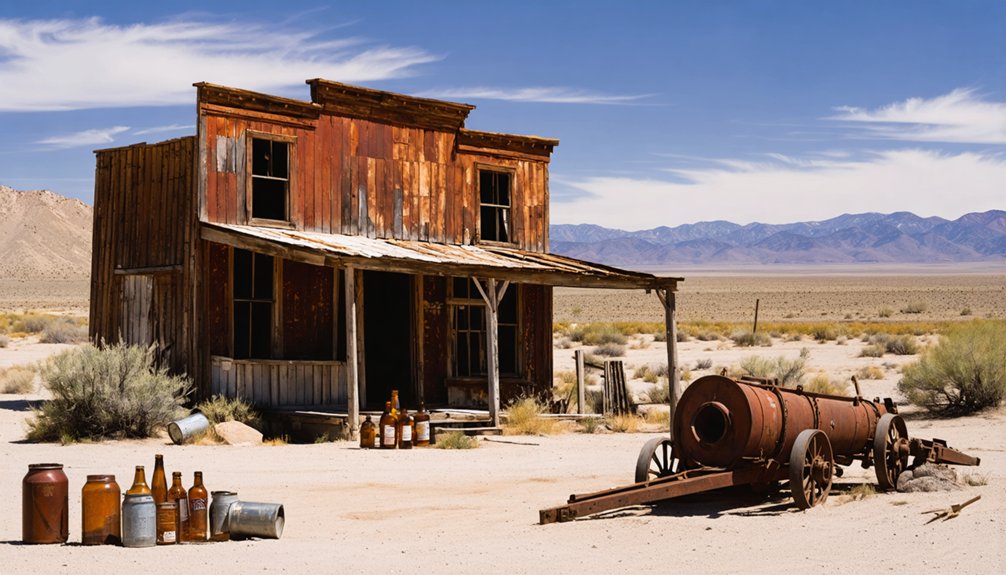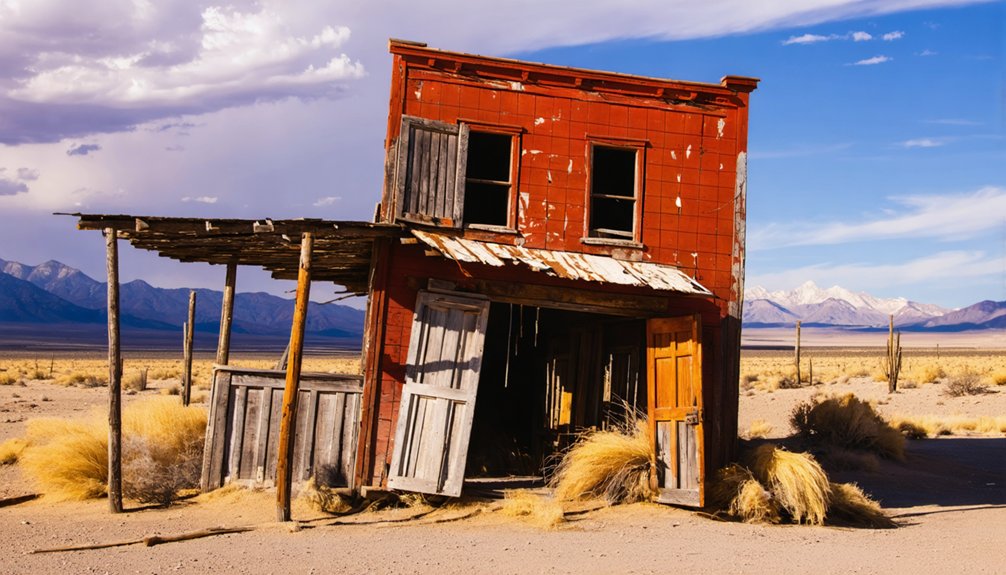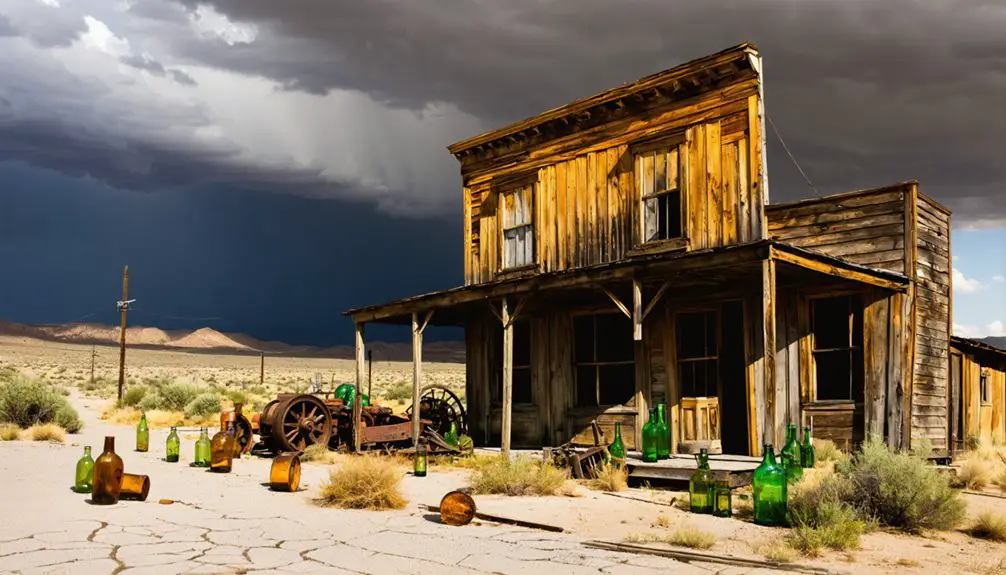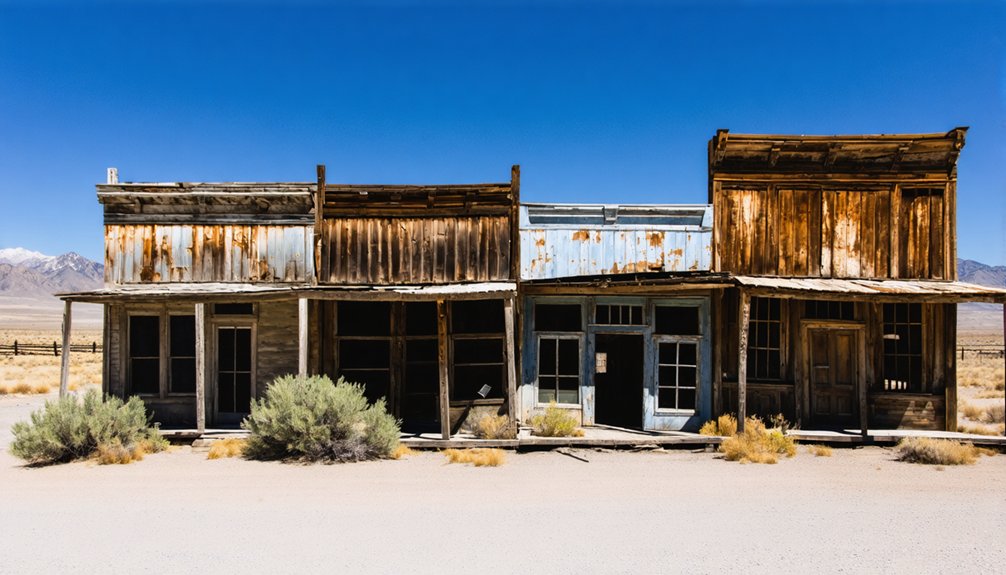
Eastern Nevada’s ghost towns offer you haunting glimpses into the region’s explosive 1860s-70s silver boom. You’ll find Hamilton’s weathered stone walls one mile past the cemetery, remnants of a 10,000-resident mining camp that collapsed by 1875. Pioche still stands as America’s once-deadliest town, where 72 consecutive Boot Hill burials were murder victims. You can explore Johntown, Nevada’s 1853 original ghost town, or discover Pine Grove’s sophisticated mill ruins from the 1866 gold rush. The following sections reveal specific locations, historical details, and what you’ll encounter at each abandoned settlement.
Key Takeaways
- Eastern Nevada experienced a massive mining boom in the late 1860s, with populations surging to 40,000 before rapid decline.
- Pioche, established in 1864, was America’s deadliest town with 60% of Nevada’s homicides occurring in 1871-72.
- Hamilton served as White Pine County’s first seat until 1887, now featuring stone ruins and weathered architecture.
- Johntown, founded in 1853, became Nevada’s original ghost town after accessible gold depleted in 1860.
- Visitors can explore mining artifacts at abandoned sites, with state reclamation bonds ensuring landscape preservation.
Pioche: A Living Relic of Nevada’s Lawless Past
When Paiute Indians led Mormon missionary William Hamblin to silver outcroppings in 1864, they unwittingly set in motion the creation of Nevada’s most notorious mining camp.
You’ll find Pioche’s lawlessness legacy etched in Boot Hill Cemetery, where the first 72 burials were murder victims before anyone died naturally. Nearly 60% of Nevada’s homicides occurred here in 1871-72, earning it the title of America’s deadliest town.
Despite catastrophic setbacks—an 1871 explosion that killed 13 and caused $500,000 in damage, plus devastating fires—Pioche’s mining memories persisted through $5 million in ore production by 1872.
The infamous “Million-Dollar Courthouse,” budgeted at $26,000 but ballooning to $1 million through corruption, stands as evidence to the town’s wild frontier character. The Nevada State Legislature intervened to resolve the prolonged financial struggle that dragged construction across 65 years.
Today, you can explore Nevada’s liveliest ghost town, still functioning as Lincoln County’s seat. The town’s historical tramways once transported ore from mines throughout the community, with some locals even riding them to school.
Hamilton: Silver Boom Ruins in the White Pine Mountains
You’ll find Hamilton’s crumbling stone walls at 8,000 feet in the White Pine Mountains, where the 1867 discovery of a massive silver vein—40 feet wide and 28 feet deep—triggered one of Nevada’s most intense mining stampedes.
Within two years, 10,000 fortune-seekers had transformed this remote elevation into a fully-incorporated county seat complete with a brick courthouse, nine assay offices, and enough saloons to outnumber the town’s 29 attorneys two-to-one.
The boom collapsed as quickly as it ignited: shallow ore deposits exhausted by 1870, devastating fires in 1873 and 1885, and disincorporation by 1875 left behind only fire-scarred ruins that mark White Pine County’s brief but spectacular silver frenzy. Hamilton served as the first county seat of White Pine County until the seat moved to Ely in 1887. The silver discovery on Treasure Hill in 1867 marked the first major mining find after the completion of the Transcontinental Railroad, positioning Hamilton at the forefront of Nevada’s eastern expansion.
1860s Silver Town Boom
Though veteran miners had discovered silver on White Pine Mountain in late 1865, the deposit attracted little attention until a Paiute guide named Napias Jim (later called “Indian Jim” in mining camp lore) led A.J. Leathers to a shiny vein in late 1867. Claims filed in January 1868 sparked North America’s richest silver discovery.
By spring 1868, word spread rapidly. The boom transformed White Pine into several bustling settlements:
- Treasure City perched among high-altitude mines
- Hamilton became the economic hub in a sheltered basin
- White Pine County established March 2, 1869
- Population surged to 25,000-40,000 by 1870
The Eberhardt mine topped production from a three-quarter-mile-long surface vein.
Between 1867-1880, silver discoveries yielded $20 million using conventional mining techniques, though rich deposits declined rapidly after 1870. Treasure City sat at an elevation of 9,206 feet, making it one of Nevada’s highest mining camps. At its peak, Hamilton City became Nevada’s second-largest city during the mining boom, rivaling even established population centers.
Remote Stone Wall Remnants
Hamilton’s stone walls stand as silent witnesses to a silver empire that collapsed nearly as fast as it rose.
You’ll find these weathered remnants scattered across the hillside above the town site, their stone wall architecture enduring Nevada’s brutal high-altitude winters where wooden structures surrendered long ago.
The main ruins cluster one mile past the cemetery, where spectral footings and crumbling foundations trace an overgrown street grid that once hosted over 100 saloons.
Ghost town exploration here means hiking above the site to discover additional foundations tucked among sagebrush mounds and rubble.
These rock walls connect to distant building remnants on surrounding hills, marking where miners once carved an entire city from Treasure Hill’s silver-rich slopes.
Among the most notable surviving structures are the J.B. Withington Hotel and the Wells Fargo building, both showcasing the architectural ambitions of Hamilton’s boom years.
Like nearby Averill, which was abandoned in 1869 after its ore deposits were exhausted, Hamilton’s brief prosperity demonstrates how quickly Nevada’s mining settlements could rise and fall.
Short-Lived Mining Frenzy Legacy
When Napias Jim led A.J. Leathers to Treasure Hill in 1867, he unknowingly sparked America’s most intensive mining legacy. That three-quarter-mile silver vein created boomtown culture so explosive that nearly 40,000 fortune-seekers descended on eastern Nevada within months.
Hamilton became White Pine County‘s seat in 1869, but this frenzy burned out faster than any rush in American history—less than two years.
The White Pine Rush transformed eastern Nevada through:
- Surface-level silver so rich it required no deep excavation initially
- Transcontinental Railroad completion reducing travel from months to six days
- Population explosion forcing rapid county establishment and infrastructure development
- Swift economic collapse when deeper mining revealed progressively worthless ore
You’ll find Hamilton’s ruins evidence to freedom-seeking prospectors who chased wealth, built communities overnight, then vanished when Treasure Hill’s surface riches disappeared. The rush followed the boom-bust cycle pattern that characterized Nevada mining from the Comstock production era through the early twentieth century. Museum Director and Historian Sean Pitts now leads heritage tours through these abandoned sites, using historical maps and photographs to document the boom’s rapid rise and fall.
Humboldt City: The Picturesque Village That Vanished
In spring of 1860, French trader Louis Barbeau struck silver in Humboldt Canyon, triggering a rush that’d transform this remote canyon into one of Nevada’s earliest mining settlements.
Silver mining prospects looked promising—initial ore assays valued between $400 and $2,700 per ton attracted investors who discovered over 1,000 deposits throughout the canyon.
By 1863, you’d have found a thriving community of 500 residents, 200 buildings, two hotels, saloons where patrons debated Reconstruction politics, and homes with carefully tended gardens.
A $40,000 wagon road connected the settlement to California, while ambitious developers planned a 61-mile ditch project to power mills.
But Humboldt history proved fleeting. The district exhausted quickly, silver prices dropped, and within nine years the town vanished—Nevada’s first ghost town, leaving only memories of its brief prosperity.
Pine Grove: Northwest Nevada’s First Settlement
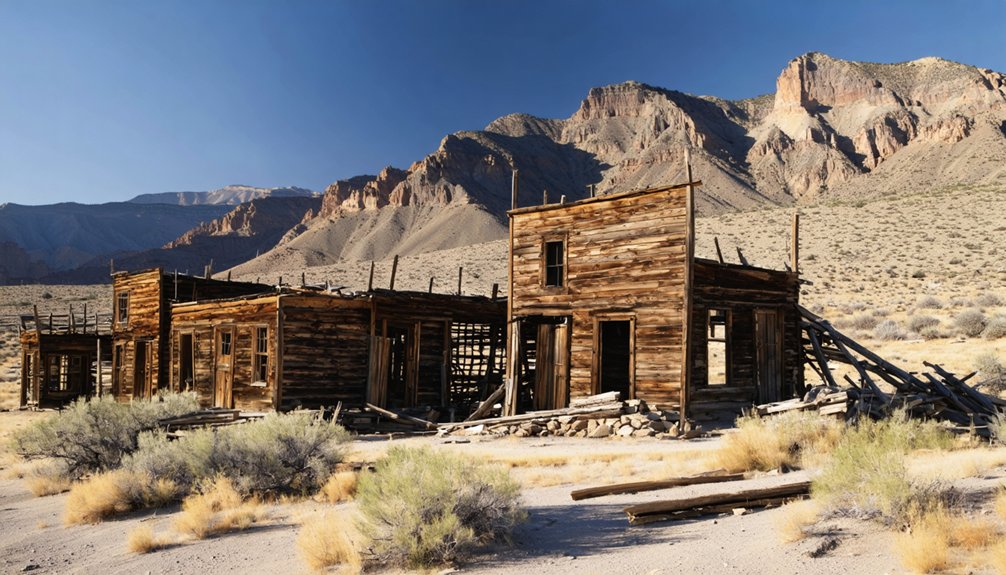
While French prospectors scoured Humboldt Canyon for silver, William Wilson discovered gold in a remote Pine Grove Hills canyon in 1866, establishing what’d become northwest Nevada’s first permanent settlement.
Pine Grove’s history reflects the boom-and-bust cycle that defined Nevada’s mining frontier.
You’ll find evidence of sophisticated mining techniques throughout the ruins:
- Two large mills and an arrastra processing ore by 1868
- 5-stamp and 10-stamp mills built by Joshua Hendy Iron Works in 1882
- Wheeler and Wilson mines producing $8 million combined by 1893
- Remaining rock walls of the 5-stamp mill still visible today
The settlement peaked at 600 residents during the 1870s, supporting five saloons, three hotels, and two physicians before declining after the Panic of 1893.
Rockland: A Town Destroyed by Fire and Time
Just three miles southeast of Pine Grove, prospector Keane struck silver in 1869 at what’d become the Rockland Mine, triggering development of a second mining camp in these rugged hills.
Despite the earlier gold discovery at Pine Grove in 1868, Rockland carved its own identity with stores, saloons, and a post office serving several hundred residents.
Mining challenges plagued operations from the start. Cash-flow problems forced irregular production, and in 1871, a disgruntled unpaid miner torched the quartz mill standing 2.5 miles north of the mine.
Though rebuilt, the camp never achieved lasting stability. A 1902 revival brought new milling equipment and World War I tungsten production, but gold operations ceased permanently in 1934.
Today you’ll find one standing cabin and mill ruins scattered down the hillside.
Johntown: Nevada’s Original Ghost Town
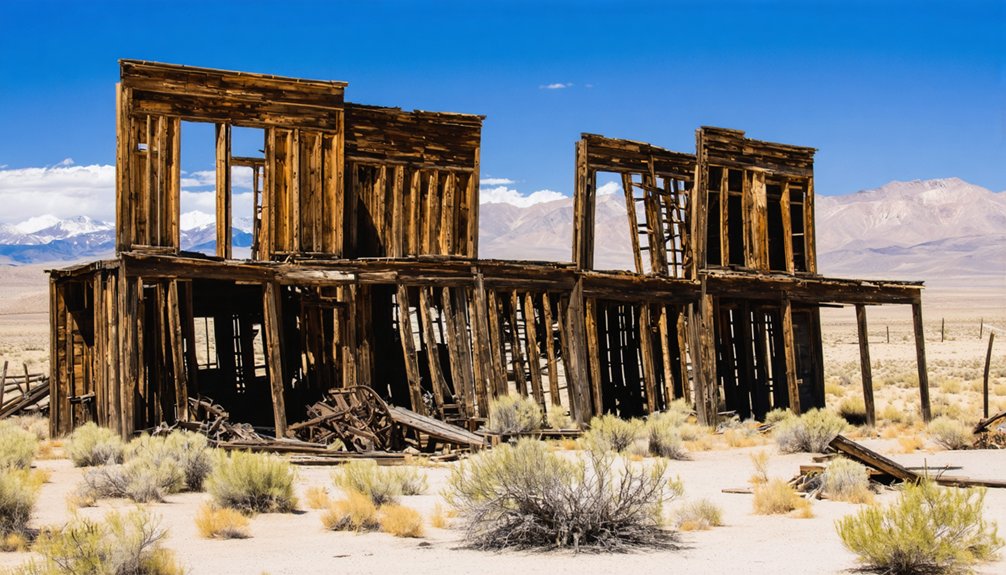
This mining legacy followed a dramatic arc:
- 1853: Founded as Nevada’s pioneering mining camp
- Mid-1850s: Grew into the territory’s largest settlement
- 1860: Population collapsed as accessible gold depleted
- Post-1860: Became Nevada’s original ghost town
You’ll find Johntown’s significance lies not in longevity but in what it represented—the template for countless Nevada boomtowns that followed, each destined to chase fortune before fading into history.
Exploring Mining Heritage in Eastern Nevada
Long before Nevada gained statehood, Eastern Nevada’s mountains concealed mineral wealth that would shape the American West.
Eastern Nevada’s mountains held mineral treasures that would transform the American West long before statehood arrived.
You’ll find remnants of this legacy scattered across districts like Pioche, where Indian guides led prospectors to prehistoric turquoise mines worked around 1200 A.D. The region’s boom began when lead deposits at North Mines sparked development, followed by the Esmeralda District‘s 1860 discovery and Pine Grove’s $8,000,000 yield by 1893.
Today’s explorers can examine mining artifacts at abandoned sites, though modern historical preservation efforts challenge you to balance access with protection.
Since 1989, state reclamation bonds approaching $3 billion guarantee these landscapes endure. Walking these grounds, you’re treading paths where fortune-seekers once wielded hand tools, chasing silver veins that built—and abandoned—entire communities.
What to Expect When Visiting These Historic Sites
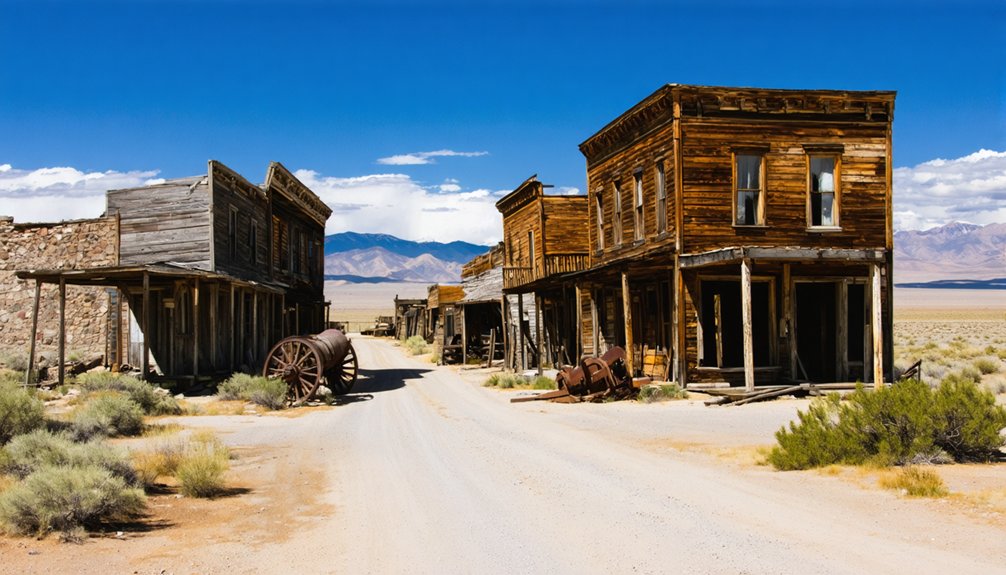
Understanding the mining heritage prepares you for what awaits at these sites, but nothing matches standing before the weathered structures themselves.
Eastern Nevada’s ghost towns offer unfiltered access to authentic decay, where you’ll encounter:
- Crumbling architecture – Stone buildings over 150 years old, many roofless from timber removal during abandonment.
- Arrested decay – Nevada’s dry climate preserves structures exactly as miners left them.
- Ghost town photography opportunities – Weathered textures, dramatic desert lighting, and isolation create compelling compositions.
- Living history elements – Some locations maintain small populations, offering visitor insights through seasonal saloons and restored cabins.
You’ll experience freedom to explore at your own pace, though structures remain fragile.
The high-altitude views in places like Belmont provide scenic backdrops, while desert sunsets enhance late-afternoon visits.
Frequently Asked Questions
Are There Any Guided Tours Available for Eastern Nevada Ghost Towns?
Yes, you’ll find guided tours available through companies like Pink Adventure Tours and Wild West Ghost Town Day Tours. Local guides lead you through Nelson’s Techatticup Mine, Berlin ghost town, and remote Mojave Desert mining sites.
What Is the Best Time of Year to Visit These Ghost Towns?
Spring and fall are your best seasons for exploring, offering mild temperatures between 60-75°F and dry roads. You’ll avoid extreme summer heat, winter snow closures, and monsoon flash floods while enjoying ideal weather considerations.
Do I Need a Four-Wheel Drive Vehicle to Reach These Locations?
You won’t need four-wheel drive for most eastern Nevada ghost towns like Pioche and Goldfield on paved highways. However, vehicle recommendations include high-clearance SUVs for remote sites like Delamar’s roughest stretches and backcountry explorations.
Are Camping Facilities Available Near Any of These Ghost Towns?
Yes, you’ll find camping facilities ranging from Silver State RV Park’s full hookups to primitive sites at Fish Lake Valley Hot Springs. Essential camping tips include preparing for dust storms, while nearby amenities vary from WiFi to natural hot springs.
What Safety Precautions Should Visitors Take When Exploring Abandoned Structures?
Respect fenced perimeters around unstable ruins, don’t climb weathered walls that’ll collapse, watch for rattlesnakes and scorpions in debris, carry plenty of water, and never disturb artifacts—you’re exploring Nevada’s history, not destroying it.
References
- https://nvtami.com/top-10-ghost-towns-nevada-northwest/
- https://en.wikipedia.org/wiki/List_of_ghost_towns_in_Nevada
- https://www.discovernorthamerica.co.uk/nevada-old/discover-nevadas-ghost-towns/
- https://www.visittheusa.com/experience/6-nevada-ghost-towns-explore-if-you-dare
- https://www.nevadaghosttownsandmininghistory.com
- https://www.youtube.com/watch?v=Bp2IcEQsWEM
- https://www.youtube.com/watch?v=kg18CwWeMnc
- https://nvtami.com
- https://travelnevada.com/ghost-town/
- https://www.pbslearningmedia.org/resource/nevada-ghost-towns-video-gallery/outdoor-nevada/