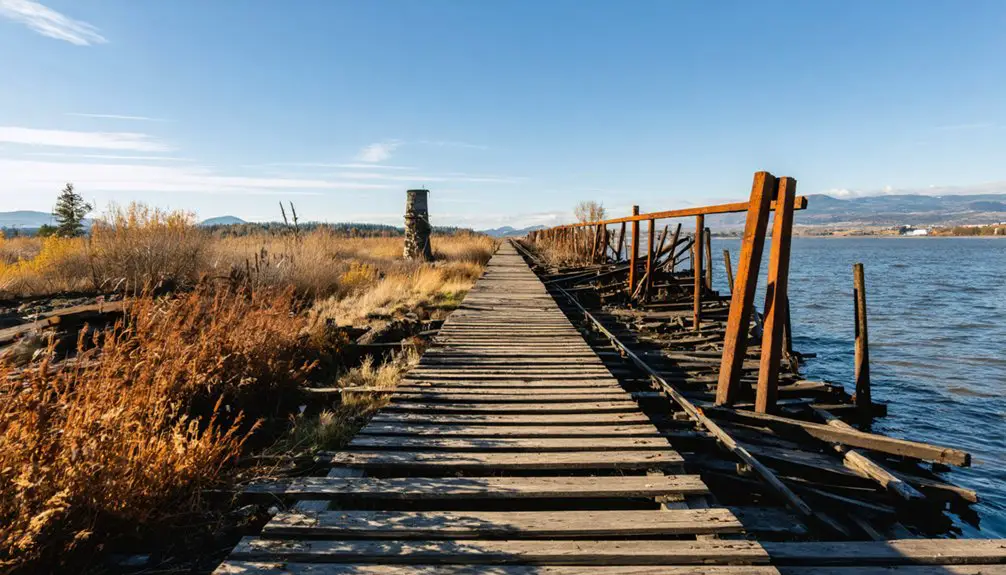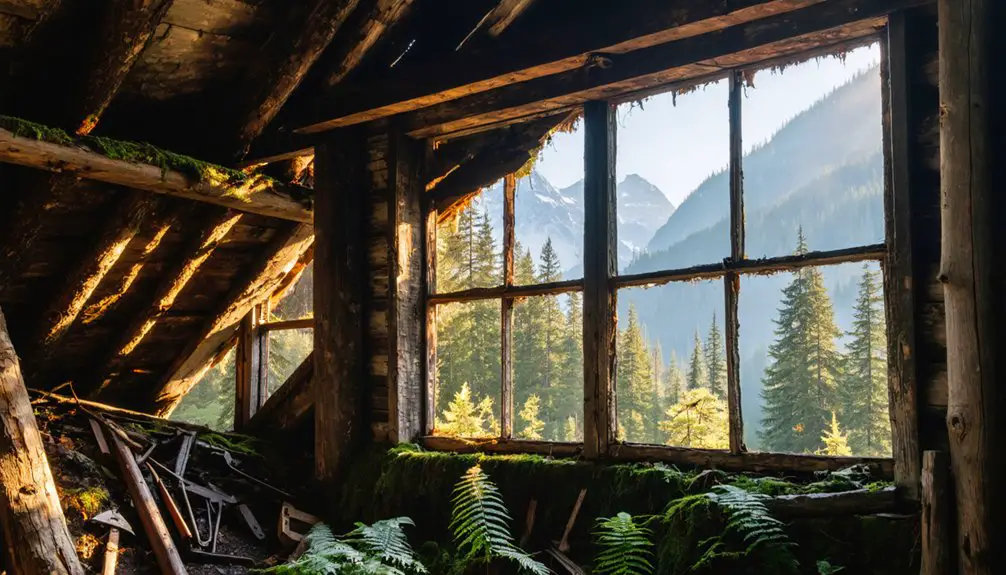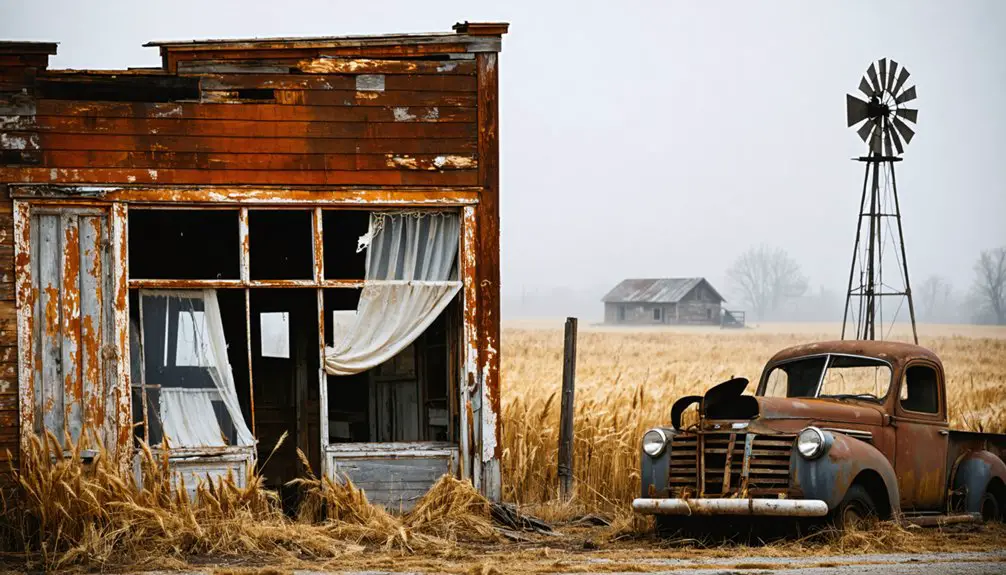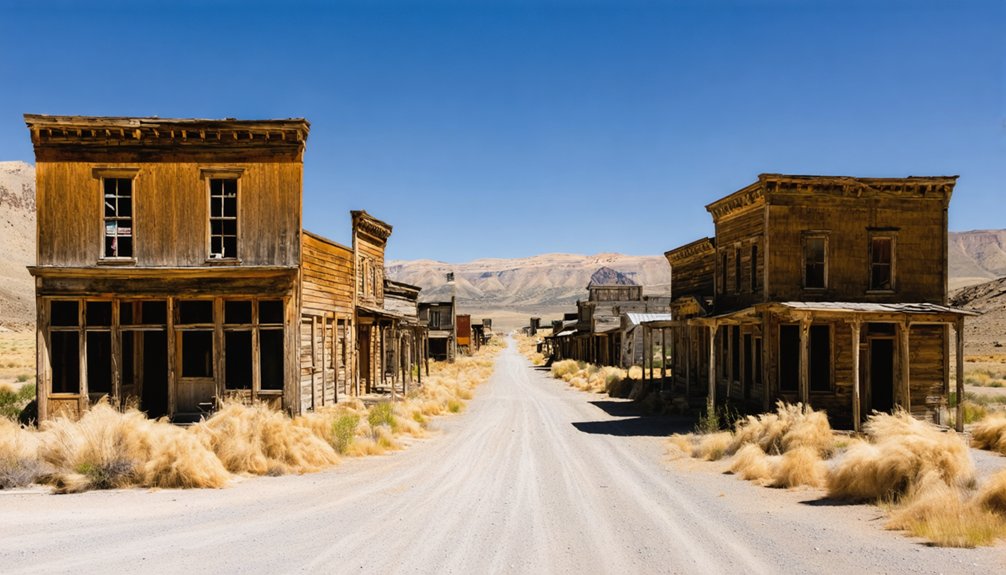
You’ll find over 30 documented ghost towns scattered across Eastern Washington’s high desert and mountain ranges, remnants of gold rushes, railroad expansion, and agricultural experiments that collapsed between the 1890s and 1940s. Notable sites include Monte Cristo, where 310,000 tons of silver ore were extracted before devastating floods ended operations in 1907, and Cloverland, an orchard town abandoned after unsuitable soil destroyed farming prospects. Access varies—some require landowner permission while others offer maintained hiking trails through preserved structures and original mining equipment that reveal the region’s boom-and-bust cycles.
Key Takeaways
- Liberty, established in 1867, is Washington’s oldest mining town, originating from the Goodwin brothers’ gold discovery in Swauk Creek drainage.
- Monte Cristo boomed after 1889 silver ore discovery, attracting Rockefeller investment before floods and depleted ore caused abandonment by 1907.
- Cloverland, founded in 1902 as an orchard town, collapsed post-1910 due to unsuitable agricultural conditions, leaving only a cemetery.
- Molson remains fully preserved since 1960 with maintained structures, while Monte Cristo requires an 8-mile roundtrip hike from Barlow Pass.
- Over 30 documented ghost towns exist across Eastern Washington, with county-by-county guides available for locating abandoned mining and agricultural settlements.
Mining Booms and Railroad Expansion: How Eastern Washington’s Ghost Towns Came to Be
When the Goodwin brothers discovered gold in the Swauk Creek drainage in 1867, they couldn’t have known Liberty would become Washington’s oldest mining town—a distinction it still holds today.
By 1873, they’d struck a rich deposit that triggered a mini gold rush three years later. You’ll find similar patterns across Okanogan County, where gold finds created instant settlements wherever creeks converged.
Mining techniques evolved from simple placer operations to hard rock extraction as fantastic silver ore discoveries drew experienced miners by century’s turn.
Settler life revolved around these booms—Monte Cristo boasted 211 claims by 1893, while Chesaw grew into a substantial town with 40 buildings by 1910.
Railroads followed wealth, connecting remote camps to eastern investors whose capital sustained expansion. The Monte Cristo Railroad grade served as the primary route to the town site, allowing prospectors and investors to reach the burgeoning mining district until washouts in the early 2000s ended vehicular access. The Central Washington Railway established Govan in 1889, linking the remote settlement to broader transportation networks before Highway 2 construction shifted traffic patterns.
Cloverland, Monte Cristo, and Other Notable Abandoned Settlements
You’ll find Cloverland’s story etched in its cemetery gravestones dating to the early 1900s, marking the brief peak of this failed orchard community 11.5 miles southwest of Asotin.
While Cloverland struggled with irrigation problems and collapsed by 1910, Monte Cristo in Snohomish County boomed to 1,000 residents through silver mining before its 1907 abandonment.
The Cloverland Garage, originally a general store before converting to an automobile service station in 1918, now stands as a National Register historic site in the town’s center. Access to Cloverland requires crossing the Snake River canyon via Lewiston, Idaho, adding distance to what seems like a short trip on the map.
These settlements—alongside Bodie’s gold rush, Liberty’s persistent mining operations into the 1940s, and Melrose’s silver deposits—reveal how quickly Eastern Washington’s towns rose and fell with their extractive economies.
Cloverland’s Rise and Fall
Nestled 11.5 miles southwest of Asotin in the rolling hills of Eastern Washington, Cloverland emerged in 1902 as an orchard town built on agricultural dreams and ambitious promotion.
Marketers pitched this settlement to land buyers as the West’s best investment opportunity, using rustic imagery to attract pioneers seeking independence through orchard-based prosperity.
Cloverland history unfolded through three distinct phases:
- 1902-1910: Rapid growth as settlers established orchards and basic infrastructure, reaching peak population.
- Post-1910: Economic collapse when unsuitable conditions destroyed the orchard economy.
- Mid-20th century onward: Complete abandonment, leaving only the cemetery as evidence.
The failed agricultural venture reveals how environmental reality trumped promotional promises.
The promotional campaign drew residents primarily from Virginia and North Carolina, bringing families who hoped to establish new lives in the Pacific Northwest.
Today, you’ll find overgrown ruins marking where settlers once pursued self-sufficient lives, their aspirations now documented only through photographs and archival records. The rugged terrain that characterizes the area makes some of the original roads completely inaccessible to modern vehicles.
Monte Cristo Mining Legacy
Unlike Cloverland’s agricultural failures, Monte Cristo’s collapse stemmed from geology itself betraying investor expectations.
You’ll find this Cascade Mountains ghost town‘s story begins in 1889, when prospectors discovered silver ore that attracted John D. Rockefeller’s syndicate by 1891. The settlement boomed to over 1,000 residents by 1894, processing 300 tons daily through advanced mining techniques at eight primary operations.
Yet erratic ore bodies undermined profitability from the start. The 1897 flood devastated infrastructure, forcing mass exodus. Avalanches repeatedly crushed railroad access and destroyed the final active mine in 1920.
Between 1889 and 1907, operations extracted 310,000 tons, but you couldn’t overcome nature’s hostility. Judge Bond, an Alabama millionaire, invested heavily in the district alongside other capitalists who saw Monte Cristo as Washington’s unrivaled mining opportunity.
Today, Monte Cristo stands as a memorial to ambitious capital meeting unforgiving terrain. ASARCO acquired the mining operations in 1903, continuing extraction efforts until economic viability finally collapsed.
Accessibility and Preservation Efforts
Today’s visitors face vastly different challenges reaching these abandoned settlements than miners and homesteaders encountered. Ghost town accessibility varies dramatically across eastern Washington. Cloverland demands high-clearance vehicles and private landowner permission, while seasonal snow blocks winter entry entirely.
Monte Cristo offers the most democratic access—an 8-mile roundtrip hike along washed-out roads from Barlow Pass.
Preservation challenges across settlements:
- Monte Cristo Preservation Association maintains trail improvements while Forest Service restrictions prevent permanent bridge construction.
- Cloverland’s obscurity limits documentation efforts, though local historians pursue access agreements for future public tours.
- Molson stands fully preserved since 1960 with maintained structures you’re free to explore.
Respect remaining artifacts—leave relics undisturbed.
You’ll discover authentic history when sites avoid over-restoration, maintaining their weathered integrity for independent exploration. The first mile of trail follows a flat dirt road bed that may accommodate mobility aids, though wheelchair users should prepare for spongy conditions and fast-moving highway traffic at the trailhead crossing. Molson’s school museum provides disabled parking and mobility-friendly facilities for visitors exploring the open-air exhibits.
Why These Towns Failed: Economic Collapse and Resource Depletion
You’ll find that Eastern Washington’s ghost towns rarely died from a single cause—most crumbled under overlapping pressures between the 1890s and 1940s.
Among the remnants of these once-thriving communities, you’ll discover many historic sites in Eastern Washington that tell the stories of their former inhabitants. Exploring these locations offers a fascinating glimpse into the region’s past, where tales of ambition and hardship intertwine. Today, preservation efforts aim to honor the legacy of these sites, allowing visitors to appreciate the rich history that shaped this area.
Mining camps like Monte Cristo and Gold Hill exhausted their ore veins within decades, while railroad-dependent settlements such as Govan and Copper City collapsed when anticipated rail lines never arrived or existing service shifted from steam to diesel power.
Agricultural communities from White Bluffs to Wilcox couldn’t survive soil depletion, falling grain prices, and the brutal economic contractions that repeatedly swept through the region’s farming districts.
Mining Boom to Bust
The ghost towns scattered across eastern Washington’s landscape didn’t fade gradually—they collapsed with startling speed as the economic foundations that built them crumbled beneath extractive pressures and market forces.
You’ll find the pattern repeated across districts like Monte Cristo, Liberty, and Molson, where mining technology couldn’t compensate for depleted ore bodies and plummeting metal prices.
These communities experienced predictable collapse through:
- Resource exhaustion within 1-9 years of discovery, as surface deposits disappeared and deeper extraction became unprofitable
- Capital withdrawal when eastern investors like Rockefeller’s syndicate recognized diminishing returns
- Population exodus as miners relocated to richer claims in other states
Ghost town folklore celebrates the boom, but the bust reveals how commodity-dependent settlements couldn’t survive market volatility or shift to sustainable economies.
Railroad Changes Eliminated Jobs
When steam locomotives gave way to diesel power in 1918, railroad communities across eastern Washington lost their economic purpose within a single generation.
Railroad innovation impacts devastated towns like Melmont, which existed solely to supply coal and water for steam engines crossing mountain passes. You’ll find that diesel engines eliminated positions for coal handlers, water station operators, and maintenance crews who’d built lives in these remote depots.
The 1929 Cascade Tunnel completion sealed Wellington’s fate when the Great Northern Railway rerouted tracks miles away from the original depot.
Community displacement effects were swift—workers faced unemployment in isolated locations with no alternative industries. Towns like Corfu and Govan couldn’t survive when efficiency replaced the need for frequent stops.
The railroad’s technological advancement rendered these communities obsolete within two decades of their peak.
Agricultural Ventures Could Not Sustain
While railroads abandoned settlements through technological progress, another wave of eastern Washington towns collapsed under the weight of impossible agricultural dreams.
You’ll find the pattern repeated across failed settlements where homesteaders confronted harsh realities:
- Cloverland’s orchards withered despite irrigation attempts, shrinking from 400 residents in 1910 to scattered livestock operations on expansive holdings.
- Molson’s 700-person farming community evaporated when agricultural industry dropped out abruptly, leaving only a bank, schoolhouse, and cemetery.
- Nighthawk shifted from mining to farming as metal values plummeted, but rising costs and depleted resources proved equally devastating.
Eastern Washington’s farming challenges centered on poor soil and water scarcity. You can’t sustain crops without viable yields, and resource management failed when irrigation collapsed.
These homestead booms crashed hard, emptying entire populations who’d gambled everything on unworkable land.
What Remains: Buildings, Mining Equipment, and Historic Structures
Scattered across Eastern Washington’s high desert and mountain valleys, remnants of abandoned settlements tell stories of boom-and-bust cycles that defined the region from the 1890s through the mid-20th century.
You’ll find authentic mining heritage at Liberty, where original equipment and interpretive signs preserve the extraction industry’s legacy. The United Brethren Church in Elberton showcases red-brick building preservation, one of few intact structures remaining from the town’s early 1900s peak.
At Monte Cristo, false-front buildings stand alongside the closed road miners traveled over a century ago. Corfu’s concrete foundations and Pleasant Valley Cemetery headstones from 1917 mark railroad workers’ settlements.
These physical traces—rusting bridges, abandoned grain elevators, weathered gravestones—offer you unfiltered access to Washington’s frontier past.
Where to Find Ghost Towns: County-by-County Guide to Eastern Washington
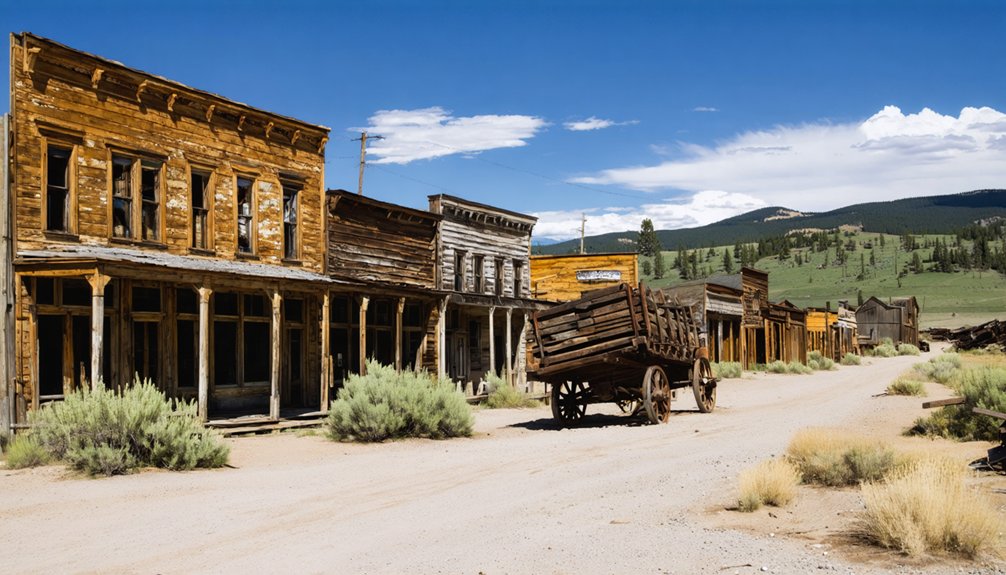
Across five counties in Eastern Washington, you’ll locate more than 30 documented ghost towns through systematic county-by-county exploration.
These abandoned sites near Spokane Washington offer a glimpse into the past, where communities once thrived before the allure of urban development took over. Exploring these ghost towns can reveal fascinating stories and remnants of architecture that tell the tale of a bygone era. Each visit invites a sense of adventure and curiosity about the lives that were once lived there.
Your Ghost Town Exploration Route:
- Okanogan County delivers premium historical preservation at Bodie and Molson near the Canadian border, where pioneer buildings and farm machinery remain intact from 1897 mining booms.
- Adams County offers Rockwell, Govan (established 1889), and Sherman—all accessible off Highway 2, showcasing railway decline and homesteading-era abandonments.
- Benton County features White Bluffs (1861-1943) and Mottinger, with over 10 documented sites linked to Hanford-related evacuations and mining settlements.
You’ll find Spokane County‘s Rodna (1912-1931) and Stevens County’s Ryan (1897-1912) through post office records.
Douglas County’s Sanderson operated 1908-1920. Each location grants you unrestricted access to Washington’s frontier legacy.
Planning Your Visit: Hiking Trails and Accessible Ghost Town Sites
Beyond identifying ghost town locations on county maps, you’ll need trail-specific intelligence to reach Western Washington’s most rewarding abandoned settlements.
Liberty Ghost Town offers easiest access—just 1 mile with minimal elevation gain along Blewett Pass, perfect for families seeking roadside exploration.
Liberty Ghost Town provides the most family-friendly ghost town experience in Western Washington with minimal hiking required from the highway.
Franklin’s 2.5-mile railroad grade follows Green River with moderate 200-foot climb to cemetery and mine shafts.
Northern State’s 5-mile pastoral route requires minimal effort across former hospital farmland.
Monte Cristo demands commitment: 8 miles roundtrip from Barlow Pass on the old miners’ road.
Melmont’s 6-mile rail grade stays muddy, testing your trail safety awareness.
Frequently Asked Questions
Are Ghost Towns in Eastern Washington Safe to Explore With Children?
Ghost towns aren’t playgrounds—child safety demands caution. You’ll face structural collapse, abandoned mine shafts, and snake-infested trails. Exploration tips: skip Marysville with young kids, choose maintained sites like Bodie, prepare supplies, and supervise constantly.
Can I Take Artifacts or Souvenirs From Abandoned Ghost Town Sites?
No, you can’t legally take artifacts from these sites. Legal regulations protect ghost towns as historical resources, with fines reaching $100,000. Artifact preservation guarantees future generations can experience Washington’s authentic frontier heritage firsthand.
What Should I Bring When Visiting Remote Ghost Towns?
Bring exploration essentials like sturdy boots, GPS devices, flashlights, first-aid kits, and water for remote Eastern Washington ghost towns. Follow photography tips: capture weathered structures during golden hour, document historical details, and respect fragile ruins without disturbing artifacts.
Are There Guided Tours Available for Eastern Washington Ghost Towns?
Most Eastern Washington ghost towns lack guided exploration—you’ll find self-directed freedom at Sherman Access, Liberty, and Monte Cristo. For guided historical significance, consider Okanogan County’s daylong Old West tours or pre-Manhattan Project excursions.
If you’re looking for a unique experience, explore the abandoned places in Washington state, which tell tales of the past amidst the wilderness. These forgotten sites often offer a glimpse into history that few get to experience firsthand. Whether it’s the remnants of a once-thriving mining town or a dilapidated schoolhouse, each location has a story waiting to be uncovered.
As you journey through abandoned towns in Washington state, you’ll encounter the eerie silence that envelops these once-vibrant communities. Each structure, overtaken by nature, serves as a powerful reminder of the lives that once flourished here. Engaging with these remnants allows visitors to reflect on the passage of time and the stories that have shaped the region.
Which Ghost Towns Allow Camping or Overnight Stays Nearby?
Sherman and Curlew offer the best overnight options. You’ll find dispersed BLM camping near Sherman off Highway 2, while Curlew provides RV parks and nearby Curlew Lake campgrounds. Check local camping regulations before settling in.
References
- https://www.atlasobscura.com/places/cloverland-ghost-town
- https://stateofwatourism.com/ghost-towns-of-washington-state/
- https://en.wikipedia.org/wiki/List_of_ghost_towns_in_Washington
- https://www.youtube.com/watch?v=thZwkLMkR8k
- http://www.ghosttownsusa.com/okanco.htm
- https://www.wta.org/go-outside/seasonal-hikes/fall-destinations/hidden-history-ghost-town-hikes
- https://www.youtube.com/watch?v=FVveO9uJBvc
- https://www.wta.org/go-hiking/hikes/liberty-ghost-town
- http://www.ghosttownsusa.com/bttales50.htm
- https://www.islands.com/1988063/washington-off-radar-abandoned-mining-ghost-town-molson-free-visit-history/