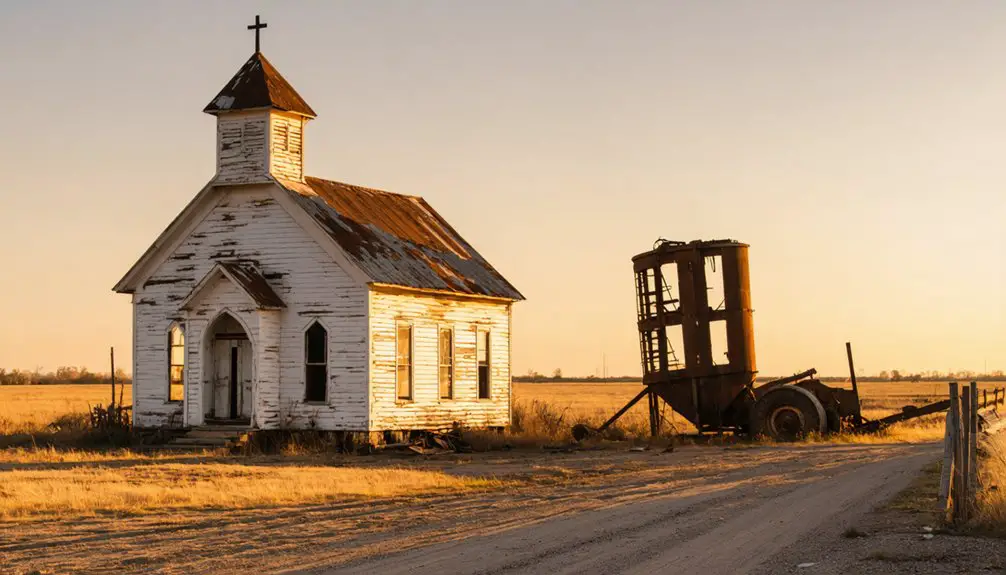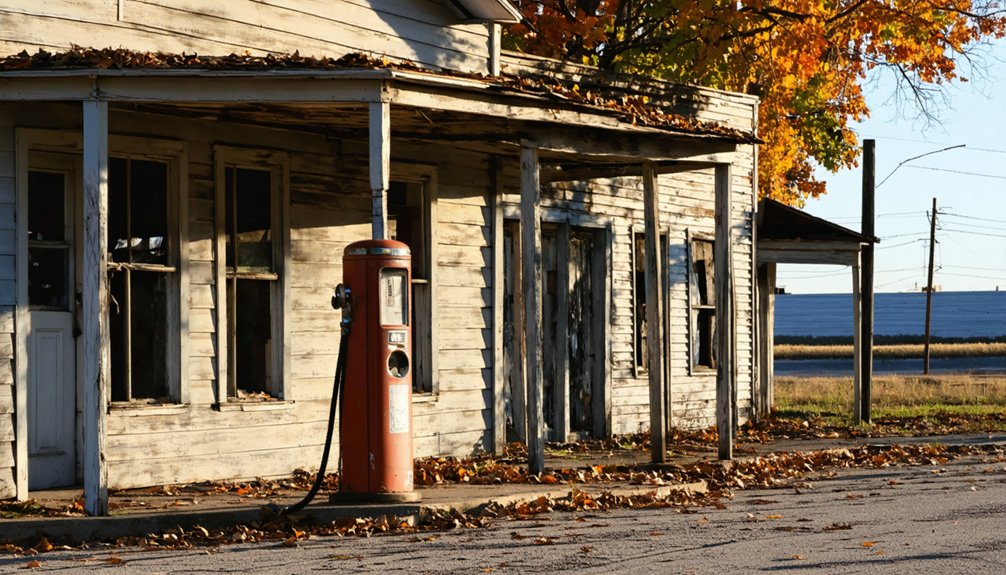
You’ll find Oklahoma’s most enthralling ghost towns come alive during fall, when cooler weather makes exploring safer and autumn light reveals hidden details. Head to Ingalls for outlaw history and replica buildings, Picher for haunting mining remnants amid toxic landscapes, or Fallis’ decaying 1892 schoolhouse perched on red hills. September through November offers ideal conditions—golden foliage frames crumbling structures while reduced vegetation exposes forgotten foundations. Pack sturdy boots, navigation tools, and safety gear, as these sites feature unstable floors and overgrown paths that demand careful exploration and preparation.
Key Takeaways
- Ingalls offers outlaw history with the Doolin-Dalton Gang base, deserted buildings, and a replica hotel recalling its 1893 shootout.
- Picher showcases abandoned mining devastation with 14,000 mineshafts, chat piles, and skeletal remains from its $20 billion mining era.
- Fallis features an 1880s schoolhouse on a red hill with fall foliage and remnants from its 1902 railroad boom.
- Loveland preserves Valentine’s tradition history with crumbling structures including a water tower and abandoned post office from its 1908 founding.
- Fall visits (September–November) provide cooler weather, golden light enhancing photography, reduced vegetation revealing structures, and fewer crowds for exploration.
Ingalls: Where Outlaws Once Roamed
When you drive down the dusty roads leading to Ingalls, you’re retracing the escape routes of some of the Old West’s most notorious outlaws. The Doolin-Dalton Gang called this place home in 1893, spending freely and keeping the peace while planning their next heist.
Stand where the Battle of Ingalls erupted on September 1st—lawmen disguised in wagons ambushed gang members mid-poker game at Ransom Saloon. Three marshals and two townspeople died that day.
Today, you’ll find deserted buildings and stone foundations along streets named Doolin and Dalton. The 1938 marshal’s monument marks where violence shattered this frontier town’s dreams. Some locals believed the monument honored the wrong side, given their sympathy for the outlaws who once frequented their establishments.
Ghost stories linger here, and many consider it one of Oklahoma’s most haunted locations. The replica Old Ingalls Hotel stands as a reminder of the building central to the historic shootout. You’re free to explore what railroad rejection and outlaw infamy left behind.
Picher: Oklahoma’s Most Haunting Abandoned Mining Town
Over $20 billion worth of lead and zinc came from beneath Picher’s streets, but what the mines gave in wealth, they took back in devastation. You’ll find mountains of toxic chat piles rising against the Oklahoma sky—remnants of mining contamination that earned Picher the grim title of America’s most toxic ghost town.
Walk carefully here. The ground’s riddled with 14,000 abandoned mineshafts, and sinkholes still swallow roads without warning.
Environmental hazards forced everyone out by 2013, leaving only skeletal buildings and rust-red streams that tell stories of lead poisoning and broken dreams. A devastating 2008 tornado accelerated the town’s final collapse, destroying what structures remained and scattering the last holdouts.
Visit the mining museum if it’s still standing—structures keep vanishing to arson and collapse. At its height in 1926, this boomtown peaked at 14,000 residents, a far cry from the empty streets you’ll encounter today. This isn’t sanitized history. It’s raw, dangerous freedom to witness what happens when progress ignores consequences.
Beer City: Remnants of a Prohibition-Era Party Town
While Picher’s destruction came from corporate greed, Beer City destroyed itself through sheer lawlessness.
You’ll find nothing but wheat fields three miles south of Liberal, Kansas, where this wild outpost once defied prohibition history. From 1888 to 1890, No Man’s Land belonged to nobody—meaning everyone who craved freedom from government control.
Eight saloons served cowboys and outlaws in white tents. Pussy Cat Nell ran the Yellow Snake Saloon until she helped gun down corrupt Sheriff Bush, leaving his body with 74 wounds.
Outlaw legends still draw treasure hunters searching for buried bootlegger caches.
The 1890 Organic Act killed the party instantly by making the Panhandle part of Oklahoma Territory. You can’t visit physical remnants, but ghost stories persist where spirits allegedly roam. The town once featured the WHITE ELEPHANT saloon, run by local outlaws who controlled this rough prairie settlement.
It’s raw prohibition history—brutal, brief, and utterly ungoverned.
Loveland: A Settlement Lost to Nature’s Fury
Unlike Beer City’s self-inflicted chaos, Loveland couldn’t outrun Mother Nature’s wrath.
Founded in 1908, this Tillman County settlement earned fame when sweethearts discovered its post office stamped “Postmarked from Loveland” on Valentine’s cards.
You’ll find community legends still whisper about the romantic tradition that made this cotton-farming town special.
But fires and tornadoes had different plans. By 1968, successive disasters drove everyone away, leaving behind a crumbling water tower and scattered buildings that defy historical preservation efforts.
The recently shuttered post office stands as a testimonial to what nature can erase.
You can explore what’s left this fall, though you’re venturing through unstable structures at your own risk.
The town developed alongside the railroad, featuring farms, stores, a hotel, bank, and blacksmith that supported the growing community. Early postal service connected Loveland to the outside world, much like the post offices established in towns such as Wybark and Yewed in the early 1900s.
The water tower rises above the prairie—your landmark to a town that loved couldn’t save.
Ingersoll: Railroad Relics and Grain Elevator Ghosts
You’ll spot Ingersoll’s twin grain elevators rising from the prairie long before you reach the townsite. Their weathered wooden frames stand sentinel over abandoned streets where a thousand residents once bustled.
The railroad’s legacy lives on in crumbling depot foundations and rusted track markers, telling the story of a boom that lasted just four decades before nature and economics reclaimed this corner of Alfalfa County. The town’s rowdy past echoes through its ruins—seven saloons once lined these quiet streets, serving a population that gave Ingersoll its reputation as one of the territory’s more sinful settlements. Like many Oklahoma settlements, Ingersoll declined when the railroad bypassed the town for more prosperous routes.
Pack bug spray for your sunset visit—the mosquitoes don’t care that you’re here to photograph those elevators silhouetted against crimson skies, but the light between those towers makes every bite worthwhile.
Historic Grain Elevator Exploration
Walk around this National Register landmark and you’ll feel the weight of agricultural history in every weathered tile.
It’s part of Oklahoma’s shift from frontier to agribusiness powerhouse, where farmer cooperatives and independent operators battled for wheat profits.
The abandoned structure stands defiantly in this ghost town, offering photographers dramatic angles and history buffs tangible connections to northwestern Oklahoma’s commercial agriculture roots.
Railroad Heritage Walking Tour
As you step onto the gravel path at Highway 33, the skeletal remains of Ingersoll’s railroad empire spread before you like an open-air museum of America’s agricultural heyday. The 1.2-mile route winds past exposed track beds where rusted railroads pierce through prairie grass, their oxidized surfaces glowing amber in October light.
You’ll encounter a derelict vintage locomotive at the 0.3-mile marker—its frozen wheels and corroded boiler telling stories of wheat harvests past. Telegraph poles still stand sentinel along the old Rock Island right-of-way, their glass insulators catching afternoon sun.
The trail climbs gently toward the towering grain elevator at 0.7 miles, where rusted switch stands and scattered rail spikes crunch underfoot. Bring sturdy boots and water; Kingfisher’s services are 15 miles distant.
Fallis: Forgotten Schoolhouse and Fading Memories
You’ll find Fallis perched on a long red hill where mission bells once called Iowa Indian children to lessons in the 1880s. The abandoned schoolhouse still stands among the trees, its walls holding stories of transformation from tribal mission to a school for Black children.
Then, it became a now-empty Baptist church.
Walk the quiet streets where a devastating fire consumed the drug store, creamery, and general store, leaving behind only foundations and the whisper of steam whistles that once announced trains pulling into this thriving agricultural hub.
Abandoned Schoolhouse Exploration
Perched on a long red hill where an Iowa Reservation village once stood, the abandoned Fallis schoolhouse crumbles quietly among the weeds and red dirt roads of Lincoln County.
Built around 1892, this deteriorating structure stands as a testament to the town’s historical significance, though school preservation efforts never materialized.
You’ll find over 40 documented photos revealing its poor condition—peeling paint, collapsed ceilings, and nature reclaiming every corner.
Visit during fall when Oklahoma’s wooded hills blaze with color, creating haunting contrasts against crumbling brick and red dirt.
The schoolhouse sits among Fallis’s remaining dozen homes, accessible via rough roads that’ll test your vehicle’s clearance.
Bring sturdy boots for exploring overgrown yards, and remember: you’re witnessing authentic decay, not sanitized history.
This isn’t preservation—it’s abandonment in its rawest form.
Rail Town Decline
The Katy railroad’s arrival in 1902 transformed sleepy Mission into booming Fallis almost overnight. You’ll discover how this railroad history shaped one of Oklahoma’s most fascinating pioneer settlements.
When Fort Smith and Western tracks crossed the Katy in 1903, Fallis became a critical trans-shipment hub with four general stores, three hotels, and thriving commerce.
The 1904 oil discovery added prosperity, but freedom from corporate control proved fleeting.
Walk among the crumbling brick buildings and you’ll witness dramatic decline—from 400 residents to just 22 by 1980.
Railroad abandonment sealed Fallis’s fate, accelerated by a devastating 1960 fire.
Today’s dozen remaining homes and silent bank vault tell tales of boom-to-bust cycles that defined countless Western towns chasing railroad dreams.
Best Time to Explore Oklahoma Ghost Towns in Autumn
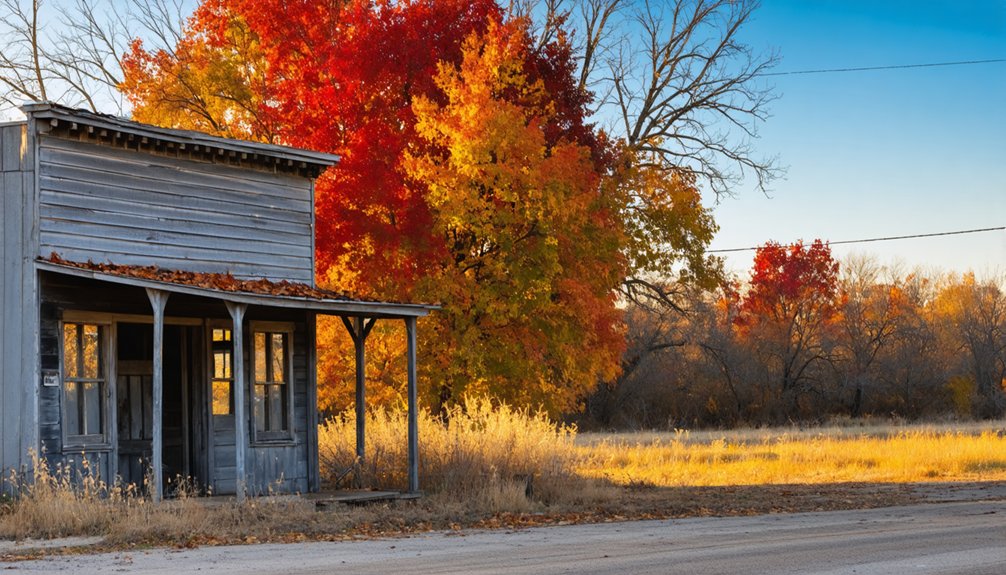
While Oklahoma’s ghost towns welcome visitors year-round, autumn transforms these abandoned settlements into particularly compelling destinations. September through November offers ideal seasonal weather for exploring remote locations like Skedee in northern Oklahoma or Texola along Route 66.
As the leaves change color, fall foliage in ghost towns creates a stunning backdrop for photography enthusiasts and nature lovers alike. Each deserted building and cracked street is highlighted by vibrant reds and golds, enhancing the haunting beauty of these once-bustling communities. Visitors can immerse themselves in the serene atmosphere, capturing the spirit of the season while wandering through the remnants of history.
You’ll escape summer’s oppressive heat while steering through overgrown paths and examining weathered foundations. Cooler temperatures make cemetery walks at sites like Skullyville more comfortable as you study gravestones dating back to 1831.
Fall’s golden light enhances photography of abandoned structures and faded signs, capturing decay’s haunting beauty. Historic preservation efforts are most visible during autumn when reduced vegetation reveals architectural details hidden by summer growth.
You’ll encounter fewer crowds at western Oklahoma’s ghost towns near Cooperton, giving you freedom to explore at your own pace without tourist interference.
What to Bring on Your Ghost Town Adventure
Successful ghost town exploration hinges on proper preparation, and packing the right gear transforms potentially risky adventures into safe, rewarding experiences. Your packing essentials start with clothing layers—long-sleeve shirts, waterproof jackets, and thermal base layers handle Oklahoma’s unpredictable fall weather.
Don’t skimp on footwear: high-ankle boots with traction soles prevent twisted ankles on crumbling foundations.
Navigation tools liberate you from marked trails. Pack a GPS device with offline maps, compass, and printed coordinates for signal-dead zones.
Your camera captures weathered doorframes and sun-bleached signage, while a headlamp illuminates forgotten interiors safely.
Include a first-aid kit, multi-tool, and whistle—these aren’t paranoia, they’re freedom insurance.
Finally, carry extra water and energy snacks. Self-sufficiency means exploring at your own pace without rushing back to civilization.
Safety Tips for Visiting Abandoned Sites

Packing smart keeps you comfortable, but staying alert keeps you alive. Before entering any structure, scan for hazard identification markers: sagging floors, exposed rusty metal, and crumbling staircases signal danger zones.
Comfort matters, but vigilance is survival—scan every structure for sagging floors, rust, and unstable stairs before entering.
Test floor stability by tossing rocks ahead—never trust surfaces in water-damaged buildings. Keep your FFP3 mask handy when exploring below-ground spaces where black mold thrives, and avoid touching asbestos insulation around old pipes.
Legal considerations matter too. That “No Trespassing” sign isn’t just decoration—it’s your warning that criminal charges could follow.
Even on seemingly abandoned land, seek permission from property owners first. Federal laws protect historic artifacts, so photograph memories instead of pocketing souvenirs. Your freedom depends on respecting boundaries while satisfying your explorer’s spirit.
Frequently Asked Questions
Are Overnight Camping or RV Facilities Available Near Oklahoma Ghost Towns?
You won’t find camping amenities or RV accommodations directly at Oklahoma’s ghost towns like Picher, Texola, Foss, or Ingersoll. However, you’ll discover free boondocking spots on nearby public lands and overgrown Corps of Engineers areas for adventurous off-grid stays.
Which Ghost Towns Allow Metal Detecting or Artifact Collecting Activities?
You’ll find metal detecting allowed at Garnettville, Blackburn, Skullyville, and Big Cedar with proper permissions. Respect historical signage and preservation efforts while hunting artifacts. Always secure landowner consent and permits—these precautions protect your freedom to explore responsibly.
Do Any Ghost Towns Offer Guided Tours or Local Historians?
You’ll find guided ghost tours in Guthrie with Historical guides sharing preservation efforts through downtown walks. Fort Reno offers group Spirit Tours with narrated haunted histories. These experiences let you explore Oklahoma’s past freely while supporting local heritage conservation.
Are Oklahoma Ghost Towns Accessible for Visitors With Mobility Limitations?
Oklahoma ghost towns present accessibility challenges due to uneven terrain and lack of modifications. You’ll find few wheelchair-friendly sites among these abandoned locations. Consider contacting local tourism offices beforehand to identify any accessible routes or viewing areas available.
Exploring historic ghost towns in Oklahoma offers a unique glimpse into the state’s past, but visitors should also be mindful of their surroundings. Apart from the accessibility issues, the remnants of former communities tell stories of resilience and change. Each town has its distinct features, making thorough research worthwhile to enhance your experience.
What Cell Phone Coverage Exists in Remote Ghost Town Locations?
Like pioneers venturing into uncharted territory, you’ll find cell service frustratingly unreliable in Oklahoma’s ghost towns. Signal strength drops dramatically in remote locations—pack offline maps and emergency supplies, since you can’t depend on connectivity for navigation or assistance.
References
- https://oklahomawonders.com/best-things-to-do-in-ingalls-oklahoma-ghost-town/
- https://1073popcrush.com/ixp/115/p/oklahoma-pumpkin-patches-corn-mazes/
- https://www.youtube.com/watch?v=i6h5huyY4q0
- https://thesocialokie.com/oklahoma-ghost-towns/
- https://en.wikipedia.org/wiki/List_of_ghost_towns_in_Oklahoma
- https://www.historynet.com/ghost-towns-ingalls-oklahoma/
- https://www.islands.com/1983558/ingalls-oklahoma-once-thriving-ghost-town-historic-hotspot-wild-west-outlaws/
- https://www.kosu.org/arts-culture/2014-02-07/ghost-towns-ingalls
- https://www.ghosttowns.com/states/ok/ingles.html
- https://en.wikipedia.org/wiki/Ingalls