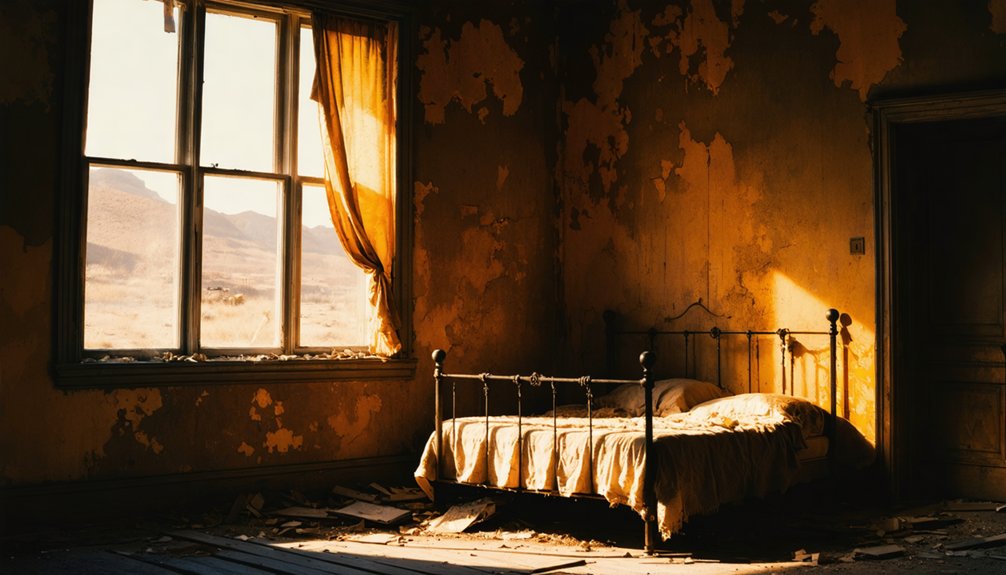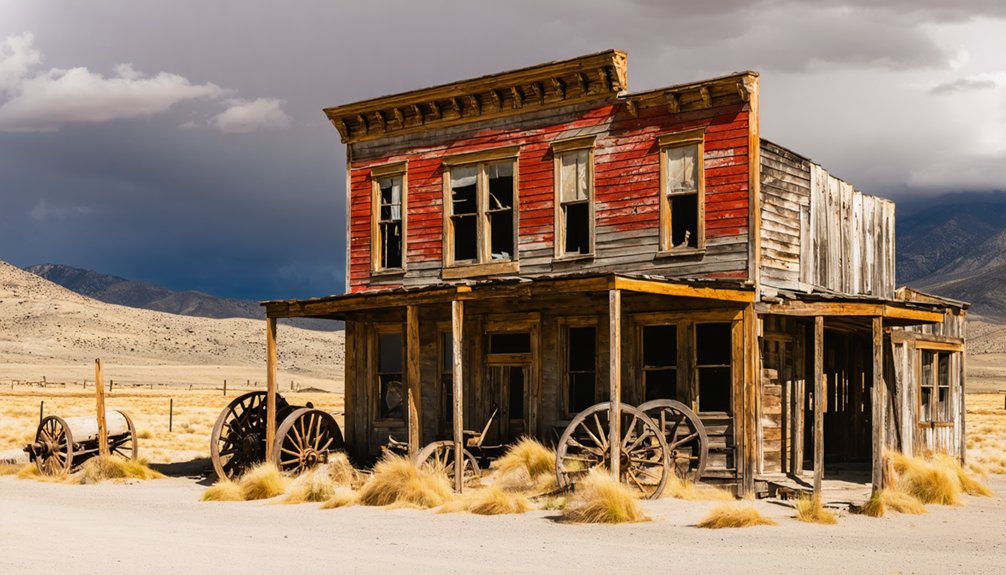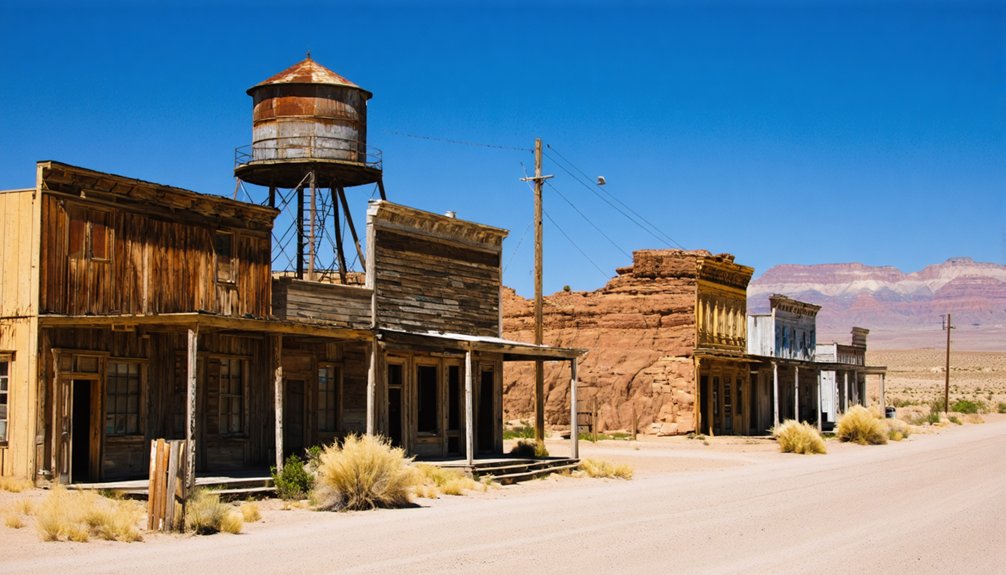
You’ll find ghost towns serving as pivotal settings in films like *Ghost Town* (1988), filmed at Arizona’s Old Tucson Studios, where authentic Western architecture enhances supernatural narratives. *Eyes of Fire* (1985) transforms Missouri’s Shawnee territories into folk horror landscapes, while *Bone Tomahawk* (2015) uses desolate frontier settlements to amplify psychological tension. These abandoned locations function as liminal spaces where documented pioneer history intersects with imagined supernatural dread, creating atmospheric foundations that transcend conventional genre boundaries. The following exploration reveals how these settings fundamentally reshape Western cinema’s mythological framework.
Key Takeaways
- Old Tucson Studios provided authentic Western sets for *Ghost Town* (1988), featuring supernatural curses and undead outlaws.
- *From Dusk Till Dawn 3* is set in 1913, establishing La Tetilla del Diablo’s origins within ghost town mythology.
- *The Assassination of Jesse James* uses authentic ghost town environments to capture Western loneliness through historical rigor.
- Abandoned towns in *Dead Birds* and *Near Dark* serve as liminal spaces where frontier mythology meets supernatural dread.
- *Bone Tomahawk* transforms isolated Western outposts into settings for brutal confrontations against cannibal tribes and malevolent forces.
Ghost Town (1988): A Supernatural Western Thriller in Arizona’s Abandoned Landscape
Released in 1988 under the Empire Pictures banner, *Ghost Town* represents a distinctive fusion of Western and horror genres that emerged during the late 1980s direct-to-video market expansion.
Director Richard Governor crafted this 85-minute R-rated film from David Schmoeller’s story, centering on Deputy Langley’s pursuit of kidnapped Kate through Arizona’s abandoned landscapes.
The production filmed on location at Old Tucson Studios during September and October 1987, utilizing the historic movie ranch’s authentic Western sets to enhance the supernatural atmosphere.
You’ll find supernatural curses dominating the narrative as Devlin, an undead outlaw bound to Satan, imprisons spectral townspeople within a ghost town that materializes unpredictably.
The film garnered mixed reviews from audiences, with ratings spanning from two to three-and-a-half stars as viewers debated its atmospheric merits against criticisms of pacing.
The film’s technical premise—modern ammunition proves useless against supernatural antagonists while vintage weaponry succeeds—establishes genre-specific logic that liberates the protagonist from conventional limitations, culminating in Devlin’s destruction and the town’s final disappearance into Arizona’s desert expanse.
From Dusk Till Dawn 3: The Hangman’s Daughter – Vampire Origins in the Old West
You’ll encounter three interconnected narratives that establish the mythological foundation of the *From Dusk Till Dawn* universe in P.J. Pesce’s 1913-set prequel.
The film traces how Esmeralda, daughter of vampire priestess Quixtla and human hangman Mauricio, transforms into the iconic Santanico Pandemonium while simultaneously documenting the origins of La Tetilla del Diablo, the isolated Mexican inn that would later become the notorious Titty Twister strip club.
Real-life author Ambrose Bierce appears as a survivor-witness to these vampire origins, his documented 1913 disappearance in Mexico providing historical authenticity to the film’s supernatural Western narrative.
The narrative interweaves with the story of dangerous outlaw Johnny Madrid, who escapes execution and becomes entangled in the supernatural events at the remote establishment.
The prequel blends horror elements with Western themes, creating a distinctive atmospheric experience that sets it apart from its predecessors in the franchise.
Ambrose Bierce’s Mysterious Journey
- Bierce’s prophetic nightmare foreshadowing his confrontation with revolutionary violence
- His entanglement with outlaw Johnny Madrid’s gang during a stagecoach robbery
- His navigation through vampire-infested catacombs beneath the establishment
- The film’s Aztec-style pyramid bookends connecting this prequel to the original movie’s setting
- The wooden stake weapons employed by survivors during the cantina’s climactic vampire battle
- The 1914 setting predates the neon-adorned roadhouse by decades
- No architectural blueprints link the frontier outpost to its modern incarnation
- The film prioritizes character-driven horror over location-specific world-building
- Rejected U.S. Cavalry assistance necessitates autonomous action
- Supernatural antagonism challenges Enlightenment rationality
- Maternal determination transcends institutional failures
- Character Evolution: Hiram Gummer transforms from Eastern aristocrat into the family’s legendary monster-hunter lineage.
- Town Survival: Rejection’s dwindling population weaponizes everything from punt guns to dynamite.
- Ecological Threat: Sound-hunting wormlike creatures force tactical adaptations in combat.
- *The Assassination of Jesse James* captures 1881’s vast Western loneliness through cinematography that makes spectral isolation palpable.
- Sets like Old Tucson’s crumbling adobe walls and Spanish Presidio ruins provide atmospheric foundations for paranormal storytelling.
- Abandoned locations such as Almeria’s Tabernas Desert create authentic ghost town environments where historical and supernatural elements converge.
- *Bone Tomahawk*’s cave-dwelling cannibals exploit remote Old West territory
- *Silent Tongue*’s desert ghosts haunt corpses beyond civilization’s reach
- *Near Dark*’s nomadic vampires weaponize Western loneliness
- Ghost towns amplify paranormal dread by eliminating witness protection, forcing you into direct confrontation with cannibalistic threats, vampire covens, and witchcraft manifestations.
- Cinematographers exploit nostalgic Western imagery—weathered saloons, skeletal homesteads—to anchor supernatural entities within tangible historical frameworks.
- Critical acclaim consistently recognizes visual storytelling quality even when narrative execution falters commercially.
- https://podcastingthemsoftly.com/2019/08/14/blood-on-the-frontier-nates-top-ten-horror-western-films/
- https://www.imdb.com/list/ls022328189/
- https://www.cbr.com/greatest-supernatural-westerns-ranked/
- https://en.wikipedia.org/wiki/Category:Films_set_in_ghost_towns
- https://editorial.rottentomatoes.com/guide/best-western-movies/
- https://en.wikipedia.org/wiki/Ghost_Town_(1988_film)
- https://letterboxd.com/film/ghost-town-1988/
- https://tvtropes.org/pmwiki/pmwiki.php/Film/GhostTown1988
- https://www.imdb.com/title/tt0095215/plotsummary/
- https://www.imdb.com/title/tt0095215/
The vampire symbolism reinforces themes of colonial exploitation and corruption plaguing revolutionary Mexico, positioning supernatural evil as metaphor for systemic oppression.
Santanico Pandemonium’s Dark Rise
While the original *From Dusk Till Dawn* introduced Santanico Pandemonium as a fully realized vampire queen presiding over the Titty Twister’s supernatural carnage, the 2000 direct-to-video prequel *The Hangman’s Daughter* excavates her origin story from the blood-soaked soil of the Old West.
You’ll discover Esmeralda’s transformation occurring a century before the franchise’s contemporary timeline, when outlaw Johnny Madrid encounters her fleeing from her hangman father across Mexico’s desolate terrain.
The remote desert inn becomes ground zero for her metamorphosis into vampire royalty, establishing the foundational vampire mythology that governs the series’ supernatural hierarchy.
Her ascension demonstrates how seductive power and demonic authority converge, positioning her within the Culebras species as a princess destined to command bloodsucker operations across generations.
Born in 1894 to Mauricio, Esmeralda’s dhampir heritage marked her from birth as something beyond human, a fate her father desperately tried to deny through brutal suppression.
Her mother Quixtla, a vampire priestess, represented the supernatural lineage that would ultimately define Esmeralda’s destiny beyond her father’s control.
This horror-western fusion contextualizes her immortal reign.
Titty Twister Bar Origins
You’ll notice the prequel strategically withholds explicit connections, allowing vampire mythology to develop organically through atmospheric suggestion rather than direct exposition.
The establishment’s evolution remains intentionally ambiguous:
This narrative restraint creates thematic tension between Old West lawlessness and supernatural corruption, refusing to codify the Titty Twister’s transformation into definitive franchise lore. The constructed set near Ghost Town Road in Yermo, California served as the physical manifestation of this infamous vampire den, bridging the franchise’s temporal gaps through location rather than narrative explanation. The venue’s reputation as a rowdy place in the middle of nowhere, operating from dusk till dawn, echoes the dangerous anonymity that characterizes both the historical frontier saloon and its modern counterpart.
Eyes of Fire (1985): Frontier Horror in Missouri’s Haunted Wilderness
Among the most distinctive entries in 1980s folk horror cinema, Eyes of Fire (1983) positions itself at the intersection of frontier mythology and supernatural dread, chronicling the catastrophic fate of a polygamous cult led by charlatan Reverend Will Smythe as they venture into Shawnee territory circa 1750.
Director Avery Crounse crafts what you’ll recognize as a precursor to THE WITCH, employing psychic possession through the young telekinetic Leah to examine cult dynamics and their vulnerability to malevolent forces.
Leah’s telekinetic powers become the vector through which ancient malevolence infiltrates and destabilizes the cult’s already fragile hierarchical structure.
The abandoned French settlement becomes a supernatural trap where spirits merge victims with forest vegetation, creating grotesque hybrid entities.
Framed through survivor Marion Dalton’s testimony, this independent production transcends budget limitations through arthouse surrealism, establishing foundational aesthetic principles for American folk horror while maintaining technical precision in its exploration of religious authority’s collapse.
The Missing (2003): A Frontierswoman’s Fight Against Dark Forces
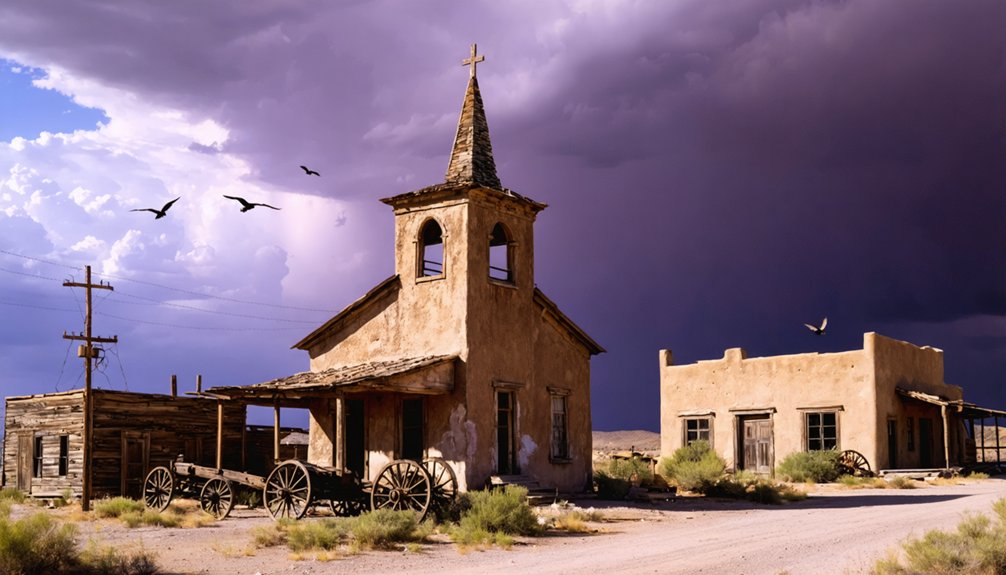
The climactic cliff confrontation eliminates both patriarchal figures—abusive and redemptive—leaving Maggie’s competence validated through successful captive liberation.
Bone Tomahawk (2015): Kurt Russell’s Brutal Rescue Mission Through Desolate Territory
When S. Craig Zahler directed *Bone Tomahawk* (2015), he transformed frontier desolation into visceral horror territory.
You’ll witness Sheriff Franklin Hunt (Kurt Russell) leading a rescue posse through Utah’s barren landscapes after cannibal tribes abduct settlers from isolated Bright Hope. The film’s ghost town atmosphere emerges through abandoned mining territories and forbidden valleys, where troglodyte caves resemble haunted underground ruins.
Zahler doesn’t romanticize the Old West—you’ll encounter graphic violence including scalping and limb amputations rendered through practical effects. The production utilized Colorado, Utah, and New Mexico locations to emphasize complete isolation, where civilization’s thin veneer crumbles against primal savagery.
This Western-horror hybrid strips away frontier mythology, exposing vulnerable outposts surrounded by merciless wilderness and inhuman threats lurking beyond mapped territories.
Tremors 4: The Legend Begins – Monster Terror in Nevada’s Mining Settlement
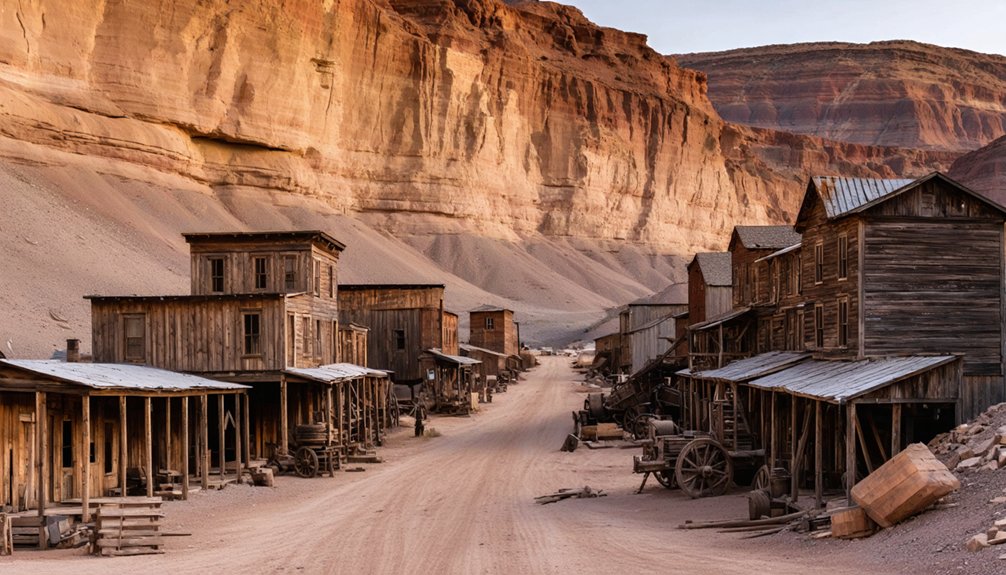
The 101-minute prequel establishes essential franchise mythology:
This Weird West narrative depicts frontier individualism confronting unprecedented biological threats, making self-reliance and community defense paramount for survival.
The Role of Abandoned Towns in Western Horror Cinema
Abandoned settlements function as liminal spaces where Western genre conventions intersect with horror’s transgressive potential, creating environments where frontier mythology‘s optimistic narratives collapse into supernatural dread.
Films like *Ghost Town* (1988) literalize this haunted heritage through devil pacts trapping outlaws in purgatory, while *Eyes of Fire* situates 1750s settlers within cursed Shawnee territory.
These spectral settlements expose economic collapse‘s psychological residue, as *We Are Still Here* demonstrates through coal industry decline manifesting paranormal violence.
*The Wind* employs vast, empty plains to amplify frontierswoman isolation against malevolent presences.
Such narratives invert westward expansion’s promise—transforming opportunity landscapes into zones of cannibalistic horror (*Bone Tomahawk*), subterranean predation (*The Burrowers*), and undead threats (*Curse of the Undead*).
You’ll find these films interrogate frontier mythology’s darker foundations.
Historical Accuracy Meets Supernatural Elements in Period Westerns
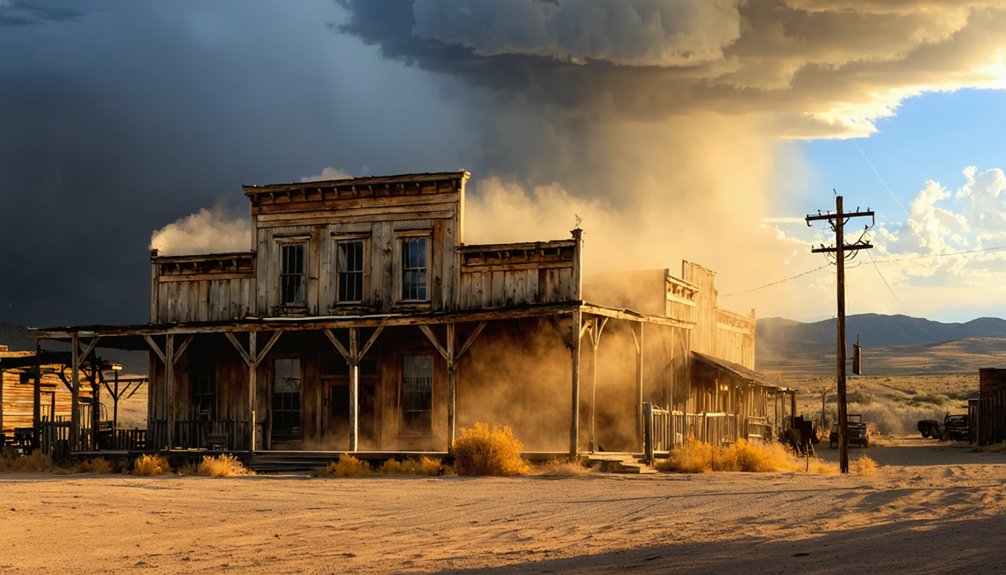
You’ll find historical rigor strengthens rather than contradicts otherworldly Western narratives.
Character Archetypes: Sheriffs, Outlaws, and Settlers in Ghost Town Settings
When ghost town Westerns transpose character archetypes into supernatural frameworks, sheriffs transform from traditional peacekeepers into reluctant champions against otherworldly malevolence.
You’ll find supernatural lawmen discarding ineffective modern weapons for period-appropriate tools, establishing practical responses to undead threats.
These protagonists must navigate compromised authority structures where possessed outlaws wield dark pacts, controlling ghost towns through sustained psychological warfare.
The cursed townspeople remain trapped within time-suspended dimensions, their spiritual release contingent upon avenging fallen predecessors and breaking supernatural subjugation.
Female settlers function as narrative catalysts, driving law enforcement intervention against zombie-like criminals perpetrating systematic terror.
This power dynamic inversion—where protective institutions become corrupted vessels—creates tension requiring cooperation between modern deputies and spectral sheriffs, ultimately demanding courage over conventional methodology.
Why Ghost Town Westerns Continue to Captivate Horror Audiences
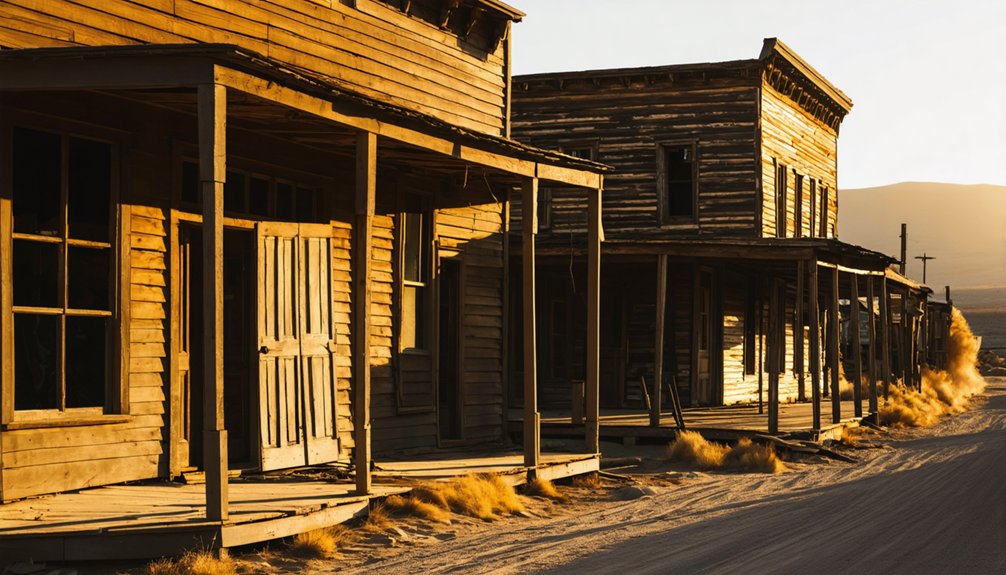
Ghost town westerns leverage spatial isolation to transform supernatural threats into inescapable psychological ordeals, trapping you alongside characters who can’t simply flee civilization’s protective boundaries.
The historical specificity of Old West settings—complete with period-accurate architecture, weaponry, and social codes—provides tangible authenticity that grounds fantastical horror elements in believable frameworks.
You’ll find that barren, sun-scorched landscapes stripped of visual comfort create sustained atmospheric tension, denying the shadowy concealment typical of gothic horror while exposing characters to relentless environmental and supernatural menace.
Isolation Amplifies Supernatural Dread
Because ghost towns strip away the comforting presence of civilization, they transform into ideal vessels for supernatural horror, where isolation itself becomes a tangible threat that amplifies every creak of weathered wood and whisper of desert wind.
Isolation effects create psychological vulnerability that supernatural entities exploit. In *Dead Birds*, haunted farmlands trap outlaws in mounting terror, while *The Fog* (2005) demonstrates how geographic remoteness enables paranormal invasion.
You’ll find that supernatural manifestations thrive without human interference—as evidenced in *Eyes of Fire*, where Native burial ground spirits punish intruders freely.
Consider these isolation-driven horrors:
This stripped-down autonomy transforms emptiness into genuine menace.
Historical Settings Ground Fantasy
Historical authenticity provides the crucial counterweight that allows supernatural elements to penetrate audience disbelief, transforming ghost town westerns into uniquely credible horror experiences.
When you encounter tangible historical details—weathered saloons, period-accurate storefronts, authentic frontier architecture—your mind accepts the setting’s legitimacy. This documented reality becomes the foundation supporting fantastic elements.
Genre fusion succeeds precisely because verifiable historical contexts anchor impossible events. Audience psychology demonstrates you’ll accept spectral apparitions more readily when they inhabit genuinely constructed 1880s structures rather than obvious fabrications.
The empirical weight of authentic ghost towns—real locations where actual pioneers lived, struggled, and died—creates psychological permission for supernatural belief.
the allure of abandoned communities in California draws adventurers and history enthusiasts alike. These once-thriving towns stand as reminders of ambition and resilience, often shrouded in folklore and tales of the past. Exploring them can evoke a sense of connection to the lives that once flourished there, inviting deeper contemplation of our own existence.
You’re fundamentally witnessing documented history colliding with imagined horror, making both elements feel simultaneously possible within the same narrative space.
Desolate Landscapes Heighten Tension
When empty horizons stretch endlessly across abandoned settlements, your psychological vulnerability intensifies exponentially beyond what enclosed spaces could achieve. Desolate Western landscapes establish atmospheric tension through visual contrast between decaying structures and supernatural isolation, creating environments where you confront horror without refuge or escape.
The genre fusion operates through specific cinematic mechanisms:
Films like Near Dark, *Bone Tomahawk*, and *Ravenous* demonstrate how supernatural isolation transforms traditional cowboy settings into spine-chilling experiences that transcend conventional genre boundaries, earning devoted cult followings despite box office underperformance.
Frequently Asked Questions
Where Can I Watch Rare Ghost Town Westerns Like Eyes of Fire?
You’ll discover rare ghost town westerns like *Eyes of Fire* on streaming platforms including Tubi, Plex, and Shudder, while classic films such as *Purgatory* and *Streets of Ghost Town* remain accessible through YouTube and Internet Archive.
Are Any Ghost Town Westerns Based on True Historical Events?
You’ll find several westerns draw from true stories with varying historical accuracy. *Winchester ’73* references authentic frontier gun culture, while *The Big Country* and *Tombstone* incorporate real conflicts, though they dramatize events beyond strict historical documentation.
Which Ghost Town Western Has the Best Special Effects?
You’ll find Bone Tomahawk (2015) delivers superior special effects through its masterful practical prosthetics and visceral gore sequences, demonstrating sophisticated visual storytelling that authentically conveys the cannibalistic tribe’s brutality while maintaining artistic integrity throughout.
What Filming Locations Were Used for These Ghost Town Movies?
You’ll find ghost town locations with rich filming history at Grafton near Zion, Paramount Ranch in Agoura Hills, Monument Valley’s Navajo Reservation, and Paria Townsite in Utah’s canyon country—authentic settings preserved for Western productions.
Are There Family-Friendly Ghost Town Westerns Without Intense Horror Elements?
Yes, you’ll find family-friendly films like *Ghost Town Renegades* (1947) and *Ghost of Hidden Valley* (1946) offer ghost town adventures focusing on heroic cowboys, whip action, and land disputes—completely avoiding supernatural horror or intense violence.