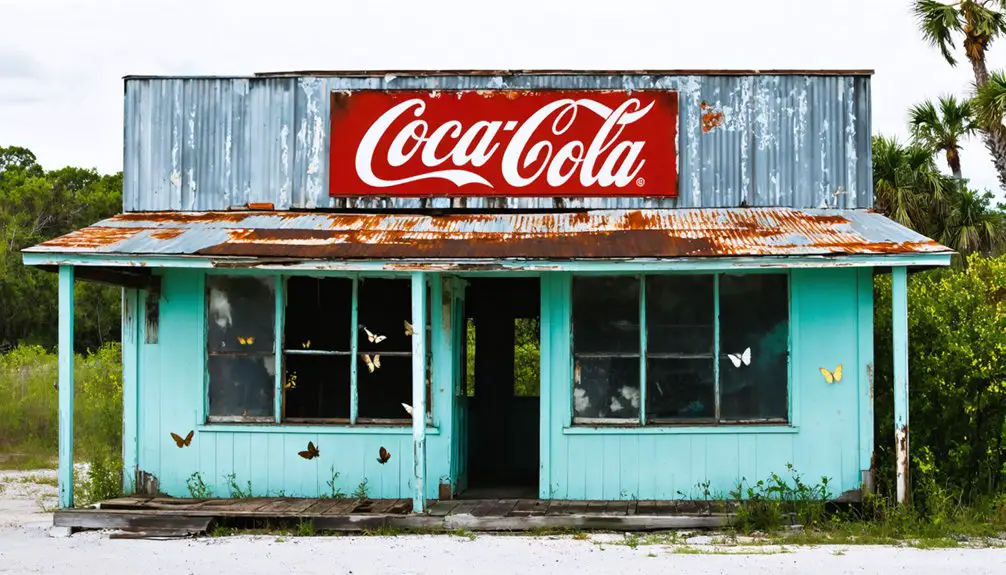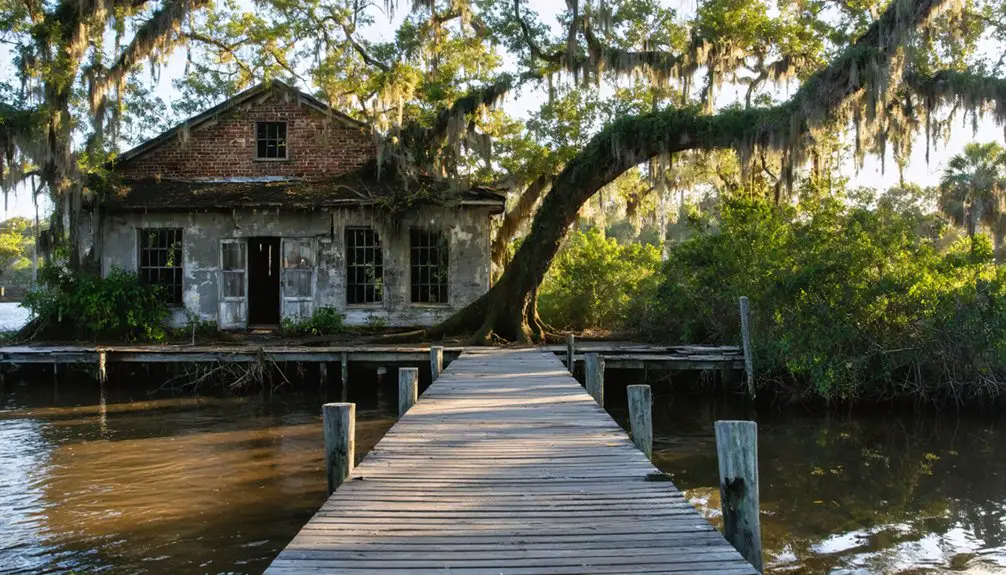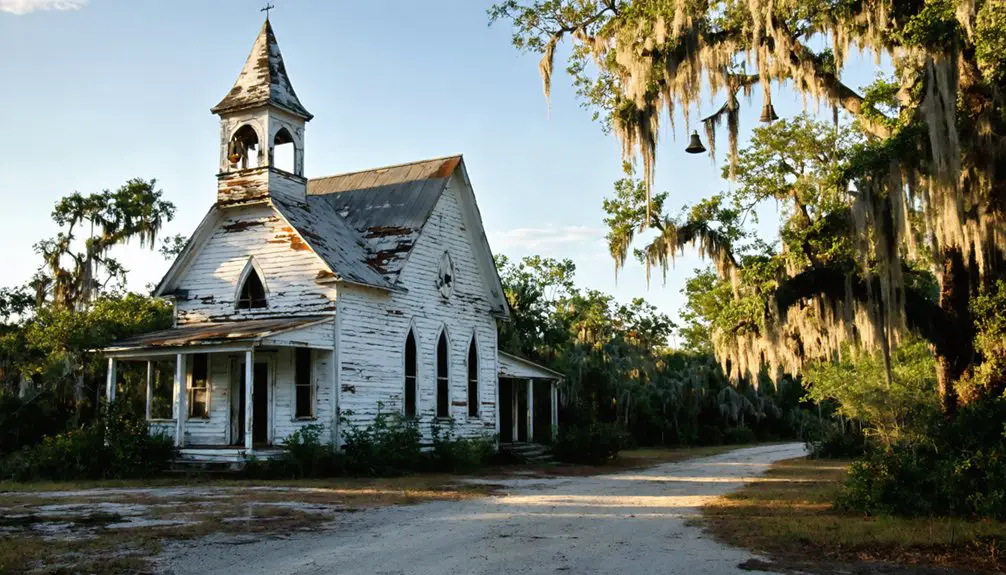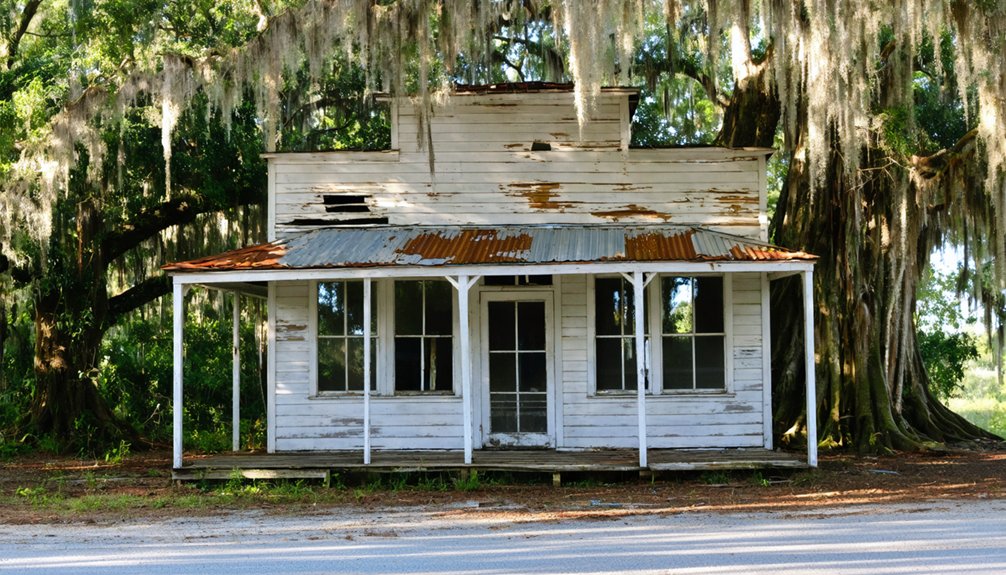
You’ll find Florida Panhandle ghost towns scattered from Escambia to Franklin counties, where lumber boom settlements like Muscogee and Century once processed millions of board feet before economic collapse. Archaeological surveys document 47 sites preserving everything from pre-ceramic Paleo-Indian camps to Depression-era homesteads claimed under the 1912 Three-Year Homestead Act. Today, rusting railroad spikes, crumbling sawmill foundations, and artifact scatters mark locations where port cities like Cedar Key and St. Joseph thrived before railways bypassed them. These remnants reveal exactly how timber, turpentine, and phosphate industries shaped—then abandoned—entire communities across Northwest Florida’s pine forests.
Key Takeaways
- Florida Panhandle ghost towns include former port cities like St. Joseph and Cedar Key, abandoned after economic or transportation changes.
- Mill towns such as Century, Muscogee, and Milton thrived on timber before declining when lumber resources were exhausted.
- Archaeological sites preserve evidence of logging operations, homesteads, and ancient communities along waterways and coastal areas.
- Early 1900s homesteaders claimed land under federal acts but often abandoned settlements due to challenging cultivation requirements.
- Historic cemeteries in ghost towns feature documented paranormal activity and face ongoing preservation challenges from vegetation encroachment.
Forgotten Port Cities and Lumber Settlements
Along Florida’s Panhandle coastline, maritime commerce once sustained entire communities that have since vanished into historical obscurity.
You’ll find forgotten ports like St. Joseph, which briefly served as Florida’s capital during the Second Seminile War before yellow fever and an 1844 hurricane erased it from existence.
Cedar Key thrived as a salt production hub until railway construction bypassed it entirely.
Carrabelle’s sawmill attracted international workers, with steamships connecting it to major Gulf ports until bridges ended its island isolation.
The Coombs Mill drove Carrabelle’s economy in the post-Civil War era before the town’s transition from bustling seaport to quiet coastal community.
Lumber legacies tell equally stark tales.
The Perdido River settlement extracted timber without replanting, and hurricanes destroyed 80 percent of standing timber in 1917-1918.
Workers paid in company scrip struck violently before the operation liquidated.
Archer in North Central Florida experienced similar economic collapse after phosphate resources were exhausted in the early 20th century.
Archaeological Evidence of Lost Communities
You’ll find traces of Florida’s vanished communities scattered across the Panhandle landscape, where archaeological surveys have documented 47 sites in Escambia, Santa Rosa, and Walton counties spanning 1500 B.C. to the early 20th century.
Along Lafayette Creek in Walton County, investigators recorded 32 locations ranging from pre-ceramic Archaic artifact scatters (8000-3000 B.C.) to identifiable homesteads like Charles Silcox’s 1901 settlement and Alfred D. Mayo’s 1907 property.
These sites preserve physical evidence of temporary resource camps, logging operations with rail trams, and the wooden pilings and refuse middens that mark where people lived before their settlements disappeared from memory. Many settlements established themselves near water resources to access timber, turpentine, oysters, and fish that sustained their economies. The PaleoAucilla and PaleoEconfina channels reveal evidence of human activity extending far beyond today’s coastline, where ancient communities once thrived on landscapes now submerged beneath coastal waters.
Archaic Period Artifact Scatters
Key discoveries reveal their cultural significance:
- Suwannee and Simpson projectile points marking Paleo-Indian shifts
- Over 600 engraved bone pins recovered from Wakulla Springs Lodge
- Steatite vessels traded from northwest Georgia to Mitchell River sites
- Lightning whelk shell beads crafted in household production centers
- Drone-mounted LiDAR mapping revealed 37 residential shell rings on Raleigh Island dating from 900 to 1200 CE
- Fiber-tempered pottery introduced by Norwood culture during the late Archaic period
These patterns document societies that thrived without centralized control, trading exotic materials across vast distances while exploiting Florida’s karst wetlands and estuaries through sophisticated seasonal movements.
Homestead Remnants and Pilings
Beneath the second-growth forests and abandoned fields of the Florida Panhandle, archaeologists have documented thirty-two homestead sites in Walton County alone—tangible remnants of communities that flourished briefly before vanishing into the landscape.
Homestead archaeology reveals settlements like Charles Silcox’s 1901 claim and Alfred D. Mayo’s 1907 site along Lafayette Creek, where cultural landscapes now lie hidden beneath regenerated timber.
You’ll find cattle dip vats from the early 1900s, turpentine cups scattered across clearings, and logging infrastructure including rail trams and log pens submerged in creeks.
Industrial-scale timbering stripped virgin longleaf pine, while subsequent farming obliterated physical evidence.
These sites provide crucial insights into burial practices, housing patterns, and daily life of early Panhandle settlers.
What remains faces constant threats from looting and erosion, prompting archaeologists to recommend National Register protection for these fragile traces of Panhandle settlement history.
The Florida Public Archaeology Network headquartered in Pensacola offers volunteer opportunities for families and groups to participate in cleaning and sorting artifacts discovered at such abandoned settlement sites.
The Rise and Fall of Mill Towns
- Milton evolved from “Milltown” in 1844 into a transportation hub for timber, brick, and shipbuilding.
- Muscogee’s Southern States Land and Lumber Company employed 1,000 men, exporting 60 million board feet worldwide.
- Century’s Alger-Sullivan operation produced more southern pine annually than any other Southern mill.
- Workers paid in scrip tokens faced exploitation, sparking strikes after devastating 1917-1918 hurricanes.
- Muscogee was founded circa 1857 by Muscogee Lumber Company and operated 50 miles of logging railroad at its peak.
- The Alger-Sullivan mill operated nearly 50 additional years beyond initial projections through strategic replanting efforts.
When timber depleted, these once-thriving communities vanished into Florida’s wilderness.
Archaic Period Sites Along Florida Waterways
You’ll find Florida’s oldest “ghost towns” aren’t settlements at all—they’re Pre-Ceramic artifact scatters left by Archaic peoples who established seasonal camps along the Apalachicola, Chipola, and Aucilla rivers between 12,000 and 5,000 years ago.
These ancient resource extraction sites preserve stone tools, projectile points, and butchering debris where hunters processed mastodon kills near mid-channel sinkholes and spring vents.
Unlike later permanent villages, these camps reflect a mobile lifeway focused on exploiting megafauna, freshwater shellfish, and riverine resources before pottery technology reached the Panhandle.
Pre-Ceramic Artifact Scatters
Archaeological evidence scattered along Florida’s waterways reveals human occupation stretching back thousands of years before pottery appeared in the region.
You’ll find pre ceramic technologies spanning 5000-2000 B.C. along the Gulf Coast, where ancient settlement patterns emerge through shell middens and artifact scatters.
These sites demonstrate sophisticated resource use:
- Whelk remains in all reduction stages indicate on-site processing
- Quahogs and fish collected during spring and summer months
- Wood, antler, and bone tools crafted without metal implements
- Heat-treated chipped stone appearing above sterile sand zones
When ceramics finally arrived around 2000 B.C., you won’t find changes in tool production.
The evidence shows people maintained their independent, self-sufficient lifestyles whether they used pottery or not, adapting to rising sea levels that increased coastal productivity.
Ancient Resource Extraction Camps
Small bands of hunter-gatherers established temporary camps along Florida’s waterways between 8000 and 3000 B.C., moving seasonally to exploit concentrated resources before abandoning sites when productivity declined.
You’ll find evidence of these archaic camps in Gulf Coast shell deposits and riverine locations up to 40 kilometers inland, where marine shells indicate seasonal resource extraction activities.
At sites like Shell Ridge, inhabitants collected whelks for tool manufacturing, leaving behind debris in all stages of reduction. They employed mass capture techniques for scallops and selective hand collection for other species, particularly harvesting quahogs and fishes during spring and summer months.
These temporary settlements functioned as logistical bases where small groups processed estuarine resources before returning to larger villages.
Early 20th Century Homesteads Now Abandoned
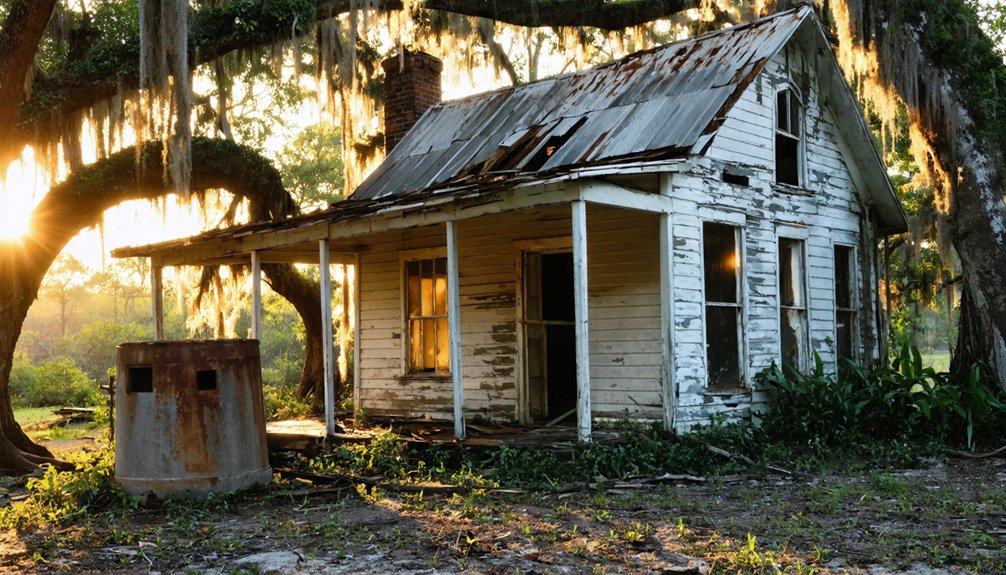
When the federal government opened Florida Panhandle lands to homesteading in the early 1900s, settlers filing claims under the Three-Year Homestead Act of 1912 established remote outposts that would later fade into abandonment.
These homesteader stories reveal individuals pursuing financial opportunity through “free” land acquisition, with documented claims along Lafayette Creek including:
- Charles Silcox’s 1901 settlement
- Alfred D. Mayo’s 1907 claim
- James H.B. Pyles’ 1908 filing
- William Goodwin’s 1909 establishment
Settlement challenges centered on meeting cultivation requirements through substantial labor investment.
Former state employees recognized rising property values, while families like the Swansons filed adjacent tracts to create interconnected holdings.
Post-military settlers, including Ralph Swanson after his 1919 Navy discharge, joined established claims before ultimately abandoning these isolated homesteads.
What Remains: Pilings, Foundations, and Artifact Scatters
Across the Florida Panhandle’s remote woodlands, physical remnants of human occupation span thousands of years, from prehistoric artifact scatters to Depression-era homestead foundations.
You’ll find Woodland period pottery fragments and stone tool byproducts along Perdido River, while Lafayette Creek reveals pre-ceramic Archaic scatters suggesting temporary camps.
The historical significance of these sites extends to early 1900s turpentine operations, where concrete structures and cattle dip vats still stand at places like Elfers.
Logging infrastructure remains visible through railroad spikes at Sumica’s ghost town and tram pilings near Lafayette Creek.
Homestead foundations from Charles Silcox (1901) and Alfred Mayo (1907) mark settlement attempts.
Artifact preservation challenges intensify as vegetation reclaims these sites, yet they remain accessible for those seeking tangible connections to Florida’s frontier past.
Haunted Cemeteries and Supernatural Legends
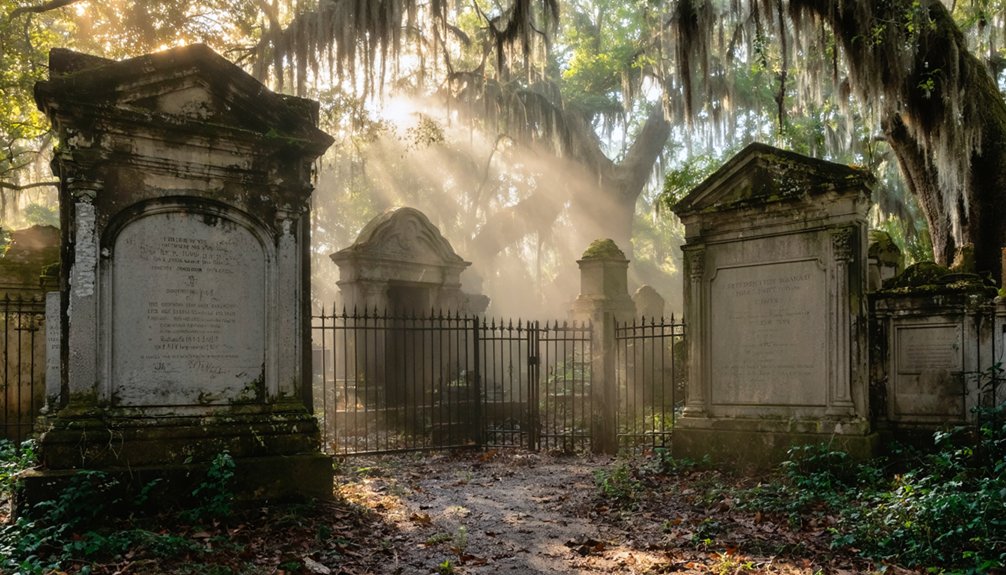
Beyond the physical remnants of abandoned settlements, the Florida Panhandle’s ghost towns harbor a darker legacy in their forgotten burial grounds, where documented paranormal activity intersects with local folklore.
You’ll find supernatural encounters concentrated at these sites:
- Palm View Cemetery – A hanged man’s ghostly figure swings from the entrance tree at 3 am, while digital recordings captured responses near a WWII veteran’s grave in 2017.
- Coon Hill Cemetery – Santa Rosa County’s oldest burial ground, surrounded by stone walls, experiences more vandalism than neighboring sites.
- St. Michael’s Cemetery – Pensacola’s burial ground since the mid-1700s attracts paranormal investigators to its historic district location.
- Cassadaga Cemetery – The infamous Devil’s Chair supposedly summons entities when occupied.
These eerie experiences define the region’s haunted reputation.
Frequently Asked Questions
Can Visitors Legally Explore Ghost Town Sites on Public Land?
You’ll find freedom to explore designated ghost town sites on public land, though legal regulations require you to respect archaeological protections. Public access varies—some historic sites welcome visitors, while sensitive areas need authorized permits for documentation.
Are Any Ghost Towns Completely Underwater Due to Coastal Changes?
Lake Okeechobee’s southern lakebed contains underwater remnants of settlements exposed during water level drops. Coastal erosion and hurricanes submerged Florida Keys communities like Indian Key, where you’ll find archaeological evidence beneath shifting waters today.
What Safety Precautions Should Explorers Take When Visiting Abandoned Sites?
You’ll need proper exploration gear like sturdy boots and flashlights, plus wildlife awareness—since 58% of Florida Panhandle snake encounters occur in abandoned structures. Always travel in groups, inform others of your location, and watch for unstable floors.
How Do I Obtain Permits for Metal Detecting at Ghost Towns?
You’ll need to contact individual county offices where ghost towns exist to obtain permit applications, as metal detecting regulations vary locally. Private property requires written landowner permission, while state lands generally prohibit detecting entirely.
Which Ghost Town Has the Most Accessible Remaining Structures Today?
Elfers offers you the most accessible abandoned architecture, with visible concrete structures and foundations emerging from vegetation. You’ll find explorable Panhandle history through remaining industrial remnants from its turpentine and lumber era, easily reachable along overgrown streets.
References
- https://en.wikipedia.org/wiki/List_of_ghost_towns_in_Florida
- https://www.florida-backroads-travel.com/florida-ghost-towns.html
- https://www.browsedestin.com/blog/hauntings-in-the-florida-panhandle.html
- https://www.emeraldcoastmagazine.com/ghost-towns-of-west-florida/
- https://freepages.history.rootsweb.com/~gtusa/usa/fl.htm
- https://fdc.com/blog/ghost-towns-in-florida/
- https://www.youtube.com/watch?v=1arYC_TUS6U
- https://thesunshinerepublic.com/2025/01/05/the-ghost-towns-of-florida-abandoned-histories-and-nearby-comforts/
- https://www.makelikeanapeman.com/2020/01/17/the-forgotten-coast/
- https://response.restoration.noaa.gov/about/media/abandoned-vessels-floridas-forgotten-coast.html