You’ll discover Guatemala’s ghost towns aren’t weathered desert relics but earthquake-shattered colonial cities and jungle-consumed Maya ceremonial centers. Antigua Guatemala, abandoned after the devastating 1773 Santa Marta earthquakes destroyed over 3,000 buildings, stands as the most accessible example—its Baroque facades and cobblestone streets frozen in time when Spanish authorities relocated the capital. Maya sites like Aguateca reveal different abandonment stories, where invasion around 830 AD left unfinished temples and scattered artifacts. These spaces preserve cultural memory through stone and silence, offering insights into civilizations interrupted by catastrophe.
Key Takeaways
- Antigua Guatemala became a ghost town after the 1773 Santa Marta earthquakes destroyed over 3,000 buildings and killed hundreds.
- The capital relocated to Guatemala City in 1776, causing Antigua’s population to dwindle below 10,000 by the 1800s.
- Maya ghost town Aguateca was abandoned around 830 AD following violent invasions, leaving unfinished temples and scattered artifacts.
- Post-earthquake regulations prohibited rebuilding Antigua, preserving its colonial architecture frozen in time since 1773.
- UNESCO designated Antigua a World Heritage site in 1979, transforming the abandoned colonial center into a premier tourist destination.
Antigua Guatemala: From Spanish Capital to Preserved Ruins
When Spanish conquistadors entered the Panchoy Valley in 1543, they brought with them blueprints for empire-building that would transform Guatemala’s volcanic highlands into the administrative heart of Central America.
You’ll find Antigua architecture reflecting this ambition—strict Renaissance grids radiating from Parque Central, where power concentrated in cathedral, palace, and market.
For 230 years, this capital governed territories stretching from Chiapas to Costa Rica, manufacturing weapons and exporting religious art across two continents.
The colonial legacy persists in earthquake-adapted Baroque facades where Mayan stonemasons carved corn motifs alongside Catholic saints, creating architectural syncretism that speaks to survival rather than submission.
The Arch of Santa Catalina, built for nuns in the 17th century, now stands as Antigua’s most recognizable symbol.
Beginning in 1773, several earthquakes struck the city, ultimately forcing authorities to relocate the capital to what is now Guatemala City.
After devastating tremors forced abandonment, these ruins became UNESCO-protected testimony to empire’s impermanence—a ghost town where you’ll walk cobblestones once traveled by conquistadors and indigenous laborers alike.
As you explore the abandoned villages in County Kerry, the landscape tells a haunting story of resilience and isolation. Each crumbling wall and overgrown path invites reflection on the lives once lived within these now silent communities. The stark beauty of the surroundings contrasts sharply with the remnants of human presence, leaving an indelible mark on every visitor.
The 1773 Earthquakes That Changed History
When you walk through Antigua’s cobblestone streets today, you’re tracing the aftermath of the Santa Marta earthquakes—a catastrophic sequence that began with tremors in May 1773 and culminated on July 29th when a 7.5 magnitude shock reduced the colonial capital to rubble.
The devastation you’ll encounter in these preserved ruins wasn’t just architectural; between 500-600 people died immediately, with another 600 succumbing to starvation and disease as aftershocks continued through December. The Mercedarian Order suffered particularly heavy losses among religious workers during the disaster.
Spanish authorities responded by abandoning the city entirely, relocating Guatemala’s colonial capital to a new valley and transforming what was once Central America’s administrative heart into the atmospheric ghost town you’re exploring now. The new capital, established in 1776, became Guatemala of Asuncion—known today as Guatemala City.
Santa Marta Earthquakes Devastation
The ground beneath Santiago de los Caballeros de Guatemala had trembled before, but what began in May 1773 would irrevocably alter the city’s destiny.
You’d have felt the foreshocks rumbling through May and June, warning signs the residents couldn’t ignore. When the mainshock struck on July 29th at 15:45—the feast day of Santa Marta—the 7.5 magnitude earthquake impact shattered over 3,000 buildings.
Churches crumbled, convents collapsed, and bell towers tumbled into rubble-strewn streets.
Between 500-600 people died immediately, while disease and starvation claimed 600 more. The Mercedarian Order lost nearly half its members.
The intensity of the earthquake registered at VII or VIII on the Mercalli scale, marking it as very strong to severe.
You can still witness this structural decay at La Recolección’s ruins, frozen in time since that devastating afternoon when Santiago’s fate was sealed. The architectural style reflects the colonial period’s design, offering visitors a glimpse into 18th-century Central American craftsmanship.
Colonial Capital Forced Relocation
After centuries of rebuilding following each seismic disaster, Spanish colonial authorities made an unprecedented choice: they’d abandon Santiago de los Caballeros de Guatemala entirely. The 1773 earthquake shattered more than buildings—it fractured 230 years of colonial governance centered in Antigua Guatemala.
You’ll find the capital relocation wasn’t merely administrative reshuffling. Church leaders, bureaucrats, and indigenous communities clashed over abandoning their cultural stronghold. The Captain General pushed forward despite fierce opposition, ordering migration to Nueva Guatemala de la Asunción by 1776.
This decision transformed thousands of lives. While officials saw fresh opportunities for social reinvention, the Mercedarian Order lost half its personnel and income. Individual beliefs and cultural views shaped whether survivors saw the catastrophe as divine punishment or opportunity for renewal.
Antigua’s gradual depopulation created Central America’s most magnificent ruins—38 churches slowly reclaimed by time, their empty corridors whispering stories of power’s impermanence. The city had already endured a 7.4 magnitude earthquake in 1717 that caused significant destruction, foreshadowing the catastrophe that would ultimately seal its fate.
How Natural Disasters Shaped Settlement Patterns
Guatemala’s abandoned settlements tell a story that only emerges when you walk through their ruins and listen to local accounts of displacement passed down through generations.
Natural disasters forced communities to constantly reimagine where they could safely live. You’ll notice settlement patterns shifting from volcanic bases toward inland valleys after repeated lahars destroyed Santiago de los Caballeros in 1541.
The 1773 Santa Marta earthquakes proved that even stone monasteries couldn’t withstand Guatemala’s seismic fury, prompting survivors to relocate their capital entirely. By 1776, most residents had relocated to Guatemala City, leaving behind a population that dwindled to under 10,000 in the 1800s.
When earthquake-shattered monasteries forced an entire capital’s relocation, Guatemala’s survivors chose resilience over rebuilding among the ruins.
When Lake Atitlán’s water levels rose following an eruption between 250 and 300 CE, the sacred island of Samabaj disappeared beneath over sixty feet of water, forcing pilgrims and priests to abandon their ceremonial site. When Volcán de Fuego buried a hamlet in 2018, killing over 110 people, it echoed centuries of forced migrations. Each disaster created ghost towns while survivors carved out new communities, demonstrating how Guatemalans continually reclaimed autonomy despite nature’s relentless disruptions.
Architectural Treasures Frozen in Time
Walking through Antigua Guatemala’s suspended ruins, you’ll encounter architectural forms that survived precisely because people were forbidden to rebuild them. After the 1773 earthquake, abandonment regulations inadvertently created preservation techniques that locked Spanish colonial architectural influences into place.
You’re witnessing BarrocoAntigueño—decorative stucco facades, carved tympanums, and earthquake-resistant designs with massive walls and squat bell towers. The 1543 grid layout, inspired by Italian Renaissance planning, frames your path through cobblestone streets connecting La Merced’s ultra-baroque towers to San Francisco’s 16th-century stones.
These structures weren’t museumified—they’re authentic remnants of adaptation, where European designs bent to local seismic realities. Five centuries of architectural fabric stand exposed, revealing how builders negotiated between aesthetic ambition and survival against nature’s unpredictable force.
UNESCO Recognition and Modern Tourism Renaissance
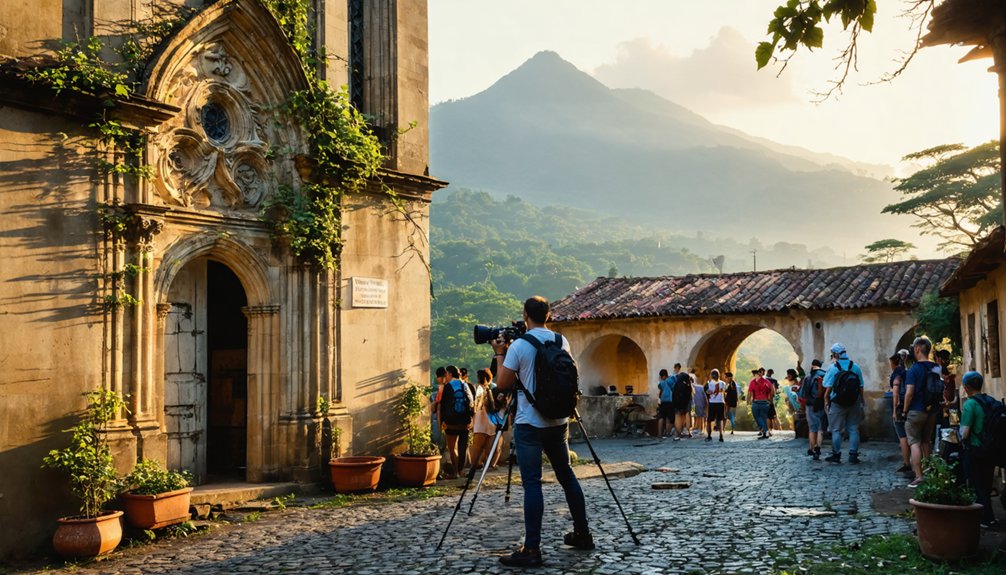
When you walk through Antigua Guatemala‘s cobbled streets today, you’re experiencing a carefully orchestrated balance between preservation and profit that began with its 1979 UNESCO World Heritage designation.
The National Council for Protection of Antigua Guatemala, established in 1972, granted you access to colonial architecture that retains its original artistry while transforming this former ghost town into the country’s premier tourist destination.
You’ll find yourself among thousands of annual visitors whose spending fuels economic revival, yet simultaneously threatens the very authenticity that drew UNESCO’s recognition—a paradox every heritage site must navigate.
World Heritage Site Designation
Since 1979, international recognition has transformed Guatemala’s abandoned colonial centers and ancient Maya cities from forgotten landscapes into protected cultural treasures.
You’ll find UNESCO significance embedded in four distinct sites, each representing different chapters of abandonment and preservation.
Antigua Guatemala earned Heritage protection first, its earthquake-shattered colonial architecture frozen in 1773’s devastation. Tikal followed immediately, where jungle-consumed pyramids stand silent among howler monkeys.
Quirigua’s towering stelae emerged from obscurity in 1981, recording celestial events in stone hieroglyphs. Most recently, Tak’alik Ab’aj gained recognition for its 1,700-year journey from Olmec-Maya crossroads to archaeological revelation.
These designations haven’t merely preserved ruins—they’ve legitimized your access to spaces once left to decay, transforming ghost towns into destinations where cultural memory survives through international covenant rather than colonial decree.
Tourism Infrastructure and Preservation
Antigua Guatemala’s transformation from earthquake-shattered colonial capital into tourism centerpiece reveals how international heritage designation creates practical infrastructure rather than merely symbolic protection.
You’ll find preservation efforts converting earthquake-ruined monasteries into cultural hubs—Casa Santo Domingo exemplifies this, where American archaeologists excavated the Dominican convent starting in 1979, ultimately creating a five-star hotel with six integrated museums.
Tourism development here bypasses typical commercialization; cruise ships from both coasts route passengers directly to Antigua, skipping Guatemala City entirely despite being forty-five minutes away.
The Escuela de Cristo and Capuchin monastery’s underground passages remain intact for your exploration. Local shops and cafes cluster around Parque Central‘s reconstructed fountain, while expatriate communities from the U.S. and Europe establish permanent residence, demonstrating how controlled tourism infrastructure preserves authenticity while generating sustainable economic activity.
Maya Ghost Towns: Aguateca and Iximché
The ancient Maya understood that power could vanish in a single night. At Aguateca, you’ll witness this truth frozen in time. Around 830 AD, invaders torched this cliff-top capital so swiftly that residents abandoned their possessions mid-use.
The archaeological significance lies in what they left behind:
Aguateca’s true value emerges from the artifacts abandoned in terror—frozen evidence of a civilization’s final desperate moments.
- Unfinished temples where construction halted abruptly
- Scattered valuables and ceramics still positioned for daily meals
- Arrowheads and burnt palaces marking the violent end
This Pompeii of Maya civilization reveals intimate details of elite life—craft workshops, household arrangements, and termination rituals performed before the royal family fled.
You can reach Aguateca by motorboat through Petén’s waterways, where nature’s defenses ultimately proved insufficient against determined attackers seeking to erase political power from existence.
Frequently Asked Questions
Are There Any Ghost Towns in Guatemala That Tourists Can Safely Visit?
You’ll find Antigua’s earthquake-ruined colonial sites offer safe exploration of ghost town history with remarkable tourist safety. Cathedral de Santiago’s 1773 collapse created atmospheric ruins where you can walk freely among towering columns, observing how locals and travelers interact with these haunting cultural spaces.
What Happened to Residents Who Refused to Leave Antigua After 1773?
Resident stories reveal you’d have found defiant holdouts rebuilding amid ruins, maintaining modest communities despite royal orders. These Antigua history accounts show residents adapting through subsistence farming, preserving traditions, and eventually stabilizing as caretakers of colonial heritage.
How Did Volcanic Soil Attract Farmers Back to Abandoned Settlements?
You’ll find farmers returned because volcanic advantages meant nutrient-rich harvests with minimal inputs. They observed how soil fertility transformed abandoned land into thriving fields, choosing agricultural abundance over distant resettlement despite lingering risks.
Can You Stay Overnight in Restored Buildings Within Antigua Guatemala?
You’ll find numerous restoration projects throughout Antigua Guatemala where you can stay overnight in colonial buildings of historical significance. These authentically preserved hotels let you experience the city’s living architectural heritage firsthand.
What Other Central American Countries Have Similar Colonial Ghost Towns?
You’ll find colonial architecture with historical significance in Honduras’ abandoned Nueva Salamanca and Teculucelo, Nicaragua’s semi-deserted León and Granada, El Salvador’s fading Suchitoto, and Costa Rica’s remote ghost settlements—all reflecting Spanish colonial decline patterns you can explore.
References
- https://themaritimeexplorer.ca/2020/06/04/antigua-guatemala/
- https://www.viator.com/blog/Maya-Ruins-in-Guatemala/l11294
- https://whc.unesco.org/en/list/65/
- https://theroyaltourblog.com/2025/03/10/antigua-guatemalas-colonial-past/
- https://www.beyondtheordinary.co.uk/features/unesco-world-heritage-sites-of-guatemala/
- https://www.royalcaribbean.com/guides/antigua-guatemala-vacation-infographic
- https://lisa.gerda-henkel-stiftung.de/abandoned_cities_halperin?language=en
- https://www.rcrcmagazine.org/2023/05/guatemala-a-touch-of-humanity-in-a-ghost-town-left-behind-by-migration/
- https://en.wikipedia.org/wiki/Category:Former_populated_places_in_Guatemala
- https://www.enjoyguatemala.com/colonial-history/