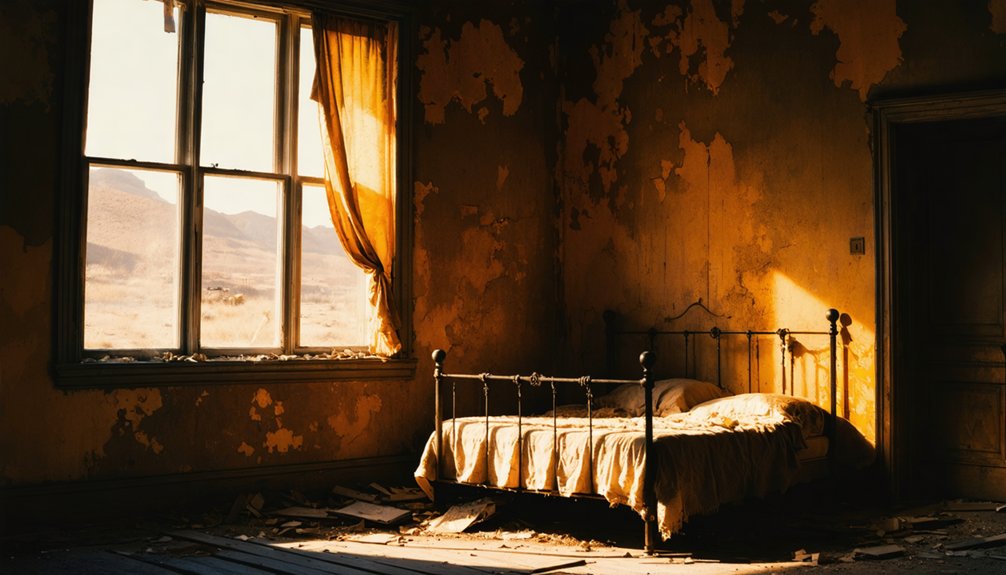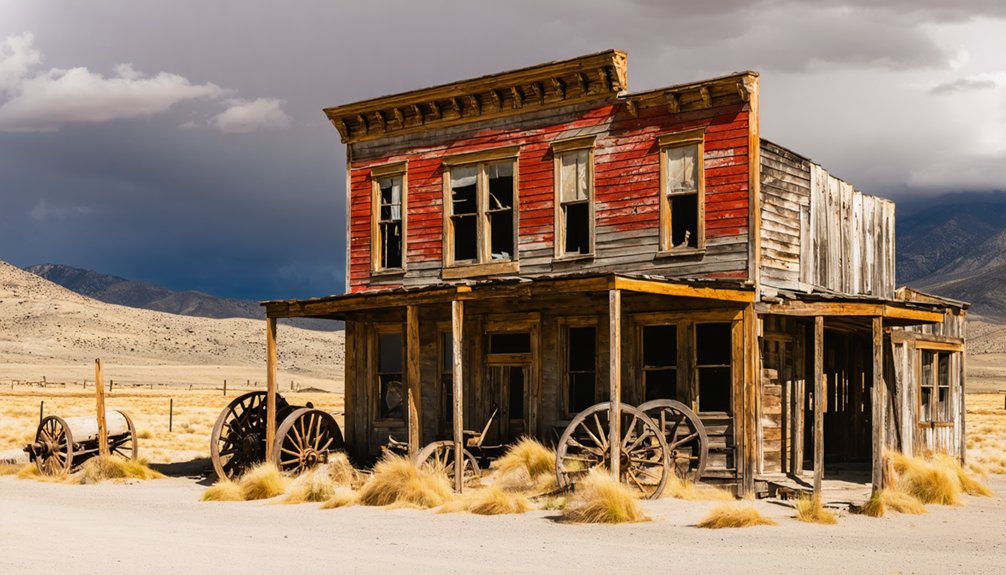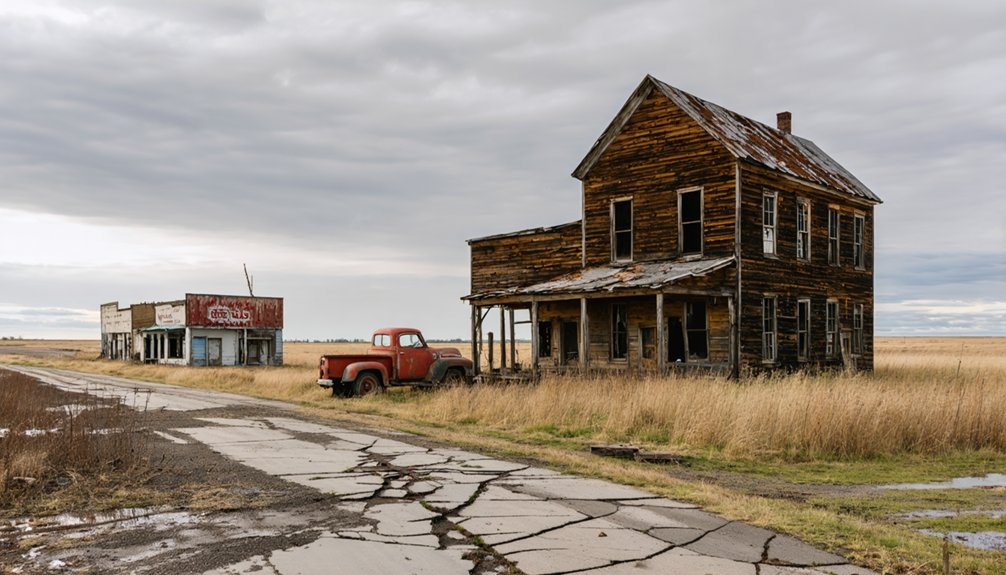
You’ll find Manitoba’s ghost towns scattered across the province, with most emerging during the 1870s agricultural boom before railway decisions sealed their fates. Towns like Nelson relocated 500 buildings to follow the rails, while Broomhill’s 1976 bridge collapse ended its story. The southwestern corridor near Saskatchewan offers the most accessible sites, including Lyleton’s grain elevator and Ste. Elizabeth’s abandoned church. From York Factory’s 1682 origins to communities that still host a handful of residents, these settlements reveal how transportation networks determined survival—and there’s much more to discover about their architectural remnants and preservation challenges.
Key Takeaways
- Manitoba’s ghost towns originated in the 1870s, with railway access determining which communities survived or declined into abandonment.
- Notable ghost towns include Nelson, which relocated 500 buildings; Ste. Elizabeth; and Broomhill, abandoned after a 1976 storm.
- Infrastructure failures, false land promises, and railway route changes caused many early settlements to disappear shortly after founding.
- Grain elevators and historic buildings remain as architectural remnants, with preservation efforts led by the Manitoba Historical Society.
- Accessible ghost towns concentrate in southwestern Manitoba, best explored spring through fall along routes near the Saskatchewan border.
Historical Settlement and Early Development
Manitoba’s ghost towns emerged across vastly different timelines, with the earliest settlements predating the province itself by nearly two centuries. York Factory, established in 1682, began this legacy, followed by West Lynne in 1801 and Grantown in 1824.
Most communities, however, originated during the 1870s boom, when settlement dynamics brought mainly Anglo-Saxon agricultural populations to southern regions. You’ll find diverse groups—French, Jewish, Ukrainian, Hungarian, Polish, Icelandic, Mennonite, and Dakota settlers—who established communities beyond farming, including Spearhill’s limestone quarries, Totogan’s lumber operations, and Hecla’s fishing industry.
Yet community decline often started before towns truly flourished. Land promoters’ false promises created instability, while conflicting railway routes doomed settlements in infancy. Manitoba City, Nelson, and Gartmore vanished within years of founding. The Sioux Settlement also represents one of the brief histories documented in this record of pioneer life. The Manitoba Historical Society maintains a compilation of historic sites throughout the province, providing information for historical interest while noting that official heritage designation requires government approval at municipal, provincial, or federal levels.
Railway Dependency and Transportation Networks
While agricultural promise initially drew settlers to Manitoba, railway lines ultimately determined which communities survived and which vanished into obscurity.
You’ll find railway evolution drove dramatic relocations—Mountain City moved to Morden in 1882-1883 after losing CPR hopes, while Nelsonville abandoned its chartered connection to follow the rails in 1885.
The CPR’s 1881 line to Gretna immediately killed the Colonization Trail‘s trade function.
Transportation shifts proved equally devastating. The Great Northern Railway‘s 1907 daily service once dominated north-south movement, but automobile adoption and Depression economics ended all trains by 1936, with tracks removed in 1937.
Early settlers endured severe transportation challenges, with ox teams and paddle wheelers forcing unsold grain pressures by 1880 before rail access arrived.
Construction of the Great Northern Railway from St. Johns to Brandon relied on horse-drawn track bed construction, with approximately 12 teams of horses or mules working per mile during 1905-1906.
Ste. Elizabeth’s failed railway bid sealed its fate, demonstrating how transportation networks controlled community survival.
Infrastructure Failures That Sealed Community Fates
Beyond railway abandonment, catastrophic infrastructure failures transformed some Manitoba communities from struggling outposts into ghost towns.
You’ll find Churchill’s 2017 flood exemplifies these infrastructure crises—track beds washed away in 19 locations, five bridges visibly damaged, and 600 culverts requiring inspection. Omnitrax called it unprecedented.
When Manitoba halted winter road construction for two weeks during peak cold season, residents couldn’t secure propane for heating. Basic goods like bread and milk vanished. Grocery prices skyrocketed. The health centre lacked medical equipment.
Climate change undermines infrastructural stability while funding uncertainty causes repeated disruptions. Northern communities lack southern-style backup systems, so institutional withdrawal becomes fatal.
Without redundant systems, northern communities face existential threats when infrastructure fails and institutional support vanishes.
Yet this failure reveals political opportunity—community resilience emerges when residents challenge provincial permitting processes blocking alternative transport solutions. Bridge and road renewal remains essential for maintaining viable connections, as infrastructure abandonment proves untenable for community survival.
Notable Abandoned Towns and Their Stories
The physical displacement of Nelson in 1884-1885 represents Manitoba’s most dramatic response to railway rejection.
You’ll find residents literally moved 500 people’s worth of buildings using sledges and horse teams to follow the railway eight miles south.
Ste. Elizabeth’s cultural significance emerged through French, Russian, and Hutterite settlement, though failed railway access and poor groundwater led to economic decline—it’s now Manitoba’s closest approximation to a true ghost town.
Broomhill’s fate was sealed when a 1976 storm destroyed the railway bridge, leaving only the concrete Kilkenny General Store skeleton.
Elva and Lauder demonstrate similar patterns: grain elevators demolished, railways departed, and buildings crumbling despite occasional occupation.
Lauder’s repurposed as a living museum, preserving prairie town heritage.
Lyleton’s decline began after the railroad left decades ago, leaving behind abandoned buildings on Main Street and a leaning grain elevator at risk of collapse.
Nelson’s refusal to grant tax concessions to the competing railway company directly triggered the decision to bypass the town, setting in motion its transformation into a ghost town.
Architectural Remnants and Standing Structures
Across Manitoba’s abandoned settlements, grain elevators emerge as the most iconic architectural survivors, their towering wooden frames serving as skeletal monuments to agricultural prosperity.
You’ll find Lyleton’s weathered shell standing sentinel behind rusted trucks, while Manitou’s Manitoba Pool elevator dominates Front Avenue. The Tyndall elevator faces endangerment, and Carman’s Elephant Brand Fertilizer structure persists as evidence to commercial networks.
Beyond grain elevators, Manitoba’s architectural heritage includes the Lyons House near Carberry—abandoned since 1964 after three decades of occupation—and Ste. Elizabeth’s maintained Roman Catholic Church, still hosting annual gatherings.
Commercial remnants like Broomhill’s concrete Kilkenny General Store skeleton and Manitou’s McLaren Medical Hall at 412 Main Street mark once-thriving business districts, their decay chronicling economic shifts.
The Daily House in Brandon, built for the city’s first mayor Thomas Maine Dailyaly, now serves as a museum preserving Victorian and Edwardian artifacts alongside archival treasures from the region’s fur trade era. These heritage preservation efforts demonstrate how existing buildings contribute to sustainable development and tourism, essential components of community revitalization.
Partially Occupied Communities Still Showing Signs of Life
You’ll find that some Manitoba ghost towns haven’t surrendered entirely to abandonment, maintaining skeleton populations that preserve selected structures even as most residents departed decades ago.
Broomhill exemplifies this pattern, where a devastating tornado eight years before 2026 destroyed most original buildings, yet remaining structures were deliberately preserved, including a historic gas pump and houses converted into a living museum.
Similarly, the former Asessippi townsite evolved from complete abandonment—its boarding house occupied until June 1961—to curated heritage site by 2020, with the Fish-Robin House and interpretive panels marking what once thrived as a functional community. Lower Fort Garry stands as another example, with main buildings dating back to the 1850s and now serving as a destination for those interested in Manitoba’s historical preservation efforts.
Towns With Remaining Residents
While most ghost towns fade into complete abandonment, several Manitoba communities cling to existence with skeletal populations that refuse to surrender their heritage.
Lauder exemplifies this defiance, housing just six residents who fluctuate seasonally. Founded in 1891 as a railway town, it declined after the rail line’s abandonment and subsequent closures of its grain elevator, store, and school.
Despite overgrown sidewalks and abandoned homes, a determined group of women maintains the Lauder Inn through rummage sales, church services, and fundraisers—demonstrating remarkable community resilience.
These six inhabitants sustain what once housed over 100 residents during peak years. Their perseverance represents Manitoba’s stubborn frontier spirit, where people make things happen rather than accept defeat, preserving their town’s identity against inevitable entropy.
Crumbling Yet Still Inhabited
Between full habitation and complete abandonment lies a haunting middle ground where Manitoba’s partially occupied ghost towns exist in slow-motion decay.
As the shadows lengthen and the wind whispers through the crumbling structures, the allure of exploring abandoned towns in Mexico presents an intriguing contrast. Each location tells a story of lost dreams and faded histories, drawing curious adventurers into their enigmatic embrace. The vibrant remnants of past lives serve as a poignant reminder of our impermanence in the vast tapestry of time.
You’ll find Elva, Snowflake, and Lauder scattered across the province, their crumbling buildings standing alongside grain elevators that still mark inhabited territory. These communities embody urban decay while demonstrating remarkable community resilience—locals refuse to surrender completely.
Broomhill exemplifies this liminal state. After a 1976 storm destroyed the railway bridge, the town’s fate was sealed. Its school closed in 1987, yet preservation efforts maintain the concrete skeleton of Kilkenny General Store.
Train tracks still cut through, sustaining minimal activity.
Tilston breaks the pattern—it’s not fully abandoned but rather populated with lovely preserved buildings, proving some communities successfully resist the ghost town designation.
Preservation Efforts and Heritage Conservation
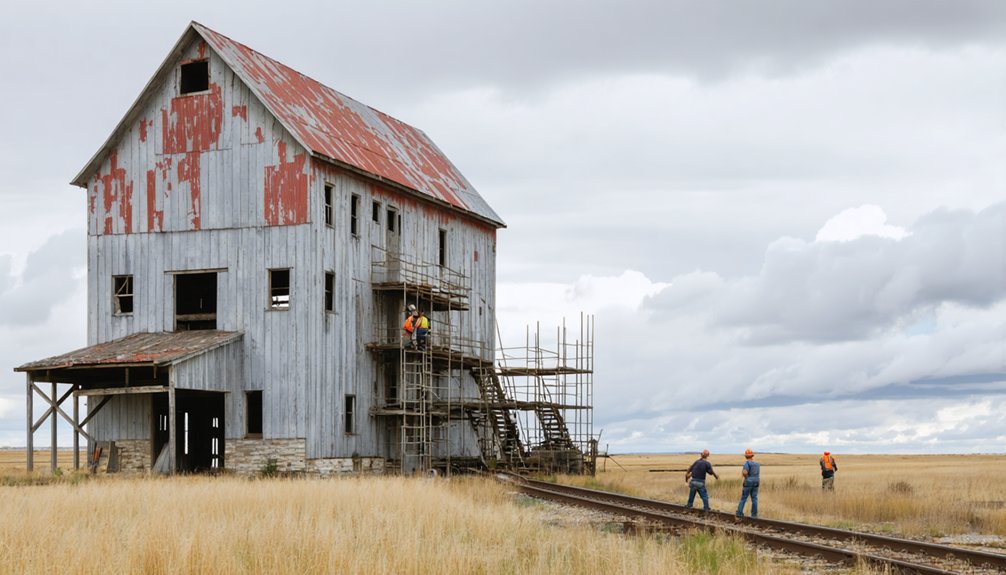
Across Manitoba’s rural landscape, individuals and organizations have mobilized to document and protect the physical remnants of abandoned communities before they disappear entirely.
Gordon Goldsborough’s heritage advocacy through his Abandoned Manitoba video series profiled 239 sites, while the Manitoba Historical Society broadcasts weekly radio segments tracking locations from Napinka’s fire hall to Bannock Point Petroforms.
You’ll find the Negrych Homestead exemplifies successful preservation—designated provincial heritage in 1992 and national in 1996, it’s maintained by Gilbert Plains municipality to depict active Ukrainian pioneer life from 1897.
Yet conservation challenges persist. Winnipeg’s Boyd Building and Masonic Temple remain endangered, while cemetery protection efforts face municipal enforcement gaps despite Goldsborough’s advocacy for endowment funds and year-round access protocols.
Exploring Manitoba’s Ghost Towns Today
You’ll find Manitoba’s most accessible ghost towns concentrated in the southwest corridor along the Saskatchewan border, where sites like Lyleton, Broomhill, and Tramping Lake remain open year-round for exploration via rural roads mapped through GPS coordinates and Google Earth.
When you visit these abandoned communities, you’re entering both historical sites and photographic subjects that demand respectful documentation—avoiding damage to deteriorating structures while capturing their architectural decay.
Your exploration success depends on understanding specific access routes to locations like the grain elevator at 49.03025, -101.25208 and adhering to preservation etiquette that protects these remnants for future visitors and heritage conservation efforts.
Best Routes and Locations
Planning your ghost town adventure requires understanding Manitoba’s geography and seasonal conditions. The southwestern route along Saskatchewan’s border offers ideal ghost town exploration from spring through fall, while winter travel becomes challenging.
You’ll discover abandoned architecture throughout several distinct corridors:
- Southern Circuit: Begin at Lyleton’s Main Street with its forsaken store and auto repair service, continue through Cameron’s highway remnants, then explore Lauder’s grain elevators before reaching Broomhill’s blue dress barn landmark.
- Border Communities: Visit Tilston near Saskatchewan, then Napinka’s historic structures.
- Central Corridor: Navigate Griswold’s old schools, Isabella’s community remnants, and McConnell’s privately-owned buildings.
- Northern Highlights: Journey to Tramping Lake, Manitoba’s premier abandoned site, or Victory Nickel Mine near Thompson.
GPS coordinates and Gordon Goldsborough’s thorough guides provide essential navigation tools.
Preservation and Photography Etiquette
Once you’ve mapped your route to these abandoned settlements, understanding how to document and interact with these fragile sites becomes paramount.
Photography guidelines emphasize capturing crumbling buildings in places like Elva and Lauder while respecting occupied areas. Document well-maintained structures such as Ste. Elizabeth Roman Catholic Church during its annual summer picnic, and photograph unique features like Broomhill’s concrete general store skeleton remaining after the 1976 railway washout.
Preservation etiquette demands respecting private ownership in technical ghost towns across southwestern Manitoba. Don’t trespass on maintained sites, including donated houses serving living museums.
The Manitoba Historical Society tracks endangered structures annually—from Napinka’s Fire Hall to precarious farmhouse granaries with fallen walls. Support these heritage efforts through non-invasive visits, observing fading grain elevators and pioneer homesteads without disturbing ongoing restoration work.
Frequently Asked Questions
Are Ghost Town Properties Privately Owned or Publicly Accessible?
Ghost town properties typically remain privately owned despite abandonment, limiting your property access and ownership rights. You’ll find most sites on private land, though some church properties and cemeteries may permit limited public visitation during specific events.
What Safety Precautions Should Visitors Take When Exploring Abandoned Buildings?
Ironically, exploring “harmless” ruins demands serious preparation. You’ll need proper safety gear—gloves, masks, sturdy boots, headlamps—and must constantly assess structural integrity by testing floors before stepping. Never explore alone; bring backup communication and emergency supplies.
Can Artifacts or Items Be Legally Removed From Ghost Town Sites?
You can’t legally remove artifacts from Manitoba ghost towns without permits. Legal regulations require heritage permits from Historic Resources Branch, and artifact preservation mandates provincial ownership of items found after 1986, with potential fines reaching $50,000.
How Do Weather and Climate Affect the Deterioration of Abandoned Structures?
Manitoba’s weather patterns accelerate structural decay through freeze-thaw cycles cracking foundations, moisture infiltrating damaged openings to rot timber, and wind stripping materials. Climate impact worsens as temperature fluctuations expand concrete and degrade insulation in abandoned buildings.
Are There Guided Tours Available for Manitoba’s Ghost Towns?
While guided tours focus on Winnipeg’s haunted buildings rather than actual ghost town exploration, you won’t find organized tours to Manitoba’s abandoned rural settlements—you’ll need to venture independently to these forgotten places.
References
- https://wevegoneonholidaybymistake.com/2020/11/02/manitoba-ghost-towns/
- https://www.youtube.com/watch?v=aQ5nkcuK-LQ
- https://www.mhs.mb.ca/docs/sites/abandoned.shtml
- https://www.manitobacooperator.ca/news-opinion/news/rural-manitoba-ghost-towns-make-an-interesting-day-trip/
- https://www.youtube.com/watch?v=nEs-yEbe-VI
- https://www.traingeek.ca/wp/abandoned-places/manitoba/
- https://en.wikipedia.org/wiki/List_of_ghost_towns_in_Manitoba
- https://crumblingmemoriesphotography.ca/tag/abandoned-towns-in-manitoba/
- http://www.mhs.mb.ca/docs/mb_history/48/ghosttowns.shtml
- https://www.youtube.com/watch?v=OEbBCOjRjlU