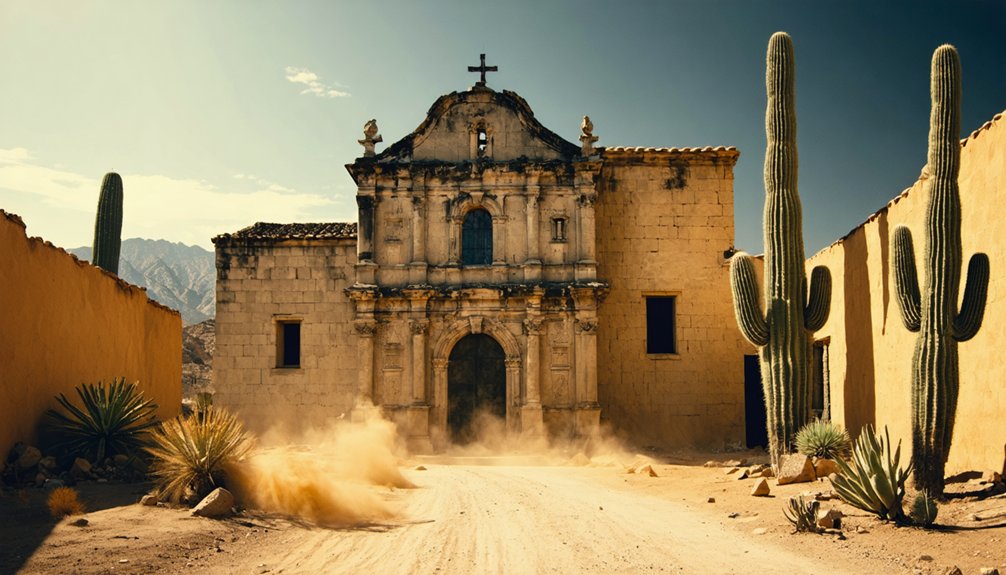
You’ll find Mexico’s most enchanting ghost towns scattered across silver-rich mountains and volcanic landscapes. Real de Catorce’s crumbling stone walls whisper tales of 20,000 miners, while Mineral de Pozos showcases Moorish arches from its 70,000-resident heyday. Don’t miss San Juan Parangaricutiro, where a church tower pierces through black lava flows from the 1943 Parícutin eruption—a haunting reminder of nature’s power. Each abandoned street and vine-covered ruin reveals layers of colonial history, indigenous ceremonies, and stories that’ll transform your understanding of Mexico’s dramatic past.
Key Takeaways
- Real De Catorce, founded in 1779, peaked at 20,000 residents before mining collapse, now hosts 1,000 and attracts Huichol pilgrims.
- Mineral De Pozos houses 3,500 residents including fifty Americans, designated Pueblos Magicos in 2012 with horseback mining tours available.
- Cerro De San Pedro, founded in 1592, declined to 97 residents due to environmental degradation from gold and silver mining operations.
- San Juan Parangaricutiro’s church tower remains visible in volcanic rock from Parícutin’s 1943 eruption, hosting annual Holy Friday pilgrimages.
- Hacienda Santa Brigida De Morin features colonial-era conical ovens from 1595, abandoned in 1938 after flooding ended smelting operations.
Real De Catorce
Perched at 2,750 meters above sea level, Real de Catorce clings to the mountainside like a faded photograph of Mexico’s silver-mining glory.
Real de Catorce perches impossibly high, a weathered monument to silver-fueled dreams now clinging stubbornly to Mexico’s stark mountainside.
You’ll reach this ghost town through the otherworldly Ogarrio Tunnel, a one-way passage carved through 2,260 meters of mountain. Founded in 1779, it thrived with 20,000 souls before silver mining collapsed after 1900.
Now you’ll wander among stone ruins where miners’ spirits allegedly linger—ghost sightings remain common folklore among the remaining 1,000 residents.
Huichol pilgrims trek here for sacred peyote ceremonies in nearby Wirikuta, while Catholic devotees visit the Immaculate Conception Cathedral. Local Huichol artisans create intricate yarn paintings that reflect their spiritual connections to ancestors and nature deities.
You’re free to explore abandoned haciendas, the crumbling bullfighting ring, and Pueblo Fantasma‘s skeletal houses overlooking endless desert canyons—a reflection of both ambition’s heights and nature’s reclamation. The last 12 miles to reach Real de Catorce wind along a cobblestone road built for tourism in the 1970s.
Mineral De Pozos
While Real de Catorce draws you through a single mountain tunnel into isolation, Mineral de Pozos sprawls across rolling hills just 40 miles from San Miguel de Allende’s colonial charm—close enough for a day trip, yet worlds apart in atmosphere.
You’ll wander through Moorish-arched mine entrances and past three Jesuit ovens from 1595, still standing after four centuries. The town that once housed 70,000 miners dwindled to 200 souls before Mexico’s historic preservation efforts sparked its 1982 revival.
Today’s 3,500 residents include fifty Americans who’ve transformed ruins into art galleries and bohemian cantinas. You’ll hear pre-Hispanic instruments crafted in local workshops echoing through abandoned haciendas where silver once flowed to Mexico City’s mint. The town’s 2012 designation as one of the original Pueblos Magicos has boosted weekend tourism while weekdays remain refreshingly quiet. Horseback tours with local guides cost about $20 per person per hour, letting you explore the mining ruins at a slower pace.
Just watch those open mine shafts—freedom requires awareness.
Cerro De San Pedro
Just fifteen miles northeast of San Luis Potosí’s bustling streets, you’ll find what remains of Cerro de San Pedro—a village where the very hill that gave birth to its fortune has vanished entirely.
Founded in 1592, this settlement once enriched the Spanish crown with gold and silver. Today, 97 souls inhabit cobblestone streets adorned with metal scrap art, while stray dogs outnumber visitors.
The mining heritage that built empires now manifests as an enormous crater—Canadian company NewGold completely removed the mountain by 2013.
You’ll witness the environmental impact firsthand: cyanide lixiviation ponds, abandoned equipment, and earth scarred by centuries of extraction. The town’s proximity helped establish San Luis Potosí’s capital in the region, with mining wealth flowing from these hills for centuries.
Despite grassroots resistance that fenced the town against displacement, the mine operated two decades before leaving residents with an uncertain legacy. Yet the town has found new life as a weekend tourist destination, drawing visitors to its colorful murals and local restaurants.
Ojuela
North of Mapimí, where the Chihuahuan Desert bleeds into Durango’s mineral-rich mountains, Ojuela clings to a hilltop like a monument to human ambition.
You’ll cross the Puente de Ojuela, a 19th-century suspension bridge swaying above a breathtaking canyon, to reach this treasure.
For 350 years, miners extracted gold and silver here. Founded in 1598 after Spanish prospectors struck precious metals, the settlement became an important stop along el Camino Real de Tierra Adentro, the UNESCO-recognized Silver Route connecting Mexico City to northern territories. The mining history shifted dramatically in 1946 when collectors discovered something more valuable—117 species of brilliantly colored mineral specimens scattered throughout the veins.
Lime-green adamite, crystalline legrandite, and vibrant aurichalcite transformed abandoned tunnels into geological wonderlands.
Today you’ll wander through 450 kilometers of underground passages, exploring ruins where miners once lived. At its peak, the village featured a post office, church, and stores, serving the mining community before revolutionary activities and flooding forced abandonment.
Today you’ll wander through 450 kilometers of underground passages, exploring ruins where miners once lived.
The cooperative still extracts specimens, making Ojuela Mexico’s most celebrated mineral locality—a place where nature’s artistry eclipsed human industry.
San Juan Parangaricutiro
You’ll find the church tower of San Juan Parangaricutiro rising from a sea of black volcanic rock, a haunting monument to the day in 1943 when Parícutin volcano emerged from a farmer’s cornfield.
The lava flows that consumed this Purepecha village left only the second story of the cathedral visible, its altar to El Señor de los Milagros still standing amid the solidified destruction. The volcano continued its destructive eruption until 1952, reshaping the entire valley with layers of ash and hardened lava.
Today, you can trek across the jagged volcanic terrain to touch these ruins, where locals make their annual pilgrimage each Holy Friday to honor the town they were forced to abandon. The church itself survived largely intact even as the lava melted the surrounding cemetery walls.
Paricutín Volcano Eruption History
On an ordinary February afternoon in 1943, Dionisio Pulido witnessed something extraordinary in his cornfield near Parícutin—a crack in the earth that would reshape the landscape forever.
The eruption timeline unfolded with breathtaking speed as Strombolian activity built a 50-meter cone within twenty-four hours.
You’ll find this nine-year spectacle remains the only complete volcano birth scientists have documented from start to finish. The lava flow advanced relentlessly, swallowing entire communities:
- Parícutin village disappeared beneath molten rock by June 12, 1943
- The cone soared to 424 meters, dominating the horizon
- San Juan Parangaricutiro faced evacuation as flows threatened the town
- Lightning strikes during eruptions claimed three lives—the only casualties
Today, you can walk among these volcanic ghosts, where church towers pierce through solidified lava fields.
Buried Church Remains
Rising from a frozen ocean of black basalt, the twin towers of San Juan Parangaricutiro’s church stand as monuments to nature’s overwhelming power.
You’ll find this half-buried sanctuary two miles from where Parícutin exploded from a cornfield in 1943, swallowing an entire indigenous village beneath ash and molten rock.
The church preservation defies logic—original plasterwork adorns the altar where priests still conduct impromptu services on jagged volcanic stone.
Locals call it Santuario del Señor de los Milagros, believing divine intervention spared their sacred space while lava consumed everything else.
You can join the annual volcanic pilgrimage, walking across hardened basalt to pray where cemetery walls once stood.
The rescued Christ image now watches over Nuevo San Juan, but pilgrims return here, leaving offerings at this altar that refused to surrender.
Visiting the Ruins
From Angahuan’s cobblestone streets, where Purépecha women still weave traditional textiles on wooden looms, you’ll commence a three-mile trek across terrain that feels more Icelandic than Mexican.
The ruins exploration demands sturdy boots as you navigate:
- Jagged black lava flows that’ll test your balance
- Designated viewpoints offering dramatic vistas of the protruding tower
- Trails marked by local guides who share folklore about divine intervention
- Steam vents near the volcano’s cone, reminding you nature’s still restless
You can arrange guided day trips from Morelia with private pickups, though hiring Angahuan villagers provides authentic cultural heritage immersion.
The altar’s intact plasterwork, emerging two stories above hardened volcanic rock, creates an otherworldly scene.
Pilgrims still conduct impromptu services here, standing on the same lava that tried erasing this sacred space.
Hacienda Santa Brigida De Morin
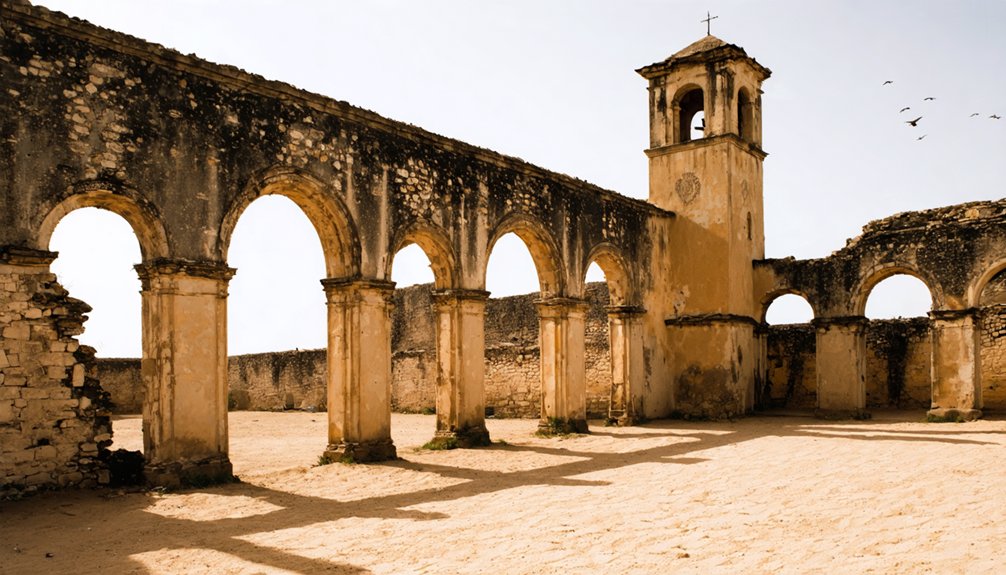
Nestled in the rugged hills near Mineral de Pozos, Guanajuato, the Hacienda Santa Brigida De Morin stands as a weathered evidence to Spain’s colonial ambitions and the Jesuit order’s industrial prowess.
The hacienda history begins in 1576 when Jesuits established this defensive fortress, later constructing three distinctive conical ovens in 1595 that still resemble pyramids behind modern fencing.
You’ll discover the architectural significance in the arched structure that served dual purposes—purifying air from smelting operations while functioning as an astronomical observatory.
Though you can’t freely enter the grand hacienda building, you’re welcome to explore the courtyard’s ceremonial center and examine vintage machinery scattered throughout.
The fortress processed silver, gold, and mercury for nearly four centuries before irreversible flooding shuttered operations in 1938, leaving behind this haunting monument.
Frequently Asked Questions
What Is the Best Time of Year to Visit Mexican Ghost Towns?
You’ll find ideal seasons between November and April when dry weather lets you freely wander sun-bleached streets. Climate considerations favor March through May—crisp mornings give way to warm afternoons perfect for exploring crumbling haciendas without rain limiting your adventures.
Are Guided Tours Available at These Ghost Town Locations?
You’ll discover a treasure trove of guided experiences at Mexico’s ghost towns, where local insights breathe life into forgotten cobblestone streets. From Real de Catorce’s atmospheric walks to Misnebalam’s ATV adventures, authentic exploration awaits your wandering spirit.
Can Visitors Stay Overnight in Any of These Ghost Towns?
You’ll find overnight accommodations at Real de Catorce’s hostels and Hotel Ogarrio, where authentic ghost town experiences await. Mineral de Pozos offers boutique lofts too, letting you sleep surrounded by whispers of Mexico’s silver-mining past.
What Safety Precautions Should Tourists Take When Exploring Ghost Towns?
Like armor for modern adventurers, you’ll need sturdy boots and safety gear to navigate crumbling structures. Maintain wildlife awareness—rattlesnakes coil beneath debris. Pack water, avoid unstable buildings, respect boundaries, and travel during daylight for true exploration freedom.
Are There Entrance Fees to Visit These Abandoned Sites?
Unlike archaeological sites with structured ticket pricing, you’ll find genuine ghost towns typically welcome free exploration. Entrance costs remain minimal—perhaps parking fees—letting you wander abandoned streets without Mexico’s usual tiered tourist charges restricting your adventure.
Among these sites, there are hidden gems in Guatemala’s history that offer fascinating tales and untouched landscapes. Exploring these lesser-known areas can enrich your understanding of the country’s rich cultural tapestry. Each visit reveals stories of resilience and heritage that have largely remained in the shadows of more celebrated locations.
References
- https://www.cheapestdestinationsblog.com/2022/04/18/ghost-towns-in-mexico/
- https://mexicaninsurance.com/your-guide-to-mexican-ghost-towns/
- https://compaslife.com/blogs/journal/abandoned-enchantment-ghost-towns-of-new-mexico-1
- https://en.wikipedia.org/wiki/Category:Ghost_towns_in_Mexico
- https://www.newmexico.org/places-to-visit/ghost-towns/
- https://www.atlasobscura.com/things-to-do/mexico/ghost-towns
- https://www.youtube.com/watch?v=OzVlfDWyMT0
- https://www.honeysharp.com/ghost-town-real-de-catorce
- https://visitingmexico.com/san-luis-potosi/real-de-catorce/
- https://escapingworlds.com/mexican-ghost-town-real-de-catorce/