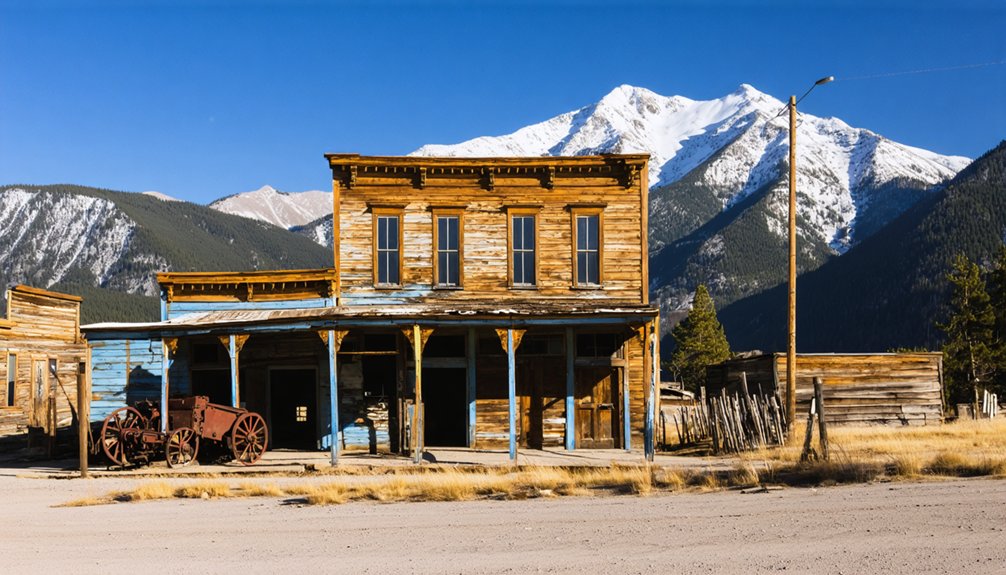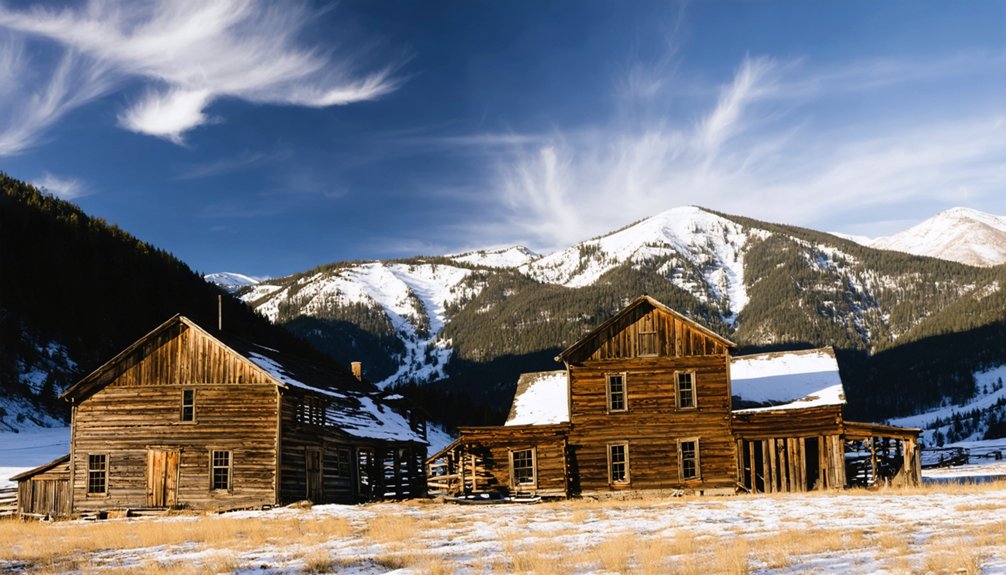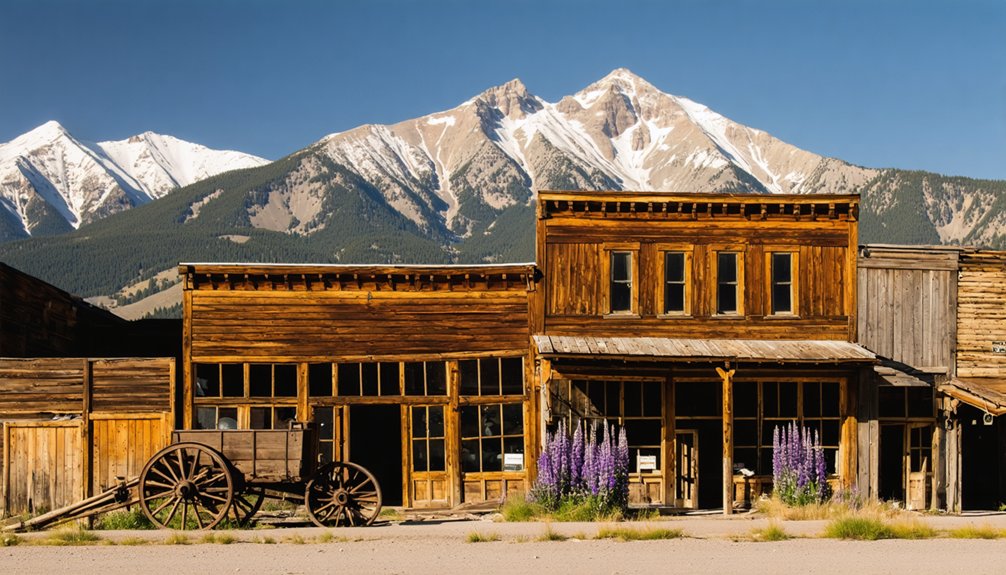
You’ll find exceptional ghost town exploration in Northern Colorado’s Gilpin and Boulder counties, where 1859’s gold rush left accessible remnants. Teller City offers a 0.75-mile interpretive trail through its 1879 settlement, while Nevadaville maintains structures at 9,000 feet with active preservation efforts. Caribou, established in 1869, and Apex require more challenging access but reward visitors with authentic mining-era foundations. Corona sits highest at 11,660 feet along Rollins Pass, featuring railroad trestles and weathered foundations. Each site reveals distinct chapters of mining heritage, with summer months providing ideal access to these mountain-elevation locations.
Key Takeaways
- Notable Northern Colorado ghost towns include Teller City, Nevadaville, Apex, Caribou, and Corona, all remnants of the 1859-1880s gold rush era.
- Most ghost towns feature accessible remnants like crumbling foundations, mining structures, cemeteries, and interpretive trails for exploration.
- Summer months (June-September) provide optimal visiting conditions, as high-elevation sites remain snow-blocked for approximately eight months annually.
- Vehicle requirements range from regular cars to high-clearance 4WD, depending on terrain difficulty and remoteness of specific ghost town locations.
- Essential gear includes sturdy boots, navigation tools, flashlights, first aid kits, and water supplies for safe exploration of these historic sites.
Teller City: A Silver Mining Settlement Lost to Time
When silver-bearing ore surfaced along Jack Creek in 1879, prospectors established Teller City in what’s now Roosevelt National Forest, southeast of Walden in North Park’s remote expanse.
Named after Senator Henry M. Teller, this Silver Boom settlement swelled to 1,500 residents by 1882, making it the region’s largest town. You’d have found 27 saloons, the elegant 40-room Yates House Hotel with Persian rugs, and two newspapers serving the community.
The Endomile mine produced ore assaying up to $3,000 per ton initially. However, falling silver prices and America’s shift to the gold standard triggered rapid collapse by 1884. Residents abandoned homes overnight, leaving dishes on tables. By 1902, Teller City became a ghost town with only scattered remnants of its former prosperity.
Today, among Ghost Towns in northern Colorado, you’ll discover Teller City’s cabin remains and mine artifacts along a three-quarter-mile interpretive trail. The nearby Aspen Campground offers primitive camping for visitors exploring the historic site.
Nevadaville: Where History Still Lives Near Central City
While Teller City vanished into North Park’s wilderness, Nevadaville clings to existence in the mountains above Central City, refusing to disappear completely.
You’ll find this 1859 gold rush settlement at over 9,000 feet elevation, where six residents still call it home. The town exploded from John Gregory’s strike in Gregory Gulch, housing 4,000 miners who developed advanced mining techniques across 40 stamp mills.
Today’s remnants tell authentic stories:
Unlike polished tourist sites, Nevadaville’s crumbling structures and weathered gravestones preserve unvarnished truth about frontier hardship and perseverance.
- The Masonic Temple still hosts lodge meetings with original 1860s wallpaper intact
- Cemetery headstones mark Irish and Cornish families who shaped community events
- Saloon foundations and mine shafts warn trespassers of dangerous ground
The Nevadaville Heritage Foundation works to stabilize what remains. The town faced near-total destruction when strong winds carried a fire from Bald Mountain through the northern gulch on a Monday evening in 1861. Water supply challenges plagued the settlement throughout its history, and after the last fire in 1914, inadequate water prevented the town from rebuilding fully.
This isn’t reconstructed history—it’s raw evidence of Colorado’s mining past, standing defiantly against abandonment.
Apex: Rugged Gold Mining Remnants Near Nederland
Unlike Nevadaville’s determined survival, Apex surrendered to the mountains decades ago, leaving only scattered timber frames among the pines near Nederland.
Richard Mackey’s 1870s discovery here sparked cycles of fortune and betrayal—Mountz lost $30,000 to a thieving partner before his final dynamite blast revealed the vein that built a thousand-person town by 1900.
You’ll find Apex history preserved in its false-fronted hotel, 1890s boarding house, and weathered schoolhouse standing among modern summer cabins. The Apex Pine Cone chronicled daily life alongside the saloons and dance halls that lined the streets.
The town’s mining techniques evolved from Mackey’s surface prospecting to deep-shaft operations supporting over 100 Main Street businesses.
Take Apex Valley Road from CO 119—the graded dirt becomes challenging beyond the cabins, demanding 4×4 capability. The 2WD accessible roads make reaching the remnants easier than many remote ghost town sites.
One year-round resident guards these remnants where stagecoaches once ran daily routes.
Caribou: Boulder’s Nearest Silver Town Escape
Twenty miles west of Boulder, silver fever struck at 10,000 feet when William Martin and George Lytle filed claims on the Caribou and Poorman lodes in December 1869, following Samuel Conger’s tip about promising veins discovered that August.
Caribou history transformed rapidly when Dutch investors paid $3 million for the mine in 1871, sparking Colorado’s first great silver camp with 3,000 residents by the mid-1870s.
Dutch investment of $3 million in 1871 rapidly transformed Caribou into Colorado’s first major silver camp with 3,000 residents.
Silver mining prosperity built a complete frontier town:
- Three-story hotel, brewery, bakery, meat market, and Caribou Post newspaper
- Church and multiple saloons serving the mountain community
- Cardinal settlement one mile downhill for gambling halls and brothels
You’ll find minimal remnants today—one collapsed cabin and two stone shells—after fires in 1879, 1899, and 1905 devastated the settlement. The post office operated until 1917, making it one of the last buildings to close before Caribou became a ghost town. Jerome Chaffee and David Moffat purchased the mine in 1876, continuing operations after the Dutch investors’ sale.
Take County Road 128 west from Nederland 4.7 miles to explore this accessible ghost town.
Corona: Frontier Mining Life in Gilpin County
You’ll find Corona perched at over 11,000 feet on Rollins Pass, where railroad workers and miners once endured extreme conditions serving Gilpin County’s 1859 gold rush economy.
The settlement operated as both a Moffat Railroad station and hotel stop, supporting the broader mining district that swelled Central City to 10,000 residents by 1860 before deposits exhausted and populations plummeted. Just 1.5 miles from Central City, Nevadaville emerged during the same gold rush era, establishing a Masonic lodge in 1859 that continues holding meetings as the only operational ghost town lodge in Colorado. Nevadaville’s population peaked at around 4,000 residents in the late 1800s before declining sharply around 1900 as gold and silver resources were depleted.
Today, you can explore Corona’s crumbling trestles and partially accessible Needle’s Eye tunnel via a self-guided auto tour near the Moffat Tunnel East Portal, where archival remnants document this high-altitude frontier outpost.
Mining Operations and Economy
When John H. Gregory discovered gold in fall 1858, you witnessed Gilpin County transform into “The Richest Square Mile On Earth.”
By 1867, the region’s economic impact was undeniable—producing over $9 million in lode gold and 40% of Colorado Territory’s total output by 1861.
Mining technology evolved rapidly from simple placer methods to industrial-scale operations:
- Hydraulic mining blasted hillsides with high-pressure water hoses into sluices
- Coal-powered drills and dynamite accessed deep quartz veins exceeding 3,000 feet
- Nathaniel P. Hill’s Boston & Colorado smelter solved extraction from complex sulfide ores in 1868
You’d find over 17,000 mining claims dotting southern Gilpin County.
Black Hawk became the milling center, where ore wagons and trains delivered tons of rock for processing.
Large companies dominated, employing immigrant miners—Irish, English, German, Chinese, and experienced Cornish hard-rock specialists.
Daily Life and Community
As gold fever drew thousands to Gilpin County in 1859, the population exploded to 10,000 within just two months—transforming a wilderness gulch into Colorado’s most densely settled region.
You’d witness community growth unlike anywhere else: miners brought families, established schools and churches, and hired police forces to attract investment capital.
Yet social challenges defined daily existence. In 1861 alone, residents recorded 217 fistfights and 97 gunfights.
You’d endure coal dust, toxic sulfur fumes, and relentless floods at 7,000 feet elevation.
Irish, English, German, and Chinese immigrants worked alongside each other in increasingly industrialized mines.
Access and Visiting Today
Perched at 11,660 feet on the Great Continental Divide’s summit, Corona stands as one of Colorado’s most remote ghost town sites—accessible only via the challenging Rollins Pass road that winds through Boulder County toward the Gilpin County border.
Though listed among Colorado’s most endangered sites, this former highest-elevation rail stop rewards adventurous visitors willing to navigate the historic Moffat Road route.
What you’ll find today:
- Weathered foundations from the once-thriving restaurant and hotel complex
- Scattered remnants and historic railroad trestles (off-limits for safety)
- Breathtaking panoramic views across the Front Range with seasonal wildflowers
The Rollins Pass Restoration Association works alongside the Forest Service to preserve this site’s historical significance.
You’ll encounter minimal structures but maximum mountain scenery where frontier mining history meets high-altitude exploration.
Homestead Meadows: Agricultural Heritage Near Estes Park
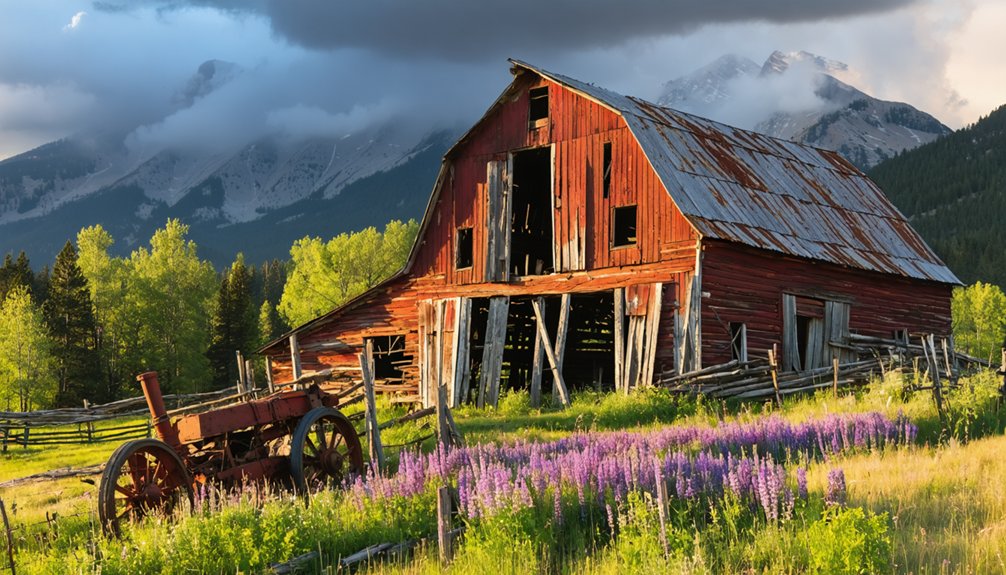
Between 1889 and 1923, eight homesteading families claimed parcels of land in what became known as Homestead Meadows, transforming a remote mountain valley near present-day Estes Park into a working agricultural community.
This homestead legacy showcases the determination required to survive in Colorado’s high country. Families like the Engerts, who secured a 320-acre patent in 1921, and William Turner House, who arrived in 1933, sustained themselves through agricultural practices including cattle ranching and timber operations.
Men often walked the creek bed to jobs in Lyons during weekdays while women managed livestock and improvements. The House family’s sawmill and Robert Boren’s cattle business exemplified their resourcefulness.
Though economic hardships forced abandonment by 1952, the U.S. Forest Service’s 1978 acquisition preserved these sites, now accessible via 15 miles of connecting trails.
Planning Your Ghost Town Adventure
You’ll need to time your ghost town expeditions around Colorado’s mountain weather patterns, with summer months offering the safest access to high-elevation sites above 11,000 feet where avalanche danger and road closures plague winter travel.
Your vehicle requirements vary dramatically—from regular cars handling approaches to lower-elevation settlements to high-clearance four-wheel drive systems necessary for Alpine Loop’s 65-mile dirt road network and Continental Divide Trail routes.
Pack water, detailed topographic maps, and sturdy hiking boots for exploring mining ruins, as these remote locations lack services and present genuine backcountry challenges despite their historical accessibility during boom years.
Best Times to Visit
Timing your ghost town expeditions requires careful attention to Northern Colorado’s dramatic seasonal shifts and high-altitude constraints.
Seasonal accessibility dictates your exploration windows, with most roads and passes opening June through September. Weather considerations become critical above 11,000 feet, where winter renders sites completely unreachable.
Best visiting windows:
- Summer months (June-September) provide full access to high-elevation towns, operating museums, and general stores while daylight extends for 12-hour round-trip hikes.
- Early fall delivers golden aspen colors with reduced crowds and crisp mountain air, though you’ll need to monitor pass closures.
- Dawn departures capture best morning light for photography and guarantee you’re off remote trails before 8 PM.
Snow blocks 4WD-only routes for eight months annually, making summer your gateway to freedom.
Essential Gear and Supplies
Proper preparation separates successful ghost town explorers from those who retreat early or face dangerous situations in Colorado’s backcountry.
Your gear essentials start with layered clothing: moisture-wicking base, mid-weight fleece, and rain shell for unpredictable mountain weather. Pack 3+ liters of water per person with electrolyte packets to combat altitude dehydration—these remote sites offer limited water sources.
For safe exploration on rough access roads, you’ll need a tire plug kit, portable compressor, and basic tools. Offline maps are critical since cell service vanishes in these forgotten valleys.
Include a first-aid kit, headlamp, and bear-proof canister for overnight camps. A quality wide-brim hat and SPF 30+ sunscreen shield you from intense high-altitude UV exposure during extended site photography.
Road Conditions and Accessibility
Northern Colorado’s ghost towns scatter across terrain demanding vastly different vehicle capabilities—from passenger cars cruising paved highways to specialized 4×4 rigs traversing boulder-strewn passes above 11,000 feet.
Vehicle requirements determine which sites you’ll access:
- Passenger cars handle Saint Elmo’s Main Street and Independence near Aspen year-round.
- High-clearance 4×4s conquer Schofield Pass’s Devil’s Punchbowl and Animas Forks at 11,200 feet elevation.
- Hiking boots complete the journey to Columbia City beyond 4WD limits and Interlaken’s short lakeside trail.
Road safety depends on seasonal timing. Summer reveals high-elevation camps after snowmelt, while winter renders most routes impassable.
You’ll find Vicksburg and Winfield best accessed spring through fall on County Road 390, avoiding treacherous conditions that challenge even experienced off-roaders.
Best Times to Visit Northern Colorado Ghost Towns
When planning your expedition to Northern Colorado’s abandoned mining camps, you’ll find that summer dominates as the prime visiting season.
Summer reigns supreme for exploring Northern Colorado’s ghost towns, when melting snow unlocks high-elevation camps shuttered by winter’s grip.
Best timing runs June through September, when snowpack clears from high-elevation sites like Animas Forks at 11,160 feet and Governor Basin above 12,000 feet. Those harsh winter conditions that originally drove miners away still render most locations completely inaccessible today.
You’ll maximize your exploration by starting at sunrise—early morning light creates ideal photography conditions while providing essential daylight hours for challenging four-wheel-drive routes.
Fall offers compelling alternatives with autumn colors transforming Vicksburg’s historic balsam poplars and reduced crowds at accessible sites.
The seasonal weather patterns demand respect: winter transforms these remote camps into snowbound ruins, just as it did when transportation difficulties forced their original abandonment.
What to Bring for Exploring Abandoned Sites
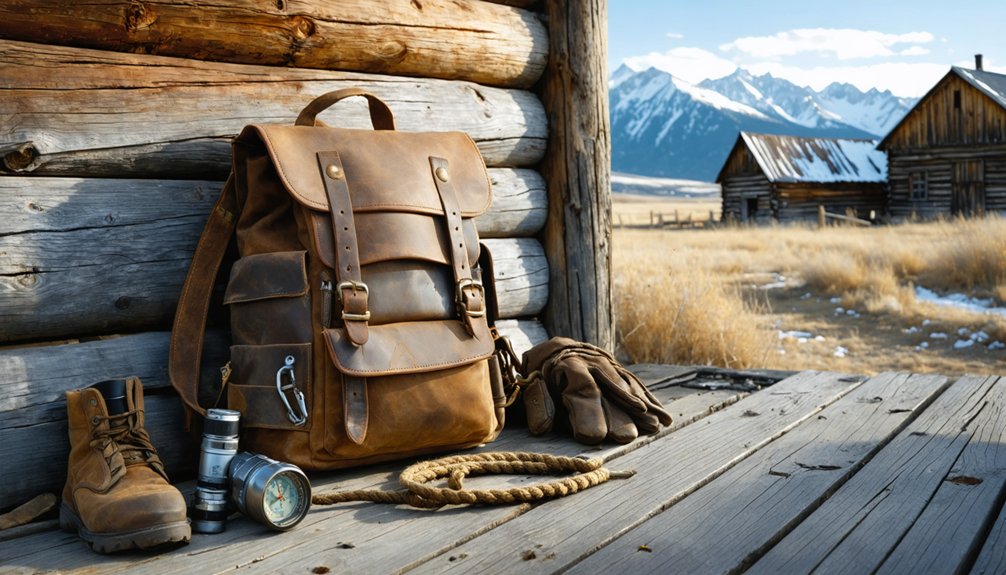
Your expedition timeline secured, the next consideration centers on gear that protects you from hazards that claimed miners’ lives and now threaten modern explorers.
Northern Colorado’s ghost town legends attract urban exploration enthusiasts, but crumbling structures demand serious preparation.
Many are drawn to the allure of abandoned mines near Colorado Springs, where the remnants of mining history offer both beauty and danger. Explorers must remain vigilant, as unstable terrain and hidden shafts can pose significant risks. The stories surrounding these sites often spark curiosity about the lives that once thrived in these now-desolate places.
The ghost towns of Colorado history tell tales of adventure and hardship, revealing the challenges faced by early settlers. Each abandoned site holds a story waiting to be uncovered, from failed mining ventures to thriving communities that once bustled with life. As explorers delve into these shadowy remnants, they not only encounter the physical remnants of the past but also the echoes of the dreams and ambitions that shaped the region.
Essential equipment includes:
- Protective clothing: Sturdy boots with thick soles, long pants, quality gloves, and a safety helmet defend against nails, broken glass, and falling debris from deteriorating roofs.
- Lighting arsenal: Primary flashlight, backup headlamp, and emergency glow sticks guarantee visibility in pitch-black mines and collapsed buildings where natural light doesn’t penetrate.
- Emergency supplies: Dust masks filter asbestos and mold spores, while first aid kits treat cuts from rusted metal and jagged wood.
Pack navigation tools, extra batteries, and water purification tablets for self-sufficient exploration beyond cellular range.
Preservation and Respect: Exploring Responsibly
Before you disturb a single timber or photograph a weathered facade, understand that Colorado’s ghost towns exist in a complex legal landscape where your actions determine whether these sites survive another century.
Research popular ghost towns to explore near Denver, as many offer unique insights into the area’s rich history. Each town has its own story, from mining booms to abandoned streets, providing a glimpse into the lives of those who once thrived there. Visiting these sites can deepen your appreciation for Colorado’s heritage while encouraging preservation efforts.
Exploring ghost towns in Colorado allows you to step back in time and witness the remnants of a bygone era. Each deserted building and rusted artifact tells a story of adventure and hardship, inviting you to imagine the lives of early settlers. As you wander through these historic sites, you’ll find a deeper connection to Colorado’s diverse and resilient past.
Ghost town conservation depends entirely on visitor responsibility. C.R.S. 24-80-1201 empowers History Colorado to designate sites, but preservation ultimately rests with you—the citizen explorer.
Respect posted boundaries at privately-owned locations like St. Elmo, where street access is permitted but trespassing carries criminal penalties. Leave structures untouched; removing artifacts destroys historical significance and violates state law.
The Ghost Town Club’s Preservation Fund channels 100% of donations toward stabilization projects, but physical preservation starts with your restraint.
Check accessibility beforehand, as contamination and structural decay create hazards. Remember: these remnants belong to everyone’s heritage, not your personal collection.
Frequently Asked Questions
Are Ghost Towns in Northern Colorado Safe to Visit With Children?
Yes, many ghost towns offer excellent ghost town safety for families. You’ll find family friendly activities at St. Elmo’s general store, Dearfield’s preserved buildings, and Independence’s interpreted trails—perfect for adventurous kids exploring Colorado’s frontier heritage independently.
Do I Need Special Permits to Explore Abandoned Mining Sites?
Yes, you’ll need permits. Mining regulations mandate Colorado’s DRMS permit for any exploration activities. Federal lands require additional authorizations beyond state permits. Permit requirements vary by land ownership—respect mining regulations protecting both historical sites and your freedom to explore responsibly.
Can I Camp Overnight Near These Ghost Town Locations?
You can camp overnight on BLM and National Forest lands near ghost towns without overnight permits, following 14-day stay limits. However, verify camping regulations with local forest offices, since private property comprises 54% of Colorado.
Are There Guided Tours Available for Northern Colorado Ghost Towns?
You’ll find guided exploration through Fort Collins Ghost Tour’s Old Town evening walks and various jeep tour operators offering access to remote sites, where you’ll discover the historical significance of mining camps like Teller City and Fulford’s abandoned structures.
What Wildlife Might I Encounter While Exploring These Areas?
You’ll encounter chipmunks near old buildings, deer and elk in pine forests, moose along byways, and various birds in alpine meadows. Wildlife sightings include reptiles at high elevations, while animal behavior shows adaptation to reclaimed mining areas.
References
- https://en.wikipedia.org/wiki/List_of_ghost_towns_in_Colorado
- https://www.colorado.com/articles/colorado-ghost-towns
- https://alissapeterson.com/blog/discover-the-spookiest-colorado-ghost-towns
- https://www.uncovercolorado.com/ghost-towns-near-me-colorado/
- https://www.uncovercolorado.com/ghost-towns/
- https://www.visitnorthparkco.com/ghost-towns-of-jackson-county/
- https://www.coloradolifemagazine.com/blog/post/colorado-mining-history
- https://www.uncovercolorado.com/ghost-towns/teller-city/
- https://stories.grandcountyhistory.org/article/teller-city-crescent-city-and-tyner
- https://centralcityopera.org/the-teller-house-turns-150-years-old/