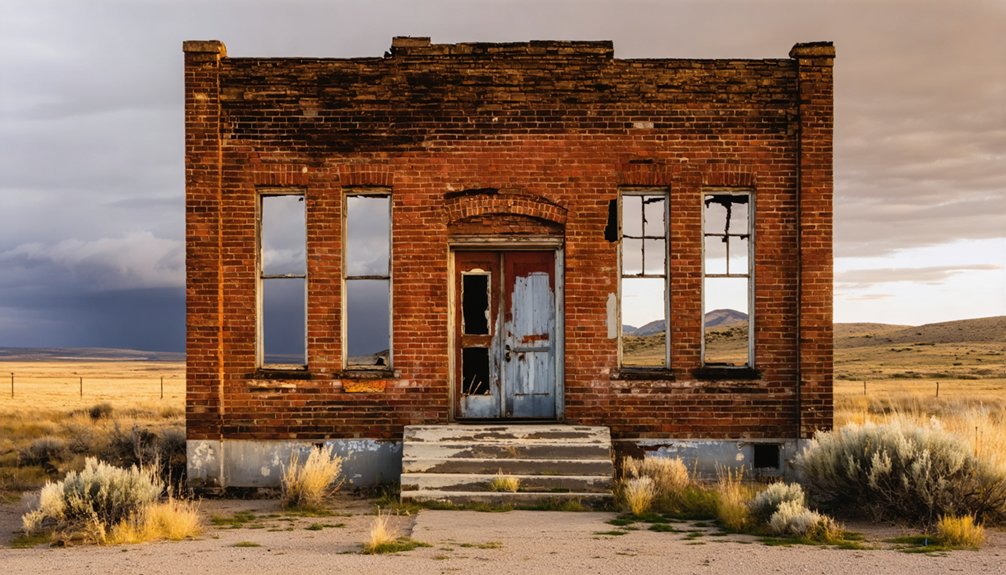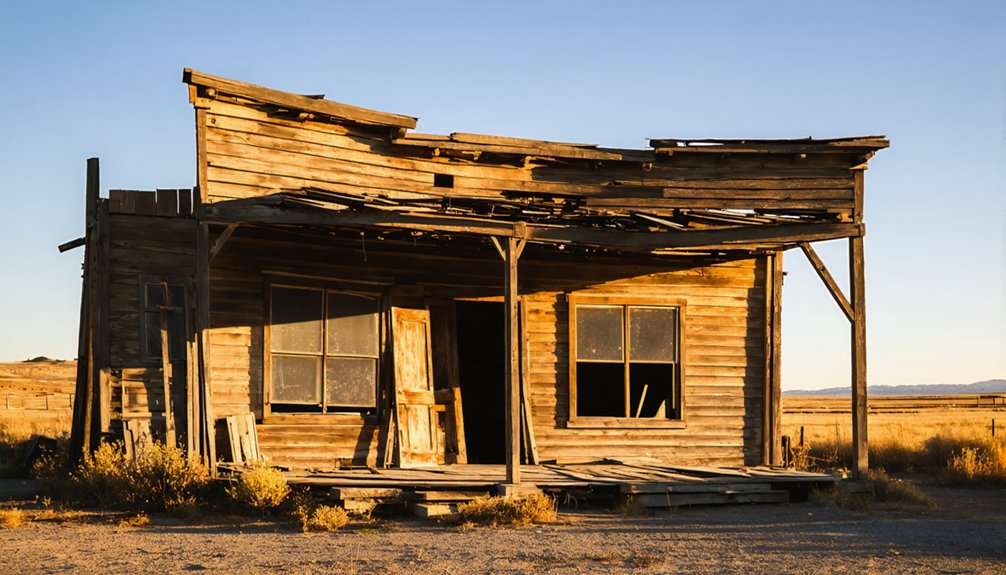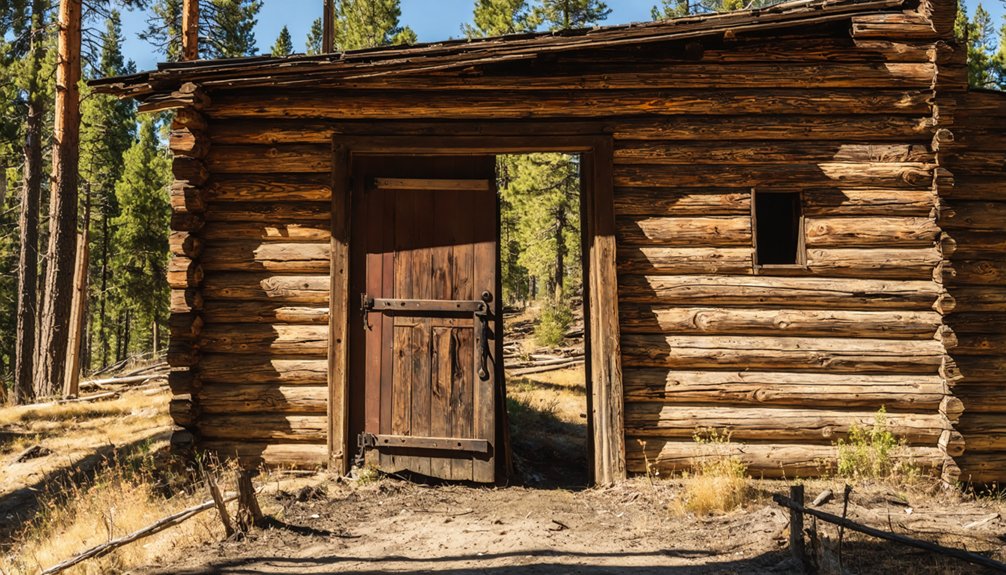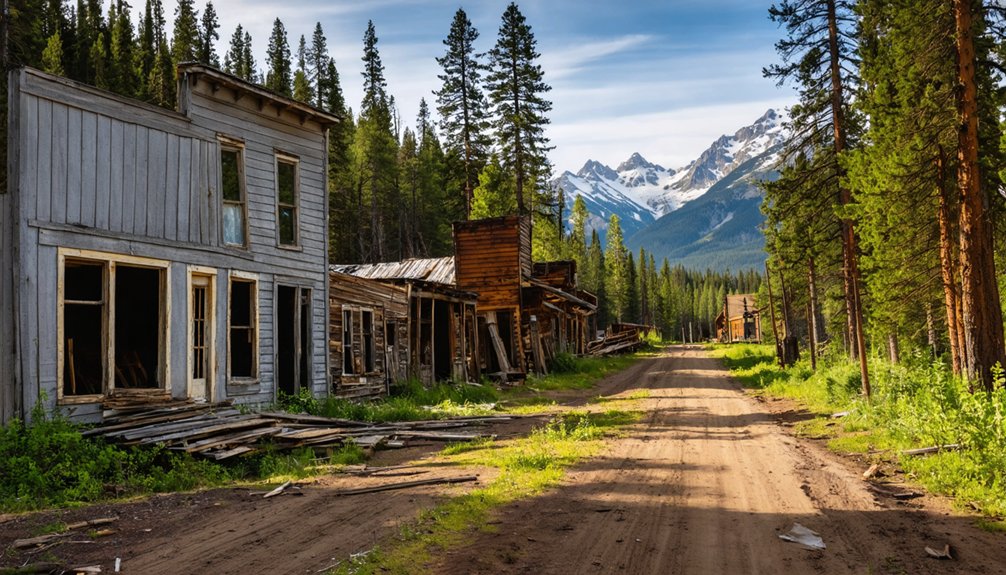
You’ll find Northern Idaho’s most fascinating ghost towns clustered in the Coeur d’Alene Mining District, where A.J. Prichard’s 1882 gold discovery sparked settlements like Eagle City and Murray, which briefly housed 2,000 residents with 44 saloons. Burke’s silver boom created a town so narrow that railroad tracks ran through hotel lobbies before a 1923 fire destroyed it. Further south, Elk City’s 1861 gold strike attracted over 2,000 prospectors who extracted $3.4 million by 1867. These abandoned sites reveal the complete arc of Idaho’s mining legacy.
Key Takeaways
- Burke evolved from a chaotic 1884 mining boomtown to a ghost town after environmental degradation and a devastating 1923 fire.
- Murray, established after an 1878-1882 gold rush, retains Idaho’s oldest operating Masonic Hall but lost its boomtown status.
- Eagle City and Pritchard Settlement emerged from 1882 gold discoveries but completely disappeared by the early 20th century.
- Elk City began with an 1861 gold strike extracting $3.4 million, transitioning from placer to hard-rock mining operations.
- The Coeur d’Alene Mining District features abandoned sites including Burke Canyon, now among America’s most contaminated mining areas.
Burke: Silver Mining Legacy in a Narrow Canyon
When prospectors discovered lead-silver-zinc ore in Burke on May 2, 1884, they couldn’t have anticipated the chaotic mining town that would emerge in this impossibly narrow canyon.
Burke’s discovery in 1884 sparked an unlikely boomtown crammed into a canyon too narrow for the chaos that followed.
Within three years, Burke exploded into a boomtown where railroad tracks ran through hotel lobbies and buildings literally spanned the creek. Burke history reflects both extraordinary mineral wealth and desperate spatial constraints in a canyon barely one hundred yards wide.
Mining techniques evolved from hand sorting and stamp mills to more sophisticated operations at the Hercules Mine, though recovery rates never exceeded 75% efficiency.
This left concentrated lead, arsenic, and zinc tailings dumped directly into Canyon Creek. Downstream farmers filed lawsuits beginning in 1903, claiming crop destruction and poisoning of farm animals from mine waste pollution. The 1923 fire destroyed over fifty businesses, but environmental degradation from deforestation and tailings ultimately sealed Burke’s fate. Today, ongoing restoration efforts in Burke Canyon work to preserve both the area’s natural beauty and its historical significance.
Murray: A Living Remnant of Idaho’s Mining Heritage
While Burke’s miners chased silver in a canyon that could barely contain their ambitions, prospectors working the creeks forty miles northeast struck an entirely different kind of fortune.
You’ll find Murray’s history rooted in A.J. Prichard’s gold discovery on Prichard Creek between 1878-1882. News sparked a gold rush that drew over 10,000 fortune-seekers to Idaho’s panhandle by 1883.
The town you’re exploring became Shoshone County’s seat in 1885, boasting 44 bars serving 2,000 residents who’d staked their claims on freedom and opportunity.
Though placer deposits played out quickly, Murray’s legacy persisted through hard-rock operations and later dredging that extracted over $6 million in precious metals. Rich deposits along Prichard and Eagle Creeks drew 5,000 miners during the harsh winter of 1883/84, transforming the wilderness into a bustling mining district.
Today, you’ll discover the region’s oldest surviving mining town, where territorial-era buildings stand as unvarnished monuments to those who refused conventional paths. The Masonic Hall has operated continuously since 1886, making it the oldest running Masonic Hall in Idaho.
Eagle City and Pritchard: Remote Mining Settlements
Though Eagle City‘s name has vanished from modern maps, its brief existence illuminates the raw desperation that drove prospectors into Idaho’s most forbidding terrain. Following A.J. Pritchard’s 1882 gold discovery, the 1884 rush transformed these remote mountains into bustling camps where fortune-seekers battled winter storms and impossible geography.
You’ll find Eagle City’s legacy documented through:
- 200 ounces of gold shipped to Helena from these isolated diggings
- Trail construction to Trout Creek’s railroad terminus
- Wyatt Earp’s reported involvement in road development
- Complete disappearance by the 20th century
The Pritchard Settlement shared Eagle City’s brutal conditions and ultimate fate. Wyatt Earp and his brother Jim established the White Elephant Saloon in a circus tent, providing entertainment and whiskey to the camp’s thirsty miners. Tom Gaumer’s 2006 expedition found nothing—no trails, no markers.
Modern homes now sprawl where miners once clawed wealth from unforgiving stone. Like the agricultural settlements in southern Idaho’s Eagle, these mining camps relied on determination and community spirit to survive the harsh frontier conditions.
Elk City: Gateway to Northern Idaho’s Gold Country
Unlike the ephemeral camps that vanished into Idaho’s wilderness, Elk City’s May 14, 1861 gold strike along Newsome Creek launched a settlement that would anchor northern Idaho’s mining frontier for generations.
You’ll find Elk City history rooted in determination—over 2,000 prospectors arrived by fall 1861, extracting $3.4 million in gold by 1867.
Gold mining techniques evolved from placer operations using hydraulic giants and sluices to hard-rock tunneling in the 1890s.
Elk City’s miners transformed their methods across decades, shifting from surface placer techniques to deep underground hard-rock extraction by the 1890s.
When Robert White’s 1930s Gold Point operation built a steam-powered stamp mill, it represented mining’s final gasp before timber dominated for six decades.
The mill’s construction utilized gravity flow processing, with ore moving downward through crushers and shaker tables on the mountainside.
Chinese miners continued working the abandoned claims after white prospectors departed by 1872.
Today you’re free to explore this gateway settlement along the Gold Rush Loop Tour, where the wilderness that once concealed fortune now invites discovery.
Exploring the Coeur D’alene Mining District’s Abandoned Sites
When Andrew Pritchard discovered gold in 1882, he transformed the Coeur d’Alene region from uncharted wilderness into Idaho’s most volatile mining district.
Eagle City emerged first, though silver strikes soon shifted focus to Burke Canyon’s narrow reaches. You’ll find remnants of communities that housed thousands before disaster and decline emptied them. Wyatt Earp briefly operated the White Elephant Saloon in Eagle City during the 1884 gold rush before the town’s rapid decline.
The district’s legacy includes:
- Eagle City’s contested mining claims where Pritchard’s extensive filings sparked legal battles over rights
- Burke’s architectural oddities like the Tiger Hotel, demolished in 1954 after the devastating 1923 fire
- Violent labor disputes requiring martial law in 1892 and armed confrontations in 1899
- Environmental devastation leaving the canyon among America’s most contaminated mining sites
Today, roughly 300 residents inhabit canyons once teeming with fortune-seekers and revolutionaries. The last mine closed in Burke in 1991, marking the end of over a century of mining operations in the canyon.
Frequently Asked Questions
What Permits or Permissions Are Needed to Visit Northern Idaho Ghost Towns?
You don’t need special permits for northern Idaho ghost towns, but you’ll respect private property boundaries and active mining claims. Their historical significance remains preserved when you follow pack-it-in, pack-it-out principles on public lands.
Exploring Idaho’s historic ghost towns can reveal fascinating stories and remnants of the past, making it a captivating adventure for history enthusiasts and curious travelers alike. As you wander through these abandoned sites, take time to appreciate the unique architecture and the tales the landscape holds. Each town has its own character, inviting you to imagine life in a different era while being mindful of the environment.
In addition to ghost towns, there are numerous abandoned places in Idaho that offer glimpses into the state’s rich history. From old mining settlements to deserted homesteads, each location presents a unique story waiting to be uncovered. Visiting these forgotten sites allows you to connect with the past while enjoying the serene natural beauty that surrounds them.
Are There Guided Tours Available for Exploring These Abandoned Mining Sites?
Yes, you’ll find guided exploration at Sierra Silver Mine with retired miners and Burke’s summer trolley service. Tour companies also offer river-based access to Shoup’s gold mines, while Bayhorse and Nicholia remain self-guided.
What Safety Precautions Should Visitors Take When Exploring Ghost Towns?
Don’t let adventure blind you to danger—wear sturdy boots and carry detailed maps as essential safety gear. Maintain wildlife awareness for rattlesnakes, avoid entering unstable structures, and never touch contaminated soil or mining artifacts.
Can Artifacts or Items Be Legally Collected From These Historic Sites?
You can’t legally collect artifacts from these sites. Federal and state laws protect ghost town remnants for artifact preservation. Removing items carries serious legal ramifications, including fines and prosecution, regardless of perceived abandonment or remoteness.
Exploring unique abandoned towns in Idaho can be an incredible way to experience history, but it’s essential to approach these locations with respect. Each site tells a story of the past, rich with culture and the remnants of those who once inhabited these areas. Visitors should focus on appreciating the preservation of these towns, keeping in mind their significance and the laws designed to protect them.
exploring ghost towns near Stanley Idaho offers a glimpse into the lives of pioneers and the challenges they faced. As you wander the crumbling structures and overgrown pathways, you can almost hear the echoes of the past. Be sure to bring your camera to capture the haunting beauty and intriguing details of these forgotten places.
What Is the Best Time of Year to Visit Northern Idaho Ghost Towns?
Summer’s your best season for visiting northern Idaho ghost towns, offering peak visitation from Memorial Day through September. You’ll find open shops, navigable gravel roads, and unrestricted access to historic structures without snow-machine requirements or weather limitations.
Exploring the ghost towns in Idaho’s wilderness reveals the fascinating remnants of a bygone era, with beautiful landscapes serving as a backdrop to intriguing stories. Many of these towns have rustic charm, inviting visitors to imagine the lives once lived amid the rugged terrain. Don’t forget to bring your camera; the scenic views are as hauntingly beautiful as the abandoned buildings they surround.
In addition to the ghost towns, there are many abandoned sites near Boise Idaho that offer unique exploration opportunities. These forgotten locations provide a glimpse into the region’s historical fabric, where each structure tells a story of its own. As you delve into these remnants, you’ll find remnants of past innovations and lifestyles, waiting to be rediscovered amidst the Idaho landscapes.
References
- https://idaho-forged.com/idahos-ghost-towns-eerie-yet-approachable/
- https://history.idaho.gov/wp-content/uploads/2018/08/0064.pdf
- https://www.atlasobscura.com/places/burke-ghost-town
- https://visitidaho.org/things-to-do/ghost-towns-mining-history/
- https://cdabasin.idaho.gov/the-dirt-mining-in-burke-canyon/
- https://visitnorthidaho.com/activity/burke-canyon/
- https://westernmininghistory.com/towns/idaho/burke/
- https://www.americanheritage.com/shoot-out-burke-canyon
- https://www.youtube.com/watch?v=Au2IYj9jA00
- https://shoshone.idgenweb.org/photos/silver-valley-mining-pictures/