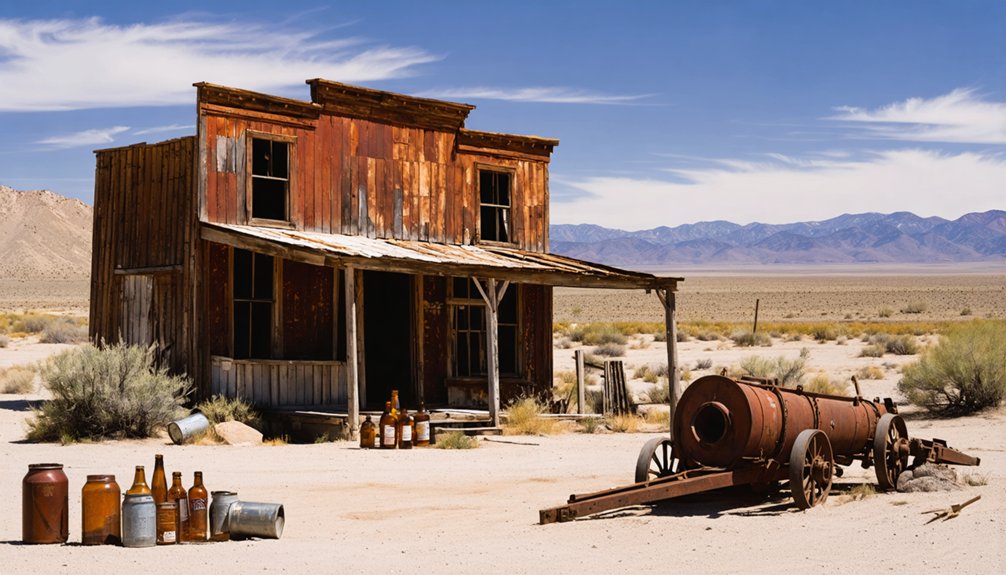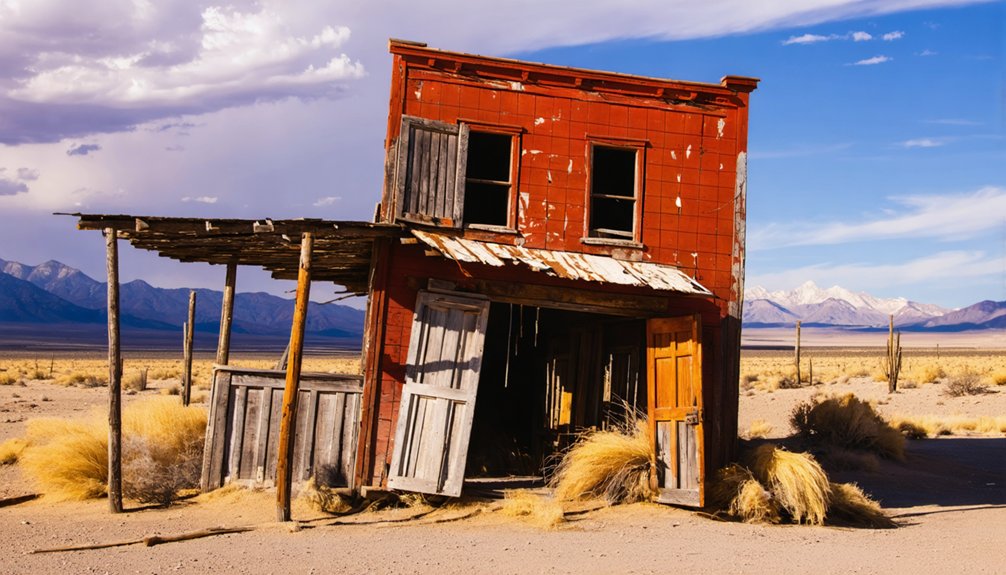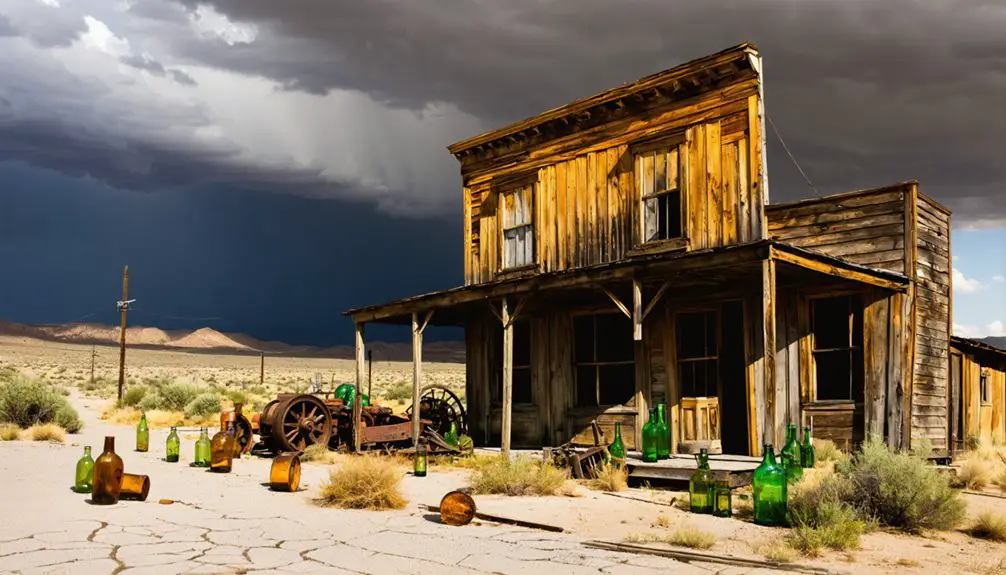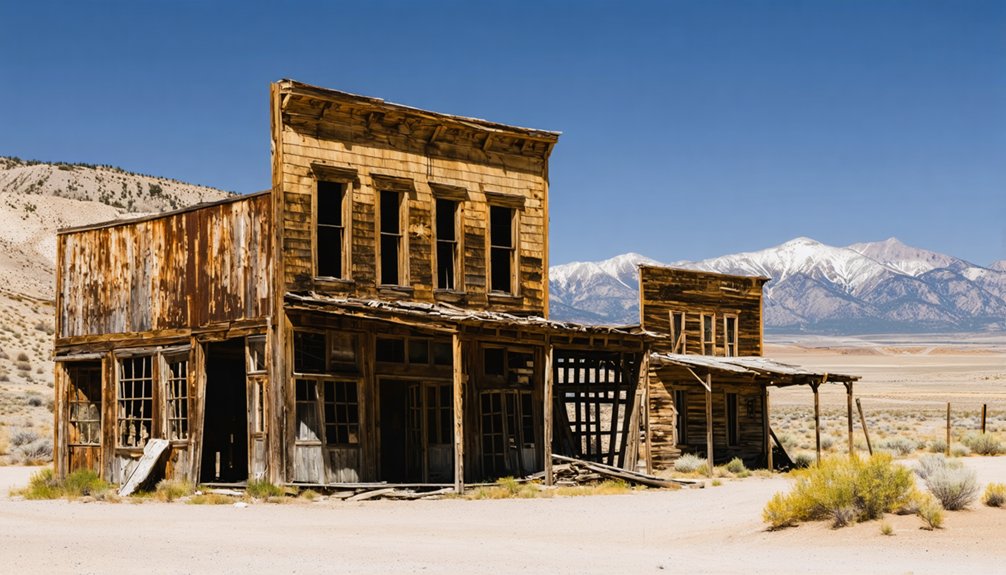
You’ll find dozens of abandoned settlements across northern Nevada’s high desert, remnants of the 1860s silver and gold rush that transformed remote valleys into thriving communities. Towns like Belmont, which housed 2,000 residents at its peak, and Humboldt City with its 200 buildings now stand silent, their populations vanished when ore veins dried up. The arid climate has preserved remarkable structures—from Fort Churchill’s adobe walls to Rhyolite’s ingenious Bottle House—while sites like Goldfield’s Paste Eater’s Grave add eerie intrigue to your exploration of Nevada’s haunted mining legacy.
Key Takeaways
- Northern Nevada’s ghost towns emerged from 1860s silver and gold rushes, with towns like Humboldt City, Belmont, and Pine Grove once thriving.
- Most towns were abandoned due to mine exhaustion, economic crashes, silver demonetization, natural disasters, and water scarcity issues.
- Architectural remnants include Fort Churchill’s adobe walls, Belmont’s courthouse, Pine Grove’s wooden structures, and Rhyolite’s unique Bottle House.
- Notable sites feature supernatural legends, ancient petroglyphs near Pyramid Lake, and unusual landmarks like Goldfield’s Paste Eater’s Grave.
- Use NBMG’s Nevada Ghost Towns and Desert Atlas for navigation; Fort Churchill and Berlin are within three hours of Reno.
Historic Boomtowns and Their Rise to Prominence
When silver and gold fever swept through northern Nevada in the mid-1800s, remote desert valleys transformed into bustling communities almost overnight.
You’ll find Humboldt City led the charge in 1861, with prospectors establishing a picturesque village that soon boasted 200 buildings and well-stocked stores serving 500 residents.
Mining operations drove the settlement dynamics as Belmont’s 1865 silver strike sustained 2,000 people through two decades of prosperity—unusual longevity for that era.
Pine Grove emerged in 1866 as a critical supply center supporting 600 residents across the surrounding region.
By 1907, Midas appeared between Elko and Winnemucca, though postal authorities rejected its original “Gold Circle” name.
Fort Churchill was established by the U.S. government in 1860 following the Pyramid Lake War to protect settlers and secure vital Pony Express routes through the territory.
These boomtowns attracted entrepreneurs and settlers seeking fortune during the peak of Nevada’s mining economy.
Each town represented your ancestors’ determination to forge independence from Nevada’s unforgiving landscape.
What Caused These Settlements to Be Abandoned
The very forces that built northern Nevada’s boomtowns ultimately guaranteed their demise. When mines exhausted their gold and silver, you’d witness entire populations vanish—90% of Nevada’s ghost towns collapsed from mining decline impacts.
When the precious metals ran dry, thriving mining towns became empty shells within months—prosperity’s foundation became its death sentence.
Economic downturn causes struck hard: the 1907 financial panic devastated Rhyolite, while silver’s demonetization crushed Pine Grove in the 1930s. The 1942 gold mine closure order accelerated Midas’s abandonment.
Nature delivered brutal blows too—flash floods wiped out Mazuma and Johntown, killing residents and washing entire safes down canyons. Fire destroyed Rockland’s mill in 1871. Austin, established in 1862, peaked in the late 1860s before entering its long decline.
Even water scarcity plagued settlements like Johnnie, where you’d haul water four miles by donkey. Mill shutdowns proved equally catastrophic, as ore processing mills not only refined minerals but generated the electricity that powered entire communities. These harsh realities transformed thriving communities into silent monuments to freedom’s price.
Preserved Buildings and Architectural Remnants
Across northern Nevada’s desolate valleys, you’ll find architectural survivors that reveal how settlers built their dreams from whatever materials the harsh landscape offered.
At Fort Churchill, adobe walls stand firm thanks to the arid climate’s natural preservation techniques. Pine Grove’s wooden barns and houses showcase frontier supply center architectural styles from the 1860s. Humboldt City’s stone foundations mark where 200 buildings once thrived, while Belmont’s courthouse demonstrates formal territorial architecture alongside rough-hewn miners’ cabins.
Tunnel Camp’s brick office building represents later industrial-era construction from 1927. You’re free to explore these structures at your own pace—no guided tours required at most sites. Candelaria preserves its original Wells Fargo building alongside a stone mercantile with storm windows still intact. At Sand Pass, buildings have recently been demolished where the Western Pacific Railroad once maintained its station.
The dry climate has become Nevada’s greatest preservationist, protecting these remnants without bureaucratic intervention.
Unique Landmarks and Supernatural Stories
Beyond the crumbling walls and weathered foundations, northern Nevada’s ghost towns harbor peculiar graves and paranormal tales that attract adventurers seeking more than architectural relics.
You’ll discover these distinctive landmarks throughout the region:
- Goldfield’s Paste Eater’s Grave – A pioneer plot memorial to a homeless person who died from eating glue during starvation, relocated by midnight workers they called “Official Ghouls.” The Goldfield Historic Cemetery also features veterans and Serbian plots alongside sections designated for Firemen and Freemasons.
- Rhyolite’s Empty Grave – A well-visited site of a murdered prostitute that never actually contained a burial, though supernatural sightings haven’t materialized despite investigations.
- Pyramid Lake’s Ancient Petroglyphs – North America’s oldest rock art (10,500-14,800 years old) near the Paiute Stone Mother formation, both tied to local legends.
- Belmont’s Haunted Circuit – Multiple sites including Washoe Club and Gold Hill Hotel feature Wednesday-Sunday ghost tours.
- Rhyolite’s Bottle House – A structure constructed by Tom Kelly using bottles as bricks, standing as a testament to the ingenuity of early mining town residents.
Planning Your Visit to Northern Nevada’s Ghost Towns
Planning your adventure through northern Nevada’s abandoned settlements requires more than just throwing a pin on a map—you’ll need reliable resources, proper vehicle preparation, and realistic time expectations.
Start your trip preparations with NBMG’s Nevada Ghost Towns and Desert Atlas, featuring 71 color maps covering 725 ghost towns, emigrant trails, and recreation areas. Most vehicles handle county roads like White Pine’s CR-5 to Vernon, but skip Google Maps’ wild routing suggestions.
Essential travel tips: note that mapped coordinates serve visual planning purposes, Fort Churchill and Berlin sit within three hours of Reno for day trips, and Elko-area towns like Metropolis and Tuscarora offer both self-guided routes and organized tours along historic Pony Express and California Trail corridors. The atlas includes 552 photographs of historic sites to help you identify locations and understand what to expect when you arrive. For a comprehensive overview, explore the alphabetical list of ghost towns to research specific destinations before your journey.
Frequently Asked Questions
Are Ghost Town Artifacts Legal to Remove or Collect?
Absolutely not—you’ll face serious legal consequences if you pocket even a rusty nail. Federal and state laws rigorously protect artifact preservation at these sites. Trail cameras and volunteers actively monitor locations, so don’t risk it.
Which Northern Nevada Ghost Towns Require Four-Wheel Drive Vehicles?
You’ll need four-wheel drive for off-road adventures to Jarbidge, requiring 47 miles over Bear Creek Pass. Gold Bar demands 4WD engagement through challenging terrain, while Delamar accommodates high-clearance vehicles for authentic four-wheel exploration.
Can Visitors Camp Overnight at These Abandoned Mining Settlements?
You can camp overnight at most abandoned mining settlements on BLM land without overnight permits. Dispersed camping follows standard 14-day limits and camping regulations requiring Leave No Trace practices. State parks like Berlin-Ichthyosaur offer developed sites.
What Safety Hazards Exist When Exploring Old Mining Structures?
You’ll face collapsing timbers with compromised structural integrity, hidden vertical shafts, unstable explosives from past operations, hazardous materials including toxic chemicals, rattlesnakes in cool tunnels, oxygen-depleted air, and rusty debris creating serious injury risks.
Are Guided Tours Available for Northern Nevada Ghost Towns?
You’ll find guided exploration throughout Northern Nevada’s ghost towns, from ranger-led Berlin tours showcasing historical significance to Carson City’s walking experiences. Multi-day packages connect Belmont, Tuscarora, and Elko County’s copper mines independently.
References
- https://en.wikipedia.org/wiki/List_of_ghost_towns_in_Nevada
- https://nvtami.com/top-10-ghost-towns-nevada-northwest/
- https://www.visittheusa.com/experience/6-nevada-ghost-towns-explore-if-you-dare
- https://travelnevada.com/ghost-town/ghost-towns-near-reno/
- https://www.atlasobscura.com/things-to-do/nevada/ghost-towns
- https://www.youtube.com/watch?v=eMc3JzSbD6k
- https://nvtami.com
- https://travelnevada.com/ghost-town/
- https://www.smithsonianmag.com/sponsored/nevadas-living-and-abandoned-ghost-towns-180983342/
- https://cowboycountry.com/ghost-towns/