You’ll find Northern New Mexico’s ghost towns scattered across high desert landscapes, each preserving distinct mining legacies. White Oaks near Carrizozo produced $20 million in gold but died without rail access, while Mogollon extracted 18 million ounces of silver before closing in 1952. Dawson’s cemetery stands as a haunting memorial to 386 miners lost in two catastrophic accidents. Chloride maintains twenty-seven original structures along its preserved main street, and ancient turquoise mines at Mount Chalchihuitl date to A.D. 900. Understanding each site’s unique story reveals the complex timeline of frontier survival.
Key Takeaways
- White Oaks reached 4,000 residents by the 1880s, producing $20 million in gold before declining due to lack of rail access.
- Mogollon housed 2,000 residents by 1909, extracting 18 million ounces of silver until the Little Fannie mine closed in 1952.
- Elizabethtown features preserved 1860s-era landmarks including crumbling saloons, accessible via State Road 14’s Central Trail with downloadable maps.
- Chloride maintains twenty-seven original structures along Wall and Main Streets, including the 1880 Pioneer Store sealed with intact inventory since 1923.
- Dawson grew to 9,000 residents before closing in 1950; only the cemetery remains after two catastrophic mining accidents killed 386 workers.
Mogollon: Silver Mining Legacy in the Gila Mountains
Deep in the Gila Mountains, where Silver Creek cuts through rugged canyon walls, James Cooney struck rich silver-copper ores in August 1875 that would transform this remote Apache territory into one of New Mexico’s most productive mining districts.
By 1889, prospectors had established permanent settlements, with John Eberle building Mogollon’s first cabin as mines proliferated along the creek.
The town’s Mogollon Heritage represents authentic frontier grit—2,000 residents by 1909 supported five saloons, brothels, and a $75,000 monthly payroll.
Mining Innovations enabled extraction of 18 million ounces of silver, comprising 25% of New Mexico’s total production. The Little Fannie mine alone operated from the 1880s until 1952. Daily stagecoach service between Mogollon and Silver City facilitated transport of bullion and goods, sustaining the town’s economy.
E. A. Wayne consolidated mining operations in 1910, merging the Top Mine and Last Chance Mine into the Ernestine Mining Co., which drove the district’s peak production years.
Today, you’ll find weathered wooden buildings, seasonal museums, and mining sites—testaments to those who carved wealth from unforgiving stone.
Dawson: A Haunting Memorial to Coal Mining Tragedy
Where rancher John Barkley Dawson sold coal-rich land to the Dawson Fuel Company in 1901, seventeen miles northeast of Cimarron in Colfax County, a company town emerged that would become New Mexico’s most productive coal mining operation—and its deadliest.
The immigrant workforce of Italian, Greek, and Hispanic miners built a community of 9,000 before catastrophe struck twice.
On October 22, 1913, a violation of mining safety protocols killed 263 in Stag Canyon Mine No. 2.
Ten years later, 123 died when a derailed car ignited coal dust in a mine with a disabled sprinkler system.
The town operated until 1950, when Phelps Dodge Corporation closed the mines and gave residents three months to relocate.
The settlement bore the rancher’s name, commemorating the landowner who initiated its development.
Today, only Dawson Cemetery remains—rows of white iron crosses marking where freedom-seeking immigrants found tragedy instead of prosperity.
White Oaks: Golden Era Preserved Near Carrizozo
In 1879, when prospectors John Wilson, Jack Winters, and George Baxter discovered gold deposits in the Jicarilla Mountains twelve miles northeast of present-day Carrizozo, they triggered one of New Mexico Territory’s most significant mining booms.
You’ll find White Oaks rose swiftly from tent city to territorial powerhouse, reaching 4,000 residents by the early 1880s—second only to Santa Fe. The North Homestake, South Homestake, and Old Abe mines produced $20 million in gold, with Old Abe alone processing 50 tons daily.
White Oaks’ mining prosperity supported 50 businesses, including four newspapers and an opera house. The town became a refuge for outlaws after the Lincoln County War, with Billy the Kid and his associates frequently visiting the West & Dedrick livery stable and Pioneer saloon. Among the town’s notable residents was Susan McSween, who transformed herself into one of the area’s wealthiest cattle ranchers after fleeing Lincoln County, eventually accumulating over 1,158 acres and 5,000 head of cattle.
However, territorial officials demanded excessive land prices, causing railroads to bypass the town entirely. Without rail access, exhausted deposits sealed White Oaks’ fate, reducing population to 200 by 1910.
Loma Parda: From Sodom on the Mora to Silent Ruins
You’ll find few places that embraced vice activities so openly. Brothels, saloons, and dance halls lined the streets where crime ran unchecked.
The local priest abandoned his post, and newspaper accounts documented kidnappings and shootouts through the 1880s and 1890s. In one notorious incident, a chicken fight in 1878 resulted in four deaths and nine injuries.
When Fort Union closed in 1889, Loma Parda vanished as quickly as it appeared.
Today, this ghost town near Mora offers explorable ruins—crumbling walls marking where New Mexico’s most notorious sin city once thrived. A footbridge over the Mora River leads to the remains of an adobe church that still stands among the ruins.
Among these ghost towns to explore in New Mexico, each location tells a unique story of the past, drawing in history enthusiasts and adventurers alike. From the eerie silence of desolate streets to the haunting beauty of dilapidated buildings, they create a captivating atmosphere that invites exploration. Visitors can immerse themselves in the rich tales of those who once called these towns home, uncovering the mysteries hidden within their crumbling facades.
Chloride: Tales of Silver Strikes and Frontier Justice
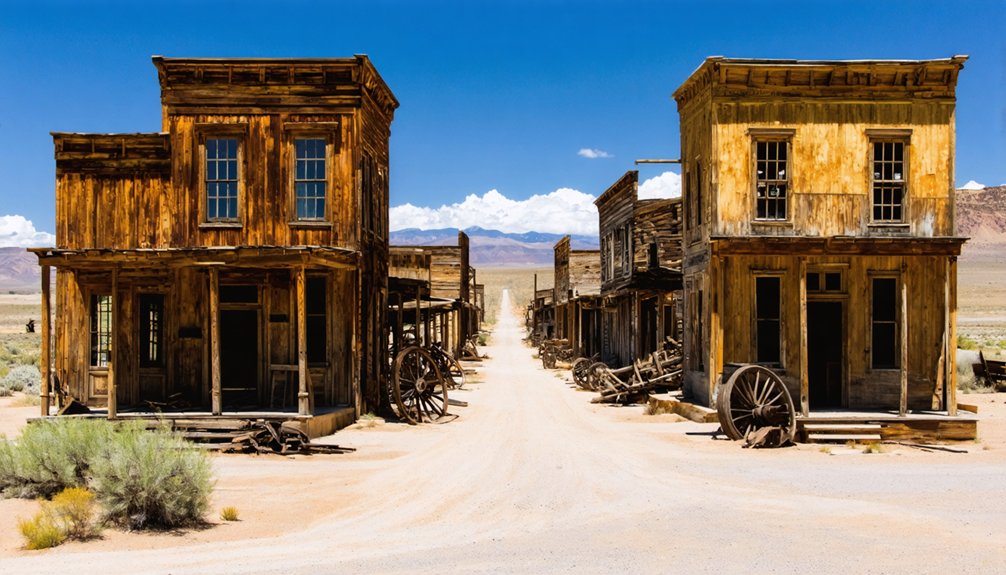
When you descend into the Black Range Mountains canyon where Harry Pye discovered high-grade chloride ore in 1879, you’ll find twenty-seven original buildings that witnessed both Apache raids and frontier violence during Chloride’s explosive growth to 3,000 residents by 1883.
The town’s forty-two working mines produced $500,000 in silver before the 1896 gold standard crashed prices from $1.81 to eighteen cents per ounce, emptying the streets faster than Victorio’s warriors ever could.
Today you can walk the preserved main street where Don Edmund’s restoration work since 1986 has transformed the Pioneer Store into a museum and the Monte Cristo Saloon into an artist co-op, keeping alive the rough justice and raw ambition that defined this Apache Mining District headquarters. The Pioneer Store museum opens Thursdays through Mondays, displaying artifacts left fully stocked when the building was abandoned in 1923. The 200-year-old Hangin Tree still stands as a grim reminder of frontier justice that kept the mining camp relatively peaceful.
Harry Pye’s 1879 Discovery
Somewhere between the freight wagons of Hillsboro and the military outpost at Camp Ojo Caliente, Englishman Harry Pye made the discovery that would transform a remote canyon in the Black Range Mountains into one of New Mexico Territory’s most significant silver camps.
While hiding from Apaches in a gulch during his 1879 freighting run, Pye spotted a rich vein of high-grade silver chloride. He kept the Silver Discovery quiet until his Army contract expired, then returned to stake the Pye Lode claim with partners Forbes and Elliot.
He built the canyon’s first log cabin and dug ten feet into the mountain.
Pye’s Legacy ended abruptly when Victorio’s warriors killed him south of town—his jammed pistol useless. The discovery he died protecting sparked the rush that created Chloride.
Violent Frontier Town History
The boom that followed Harry Pye’s discovery brought more than miners and merchants to Chloride—it released the violence that marked nearly every silver camp in the Territory.
By 1883, you’d find 3,000 souls crowded into a settlement where frontier justice often trumped written law. The rapid silver strikes that created instant wealth also bred desperate men willing to kill for a claim or a card game gone wrong.
Violence shaped daily life in ways the Eastern newspapers rarely captured:
- Nine saloons fueled disputes that spilled into Main Street shootouts
- Mining claim jumpers faced vigilante retribution beyond legal proceedings
- The red light district generated regular brawls requiring armed intervention
- Professional gamblers settled disagreements with revolvers, not referees
This wasn’t romanticized lawlessness—it was survival in raw form.
Preserved Main Street Buildings
Today’s Chloride preserves twenty-seven original structures along Wall Street and Main Street—weathered false-fronts and thick-walled adobes that survived where hundreds of neighboring buildings succumbed to gravity and time.
You’ll find the 1880 Pioneer Store sealed in 1923 with its inventory intact, later restored and listed on New Mexico’s State Register of Cultural Properties—a reflection of serious historic preservation efforts.
Don and Dona Edmund rescued thirteen buildings since 1985, maintaining their architectural significance while transforming them into functional spaces. The Monte Cristo Saloon now houses local artists, while the 1880 Judge’s adobe operates as a woodworking shop.
You can explore independently with sketch maps from the Pioneer Store, discovering Cassie Hobbs’ Doodle Dum workshop and Henry Pi’s cabin—structures earning their cultural property designations through authentic frontier character.
Golden: Ancient Turquoise Mining and Spanish Gold Rush
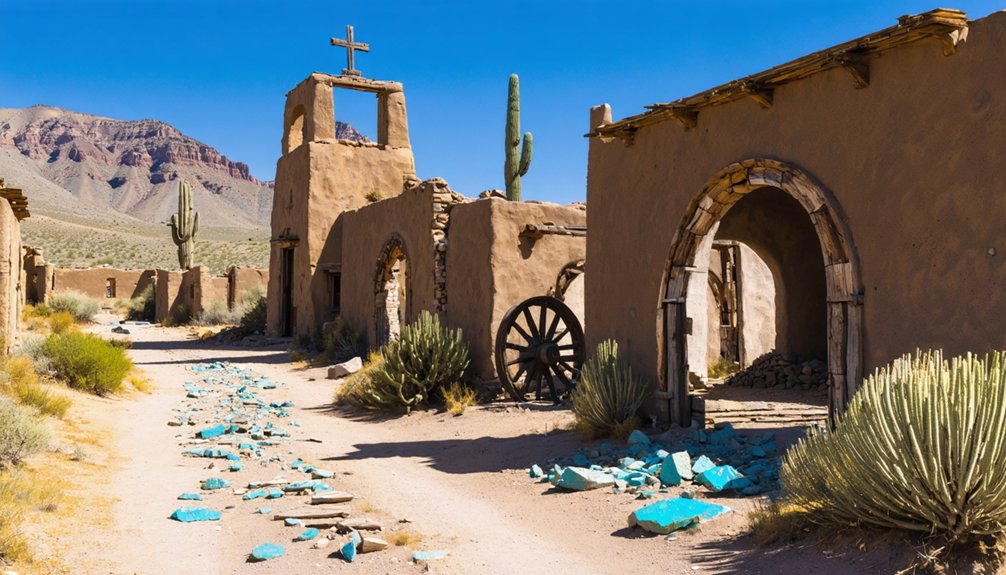
Long before Spanish conquistadors dreamed of golden cities, Puebloan miners were extracting turquoise from Mount Chalchihuitl and Turquoise Hill as early as A.D. 900, creating what would become North America’s largest known prehistoric turquoise operation.
You’ll find evidence of their ingenious methods—stone hammers and fire-cracking—throughout these ancient diggings.
The turquoise trade stretched across the Southwest into Canada and Mexico until San Marcos Pueblo controlled the deposits after 1300 A.D.
Spanish exploitation followed Coronado’s 1541 visit, when he sent specimens to Spain’s crown jewels:
- Francisco Coronado shipped Cerrillos turquoise to Spanish royalty in 1541
- Spanish colonists possibly used Indian slave labor in 17th-18th centuries
- Tiffany & Co. promoted Cerrillos stones, inspiring their iconic Tiffany Blue
- 1825 placer gold discovery sparked the first gold rush west of the Mississippi
Planning Your Northern New Mexico Ghost Town Adventure
Before you set out to explore these weathered settlements scattered across Northern New Mexico’s high desert and mountain valleys, you’ll need to prepare for backcountry conditions that challenge even experienced travelers.
Download the printable PDF map from Earth Data Analysis Center—it’ll guide you through ghost town itineraries along State Road 14’s Central Trail, including Cerrillos (28 miles south of Santa Fe), Madrid, and Hagan.
Exploring the ghost towns of New Mexico offers a glimpse into the region’s rich history and cultural heritage. Visitors can experience the remnants of mining towns, each with its own unique story and character. Don’t forget to stop by local shops and galleries that celebrate the artistry inspired by these haunting landscapes.
As you venture into ghost towns to explore in New Mexico, consider bringing along a camera to capture the stunning landscapes and historical architecture. Each site presents an opportunity to uncover intriguing tales of the past and engage with the local culture. Make sure to check local events, as some towns host festivals that celebrate their unique heritage and attract visitors year-round.
Check weather and road conditions beforehand; expect zero cell coverage in remote areas.
Elizabethtown sits 103 miles northeast in Moreno Valley, where 1860s-era historical landmarks like crumbling saloons still stand.
White Oaks near Carrizozo Peak rewards visitors with Victorian-era structures: the Gumm House, 1893 Hoyle Mansion, and Cedarvale Cemetery.
Respect posted signage and ask permission before entering private property.
Frequently Asked Questions
Are Ghost Town Visits in Northern New Mexico Safe for Families With Children?
Ghost town visits can be family-safe if you take proper safety precautions. Stick to exterior viewing, avoid crumbling structures, and pack essentials for remote areas. Lake Valley offers accessible family activities with maintained facilities year-round.
Exploring historic sites in New Mexico can add an educational twist to your adventure. Many sites provide guided tours that highlight the rich history and culture of the region. Engaging with local history can create memorable experiences for families and foster a deeper appreciation for the area.
What Photography Restrictions Exist When Visiting These Historic Ghost Town Sites?
You’ll find most sites allow personal photography freely, but commercial shoots need permission and aren’t permitted everywhere. Respect photography etiquette around private property, follow site regulations about drones, and never disturb artifacts while capturing history.
Can Visitors Legally Take Artifacts or Souvenirs From Abandoned Ghost Town Structures?
No, you can’t legally take artifacts from ghost town structures. Federal and state laws protect these sites, with artifact preservation requirements carrying serious legal implications including fines up to $100,000 and potential imprisonment for violations.
The haunting histories of New Mexico towns often serve as a reminder of the vibrant cultures that once thrived there. Exploring these areas allows visitors to connect with stories of resilience and transformation that have shaped the region. Preserving such sites ensures that future generations can continue to learn from these intriguing legacies.
Many of these abandoned towns in New Mexico showcase stunning examples of architecture from the past, providing a glimpse into the lives of those who once called these places home. As visitors wander through the remnants, they can imagine the bustling streets and vibrant communities that existed before time left them behind. The haunting beauty of these locations encourages a deeper appreciation for the history woven into the landscape.
Which Northern New Mexico Ghost Towns Offer Overnight Camping or Lodging Nearby?
Cerrillos offers nearby Santa Fe lodging just 28 miles north, while Lincoln provides camping in Lincoln National Forest boundaries. White Oaks features Harvest Host RV camping with owner-guided tours, giving you authentic overnight options near these historic mining towns.
Do Any Ghost Towns Require Entrance Fees or Guided Tours Only?
You’ll part with $10-$20 at Shakespeare’s entrance fees, while Lake Valley asks $3 per visitor. Mogollon offers guided tours most weekends—you’re free to explore independently at Glenrio’s roadside ruins anytime.
References
- https://newmexicotravelguy.com/new-mexico-ghost-towns/
- https://compaslife.com/blogs/journal/abandoned-enchantment-ghost-towns-of-new-mexico-1
- https://www.atlasobscura.com/things-to-do/new-mexico/ghost-towns
- https://santafe.com/new-mexico-road-trip-ghost-towns/
- https://www.tripadvisor.com/Attractions-g28952-Activities-c47-t14-New_Mexico.html
- https://www.newmexico.org/places-to-visit/ghost-towns/
- https://www.newmexicoghosttowns.net/counties
- https://en.wikipedia.org/wiki/List_of_ghost_towns_in_New_Mexico
- https://www.newmexicomagazine.org/blog/post/abandoned-ghost-towns-new-mexico/
- https://www.newmexico.org/places-to-visit/ghost-towns/map/