You’ll find Northern Utah’s ghost towns scattered across the Great Basin Desert and Tintic Mountains, where mining booms and railroad expansion once sustained thousands of residents. Eureka still maintains a small population near its historic silver mines, while Terrace’s cemetery marks where Chinese laborers built the transcontinental railroad in 1869. Cisco preserves its railroad heritage near the Colorado border, and Iosepa commemorates a unique Hawaiian LDS settlement from 1889. Each site offers distinct glimpses into Utah’s territorial past through surviving structures, cemeteries, and archaeological remains.
Key Takeaways
- Eureka, 70 miles southwest of Salt Lake City, features the Tintic Mining Museum and hosts the annual Tintic Silver Jubilee celebration.
- Terrace Ghost Town in Box Elder County served as a Central Pacific Railroad division point until its 1904 collapse.
- Frisco’s ruins and Horn Silver Mine remain prominent features in the Great Basin Desert’s abandoned mining settlements.
- Fort Willden and Schellbourne’s Pony Express station represent early Mormon outposts scattered across northern Utah’s desert landscape.
- Thistle collapsed in 1983 due to environmental challenges, serving as a modern reminder of settlement vulnerability in the region.
Eureka: a Semi-Ghost Town With Rich Mining History
When silver ore glinted in the Tintic Mountains in 1869, prospectors flooded into what would become one of Utah’s most productive mining districts.
You’ll find Eureka 70 miles southwest of Salt Lake City, where the “Big Four” mines once sustained over 5,000 residents. By 1922, Chief Consolidated became America’s largest silver producer, making this Utah’s ninth-largest city.
The mining legacy persists through downtown ruins, the Tintic Mining Museum, and miles of underground tunnels you can explore—though you’d better watch for toxic air and unstable shafts. The 1902 Elks Lodge building still stands as one of the oldest in the West, having served as a vital community gathering place throughout the town’s heyday.
Eureka’s abandoned mines and tunnels beckon adventurers, but crumbling passages and poisonous gases make exploration a potentially deadly pursuit.
Today’s semi-ghost town offers spectral sightings at the Gatley Building and Historic City Hall, earning National Register recognition in 1979 for its authentic Old West character. Every August, locals celebrate their heritage during the Tintic Silver Jubilee, bringing history to life with community festivities.
Cisco: Restored Railroad Stop Near the Colorado Border
You’ll find Cisco tucked in the remote desert of Grand County near the Colorado border, where it began in the 1880s as a watering stop for Denver and Rio Grande Western Railroad steam locomotives.
The town evolved through boom cycles of sheep ranching, oil and gas production, and uranium prospecting before Interstate 70‘s construction in the 1970s sealed its decline to just four residents by 2020.
During its peak years, Cisco served as a major center for the wool industry, processing up to 100,000 sheep annually for shearing operations.
The community’s population peaked around 200 residents in the 1940s when it functioned as Utah’s largest oil and natural gas producer.
Today, a seasonal storefront operated by a Grand Junction resident breathes intermittent life into this weathered railroad outpost, where surviving structures and railroad relics preserve its old west character amid ongoing preservation discussions.
Established in the 1880s
The settlement quickly evolved beyond its original purpose:
- Depot operations included a treatment plant pumping directly from the Colorado River to maintain consistent water supply for locomotives.
- Commercial development brought stores, hotels, and restaurants serving railroad workers, cattle ranchers, and sheep herders.
- Regional hub status emerged as Cisco became the primary provisioning and shipping center for livestock operations throughout the Book Cliffs area.
Rail hauled drinking water to cisterns supplying the growing community’s businesses and homes.
The town’s prosperity was also fueled by sheep farming and oil development.
The town was officially abandoned by the 1990s due to interstate development.
Art Residency Program Today
Despite Cisco’s remote location—where the population fluctuates between just 1-3 seasonal residents—artists have transformed this near-abandoned railroad stop into an unlikely cultural destination.
The Held Horizon Residency, relaunched by Kara Bard in October, offers 4-6 week stays in a restored 1923 log cabin and original post office. You’ll find WiFi and electricity but no running water—hauled in for the outdoor shower overlooking La Sal Mountains and woodfired bath.
This art residency evolved from the Home of the Brave Program, which operated until December under Eileen Muza’s decade-long stewardship. The property features unconventional amenities: a Möbius loop snake sculpture housing a skate ramp, retrofitted Winnebago studios, and found material archives. Artists receive regular updates about residency developments and creative opportunities throughout their stay.
Creative isolation here demands genuine bravery—you’re truly off-grid in Utah’s high desert. Muza purchased the entire town using personal savings, motivated by a desire for adventure and ownership of this unique space.
Single Resident Maintains Town
From its 1880s founding as a Denver and Rio Grande Western Railroad watering stop, Cisco evolved through successive boom-and-bust cycles that shaped Utah’s high desert frontier.
While only four residents remain according to 2020 census data, you’ll find dedicated town maintenance continuing through unexpected means.
Jean, a Grand Junction resident, embodies the single resident spirit by operating Buzzard’s Belly General Store daily from March through November:
- Daily 30-mile commute across the Colorado border seven days weekly
- Serves boaters launching at Cisco’s boat ramp for Westwater Canyon trips
- Reopened storefront in 2019 amid ghost town ruins, offering provisions to passersby
This commitment preserves Cisco’s functioning presence, maintaining one operational business where steam locomotives once stopped and oil derricks pumped.
The town’s decline accelerated with the construction of the nearby interstate, which redirected traffic away from the original railroad stop and reduced the flow of visitors who had sustained local businesses.
Cisco also hosts the Home of the Brave artist residency program, bringing creative energy to the historic settlement’s evolving story.
Ophir: Accessible Mining Settlement West of Lehi
Nestled in a quiet canyon on the west slope of the Oquirrh Mountains, Ophir emerged as one of northern Utah’s most accessible mining settlements after soldiers from Camp Douglas discovered rich lead and silver deposits there in 1870.
You’ll find this semi-ghost town west of Lehi, where downtown remnants preserve the mining era’s architectural heritage.
During its 1870s boom, Ophir mining operations attracted an estimated 6,000 residents who built substantial infrastructure—saloons, theaters, hotels, and two schools.
Production surged again from 1904, with zinc recovery beginning in 1911. Ghost town exploration here reveals preserved buildings including the original post office and a 1930s clubhouse with period furnishings.
Today, about twenty year-round residents maintain this once-thriving settlement, which disincorporated in 2016 after its remaining population couldn’t form a town government.
Terrace: Railroad Cemetery Near the Nevada Border
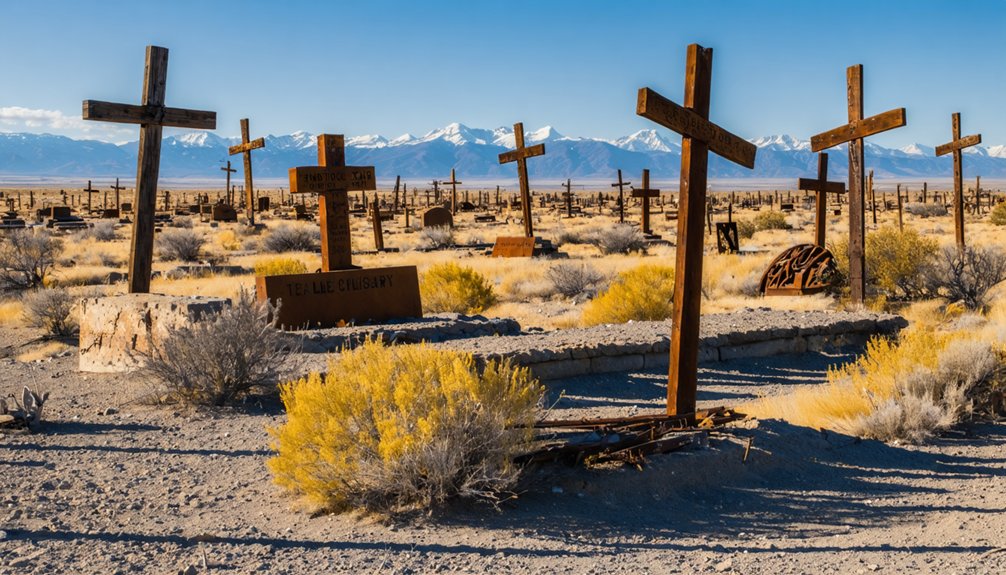
Steam engines once thundered through Terrace, a division point established in 1869 where the Central Pacific Railroad positioned critical maintenance facilities halfway between Ogden and the Nevada mining towns of Elko and Winnemucca.
Terrace served as a vital Central Pacific Railroad division point linking Ogden to Nevada’s mining frontier in 1869.
You’ll find this ghost town 35 miles from Nevada’s border in Box Elder County, where roundhouses serviced locomotives traversing the northern route around Great Salt Lake.
The allure of ghost towns in southern Utah is undeniable, with their remnants echoing stories of the past. Exploring these deserted places reveals fascinating artifacts and structures that tell of a once-thriving community. Each town has its own unique charm, drawing in adventurers and history buffs alike.
While many are drawn to the rich history of ghost towns, some seek to explore abandoned towns in Utah for their stunning landscapes and eerie beauty. The stark contrast of crumbling buildings against the picturesque backdrop of the canyon country provides a unique photographic opportunity. Venturing into these forgotten places often evokes a sense of wonder and nostalgia, as visitors imagine the lives once lived within those walls.
What remains at Terrace:
- Terrace Cemetery (41° 30.42′ N) near Wendover preserves burial grounds
- Archaeological sites investigated over two years reveal infrastructure details
- Chinese Railroad worker heritage honored through descendant association events
The town collapsed in 1904 when traffic shifted across the lake.
Today, Bureau of Land Management oversees these public domain lands, protecting historical landscapes from transcontinental railroad days through collaborative preservation partnerships.
Iosepa: Hawaiian Settlement in Skull Valley
Among Utah’s ghost towns, Iosepa stands apart as the only Hawaiian settlement on the mainland, established in 1889 when 46 Pacific Islander converts journeyed to Skull Valley’s remote grasslands.
This 1,500-acre colony—named for Joseph F. Smith—survived 28 years before its abandonment in 1917, leaving behind a cemetery, scattered foundations, and the enigmatic Story Rock with its carved palms and sea turtles.
You’ll find the site 75 miles southwest of Salt Lake City, accessible via a dirt road off Highway 196, where informational markers and an annual Memorial Day luau preserve the memory of Utah’s brief Polynesian frontier.
Historical Background and Founding
In 1889, forty-six Hawaiian converts to the LDS Church stepped off wagons into Skull Valley’s harsh desert landscape, establishing what they’d name Iosepa—Hawaiian for Joseph—in honor of Joseph F. Smith, who’d served as a missionary in Hawaii since 1854.
This LDS immigration initiative reflected Church leaders’ vision for Pacific Islanders seeking proximity to temples and headquarters.
The colony’s establishment involved:
- Land Acquisition: Church committee purchased 1,500 acres of ranch land near Dugway in Utah’s arid western desert
- Corporate Structure: Organized as Iosepa Agriculture and Stock Company, with Church-held stock managed in trust
- Initial Settlement: First arrivals drew lots for land parcels, beginning construction immediately
They’d layout a gridded town with Hawaiian-named streets, centering their meetinghouse in a public square—creating home in unforgiving territory.
Visiting Iosepa Today
Today’s Iosepa exists as a windswept collection of stone foundations, a well-maintained cemetery, and scattered artifacts half-buried in sagebrush—remnants of the Hawaiian colony that thrived here from 1889 to 1917.
You’ll find the site 75 miles southwest of Salt Lake City off Interstate 80, accessible via Utah Highway 196. Cemetery preservation efforts led to its National Register listing in 1971, with modern improvements including a pavilion and restrooms added in the late 1900s.
You can explore Iosepa history anytime, though you’ll need preparation—bring water (no public sources exist), wear ankle-supporting shoes, and watch for rattlesnakes.
The limestone “Story Rock” displays original inhabitants’ petroglyphs of palm trees, canoes, and sea turtles. Each Memorial Day, over 1,000 visitors gather for luau celebrations, honoring this isolated chapter of Utah’s past.
Exploring the Carbon Corridor Ghost Towns
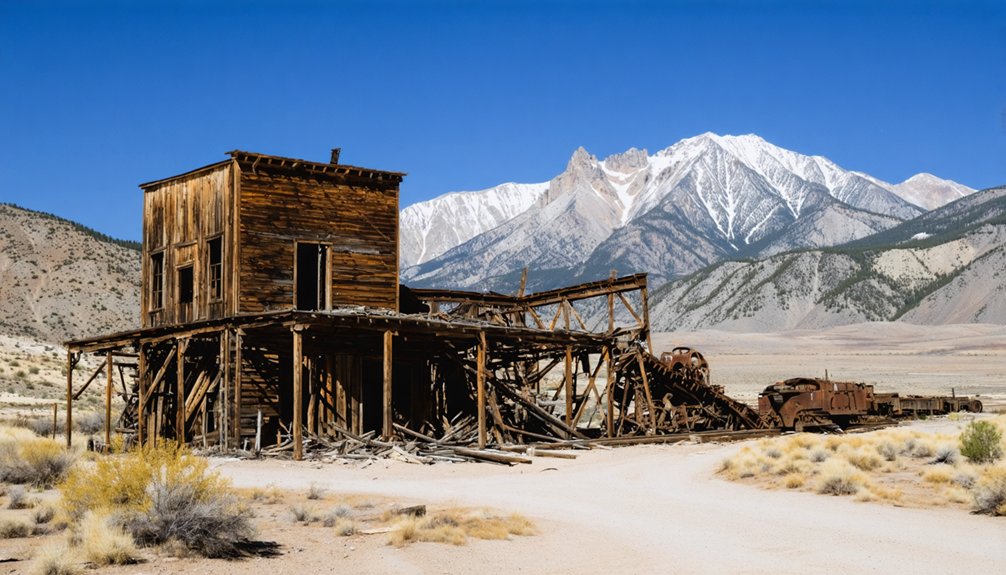
Ancient Fremont rock art and dinosaur tracks complement this industrial archaeology, creating layers of human and prehistoric history.
Great Basin Desert Abandoned Settlements
Stretching across the harsh expanse between Utah and Nevada, the Great Basin Desert harbors settlement ruins that tell stories of ambition, adaptation, and abandonment spanning millennia.
You’ll find Frisco’s ghostly remains near the West Desert, where the Horn Silver Mine‘s 19th-century riches bred prosperity and lawlessness before collapse. These abandoned landscapes reveal mining legacies alongside older narratives—prehistoric communities survived here for ten thousand years using glacier-fed springs and seasonal movements until megadrought forced relocations around 3100 BP.
Early Mormon outposts like Fort Willden at Cove Creek and Schellbourne’s Pony Express station preceded Snake Valley’s first permanent settlers.
Even Thistle, functioning until 1983‘s catastrophic landslide-flood, now stands silt-imprisoned—testament to the desert’s indifference toward human ambition.
Planning Your Northern Utah Ghost Town Adventure
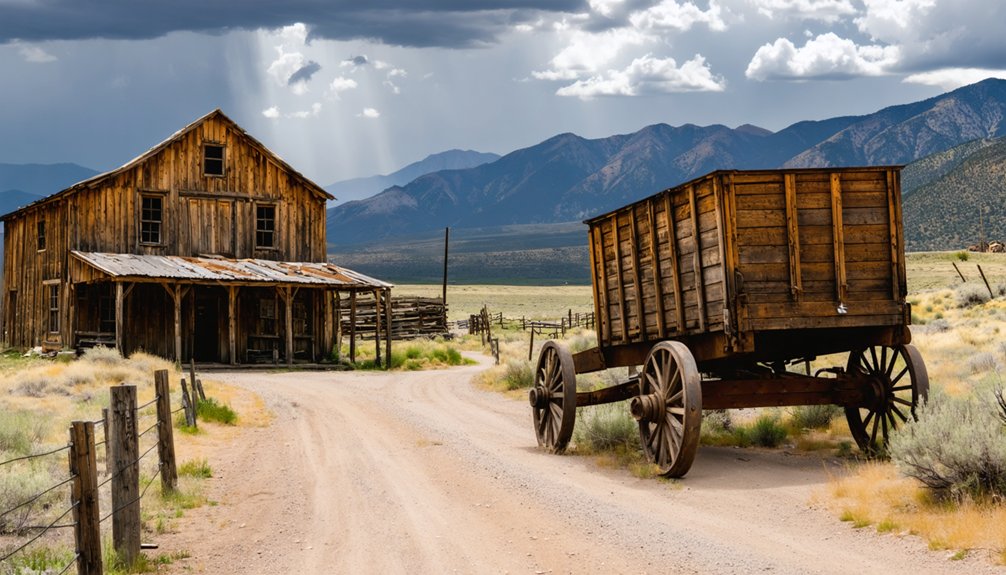
Before you venture into the sagebrush-studded remnants of northern Utah’s abandoned settlements, you’ll need to understand that these 195 documented sites demand different preparation than typical tourist destinations.
Ghost town preservation requires your respect, while visitor safety depends on practical planning.
Essential Planning Steps:
- Map your route using GIS open data and Google Maps regional links – Most ghost towns cluster in northern counties, with Eureka on State Route 6 serving as an accessible starting point.
- Respect private property boundaries – Iosepa’s cemetery remains accessible via marked paths, but surrounding ranchland is off-limits.
- Prepare for remote conditions – Bring water, check road conditions, and inform someone of your itinerary before exploring sites like Latuda or Washakie.
Frequently Asked Questions
Are Pets Allowed When Visiting Ghost Towns in Northern Utah?
You’ll find most northern Utah ghost towns welcome pets under pet friendly policies requiring leashes. However, historical preservation concerns restrict access to fragile structures. Always verify site-specific rules, pack waste bags, and respect wildlife boundaries during your exploration.
Some of these ghost towns in Utah history offer guided tours that delve into their intriguing pasts, providing insight into the lives of those who once called these areas home. Visitors often enjoy uncovering remnants of old homes and businesses that showcase the state’s mining and pioneer heritage. Be prepared for a fascinating journey through time as you discover the stories that shaped these now-silent landscapes.
What Is the Best Season to Explore Northern Utah Ghost Towns?
You’ll find the best months are late spring through early fall, when weather conditions stabilize dirt roads and temperatures remain manageable. Summer offers peak accessibility to volunteer-operated sites, though you’ll need substantial water for desert locations.
Do I Need Special Permits to Photograph Historic Buildings?
You’ll need permits for federal and state lands, but photography etiquette matters most—respect historical preservation by researching ownership beforehand. Private ghost town properties require permission, while BLM lands often grant you unrestricted access to explore freely.
Are There Guided Tours Available for Northern Utah Ghost Towns?
You’ll find guided tour options through BLM-led Terrace expeditions with archaeologists, while Expedition Utah provides self-guided routes. These experiences reveal historical significance through archival research, letting you explore vanished railroad towns and mining communities independently.
Can I Camp Overnight Near Any of These Ghost Town Sites?
You’ll find absolutely zero developed camping regulations or ghost town amenities at most sites, but dispersed camping’s typically allowed on surrounding BLM land. Check local land management offices beforehand—historical property boundaries aren’t always clearly marked.
References
- https://en.wikipedia.org/wiki/List_of_ghost_towns_in_Utah
- https://www.visitutah.com/things-to-do/history-culture/ghost-towns
- https://www.atlasobscura.com/things-to-do/utah/ghost-towns
- https://www.ksl.com/article/51308628/restored-utah-ghost-towns-that-should-be-on-your-summer-travel-bucket-list
- https://www.youtube.com/watch?v=FLdClYRU0bY
- https://film.utah.gov/spooky-rural/
- https://www.grandcountyutah.net/388/Ghost-Towns-Communities
- https://www.youtube.com/watch?v=Zv_jUDo2sZY
- https://www.islands.com/1932021/utah-old-mining-town-eureka-silver-city-ghost-town-adventure-hike/
- https://westernmininghistory.com/towns/utah/eureka/