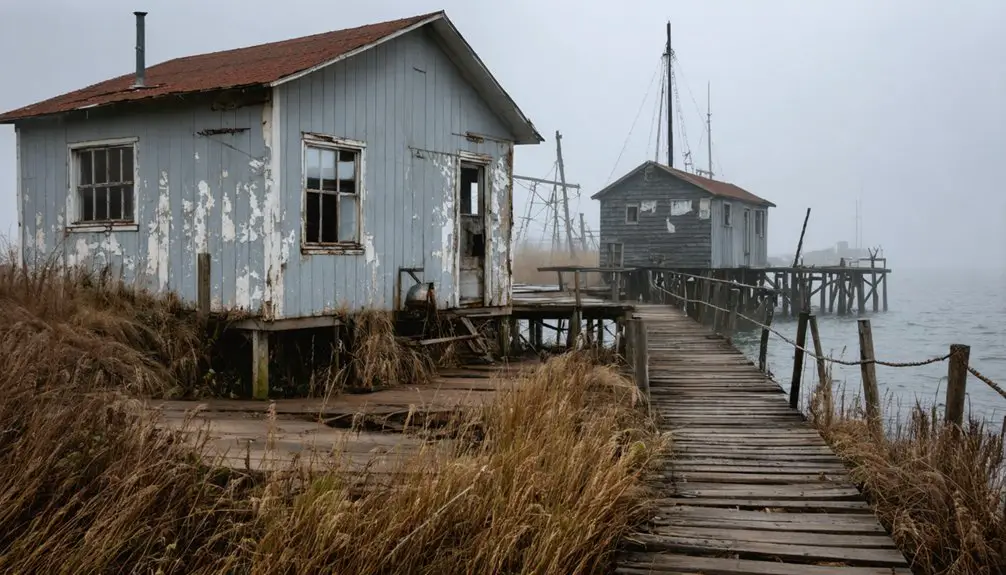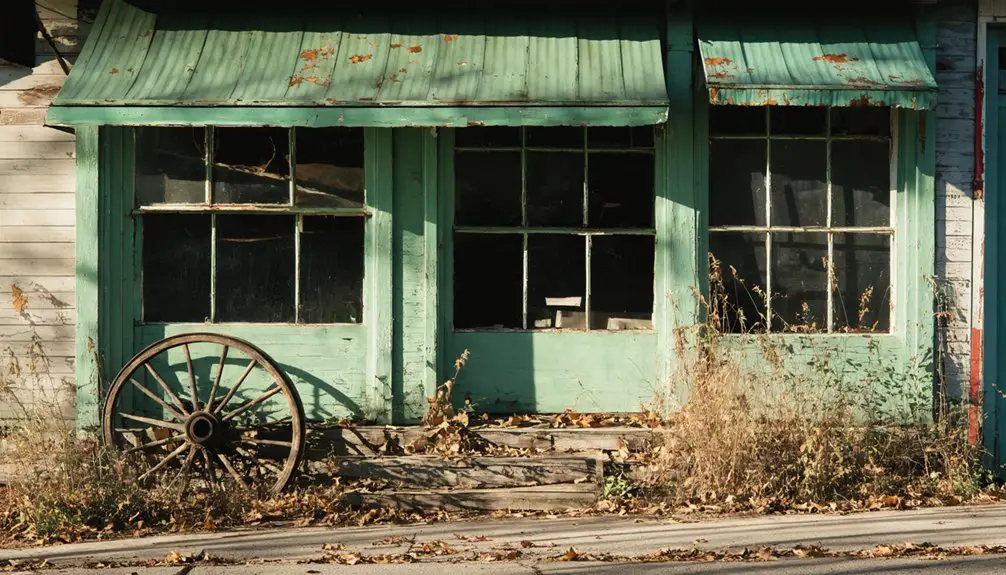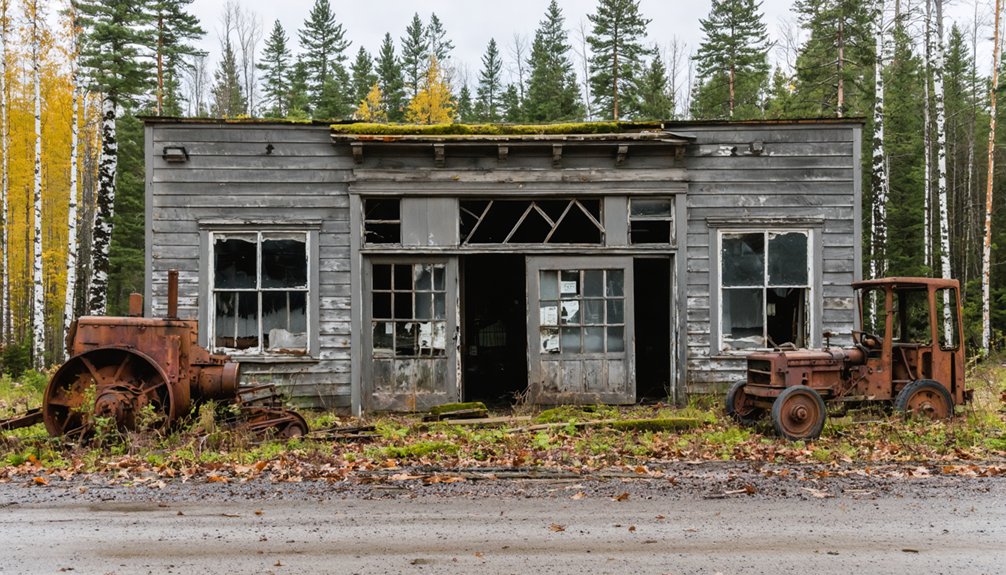
You’ll find northern Wisconsin’s ghost towns scattered across dense forests and river valleys, where lumber booms created thriving communities that vanished almost overnight. Peshtigo once housed 2,000 residents before the devastating 1871 fire, while Imalone grew around Snowball Anderson’s remote gas station and Bible camp. Railroad decisions sealed Pokerville’s fate in 1881, and religious leader James Strang’s departure emptied Voree by 1849. Today, weathered foundations, overgrown cemeteries, and abandoned post offices mark these forgotten settlements. The stories behind each community’s rise and disappearance reveal fascinating patterns of frontier life and economic transformation.
Key Takeaways
- Peshtigo, once home to 2,000 residents and the world’s largest woodenware factory, was devastated by the 1871 fire killing 2,500 people.
- Imalone emerged from Snowball Anderson’s gas station and became a social hub with a Bible camp before declining to remnants.
- Pokerville, Dane County’s earliest town, was abandoned in 1881 when the railroad bypassed it, sealing its fate as a ghost town.
- Voree flourished 1846-1849 with stone houses and commerce before followers relocated to Beaver Island, leaving the settlement abandoned.
- Railroad decisions determined settlement survival; many northern Wisconsin towns declined when tracks favored neighboring communities, leaving only scattered remnants.
The Rise and Fall of Lumber Towns: Peshtigo and Sugar Bush
When German and Scandinavian immigrants arrived along the Peshtigo River around 1838, they found dense white pine forests blanketing northern Wisconsin—timber that would float directly to Lake Michigan and fuel an economic boom.
By 1871, you’d have discovered a thriving town of 2,000 residents, home to the world’s largest woodenware factory and one of America’s most productive sawmills.
By 1871, Peshtigo had transformed into a bustling lumber capital with 2,000 residents and America’s most productive woodenware operations.
William Ogden’s Peshtigo Company operated 97 saws simultaneously, while nearby Sugar Bush housed logging settlements feeding this lumber industry juggernaut. Ogden, a former Chicago mayor, had purchased thousands of acres of forest to establish this industrial empire.
Then October 8, 1871 arrived. The Great Peshtigo Fire killed up to 2,500 people—America’s deadliest wildfire—consuming everything wooden in its path.
Though Peshtigo rebuilt, the fire aftermath changed everything. Ogden never reopened his factory, and Sugar Bush eventually faded into obscurity, leaving only ghost town remnants behind. Despite the devastation, survivors rebuilt homes, mills, businesses, churches, and schools, demonstrating the community’s remarkable resilience in the face of unimaginable loss.
Imalone: From Gas Station to Bible Camp Community
You’ll find Imalone’s origins in Snowball Anderson’s remote gas station, where isolation spawned the town’s peculiar name in Rusk County’s logging territory.
Anderson’s modest enterprise established the community’s foothold before Rev. Olaf Newhagen transformed the area in 1940, founding Imalone Bible Camp and Church.
Newhagen’s vision drew annual campers from Illinois, Michigan, and Minnesota, creating a summer gathering place complete with softball fields, tennis courts, and Chippewa River access that defined the community’s peak years.
The community once thrived as a social hub with bars, a dance hall, and lively Saturday night events that packed the venues.
Today, the Wagon Wheel bar stands as one of the few remaining structures alongside a handful of houses in this largely forgotten Northern Wisconsin town.
Snowball Anderson’s Expanding Enterprise
Snowball Anderson carved out his remote enterprise in the early 1900s along the Chippewa River, where the dense Wisconsin logging country left few outposts for weary travelers. His initial gas station became the foundation for something larger—a hub where isolation transformed into connection.
Snowball’s legacy expanded through strategic additions:
- A bar and dance hall that drew packed crowds every Saturday night
- A second tavern operated by Charlie and Esther Thorpe, later owned by Barney Cross
- Infrastructure including a post office, grocery store, softball field, tennis court, and cabins
These weren’t just buildings—they were lifelines. The remote location meant travelers often found themselves completely alone between settlements, making Anderson’s establishment a crucial stop.
Community gatherings at the dance hall gave loggers and families rare opportunities to socialize. You’ll find few records of formal planning; Anderson simply built what people needed in that unforgiving wilderness.
Rev. Newhagen’s 1940 Legacy
A different vision took root at Imalone in 1940, when Rev. Olaf Newhagen established his Bible Camp and Church along the Chippewa River.
This Norwegian immigrant farmer worked his land weekdays and preached Sundays, creating a religious and social hub that drew campers from Illinois, Michigan, and Minnesota.
Newhagen’s Influence extended beyond Sunday services—he built softball fields, tennis courts, and cabins where kids could bike down for post-chore swims.
His Community Legacy lasted decades, though schisms followed his 1962 death.
By 1967, baptism disputes split the congregation. Another exodus in the late 1970s created Living Waters Church a mile north.
The area had seen earlier settlement, including George Alton’s work as a mason in nearby Greenwood before he moved his family to operate restaurants elsewhere.
Today you’ll find deteriorating buildings at coordinates 45°33′08″N 91°13′39″W, nine miles northwest of Ladysmith—another faded dream in Rusk County.
Pokerville’s Colorful Past and Railroad Demise
You’ll find Pokerville’s legacy written in 1925 newspaper archives, where it earned its designation as Dane County’s earliest town—a rowdy settlement of 500 residents where poker tables, whiskey, and fistfights dominated the scene after dark.
The town’s reputation for gambling was so notorious that residents renamed it from Blue Mounds West to Pokerville, reflecting the card-playing culture that defined community life until 1880.
When the Chicago and North Western Railway laid tracks east of town and established a depot at Blue Mounds in 1881, businesses and residents abandoned Pokerville en masse, transforming this once-bustling hub into scattered ruins within decades.
The original settlement had been established at a site 2 miles east following a brutal Indian attack in 1852, prompting survivors to relocate their structures to the safer ground at the foot of the Blue Mounds.
Like many Wisconsin ghost towns, Pokerville’s decline followed a familiar pattern where transportation changes led to abandonment, as communities bypassed by new railroad routes struggled to maintain their populations and economic viability.
Gambling, Liquor, and Brawls
By the 1870s, Pokerville had earned its name through the constant shuffle of cards and clinking of poker chips that echoed from its gambling dens each night.
You’d find miners risking their daily wages on poker, faro, and roulette despite state regulations banning such games of chance. The gambling culture thrived alongside equally questionable establishments holding liquor licenses.
Community gatherings after dusk became rowdy affairs where three elements collided:
- Card games running until dawn with fortunes changing hands
- Freely flowing whiskey fueling the crowds
- Brawl incidents erupting among the 500 residents
These vice-driven entertainments sustained Pokerville’s economy and reputation as a happening destination. Similar to Milwaukee’s gambling scene, “policy” games resembling modern-day lotteries became popular betting options at local saloons.
The first coin-operated games of chance appeared in the 1870s, requiring attendants to handle payouts before automatic machines arrived decades later. State authorities occasionally cracked down—like the 1945 Beverage Tax Commission enforcement against slot machines—but the frontier spirit of freedom persisted until the boom finally ended.
Railroad Bypass Abandonment
When Ebenezer Brigham arrived in 1828 searching for lead deposits, he couldn’t have predicted that his settlement would one day become synonymous with poker tables and rowdy frontier entertainment.
By 1850, Pokerville thrived with blacksmiths, opera houses, and taverns serving a bustling population that produced governors.
The railroad significance became devastatingly clear in 1881 when the Chicago and North Western Railway placed its depot half a mile west.
Business owners dragged entire buildings—including the General Store—down dirt roads to follow commerce. This community transformation proved fatal for original Pokerville.
The depot handled four passenger trains daily through the early 1900s before dismantlement in 1943.
When automobiles replaced rail travel, Pokerville’s fate as a ghost town was sealed.
Today, the abandoned rail corridor serves as Military Ridge State Trail.
Voree: The Forgotten Mormon Settlement
Voree’s significance peaked between 1846-1849 when residents quarried limestone for an ambitious temple and performed baptisms for the dead in the White River.
The settlement featured:
- Stone houses and commercial enterprises including plough manufacturing
- Two newspapers documenting frontier Mormon life
- A partially completed temple foundation before Strang relocated followers to Beaver Island in 1849
Today, you’ll find Strangite church headquarters still operating in Burlington, with several original stone structures surviving along Mormon Road—tangible evidence of this independent religious experiment.
Argon: A Vanished Community in the Northern Wilderness
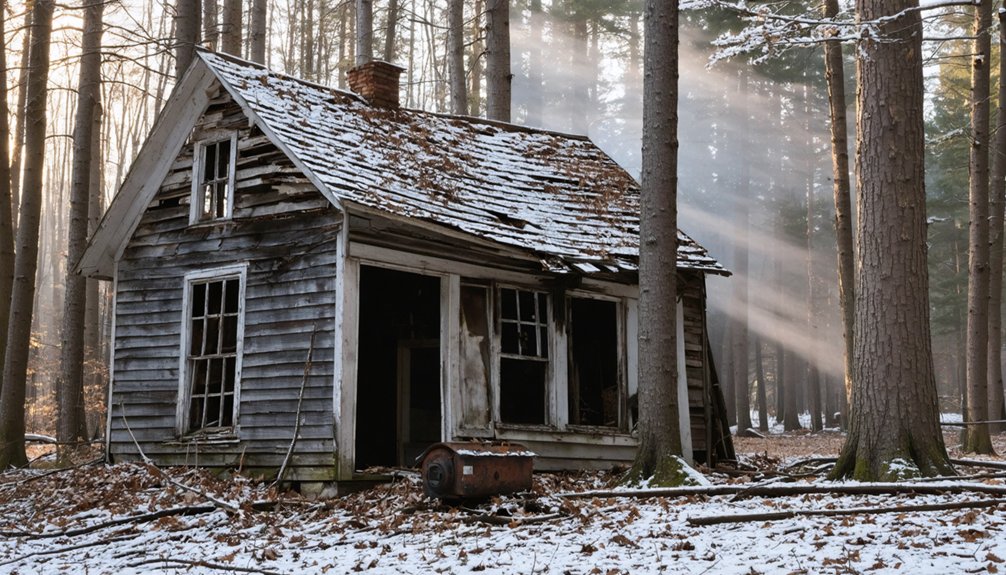
Deep in Wisconsin’s northern forests near Eagle River, the vanished settlement of Argon carries a name born from tragedy and remembrance. Originally platted as Vanzil in 1888, the town underwent two renamings before settling on Argon in the 1920s—a tribute honoring a local veteran’s son killed in France’s Argonne Forest during World War I.
Argon history reveals a community shaped by Polish heritage, evident in cemetery headstones bearing names like Yesis, Boruskis, and Grabowskis. The post office, established in 1889, served residents until the 1970s brought complete abandonment.
School closures, railroad cessation, and the departure of the last resident transformed Argon into a ghost town. Today, nothing remains but the cemetery and an operational post office serving scattered residents—silent witnesses to a community that once thrived.
How Railroads Shaped Ghost Town Development
While Argon’s fate stemmed from multiple factors, countless northern Wisconsin settlements rose and fell based solely on railroad decisions.
You’ll find railroad impact throughout the region’s town evolution, where track placement determined which communities thrived and which vanished completely.
Key patterns of railroad-driven development:
- Boom cycles – Stiles transformed from near-ghost town to bustling settlement after 1881 railroad arrival, supporting mills until 1910
- Bypass abandonment – Dover slowly died when tracks favored Mazomanie instead, leaving entire communities without buildings
- Resort transformations – Star Lake evolved from logging camp to destination via Milwaukee Road’s Northwoods Hiawatha, delivering Chicago tourists until 1943
When you explore these sites today, you’ll discover rail artifacts in lakeshores and woods—physical evidence of how corporate route choices sealed community fates across the Northwoods.
Exploring What Remains: Visiting Northern Wisconsin’s Abandoned Sites
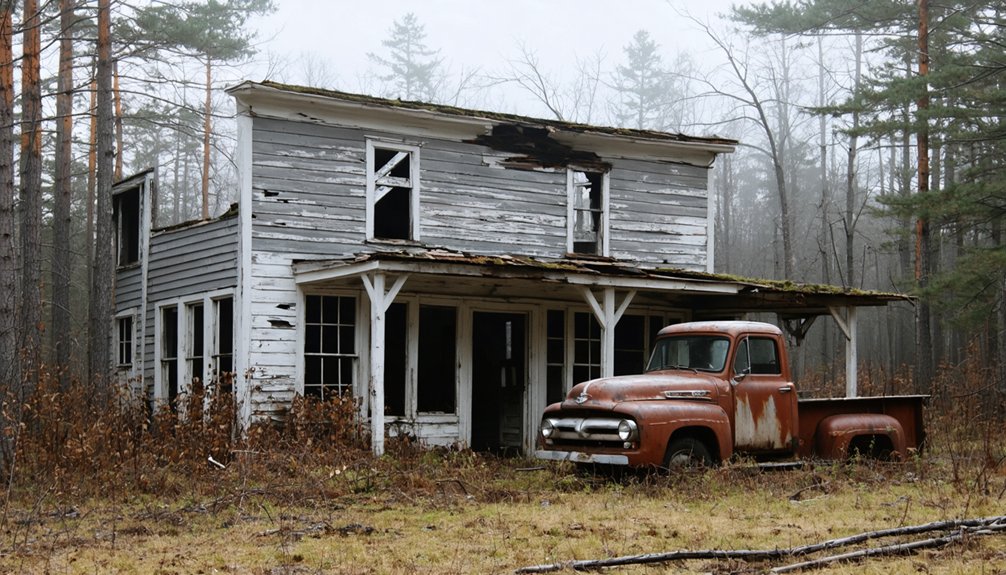
What draws today’s explorers to these vanished settlements?
You’ll find tangible connections to Wisconsin’s past in weathered remnants scattered across northern counties. At Imalone, you can still locate the Bible Camp’s foundation and access the Chippewa River where generations swam.
Dunville’s Red Cedar River valley holds traces of its courthouse era, though farming never took root in the post-lumber landscape.
Earling’s railroad corridor marks where Trout City once thrived before cutover farming failed. The abandoned architecture at Argon—formerly Vanzil and Northrandon—tells stories of multiple reinventions.
Old cemeteries persist near Berlin and coordinates mark Perote’s location. These sites preserve local legends while offering freedom to explore Wisconsin’s unvarnished history beyond official narratives.
Frequently Asked Questions
What Legal Restrictions Exist for Exploring Abandoned Ghost Town Sites in Wisconsin?
You’ll need exploration permits from property owners before entering ghost town sites, as trespassing laws apply even to abandoned structures. Without written permission, you’re risking prosecution regardless of missing fences or signage on private land.
Are There Other Significant Fires Besides 1871 That Destroyed Wisconsin Towns?
Yes, you’ll find significant fires devastated Wisconsin towns throughout history. The 1894 fires destroyed Phillips entirely, while 1907’s blazes left 300 homeless. These disasters had profound historical impact on northern settlements, creating numerous ghost towns.
Which Ghost Towns Had Native American Settlements Before European Arrival?
Most northern Wisconsin ghost towns sit atop ancient Native settlements. You’ll find historical significance in areas near Madeline Island, Lac Courte Oreilles, and Lac du Flambeau, where Ojibwe communities thrived before European contact transformed these landscapes.
The tale of ghost towns in Wisconsin history reflects a time when bustling communities flourished along trade routes and waterways. As you explore these abandoned sites, you might uncover relics of the past that tell the story of resilience and change. These remnants serve as a poignant reminder of the lives and cultures that once thrived in the shadows of towns now long forgotten.
Among these ghost towns in Wisconsin, there are numerous abandoned structures that showcase unique architectural styles once popular in the region. Each location reveals stories of the families who called these places home, with remnants of their endeavors still visible in dilapidated barns and crumbling homes. Visiting these sites offers a glimpse into the past, allowing you to walk through history as you connect with the spirits of those who lived and thrived before.
How Do Property Ownership Laws Apply to Abandoned Ghost Town Lands?
You’ll find property rights on abandoned ghost town lands require proving 20 years of open occupation for land reclamation through adverse possession. Without heirs, these properties ultimately revert to Wisconsin’s School Fund, limiting your ownership options.
As you explore these ghost towns of Wisconsin’s past, you may encounter remnants of vibrant communities that once thrived but now lie in silence. Each abandoned structure tells a story, revealing the history of economic shifts and the passage of time. Understanding the legal implications and the significance of these sites can enhance your appreciation of the state’s rich heritage.
What Role Did Mining Play in Northern Wisconsin Ghost Town Development?
Mining’s boom-bust cycle basically “disrupted” northern Wisconsin, creating then abandoning entire communities. You’ll find the mining impact drove ghost town economy through resource exhaustion, investor withdrawal, and workforce exodus—leaving preserved architectural remnants documenting this extractive era’s unsustainable foundation.
References
- https://upnorthnewswi.com/2024/02/21/the-fascinating-stories-behind-7-wisconsin-ghost-towns/
- http://freepages.rootsweb.com/~gtusa/history/usa/wi.htm
- https://exploringnorthshore.com/north-shore-ghost-towns/
- https://en.wikipedia.org/wiki/List_of_ghost_towns_in_Wisconsin
- http://shunpikingtoheaven.blogspot.com/2016/05/a-wisconsin-ghost-town.html
- https://www.wisconsinhistory.org/Records/Image/IM116137
- https://www.youtube.com/watch?v=2U6yUMTpODM
- https://grantcountyhistory.org/wp-content/uploads/2016/01/GhostTownsGrantCountyTLundeen.pdf
- https://townofgraftonwi.gov/town-history/
- https://ci.peshtigo.wi.us/history/