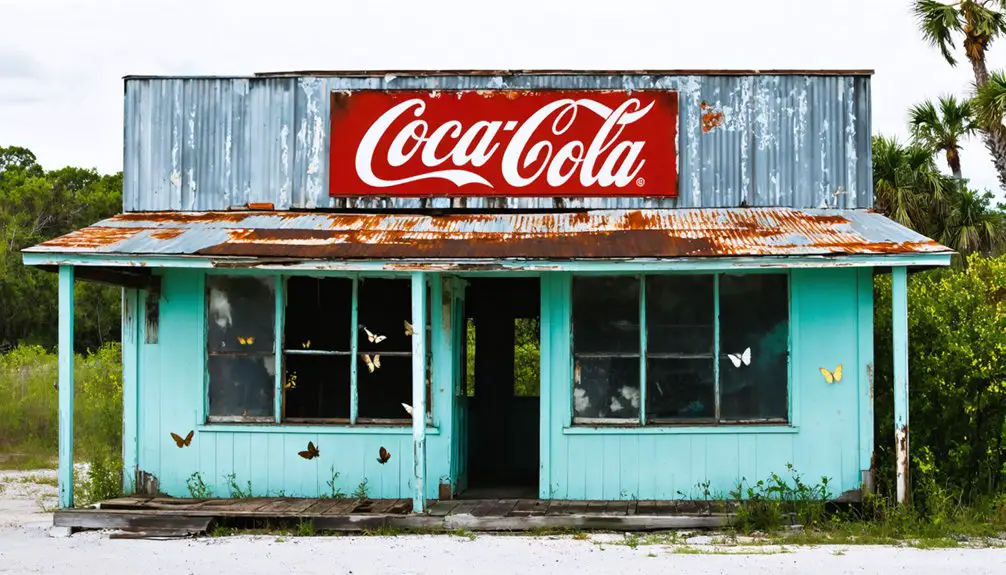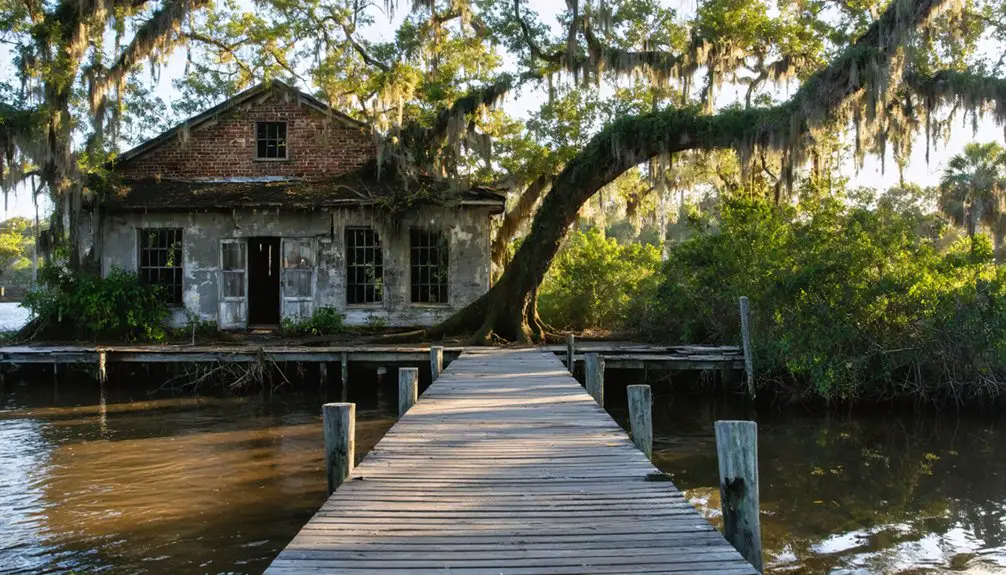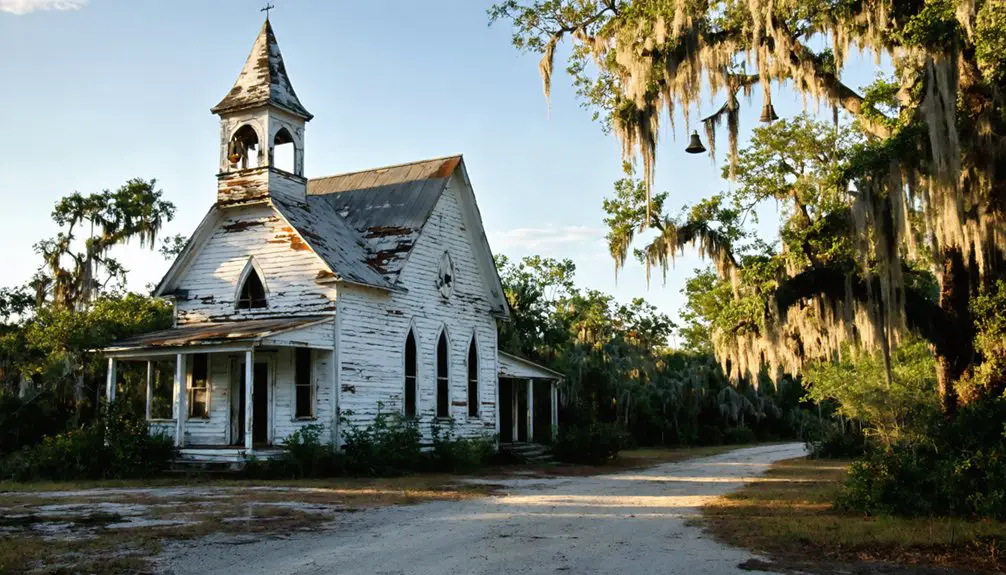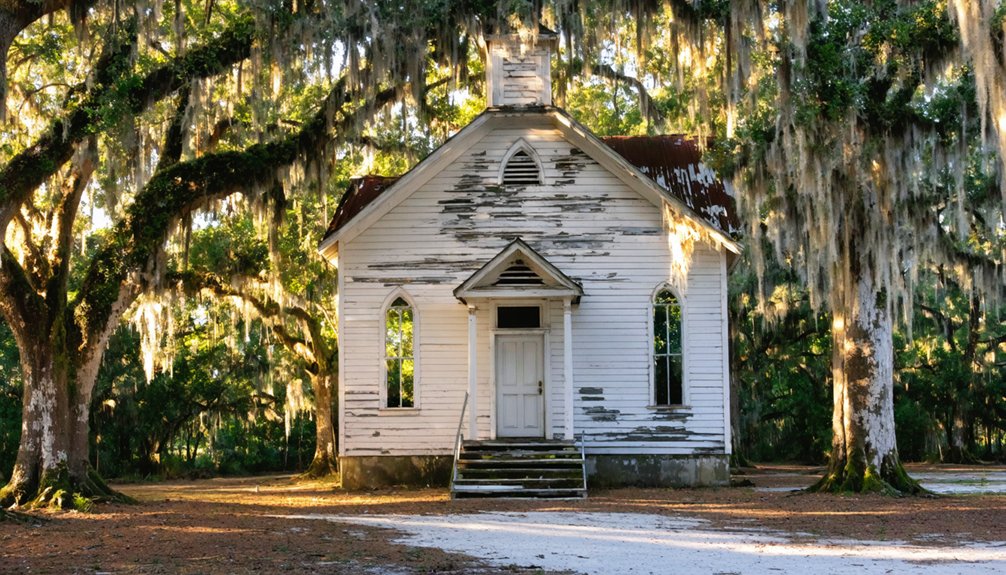
You’ll find Northwest Florida’s ghost towns scattered from the Gulf Coast to the pine forests, where human ambition repeatedly collided with nature’s power. St. Joseph, once Florida’s largest city with 11,000 residents, vanished after yellow fever and hurricanes struck in the 1840s. Turpentine camps like Old Muskogee and Fundy disappeared when timber ran out, while coastal settlements such as Atsena Otie Key were abandoned after devastating storms. Archaeological evidence reveals these sites span 10,000 years of continuous occupation, connecting ancient indigenous camps to 20th-century industrial operations that shaped the region’s forgotten landscape.
Key Takeaways
- St. Joseph, Florida’s largest city in 1835 with 11,000 residents, vanished within eight years due to yellow fever and hurricanes.
- Old Muskogee and Fundy were thriving timber towns employing 1,000 workers before forest exhaustion caused abandonment by 1905.
- Atsena Otie Key, a chartered coastal town of 200 residents, was devastated by an 1896 hurricane, leaving ruins and cemeteries.
- Bay Port and Bay Harbor were abandoned as populations moved inland for security from coastal threats and natural disasters.
- Remains of ghost towns include cemeteries, mill foundations, stone markers, and museums accessible for kayaking and historical exploration.
St. Joseph: The Former Capital by the Gulf
The founding of St. Joseph in 1835 transformed Gulf County’s shoreline into Florida’s most ambitious frontier experiment.
You’ll find its story rooted in a land dispute that drove Apalachicola residents westward, where they discovered a superior 17-foot harbor. Within two years, this settlement exploded to 11,000 residents—Florida Territory’s largest city—earning its reputation through boomtown prosperity fueled by cotton exports and steamboat commerce.
From land dispute to Florida Territory’s largest city in just two years—11,000 residents built on cotton, commerce, and ambition.
In 1838, fifty-six delegates gathered here to draft Florida’s first state constitution, cementing the town’s legacy as “Constitution City.”
Yet prosperity proved fleeting. Yellow fever struck in 1841, followed by mass exodus. By 1844, a hurricane’s storm surge erased what disease hadn’t claimed.
Less than eight years after its founding, St. Joseph vanished—a cautionary tale of ambition meeting nature’s indifference.
Today, remnants of this lost capital include a cemetery and stone marker, with a museum commemorating the achievement of statehood where delegates once shaped Florida’s future. The city’s re-establishment in 1909 brought new life to the area, though the original constitutional convention site remains its most enduring historical legacy.
Turpentine and Timber Towns of Old Muskogee and Fundy
While St. Joseph met its demise through disease and storms, Old Muskogee and Fundy vanished when their resources ran dry.
You’ll find Muskogee’s timber history began around 1857, twenty miles northwest of Pensacola on the Perdido River. Georgia lumbermen established what became Southern States Lumber Company, eventually employing 1,000 men across four mills and exporting 60 million feet of lumber annually.
The turpentine legacy lives on through nearby Fundy, a settlement built atop an aboriginal village site. The community supported itself through local stores and a commissary that served the workers and their families. By 1905, exhausted forests silenced the saws. Hurricanes in 1917 and 1918 destroyed 80% of the remaining standing timber, hastening the town’s abandonment.
Today, you can visit Old Muskogee Cemetery—recently added to Florida’s Historic Cemetery Inventory—where forgotten graves emerge from decades of vines and brush, marking the final resting places of those who built this once-thriving industrial frontier.
Grassy Point’s Aboriginal Settlements and Early Land Claims
Long before European land patents formalized ownership at Grassy Point, aboriginal peoples established thriving settlements along East Bay’s productive shoreline.
You’ll find evidence of their presence spanning three millennia, from 1500 B.C. through A.D. 1500. Aboriginal adaptations centered on the bay’s abundant resources—oyster beds and shallow waters perfect for spear fishing sustained camps and villages throughout the Archaic, Woodland, and Mississippian periods.
Early settlements left archaeological signatures revealing their sophistication:
- Sand-tempered pottery fragments indicating sedentary culture
- Stone tool byproducts from established communities
- Village middens stretching along coastal live oak stands
- Trade network artifacts connecting distant cultures
These communities developed complex social structures including religious practices and sophisticated art forms, distinguishing them from simple hunter-gatherer societies. Similar to the Spruce Bluff Mound dating between 100 and 300 B.C., these coastal settlements demonstrate the region’s long history of indigenous occupation before organized non-Native American settlement.
Lafayette Creek’s Ancient and Modern Inhabitants
Archaeological evidence along Lafayette Creek reveals human occupation spanning ten millennia, from Pre-Ceramic Archaic hunter-gatherers through early 20th-century homesteaders.
You’ll find 32 newly discovered sites documenting this continuous use. The prehistoric campsites, dated 8000-3000 B.C., represent temporary resource extraction stations scattered along the waterway.
Fast-forward to 1901-1909, and early homesteaders like Charles Silcox, Alfred Mayo, James Pyles, and William Goodwin claimed their stakes here. They weren’t just farming—archaeological surveys uncovered logging infrastructure, turpentine cups, and cattle dip vats that reveal multi-industry operations.
The creek’s logging roads and rail trams fed West Florida’s timber economy, while turpentine production connected to settlements like Fundy. The region’s commercial fishing industry, which shifted focus after World War II in nearby coastal communities, never took root in this inland timber territory. An old fishing cabin still stands along the creek, its weathered structure a testament to the area’s diverse resource use beyond timber and turpentine. Archaeologist Mikell’s survey recommended testing several sites for National Register eligibility, potentially securing preservation for this layered landscape.
Coastal Settlements: Atsena Otie Key, Bay Port, and Bay Harbor
Florida’s Gulf Coast harbored thriving settlements that couldn’t withstand the convergence of economic shifts and natural catastrophes.
You’ll find Atsena Otie Key’s story most compelling—once a chartered town with 200 residents, it vanished after the 1896 hurricane‘s 10-foot surge claimed over 30 lives and destroyed 50 buildings.
What remains today:
- Faber pencil mill foundations scattered across overgrown terrain
- Concrete cisterns marking former homesteads
- Cemetery dating to 1877 with weathered headstones
- Crumbling clipper ship dock pilings along the shoreline
Bay Port and Bay Harbor followed similar trajectories, their populations abandoning coastal exposures for inland security.
You can kayak to Atsena Otie’s ruins within Cedar Keys National Wildlife Refuge, where freedom-seekers explore evidence of communities that chose retreat over rebuilding. The island’s name derives from Muscogean Indian words meaning “Cedar Island,” reflecting its occupation by Native Americans over 2,000 years ago. Tidewater Tours operates drop-off service to the island, departing at 11:00 AM with afternoon pickup at 3:00 PM.
Archaeological Discoveries Across the Panhandle
Archaeological surveys across Northwest Florida’s panhandle have uncovered evidence of settlements spanning nearly 10,000 years, from pre-ceramic Archaic camps to early 20th-century homesteads.
You’ll find that recent fieldwork documented 47 previously unknown sites in Escambia, Santa Rosa, and Walton counties, revealing how communities exploited timber, turpentine, oysters, and fish resources before vanishing from the landscape.
These discoveries—including 32 sites along Lafayette Creek alone—expose the region’s layered history of resource extraction that sustained both temporary seasonal camps and permanent mill towns.
Prehistoric Settlement Patterns Revealed
Beneath the rivers and springs of northwest Florida’s Panhandle lies evidence of human occupation stretching back nearly 15,000 years.
Paleoindian migration patterns reveal hunters following megafauna to karst features like sinkholes and springs, where they established camps and processing sites. You’ll find their legacy preserved underwater—a consequence of post-Ice Age sea level rise that drowned coastal plains and river settlements.
Prehistoric hunting strategies centered on extracting resources from this karst-rich landscape:
- Chert spearpoints concentrated in river bottoms targeted mastodons and giant sloths
- Stone knives and scrapers processed game at springs like Page-Ladson and Sloth Hole
- Seasonal shellfish camps dotted ancient coastlines, now submerged offshore
- Burial sites and fish traps occupied strategic locations along the Aucilla, Wakulla, and Chipola Rivers
These drowned settlements hold Florida’s earliest archaeological record.
Mill Town Foundations Documented
During the early 1990s, conversations with visitors at the Arcadia Industrial Complex excavations sparked a three-year documentation effort that would transform understanding of northwest Florida’s industrial heritage.
You’ll find approximately 80 mill sites recorded across the western panhandle, from water-powered grist operations to steam-driven lumber facilities that anchored pioneer communities.
Crary’s Mill at Bluff Springs near Century exemplifies these discoveries—a 1920s-era electrical generator and grist mill that formed the social center of North Escambia County’s oldest settlement.
The Muskogee Mills foundations revealed planing and finishing operations potentially eligible for National Register listing, complete with brick wells, rail lines, and possible locomotive roundhouse remnants.
This mill town archaeology connects you directly to the industrial frameworks that shaped regional development before bureaucratic oversight constrained independent enterprise.
Frequently Asked Questions
Can Visitors Legally Explore These Northwest Florida Ghost Town Sites Today?
Want to explore Florida’s forgotten settlements? You’ll find most northwest ghost town sites legally accessible through public lands, though you should verify current exploration rules and legal restrictions before visiting, as some locations require ferry access or sit near private property boundaries.
What Artifacts Are Most Commonly Found at Panhandle Ghost Town Locations?
You’ll most commonly find ceramics, metal fragments, and industrial remnants like cut nails, bottle glass, and brick. These artifacts hold tremendous historical significance, revealing multicultural contexts from Native American settlements through logging-era homesteads across Florida’s Panhandle.
How Do Hurricanes Continue to Impact These Abandoned Settlement Areas?
You’ll witness hurricane destruction repeatedly battering these sites, scattering bricks, toppling structures, and flooding foundations. Each storm tests settlement resilience, preventing natural recovery while wind and water accelerate decay, ultimately erasing what communities once built here.
Are There Guided Tours Available for Any Northwest Florida Ghost Towns?
No guided ghost tours exist specifically for Northwest Florida’s abandoned settlements. You’ll find guided ghost tours focused on Pensacola’s historic districts instead, where local operators emphasize haunted sites with documented historical significance rather than depopulated towns.
What Role Did Railroads Play in These Towns’ Rise and Fall?
Railroads were the lifeblood pumping prosperity into these settlements—railroad expansion brought lumber mills, phosphate mines, and commerce that fueled boom times, while resource depletion and economic decline turned bustling depots into silent, overgrown relics you’ll find today.
References
- https://en.wikipedia.org/wiki/List_of_ghost_towns_in_Florida
- https://www.ghosttowns.com/states/fl/fl.html
- https://fdc.com/blog/ghost-towns-in-florida/
- https://www.emeraldcoastmagazine.com/ghost-towns-of-west-florida/
- https://www.freakyfoottours.com/us/florida/
- https://floridatrailblazer.com/tag/ghost-towns/
- https://freepages.history.rootsweb.com/~gtusa/usa/fl.htm
- https://floridahikes.com/constitution-convention-museum/
- https://www.visitgulf.com/plan-your-trip/about-gulf-county/history/
- https://en.wikipedia.org/wiki/St._Joseph