You can’t technically sleep *in* Oklahoma’s ghost towns like Texola or Ingersoll, but you’ll get remarkably close by staying at Guthrie’s haunted Stone Lion Inn, where phantom footsteps echo through 1907 Victorian halls, or Oklahoma City’s Skirvin Hotel, where “Effie” the spectral maid still wanders thirteen floors of Gothic architecture. For authentic desolation, camp at Foss State Park near abandoned storefronts and crumbling foundations, or explore Skedee’s flood-frozen ruins before retreating to nearby Pawnee County lodging. The stories behind these spectral destinations reveal Oklahoma’s darkest frontier secrets.
Key Takeaways
- Texola offers 36 residents and weathered Route 66 ruins like Magnolia Service Station for free daytime exploration without overnight facilities.
- Foss State Park, 10 miles from Foss ghost town, provides camping access to explore abandoned structures and historical sites.
- Stone Lion Inn in Guthrie offers paranormal overnight stays in Oklahoma’s most haunted 1907 Victorian mansion with ghostly encounters.
- Skirvin Hotel in Oklahoma City provides 225 modern rooms in a restored 1911 Gothic landmark notorious for hauntings like “Effie.”
- Ingersoll and Skedee require nearby Pawnee County accommodations starting at $87 for exploring these semi-abandoned railroad ghost towns.
Texola: Sleep Among the Ruins Along Historic Route 66
When the Choctaw, Oklahoma, and Gulf Railroad laid its tracks across the windswept plains in 1902, few could have imagined that the bustling depot town springing up along its route would one day become a haunting monument to America’s vanished Main Streets.
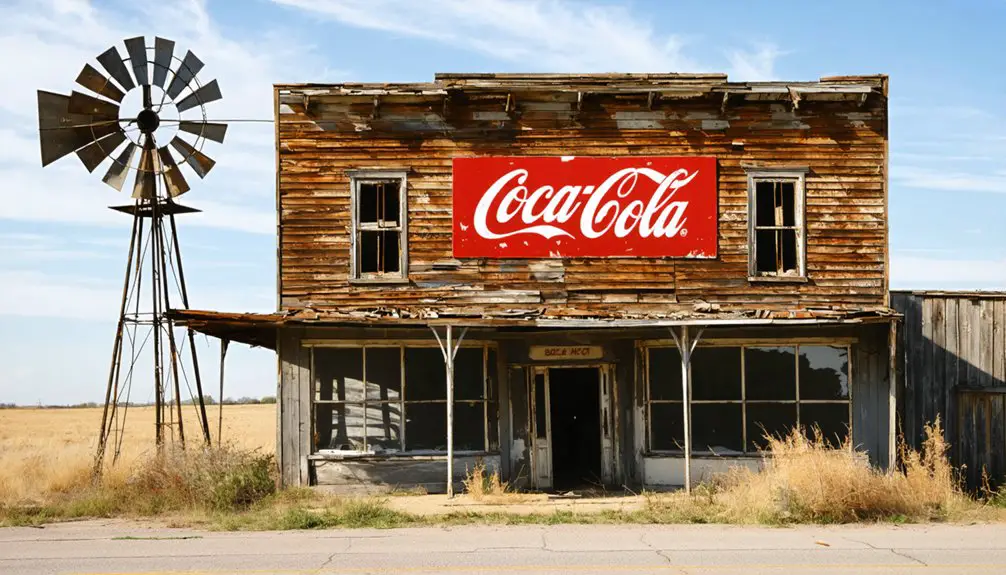
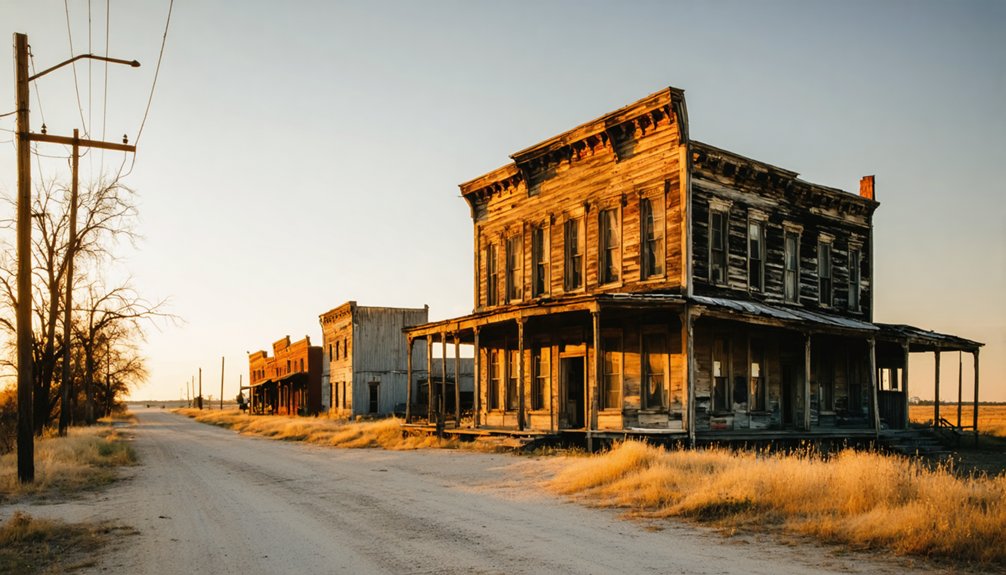
You’ll find Texola straddling Oklahoma’s western edge, where urban decay tells stories through weathered storefronts and a solitary one-room jail. Once thriving with 581 souls during Route 66’s heyday, this near-ghost town now shelters merely 36 residents among crumbling cotton gins and empty gas stations.
The Magnolia Service Station stands sentinel at Broadway’s intersection, its historical preservation status contrasting sharply with surrounding abandonment. Abandoned trucks rest in overgrown lots alongside deteriorating houses, their rusted frames adding to the town’s ghostly atmosphere. You’re free to wander plywood-covered porches and overgrown lots where Steinbeck’s Joads once passed through, experiencing authentic desolation without barriers or tours. The ruins of the Friendly Cafe, once a popular restaurant for Route 66 travelers, can still be glimpsed among the decay.
The Haunted Stone Lion Inn in Guthrie
Towering above Guthrie’s brick-lined streets since 1907, the Stone Lion Inn beckons you into Oklahoma’s most persistently haunted mansion—a Victorian behemoth where F.E. Houghton raised twelve children before undertakers embalmed bodies in the kitchen.
Step inside Oklahoma’s most haunted Victorian mansion, where twelve children once played and embalmers practiced their grim trade in the kitchen.
You’ll climb the back staircase where phantom footsteps echo through four floors of historical architecture, pause before the relocated embalming table now displayed in the hallway, and maybe glimpse F.E. himself puffing his tobacco pipe through shadowed rooms.
The third floor draws spirits like moths to flame—guests report invisible children patting their faces at night while phantom music boxes play melodies.
Paranormal investigations capture EVP voices throughout, particularly on the second floor. Doors slam despite your props. Toys scatter overnight. A wooden ball rolls across the floors, propelled by unseen hands. The mansion’s murder mystery dinners draw visitors seeking both Victorian ambiance and supernatural thrills. During full moons, this bed and breakfast transforms into your basecamp for confronting Oklahoma’s restless dead.
Skirvin Hotel: Oklahoma City’s Most Spirited Accommodation
Rising thirteen stories above Broadway Avenue in downtown Oklahoma City, the Skirvin Hotel has commanded attention since 1911—when oil tycoon William Balser Skirvin defied conservative advice and erected ten floors of English Gothic grandeur instead of the modest six originally planned.
You’ll walk corridors where “Effie,” a maid allegedly imprisoned on the tenth floor during Prohibition, still roams. NBA players flee scratching specters. Naked apparitions materialize in showers. Phantom voices proposition male guests in locked rooms.
The $46.4 million restoration balanced historical preservation with modern luxury, yet paranormal investigations consistently document disembodied crying, self-operating fixtures, and doors that won’t budge. The property now features 225 well-equipped rooms, alongside an indoor swimming pool, tennis courts, and the Park Avenue Grill serving American cuisine with Southwestern influences. The hotel made history as one of the first buildings in Oklahoma City to feature air conditioning—marketed then as “iced air”—and running ice water in every room.
You’re free to dismiss the legends—until you experience that creepy vibe yourself, standing alone in dimly-lit hallways where moldings and tiles haven’t forgotten their secrets.
Foss: Experiencing What Remains of a Once-Thriving Community
Along the windswept plains of western Oklahoma, Foss presents a haunting study in abandonment—its overgrown sidewalks leading nowhere, its crumbling foundations marking businesses that haven’t seen customers since Eisenhower was president.
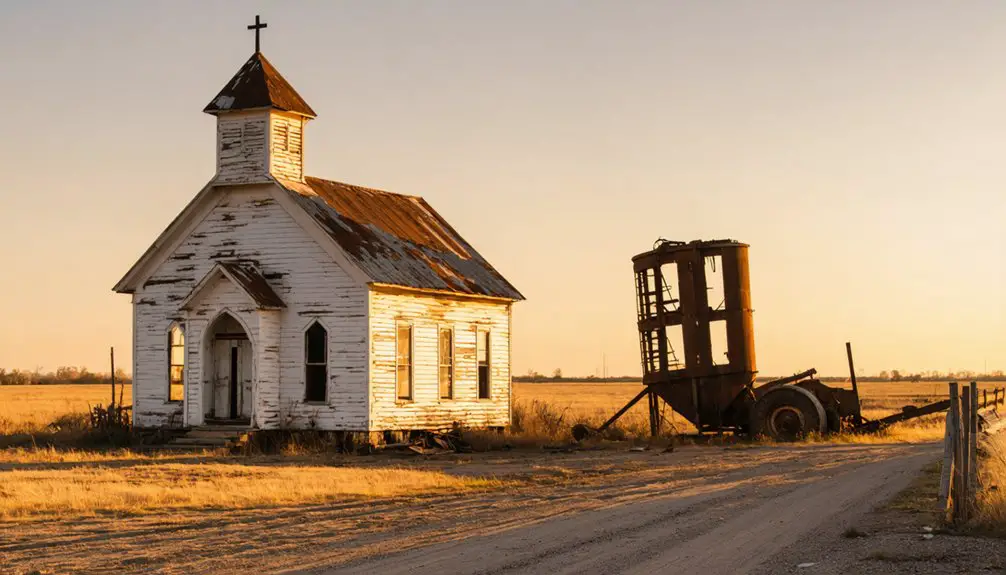
You’ll discover historical architecture frozen in decay: an old church standing sentinel, a weathered jail that once held cattle rustlers, and a gas station where weeds now grow through concrete cracks.
The town legends whisper of catastrophic floods that drowned nine souls in 1902, forcing survivors to rebuild uphill, and fires that repeatedly razed their dreams. Additional blazes in 1908 and 1909 consumed large sections of the community, requiring costly rebuilding efforts that strained the frontier settlement.
Today, 103 residents inhabit what once supported 1,600. Walk these ghost streets where Route 66 bypassed prosperity by half a mile.
Touch the historical plaque commemorating the vanished school. Just 10 miles north, Foss State Park offers 120 campsites where you can base your exploration of this vanished world. You’re witnessing freedom’s price—the American dream abandoned.
Ingersoll: Overnight Adventures in Northwestern Oklahoma’s Forgotten Town
You’ll find Ingersoll rising from the plains like a whisper of 1901, when the Choctaw Northern Railroad birthed a thousand-strong town overnight in northwestern Alfalfa County.
The twin grain elevators—especially the historic tile elevator from 1920—stand as weathered sentinels against crimson sunsets, marking where Charles E. Ingersoll’s railroad empire once connected Oklahoma to Kansas.
Though the tracks vanished in 1936 and the post office closed in 1942, the remaining houses and abandoned rail corridors now offer you a rare chance to spend the night where boom turned to ghost. The town’s naming sparked controversy among religious communities who believed it honored Robert Ingersoll, an agnostic, though it actually took the railroad president’s name.
Today, Ingersoll exists as a semi-abandoned site, with some structures still standing but most buildings empty and the community no longer active.
Railroad Boom Town History
Between 1897 and 1907, Oklahoma transformed into a sprawling web of steel rails as competing railroad companies raced to claim their share of the territory’s promised wealth. You’d have witnessed fifteen different right-of-ways crisscrossing the landscape by 1911, each promising prosperity to settlements along their routes.
Railroad expansion exploded from 289 miles in 1880 to 6,572 by 1920, driven by land rushes and oil strikes that drew fortune-seekers by the thousands.
But this frenzied overbuilding carried a price. Towns lived and died by the railroad’s whim—Parkersburg vanished in 1904 when tracks intersected elsewhere.
The 1907 financial panic ended the construction boom, and within three decades, 75 percent of these hastily-laid lines were abandoned. Town abandonment followed swiftly, leaving ghosts like Ingersoll scattered across the prairie.
Modern Exploration Opportunities
Today, Ingersoll slumbers beneath Oklahoma’s endless skies, a living remnant of that railroad frenzy where weathered grain elevators pierce the horizon like sentinels guarding forgotten dreams.
You’ll navigate red dirt paths into this northwestern pocket of Alfalfa County, discovering abandoned structures that whisper tales of seven saloons and rougher days.
Historical preservation hasn’t formalized here—instead, you’re free to wander unincorporated territory where community revitalization means a handful of residents maintaining their own terms of existence.
Position yourself between those photogenic elevators at sunset, dodging bugs while golden light transforms decay into art.
The isolation demands preparation, yet rewards with authentic discovery.
Combine Ingersoll with nearby Shamrock or Ingalls for extended ghost town circuits, camping where atmosphere trumps amenities and adventure flows unrestricted.
Skedee: Finding Lodging Near Pawnee County’s Declining Settlement
You’ll witness Skedee’s haunting transformation from a thriving railroad town of 277 souls to a near-ghost settlement of just 51 residents.
Its abandoned high school has been frozen in time since the catastrophic 1957 flood destroyed the rail line.
While no hotels exist within Skedee’s fading boundaries, you can secure fully refundable accommodations starting at $87 in nearby Pawnee County communities that once prospered alongside this declining settlement.
Your base in neighboring Pawnee positions you near the historic Pawnee Bill Ranch and bathhouse while you explore Skedee’s reclaimed calaboose jail and the mysterious Bond of Friendship monument standing sentinel over this disappearing town.
Skedee’s Dramatic Population Decline
Today’s numbers tell a story of resilience against odds. You’ll find 67 residents calling this place home in 2024, with a median age of 23.5 years suggesting unexpected significance.
Despite losing 36 people between 2000 and 2023, Skedee‘s young population hints at something rare: defiant spirits refusing to abandon their railroad-born heritage.
Nearby Accommodation Options Available
Where can visitors lay their heads after exploring this wind-swept remnant of Oklahoma’s oil boom past? You’ll find the Victorian Inn right in Skedee, offering rooms from $91 nightly with fireplaces and personalized touches that contrast sharply with the decaying structures outside.
Eight hotels scatter across the immediate area, starting at $87, while nearby communities like Pawhuska, Stillwater, and Ponca City expand your options further.
These accommodations serve as base camps for your ghost town adventures, though limited transportation infrastructure—a legacy of the 1957 railroad flooding—keeps this place genuinely remote.
The sparse lodging reflects minimal tourism development despite historical preservation efforts centered on landmarks like the 1926 Bond of Friendship monument. You’re experiencing authentic abandonment here, not manufactured nostalgia.
Pawnee County Lodging Recommendations
The handful of lodging options surrounding Skedee mirrors the settlement’s own sparse existence—scattered, weathered, but stubbornly present. You’ll find authentic ranch stays and historic inns within Pawnee’s twenty-minute radius, where proprietors share haunted legends over morning coffee.
These hosts know the local legends—stories of oil barons, Native American heritage, and railroad dreams that dissolved into prairie wind.
Your overnight choices include:
- Working cattle ranches offering bunkhouse accommodations where you’ll experience genuine frontier hospitality and unfiltered Oklahoma sunrises
- Pawnee’s Victorian-era bed and breakfasts preserving pioneer architecture with creaking floorboards that whisper century-old secrets
- Rural campgrounds providing unobstructed access to Skedee’s silence, where starlight replaces streetlights and coyote calls replace traffic
Each option positions you within striking distance of exploration while respecting the ghost town‘s untamed solitude.
What to Expect When Staying in Oklahoma’s Ghost Towns
When you settle into one of Oklahoma’s ghost town accommodations, you’re choosing more than a place to sleep—you’re immersing yourself in atmospheres thick with history and otherworldly presence.
Haunted hotels like the Skirvin reveal opulent decor masking darker stories, where phantom cries echo through tenth-floor hallways and objects move without explanation.
Beneath the Skirvin’s gilded elegance lurks something sinister—phantom cries piercing tenth-floor silence, objects defying gravity, history refusing to rest.
At the Regency Inn’s Room 110, poltergeist activity transforms ordinary lodging into visceral encounters with male apparitions.
Victorian mansions-turned-inns harbor spirits from their funeral home pasts, while self-operating doors and mysterious lights punctuate your stay at campus properties.
Phantom footsteps, disembodied voices, and rocking chairs moving on their own become your nighttime companions.
Those seeking paranormal investigations will find cold breezes, shadowy figures, and unexplained occurrences woven into every creaking floorboard and darkened corner.
Best Times of Year to Visit Abandoned Oklahoma Communities
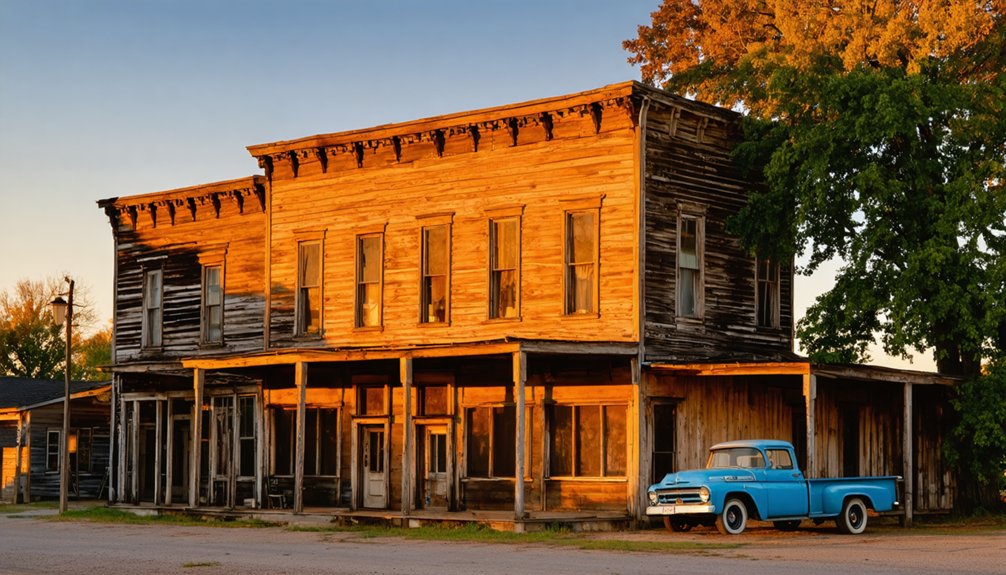
Oklahoma’s abandoned communities reveal their most haunting beauty when winter’s crisp air settles over silent prairies and weathered structures. You’ll discover cultural preservation at its purest during January through April, when empty trails and bare landscapes mirror the 1890s frontier.
Winter’s minimal environmental impact allows undisturbed exploration of sites like Ingalls and Boggy Depot, where intricate tree patterns frame crumbling stone facades.
Optimal visiting windows for maximum solitude:
- Winter months offer crisp mornings when frost highlights architectural decay and weathered wood grain.
- Early spring shoulder season provides mild temperatures perfect for prairie walks without summer’s oppressive heat.
- Late fall delivers stunning foliage contrasts against abandoned homesteads while avoiding holiday crowds.
Locals know dawn visits ensure complete isolation. Skip Memorial Day and Labor Day entirely—these ghost towns demand quiet reverence, not tourist chaos.
Safety Tips and Regulations for Ghost Town Overnight Stays
Before you spread your sleeping bag in a ghost town’s shadow, you’ll need written permission from the property owner—trespassing charges follow swiftly in Oklahoma’s abandoned settlements.
Pack a first-aid kit stocked with bandages for rusted metal cuts, water purification tablets for contaminated sources, and a charged satellite phone since cell towers don’t reach places like Picher’s toxic wasteland.
Your emergency contact list should include the nearest hospital’s coordinates, local sheriff’s non-emergency line, and a backup exit route marked on physical maps that won’t fail when your GPS loses signal.
Property Access and Permissions
The crunch of gravel beneath your boots echoes differently when you’re uncertain whether you belong. Before stepping onto forgotten ground, understand that property ownership doesn’t vanish with abandonment. Ghost towns remain under legal procedures that protect landowners’ rights, even when buildings crumble and streets fade.
You’ll need written permission from current owners—not assumptions based on decay.
Secure your freedom through proper channels:
- Contact tribal authorities before entering Native American lands; respect isn’t optional
- Document everything—emails, texts, signed agreements become your shield against trespassing charges
- Call local police non-emergency lines beforehand; transparency prevents midnight confrontations
Your adventure shouldn’t cost you legal trouble. Property rights transcend appearance, and Oklahoma law empowers owners to eject trespassers swiftly.
Wanderlust demands responsibility, not recklessness.
Emergency Preparedness Essentials
Darkness settles differently over abandoned places—heavier, more thorough than you’ve experienced in cities where streetlights chase away true night. You’ll need reliable illumination: headlamps with backup batteries, not just flashlights that tie up your hands.
Pack a complete first-aid kit, since cell service vanishes where historical preservation meets wilderness. Water purification tablets matter when modern amenities don’t exist. Your weather radio becomes essential—Oklahoma’s storms don’t care about your adventure timeline.
Visitor amenities in ghost towns range from minimal to nonexistent. Bring multiple fire-starting methods, emergency blankets, and enough food for an extra day. Download offline maps; GPS fails when satellites can’t penetrate canyon walls.
Tell someone your exact location and expected return. Self-reliance isn’t romantic here—it’s survival protocol in places civilization abandoned decades ago.
Combining Ghost Town Visits With Other Oklahoma Attractions
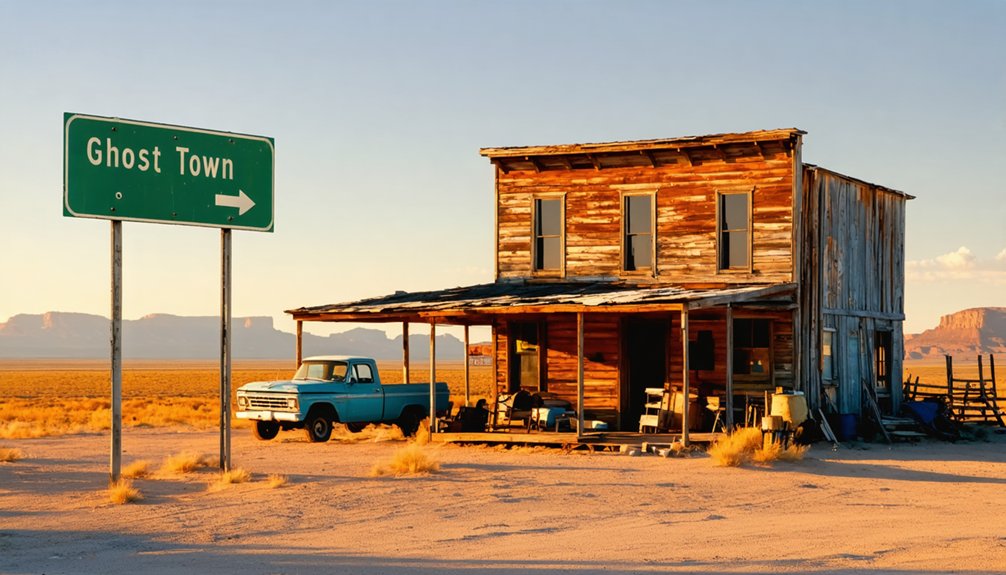
Strategic routes reveal Oklahoma’s darker narratives:
- Foss-to-Watonga corridor: Noble House B&B connects ghost town exploration with flickering lights and phantom footsteps.
- Route 66 haunted trail: Texola through Elk City’s poltergeist-plagued Regency Inn Room 110.
- Victorian murder circuit: Guthrie to Hugo’s Johnson House Inn, complete with hanging judge history.
Frequently Asked Questions
Are Restroom and Shower Facilities Available in Oklahoma’s Ghost Town Accommodations?
You’ll find restroom facilities and shower amenities at Oklahoma’s ghost town accommodations, though they’re standard B&B features rather than luxurious retreats. These historic havens prioritize authentic atmosphere over modern comforts, letting you experience genuine frontier-era ambiance.
Can I Bring Pets When Staying Overnight in Ghost Towns?
Pet policies remain undocumented across Oklahoma’s ghost towns, leaving you steering uncertainty. Without confirmed pet-friendly accommodations at Texola, Foss, Ingersoll, or Skedee, you’ll need contacting local operators directly before bringing your four-legged companions along.
Is Cell Phone Service and Wifi Available in These Remote Locations?
You’re out in the sticks regarding remote connectivity in Texola, Foss, and Ingersoll—expect spotty signals limiting social media sharing. However, haunted hotels like Skirvin and Stone Lion Inn offer reliable WiFi, letting you document your adventure freely.
What Should I Pack for an Overnight Stay in an Abandoned Town?
You’ll need essentials like flashlights, sturdy boots, and sleeping gear to explore these remnants of historical significance. Pack cameras to document preservation efforts, plus water and food—embracing self-reliance as you wander through Oklahoma’s abandoned, freedom-soaked landscapes.
Do I Need Special Permits to Photograph Ghost Town Properties?
Like a wanderer crossing unmarked borders, you’ll navigate varied terrain. Private ghost town properties require owner permission—your golden key. Public lands offer freer passage, though commercial photography restrictions may apply. Always respect the ruins; permit requirements protect these silent storytellers from exploitation.
References
- https://www.hauntedrooms.com/oklahoma/haunted-places/haunted-hotels
- https://the405voyager.com/5-ghost-towns-in-oklahoma-that-will-give-you-the-creeps/
- https://hauntedhotelstays.com/usa/oklahoma
- https://lizzie-borden.com/ghost-tours/oklahoma-city/
- https://www.cozycozy.com/us/oklahoma-unique-stays
- https://www.okhauntedhouses.com/real-haunts/hotels.aspx
- https://www.youtube.com/watch?v=t5fjDuMANLY
- https://www.tripadvisor.com.sg/ShowTopic-g28957-i520-k13201690-Ghost_Town_along_40-Oklahoma.html
- https://www.youtube.com/watch?v=0enwBg8Glrk
- https://icatchshadows.com/a-visit-to-texola-oklahoma-a-near-ghost-town-on-old-route-66/