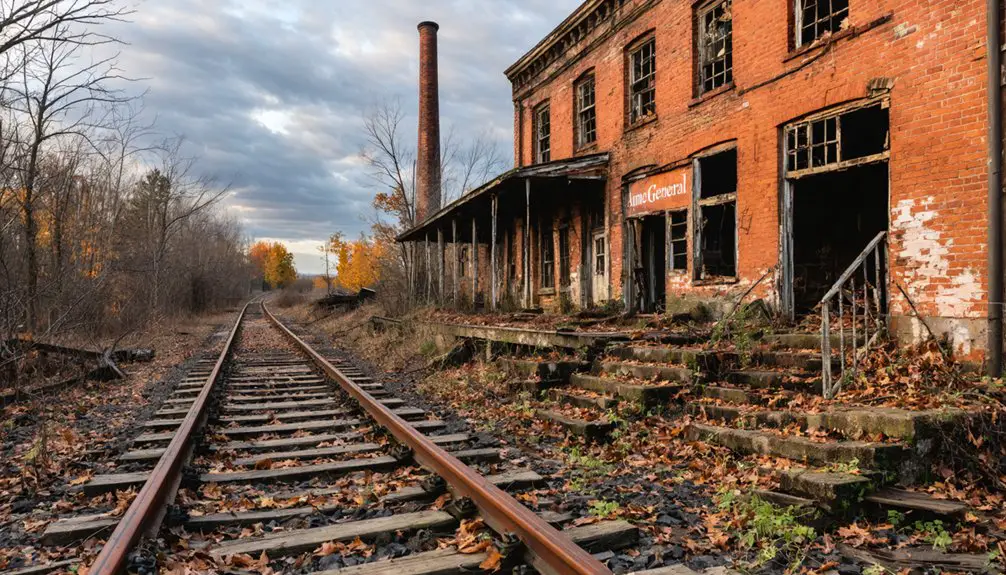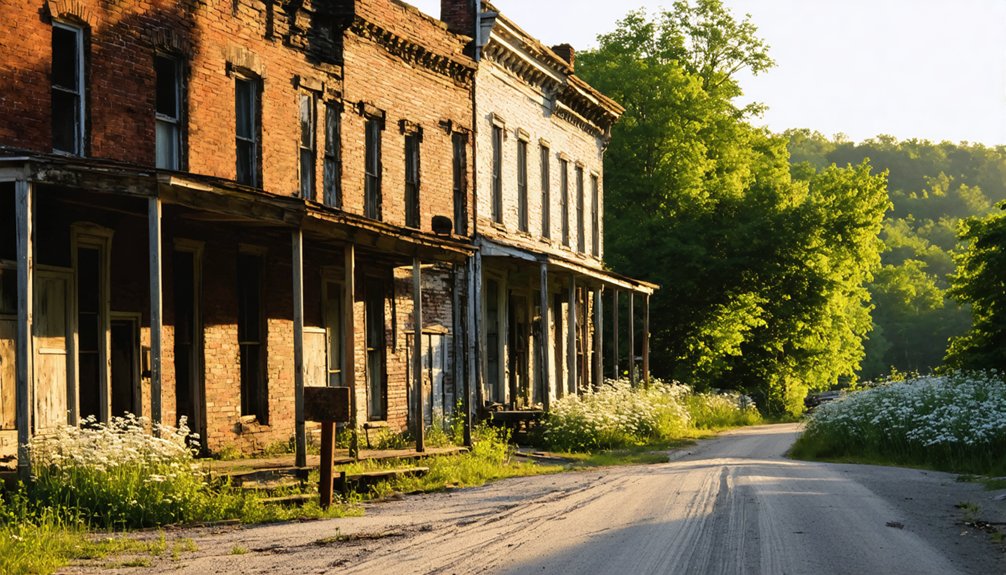
You’ll find Pennsylvania’s best summer ghost town explorations at Pithole, where you can walk through grassy meadows tracing America’s first oil boom, and Yellow Dog Village, a preserved mining town with original furnished homes frozen in time. Eckley Miners’ Village offers authentic 19th-century coal town architecture that once starred in Hollywood films, while the eerie remains of Frick’s Lock hide beneath cooling towers. Summer’s warm weather and extended daylight make these sites safer to navigate than ice-covered winter paths, and the Ghost Town Trail conveniently connects multiple locations for ambitious adventurers ready to uncover Pennsylvania’s industrial past.
Key Takeaways
- Pithole offers mowed pathways through grassy meadows, museum exhibits, and visible street remains, making summer exploration comfortable and accessible.
- Yellow Dog Village provides guided tours, open houses, and volunteer opportunities with intact mining-era buildings surrounded by blooming summer flora.
- Eckley Miners’ Village features authentic 19th-century coal town structures, including company stores and miners’ houses, ideal for immersive summer visits.
- Centralia displays abandoned homes, buckled Route 61, and sulfurous smoke vents, though extreme underground temperatures exceed 1,000°F year-round.
- The Ghost Town Trail connects multiple western Pennsylvania sites like Vintondale and Wehrum, perfect for summer multi-site exploration trips.
Centralia: Pennsylvania’s Infamous Underground Fire Town
On May 27, 1962, borough workers set fire to a trash dump near Odd Fellows Cemetery as part of a routine Memorial Day cleanup—a decision that would transform Centralia from a thriving mining town of 1,500 residents into one of America’s most haunting ghost towns.
The blaze ignited an underground coal seam through an unsealed strip mine opening, spreading through abandoned mine tunnels beneath the borough. Underground fires now burn across 3,700 acres at depths reaching 300 feet, advancing 75 feet annually with enough fuel for another 250 years. Temperatures at the fire site have exceeded 1,000 °F, creating hazardous conditions beneath the surface.
Sulfurous smoke seeps through cracked pavement while sinkholes threaten unwary explorers. In 1981, a dangerous sinkhole nearly swallowed a child, measuring 80 feet deep and highlighting the ground instability caused by the fire below. You’ll find abandoned architecture scattered across this apocalyptic landscape, where fewer than six residents remain among demolished homes and the infamous buckled Route 61—a crumbling highway testimony to nature’s refusal to be tamed.
Pithole: America’s First Oil Boom Ghost Town
You’ll find the Oil Creek History Museum serves as your gateway to understanding Pithole’s meteoric 500-day rise and fall, with artifacts and exhibits documenting when 15,000 fortune-seekers descended on a Pennsylvania farm in 1865.
Walking the abandoned streets today, you’ll follow mowed paths through grassy meadows where 900 wooden buildings once stood—look for the subtle depressions marking old cellars and the weathered Methodist Episcopal Church still standing among the ruins.
Pack water for your visit since Pithole’s original residents faced such severe shortages they drank whiskey instead, and wear sturdy shoes to navigate the uneven terrain where oil derricks once pumped 5,000 barrels daily. The town’s rapid collapse began with 1866 bank failures and a devastating fire on August 2, reducing the population from thousands to just 2,000 by December of that year. The nearby Drake Well Museum & Park displays historical photos and artifacts from Pithole’s brief but explosive existence, including a replica engine house with operational oil machinery.
Oil Creek History Museum
Within sixteen months, a quiet Pennsylvania valley transformed into America’s most explosive oil boomtown—and then vanished just as quickly. You’ll discover this remarkable story at the Oil Creek History Museum, where Pennsylvania’s historic preservation efforts bring the oil industry’s wild origins to life.
The museum’s centerpiece diorama recreates Pithole’s peak, when Edwin Drake’s 1859 discovery sparked unprecedented chaos. You’ll see:
- The world’s first oil pipeline—Samuel Van Syckel’s revolutionary 5.5-mile system that transported 81 barrels per hour
- Interpretive panels along mown streets marking where 20,000 residents once lived
- Exhibits documenting seventeen devastating fires that caused $2 million in damages
Since Pennsylvania assumed ownership in 1963 and opened the visitor center in 1975, you’re free to explore this cautionary tale of boom-and-bust capitalism. At its height, Pithole handled 5,500 pieces of mail daily, making it Pennsylvania’s third-busiest post office despite lasting only 500 days as an active boomtown. The site sits 50 miles southeast of Erie, positioned between the nearest cities of Titusville and Oil City in northwestern Pennsylvania’s historic oil region.
Walking the Abandoned Streets
Standing where whiskey once cost less than water, you’ll walk through what remains of America’s most spectacular oil boom failure.
Mowed paths guide your urban exploration through forests and fields where 15,000 residents once crowded into 900 wooden buildings. Interpretive signs mark former streets where oil and mud once coated everything, but nature’s reclaimed this landscape completely.
The visitor center’s massive diorama helps you visualize the vanished city before you hit the trails. Built in 1972, the center displays exhibits, models, and photographs illustrating the city at its height.
For photography tips: shoot during golden hour when light filters through trees marking old thoroughfares. The meadow grass and scattered markers create hauntingly beautiful compositions. Oil derricks once replaced the white pines and rock maples that originally covered this verdant landscape.
This place went from boomtown to ghost in just 500 days—proof that fortunes built on finite resources don’t last, but their stories endure.
Yellow Dog Village: A Preserved Mining Company Town
You can explore Yellow Dog Village through affordable guided tours offered by the current owners, who’ve preserved this eerie snapshot of early 1900s mining life.
Walk through 19 duplexes and single-family homes where furniture, dishes, and children’s toys still sit untouched—frozen reminders of families who fled during the 2008 E. coli outbreak. The solid 1910s-1920s architecture remains intact beneath peeling paint and shattered windows, making this ghost town less than an hour from Pittsburgh your most authentic summer adventure into Pennsylvania’s coal mining past.
The town originally formed around a limestone mine in western Pennsylvania, where workers lived under a “Yellow Dog contract” that prohibited union membership in exchange for increased wages and improved living conditions. After the mines closed in the 1950s, the village continued to be used until the early 2000s before falling into severe disrepair. A retired history teacher now owns the property and plans to transform it into Limestone Village, an artisan community offering craft education programs.
Guided Tours and Access
Since Yellow Dog Village changed hands in 2022, the current owners have embraced a visitor-friendly approach that lets you explore this eerie time capsule firsthand. You’ll find this 32-acre ghost town near Worthington in Armstrong County, where accessibility improvements now make it easier to wander among 26-34 decaying structures.
For a small fee, you can:
- Join guided tours revealing the site’s coal-mining history and “Yellow Dog” contract origins
- Attend periodic open houses to photograph abandoned interiors filled with left-behind belongings
- Participate in volunteer preservation efforts to help maintain select buildings
The owners even plan overnight stays in renovated houses—imagine sleeping where miners once lived.
Summer’s your ideal window to roam these grounds, peering through shattered windows at furniture frozen in time since 2012’s evacuation.
Preserved 1900s Architecture
Frozen in time since its mining heyday, Yellow Dog Village showcases rare intact examples of early 1900s company town architecture that’ll transport you straight back to industrial-era Pennsylvania. You’ll discover 19 original duplexes and single-family homes constructed between 1910-1925, plus a commanding manager’s house perched atop the hillside.
The structures retain their authentic mining-era layout—streets, chapel, and playground all preserved despite decades of vacancy.
While financial hardships stripped the homes of brass fittings and claw-foot tubs, architectural preservation efforts have maintained the essential bones.
Modern restoration plans promise to revive these buildings without erasing their historical character.
Walk through these semi-abandoned structures, and you’re experiencing a genuine mid-20th-century time capsule—no sanitized museum recreations here, just raw industrial history waiting for you to explore.
Eckley Miners’ Village: Hollywood’s Coal Mining Legacy
When Hollywood needed an authentic coal mining village for the 1970 film “The Molly Maguires,” they found their perfect backdrop in Eckley—a real patch town that had survived nearly unchanged since the 1800s.
Eckley’s authenticity made it Hollywood’s ideal setting—a genuine 19th-century coal town frozen in time for The Molly Maguires.
You’ll walk the same coal-dust shrouded streets that Pinkerton Detective James McParland traversed on screen, discovering how town preservation efforts have maintained this cinematic time capsule.
Explore the authentic structures that tell miners’ stories:
- Slate pickers’ houses: cramped two-room dwellings with thin board-and-batten walls where families squeezed into minimal space
- Company store: where inflated prices and scrip payments kept workers perpetually indebted
- Band practice house: symbol of resilience through music despite harsh conditions
You’ll understand 19th-century mining techniques firsthand, witnessing how breaker boys separated coal from slate in dangerous, dirty conditions that shaped generations.
Frick’s Lock: A Nuclear Age Ghost Town
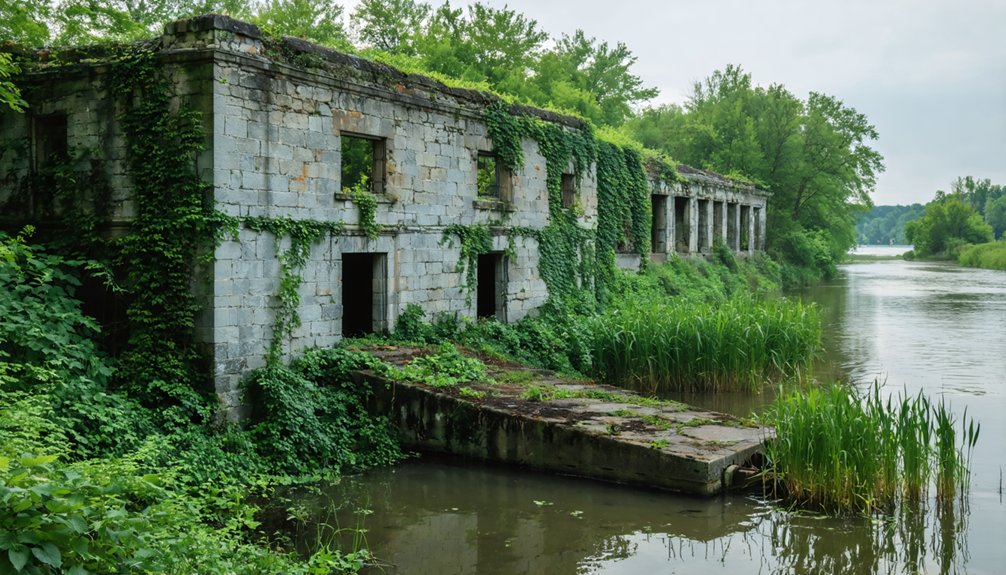
You can’t just wander in—this is private property owned by the power plant operator. However, historic preservation efforts by the East Coventry Historical Commission offer free guided tours several times each summer.
Former child residents sometimes lead these walks, sharing firsthand memories of life before evacuation. The eerie atmosphere, with boarded-up structures shadowed by cooling towers, makes this Pennsylvania’s most unique ghost town experience.
Lausanne: Hidden Ruins Along the Lehigh River
While Frick’s Lock tells the story of mid-century America, Lausanne whispers tales from an even earlier era—Pennsylvania’s coal frontier days. You’ll find this hidden settlement buried beneath railroad yards near Jim Thorpe, where Nesquehoning Creek meets the Lehigh River.
What remains requires archaeological excavation-level searching:
- Stone bridge pillars flanking Jeans Run
- Scattered foundations and walls along the riverbank
- Toll bridge remnants with stones marking all four corners
Founded in 1815 as a coal shipping hub, Lausanne couldn’t survive repeated floods and railroad competition. By 1873, it vanished—covered by tons of coal breaker fill.
Today’s ruins demand careful exploration, almost like art restoration, revealing fragments of sawmills, homes, and Pennsylvania’s industrial birth along ancient warrior paths.
Planning Your Pennsylvania Ghost Town Road Trip
Before you load your trunk with hiking boots and camera gear, understand that Pennsylvania’s ghost towns cluster into distinct regional corridors that’ll shape your entire itinerary.
Pennsylvania’s ghost towns aren’t randomly scattered—they follow deliberate regional patterns that demand strategic planning before your first stop.
The western concentration—spanning Cambria, Indiana, Venango, and Clearfield Counties—forms a logical loop through coal and oil remnants where urban legends still whisper through collapsed frameworks.
Start at the 49-mile Ghost Town Trail‘s Ebensburg trailhead (424 Prave Street), hitting Vintondale and Wehrum before pushing north to Pithole’s oil-boom ruins.
Ghost stories thrive in Petroleum Center‘s silent foundations and Yellow Dog Village‘s overgrown streets.
Check interactive maps for 38 legally explorable sites—skip toxic Centralia entirely.
Download abandoned mine impact maps beforehand.
Summer’s extended daylight grants you freedom to cover multiple locations daily without rushing through history.
What to Bring When Exploring Abandoned Sites
Routes mapped and departure times locked in—now let’s tackle the gear that’ll keep you safe when you’re ducking through Wehrum’s skeletal doorframes or photographing Pithole’s crumbling foundations.
Your safety gear starts with sturdy boots and long sleeves to deflect rusty nails and broken glass. Pack a quality respirator (N95 minimum) because Pennsylvania’s abandoned coal towns harbor serious airborne nasties. Don’t skimp on a powerful headlamp—your phone’s flashlight won’t cut it in windowless mine offices.
Essential items:
- GPS device with offline maps plus marking chalk
- Extensive first aid kit with antiseptic wipes
- Emergency supplies: water purification tablets, energy bars, duct tape
I learned the hard way at Centralia that emergency supplies aren’t optional. When unexpected ground fissures block your planned exit, that backup compass and extra batteries become lifelines, not luxuries.
Respecting History: Ghost Town Visitor Guidelines
The thrill of discovery doesn’t give you license to pocket a rusty mining tag or spray-paint your initials across Wehrum’s last standing wall. Ethical exploration means treating these sites as outdoor museums—photograph everything, take nothing.
Every artifact you leave behind preserves context for researchers and future visitors who crave the same authentic experience you’re seeking.
Stick to established paths to prevent erosion around fragile foundations. That crumbling doorframe isn’t Instagram-worthy if your weight brings it down.
Preservation guidelines exist because these places can’t defend themselves—abandoned doesn’t mean forgotten.
Respect posted warnings about unstable structures and underground fires. Your freedom to explore ends where safety risks and property rights begin.
Document responsibly, tread lightly, and these ghost towns will haunt Pennsylvania’s landscape for generations.
Frequently Asked Questions
Are Pennsylvania Ghost Towns Safe to Visit With Young Children?
You’ll find historical ruins generally safe, but take safety precautions seriously. Watch for unstable structures, bring first-aid supplies, and supervise kids closely around old buildings. I’ve explored these sites—staying alert lets you enjoy freedom while protecting your family.
Do Any Ghost Towns Charge Admission Fees or Require Advance Reservations?
Most Pennsylvania ghost towns offer free access to grounds, but you’ll pay $5-15 for visitor amenities like guided tours and visitor centers. Historical preservation efforts fund these fees. Popular ghost tours need advance reservations, especially during peak seasons.
What Is the Best Time of Day to Photograph Ghost Towns?
You’ll capture ghost towns best during golden hour—that magical early morning photography window or sunset lighting period. Arrive at dawn for pristine shots without crowds, or stay through dusk when warm light dramatically paints abandoned structures in breathtaking amber hues.
Can You Camp Overnight Near Any of These Ghost Town Sites?
Like stepping into a time capsule with a sleeping bag, you’ll find overnight camping at Oil Creek’s ghost town shelters and Yellow Dog Village. Check camping regulations beforehand, pack for wildlife encounters, and embrace the freedom of historical exploration.
Are Pets Allowed When Visiting Pennsylvania’s Ghost Towns?
Pet policies vary by ghost town—you’ll typically need leashes at state parks near ruins, while private sites like Yellow Dog Village welcome well-behaved pets. Always control your dog during wildlife encounters to protect both animals and fragile historic sites.
References
- https://uncoveringpa.com/ghost-towns-in-pa
- https://pabucketlist.com/abandoned-places-in-pa-you-can-legally-explore/
- https://optingoutofnormal.com/2021/04/12/off-the-beaten-path-in-pennsylvania/
- https://www.atlasobscura.com/things-to-do/pennsylvania/ghost-towns
- https://www.youtube.com/watch?v=_u5MUuwynhw
- https://eckleyminersvillage.com
- https://www.britannica.com/video/coal-mine-fire-Pennsylvania-Centralia/-207717
- https://en.wikipedia.org/wiki/Centralia_mine_fire
- https://files.dep.state.pa.us/mining/Abandoned Mine Reclamation/AbandonedMinePortalFiles/Centralia/CentraliaFrequentlyAskedQuestions.pdf
- https://daviddekok.com/centralia-mine-fire/