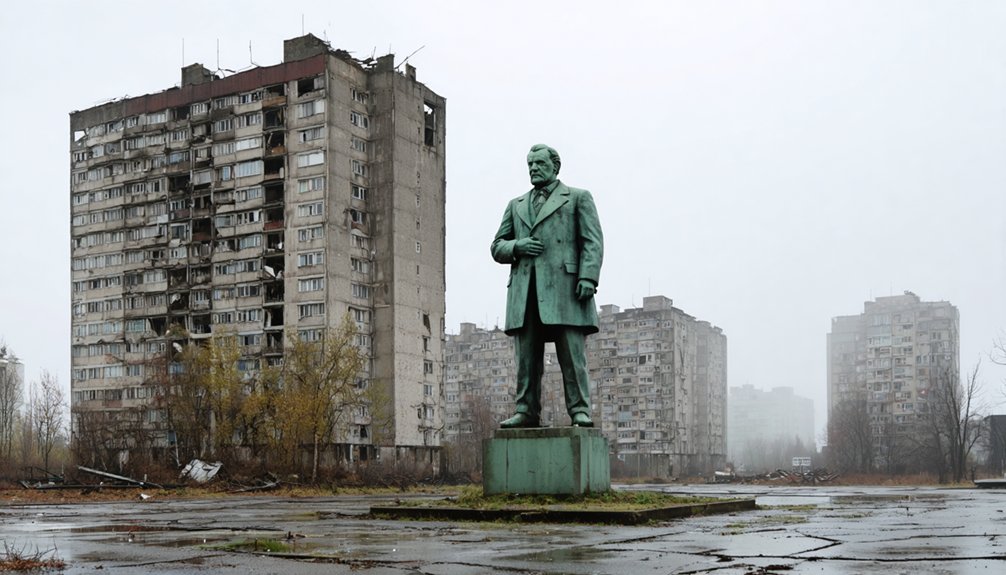
You’ll find over 19,000 officially uninhabited settlements across Russia’s vast territory, from 6,000 ghost villages in western regions like Tver and Pskov to Soviet-era industrial towns in the Ural Mountains and Siberia. These abandoned places include Pyramiden’s Arctic coal settlement, earthquake-destroyed Neftegorsk, radioactive Pryp’yat’, and 663 villages submerged beneath Rybinsk Reservoir. Russia also maintains 44 closed nuclear cities housing 1.5 million residents in settlements that don’t appear on public maps, representing a unique category between inhabited and abandoned—a hidden geography that reveals the full scope of Russia’s demographic transformation.
Key Takeaways
- Russia has approximately 6,000 ghost villages in western and northern territories, with 20,000 settlements completely empty by 2012.
- Monotowns declined after Soviet dissolution, with 319 communities facing economic collapse due to mine closures and unpaid workers.
- Industrial ghost towns like Pyramiden and Vorkuta were abandoned when ore reserves depleted or operations became economically unviable.
- Natural disasters and reservoir construction displaced over 130,000 people, submerging 663 villages beneath artificial lakes like Rybinsk Reservoir.
- Pryp’yat’ became an abandoned exclusion zone after the 1986 Chornobyl reactor explosion forced complete evacuation of its residents.
The Haunting Landscape of Russian Abandonment
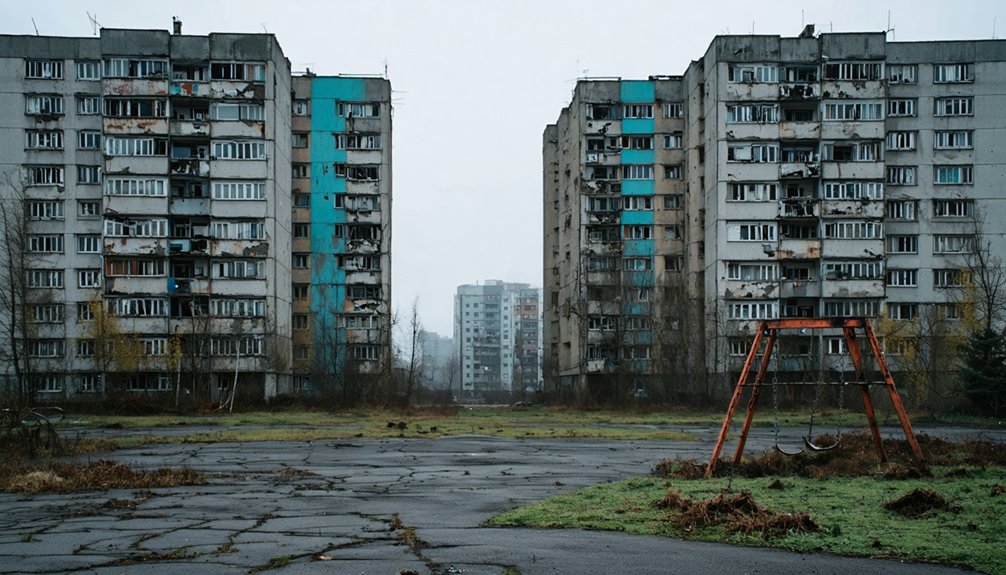
Across the vast expanse of Russia’s western and northern territories, approximately 6,000 ghost villages stand as silent monuments to demographic collapse.
Six thousand abandoned villages across Russia’s northwest bear witness to a nation’s unraveling rural fabric.
You’ll find Timnovo with zero residents, Molodoshkovo’s seven looted houses with billowing drapes, and Yesinovichi—once a district center—now completely burnt-out.
The Tver region leads this exodus with 2,500 uninhabited settlements, while Pskov’s population plummeted 11.5% between 2002 and 2010.
Cultural remnants scatter through these spaces: torn photographs, abandoned farm tools, crumbling Tsarist estates.
Economic impacts devastate surrounding areas—muddled land ownership deters repopulation, while entire communities vanish far from urban centers.
Of Russia’s 150,000 villages, 36,000 house single residents and 20,000 sit completely empty, surpassing other developed nations in rural abandonment severity. The collapse of Soviet agriculture accelerated urban migration, transforming once-productive farming communities into desolate wastelands. Around Vorkuta, a ring of settlements and mines once supported 13 operational mines and 10 communities, now reduced to just four of each.
Arctic Ghost Settlements: Life and Death in the Far North
Beyond the Arctic Circle, Russia’s northernmost settlements face extinction on an unprecedented scale.
You’ll find the Kola Peninsula’s population collapsed from 1.2 million to 732,864, while Chukotka lost 70 percent of its residents. Kamchatka’s Koryak okrug hemorrhaged 65 percent through relentless out-migration.
Economic collapse devastated Arctic Survival when state subsidies vanished. Vorkuta’s thirteen mines dwindled to four. Pyramiden’s population plummeted from 1,500 to 500 workers. Severny cratered from 20,000 to 3,600 before its mine closed after killing thirty-six workers.
Yet Cultural Resilience persists in deteriorating settlements where boarded houses still show lights burning. Tiksi holds 4,000 souls, down from 11,000. Many settlements were completely abandoned as out-migration exceeded one-third of the Russian Arctic’s population. Moscow’s new Arctic standard initiative proposes a 417-page design code covering everything from street lighting to building paint schemes.
These communities survive on winter roads and summer barges, clinging to existence despite Moscow’s indifference toward the ethnic homelands bleeding populations eastward.
When Disaster Strikes: Natural Catastrophes That Erased Communities
While human decisions emptied Russia’s Arctic settlements, nature itself obliterated communities in minutes.
On May 28, 1995, a 7.6-magnitude earthquake destroyed Neftegorsk on Sakhalin Island in seventeen seconds, killing 2,040 of 3,197 residents. You’ll find no disaster recovery here—survivors relocated permanently, leaving houses crumbled to dust.
Water swallowed towns more gradually.
Mologa’s 7,000 residents spent four years dismantling their homes before the 1941 flooding for Rybinsk Reservoir. The ancient fortress Sarkel disappeared underwater during Tsimlyansk Reservoir‘s 1952 construction; divers now locate its remnants. Vesyegorsk faced similar fate in 1943, with women primarily conducting the resettlement work as men had been drafted into WWII.
In 2002, flooding along Sadonka River buried Sadony village in mud, rendering first floors uninhabitable.
Ukraine’s Pryp’yat’ suffered a different catastrophe when the April 1986 reactor explosion at Chornobyl released radioactive emissions, forcing the evacuation of all 49,000 residents within hours and transforming the modern city into an abandoned zone.
These catastrophe sites remain largely inaccessible, though ghost town tourism occasionally brings visitors when reservoir levels drop, revealing submerged foundations.
Soviet Industrial Legacy: Mines That Built and Broke Towns
You’ll find the Soviet Union’s most ambitious industrial projects concentrated in three harsh environments: the Ural Mountains’ coal seams, Siberia’s Arctic mineral deposits, and the Kuznetsk Basin’s coalfields.
These sites demanded massive labor forces—often prisoners—and spawned entire cities around single-resource extraction, from Vorkuta’s thirteen coal mines encircling the Arctic settlement to Norilsk’s nickel operations on the Putorana Plateau. Magnitogorsk exemplified this pattern, founded in 1929 around Mount Magnitnaya’s high-grade iron ore deposits to become the capital of Soviet iron and steel industry with a population reaching 413,000. Norilsk began with the Norillag labor camp established in 1935, employing prisoners to extract the region’s vast nickel deposits under brutal Arctic conditions.
When ore reserves depleted or post-Soviet economics made operations unprofitable, populations that once numbered in the hundreds of thousands abandoned these purpose-built communities, leaving ghost settlements connected by highways to nowhere.
Coal and Tin Boom
In 1930, geologist Georgy Chernov discovered coal fields near the Vorkuta River in the Pechora coal basin, triggering one of the Soviet Union’s most ambitious—and brutal—Arctic industrialization projects.
You’ll find the Vorkuta legacy built on GULAG prisoner labor, who constructed settlements 100 miles north of the Arctic Circle starting in 1931. Hundreds died from hypothermia, starvation, and disease while building a narrow-gauge railroad in just 145 days.
Mining hardships intensified during WWII when operations expanded from one to eleven mines, creating the “Vorkuta ring” of settlements. High state investments transformed this frozen wasteland into a thriving company town with neoclassical buildings, panel housing, and generous northern benefits—a showpiece of Soviet power that masked its foundation of human suffering.
Voluntary migration and northern benefits attracted workers, swelling Vorkuta’s population to 116,000 by 1989.
By the early 21st century, many mines closed due to high operational costs, leaving workers unpaid in the late 1980s and 1990s and accelerating the town’s decline.
Post-Soviet Economic Collapse
The neoclassical facades and generous northern benefits couldn’t outlast the Soviet state that built them. When the USSR dissolved in 1991, approximately 319 monotowns—communities built around single enterprises like metallurgical plants and mines—faced immediate economic despair.
These settlements, which contributed 40% of GDP, watched their foundational industries collapse or dramatically scale back operations. The 2008 financial crisis delivered another devastating blow, exposing monotowns as crisis epicenters.
You’ll find shrinking living spaces, fewer hospital beds, and deteriorating infrastructure throughout these communities. Local budget deficits accelerated the decay while young populations fled.
Yet community resilience persists in some locations, where residents navigate reduced public facilities and stifled business opportunities, clinging to settlements that Soviet planners once deemed permanent.
Stranded Arctic Mining Communities
Four hundred meters above Pyramiden‘s abandoned apartment blocks, the coal mine that justified this Arctic settlement‘s existence carved into permafrost that Soviet planners believed would yield prosperity for generations.
You’ll discover these Svalbard settlements produced merely one-thousandth of Kuzbass region coal—economically absurd ventures sustained through motherland subsidies.
Strategic realities behind Arctic outposts:
- Pyramiden’s 1,100 residents evacuated throughout summer 1998 after March 31st final extraction
- Barentsburg survived closure due to ice-free positioning at Isfjorden entrance
- 1920 Svalbard Treaty granted all signatories commercial rights, legitimizing territorial claims through mining
- Putin’s 2019 Svalbard Committee signals continued geopolitical interest beyond mineral extraction
These weren’t profit-driven enterprises—they demonstrated communist achievement while maintaining Western hemisphere presence that Russia values today.
Submerged Beneath the Waters: Reservoir-Drowned Settlements
During the late 1930s and 1940s, Soviet industrialization drowned entire communities beneath artificial reservoirs, transforming vibrant settlements into submerged ghost towns.
You’ll find Mologa’s remains beneath Rybinsk Reservoir, where 663 flooded villages disappeared under 5,000 square kilometers of water. The regime forcibly relocated 130,000 people, using Volzhsky camp prisoners for construction.
The Soviet regime erased 663 villages and displaced 130,000 people to create Rybinsk Reservoir using forced labor from Volzhsky camp.
Kalyazin’s historical center vanished under Uglich Reservoir, erasing twelve centuries of heritage—only its bell tower remains as a haunting reminder.
The Angara River’s Atalanka joined this catalog of submerged heritage in 1961.
While the 2023 Kakhovka Dam destruction wasn’t intentional flooding, it echoed this pattern, drowning 24 Ukrainian villages and displacing 17,000 people.
These reservoirs prioritized industrial power over human communities and cultural preservation.
Rural Exodus: The Disappearing Villages of Western Russia
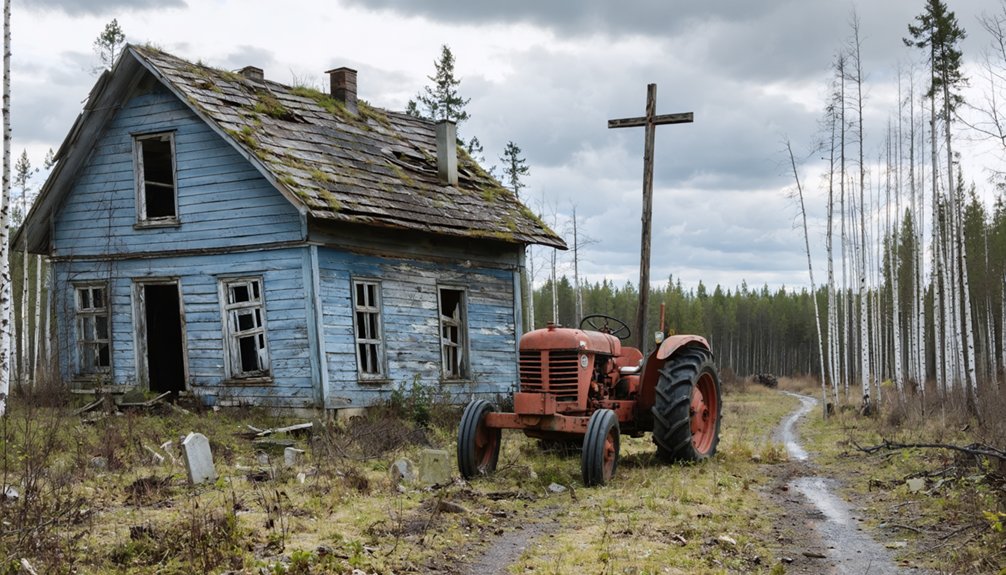
Between 1989 and 2010, Russia’s uninhabited settlements more than doubled from 9,400 to 19,400, marking an unprecedented rural collapse across the country’s western territories.
You’ll find this rural migration most severe in Central Russia, where employment scarcity and school closures drove systematic depopulation. By 2012, 153,100 rural settlements existed, yet only 133,700 remained inhabited—leaving 30,000 existing solely on paper.
The exodus follows predictable patterns:
- Youth departure accelerates as 50% consider urban relocation for employment opportunities
- Infrastructure collapse intensifies—40% of schools closed by 2018
- Seasonal village revival occurs as 10-12 thousand “paper” settlements gain summer residents
- De-urbanization emerges with business-minded urbanites creating agro-tourism ventures in abandoned territories
This cycle continues reshaping Russia’s demographic landscape.
Military Ghosts: Decommissioned Bases Frozen in Time
Across Russia’s military archipelago, you’ll find bases like Bechevinka where tank storage yards once held 884 vehicles in March 2023 but retained only 815 by September 2024—concrete evidence of systematic depletion rather than abandonment.
The Far North’s military settlements have lost 20-30% of their populations since 2022, transforming operational zones into skeletal outposts where infrastructure decays faster than snow accumulates.
At sites like Aerodrome Neutief, you can trace the arc of Soviet expansion and post-invasion contraction through empty hangars and stripped equipment lots that mirror the 3,825 tanks extracted from central storage bases.
Bechevinka’s Crumbling Military Infrastructure
Hidden within Kamchatka’s volcanic coastline, Bechevinka once bristled with Soviet naval power as a diesel-torpedo-submarine base that housed the 182nd submarine brigade’s twelve vessels after their 1971 transfer.
Today, Bechevinka decay transforms this secret facility into a haunting snapshot of abandoned Soviet relics.
You’ll find crumbling infrastructure throughout the site:
- Eight residential towers (3-5 stories) where submariner families lived without ground transport connections
- Military command structures including headquarters, barracks, fuel warehouses, and diesel substations
- Fortified hill positions with armored lookout posts and gun emplacements guarding the vulnerable bay entrance
- Civilian buildings such as the school, kindergarten, and post office serving the isolated community
Since 1996’s garrison disbandment and 1998’s official write-off, Kamchatka’s harsh climate steadily consumes these structures, preserving Cold War secrecy in rust.
Abandoned Aerodrome Neutief Tours
On the Vistula Spit’s narrow Baltic coastline, 5 km southwest of Baltiysk center in Kaliningrad Oblast, Aerodrome Neutief stands as Germany’s architectural legacy frozen in Russian territory.
You’ll discover two heated concrete abandoned runways forming an X-shape—1 km and 2 km long—built between 1936-1939 for Luftwaffe operations. The base housed fighters, bombers, and seaplanes including Arado 196s and Heinkel variants until 1945.
Walking or biking the 4 km approach reveals eerie hangars: three reinforced concrete structures and two metal buildings, mostly German-origin.
Soviet forces operated Beriev Be-6 and Be-12 seaplanes from the northeast harbor until 1992. At coordinates 54°36′36″N 19°52′6″E, this abandoned military complex attracts those seeking unguarded glimpses into Cold War infrastructure—no official tours restrict your exploration through what was once considered the era’s finest military aerodrome.
Visiting the Void: Tourist-Accessible Abandoned Sites
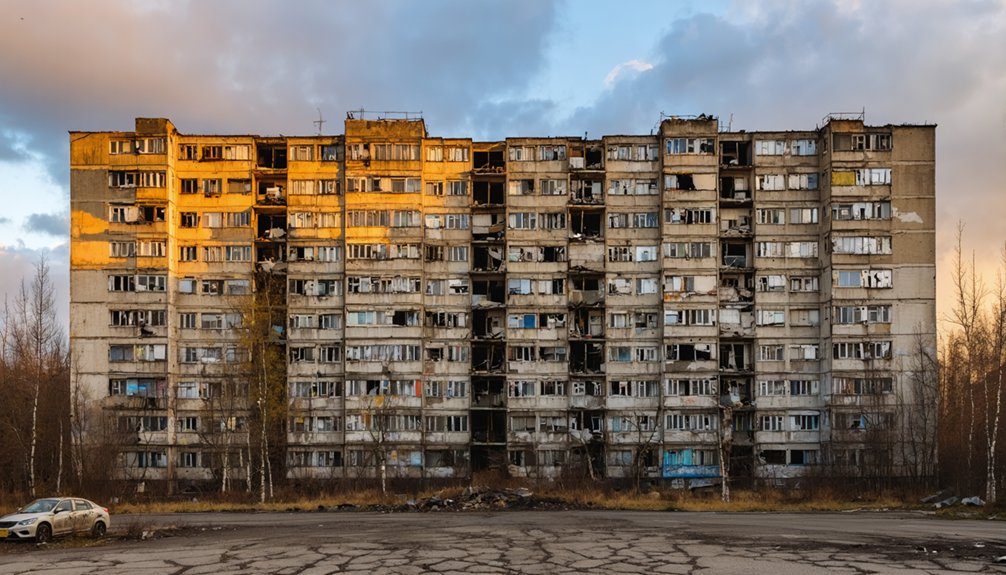
While many Russian ghost towns remain inaccessible due to remote locations or legal restrictions, several abandoned sites now welcome visitors who seek firsthand encounters with Soviet-era ruins.
Despite decades of isolation, select Russian ghost towns have transformed from forbidden zones into destinations for travelers seeking authentic Soviet decay.
Notable Tourist-Accessible Locations:
- Kadykchan exploration requires a 90-minute drive from Susuman along the Kolyma Highway, where you’ll find Gulag-built structures and climbable fire towers overlooking swampy terrain.
- Pyramiden tourism thrives in Arctic Svalbard, where preserved interiors and an Olympic-sized pool attract adventurers to this 1998-abandoned mining settlement.
- Gamsutl history unfolds atop Mount Gamsutlmeer in Dagestan, earning 4.7 Tripadvisor ratings for its ancient mountaintop ruins.
- Dagdizel ecology dominates offshore exploration, where birds inhabit this 1939 Caspian Sea military facility accessible via helicopter or winter snowmobile.
Kaliningrad’s House of Soviets offers urban exploration without leaving city limits.
Closed Cities: Russia’s Secret Towns Between Life and Death
Russia’s 44 publicly acknowledged closed cities occupy a peculiar category—neither fully alive nor abandoned. Their 1.5 million residents exist in settlements that don’t appear on maps and require special permits for entry.
These *zakrytye administrativno-territorial’nye obrazovaniya* (ZATO) emerged from Stalin’s nuclear weapons program, built by Gulag prisoners around facilities like Sarov and Ozersk, where plutonium production and warhead development demanded absolute secrecy.
You’ll find concrete walls encircling cities where birth certificates still list false locations, where polar nights in Severomorsk remain inaccessible to foreigners, and where Rosatom and the Ministry of Defence maintain administrative control over populations living in Russia’s shadow geography.
Nuclear Heritage and Secrecy
During the 1940s, Stalin’s government erected an invisible architecture of secrecy across the Urals and Siberia, establishing closed cities that would vanish from Soviet maps yet house the nation’s nuclear arsenal.
You’ll find that nuclear secrecy defined every aspect of these settlements, from their postal code designations—Ozersk as “City 40,” Zarechny as “Penza-19″—to their complete erasure from censuses and transportation routes.
Urban isolation manifested through multiple mechanisms:
- Physical barriers: Barbed wire fences and armed checkpoints surrounded facilities like Mayak nuclear plant.
- Information control: Code words replaced technical terms; “zero points” meant neutrons.
- Social surveillance: Constant informers monitored scientists; criminal prosecution awaited anyone divulging their residence.
- Geographic concealment: Remote locations near Ural rivers, strategically positioned beyond enemy bomber range.
This system created paradoxical communities—simultaneously thriving research centers and invisible prisons.
Population Control and Access
Behind the classified postal codes and administrative euphemisms, Russia maintains 44 publicly acknowledged closed cities—sealed urban centers housing approximately 1.5 million residents under conditions that blur the boundary between state protection and imprisonment.
You’ll find 75% administered by the Ministry of Defense, the remainder under Rosatom’s nuclear authority, with an estimated 15 additional undisclosed locations.
Urban isolation reaches physical extremes: barbed wire perimeters, armed checkpoints, absolute foreigner exclusion. You can’t simply leave—local citizens need special permission for travel, while prospective residents face vetting by NKVD successor agencies.
This population surveillance extends beyond movement control into demographic manipulation. By 2019, fertility rates dropped to 1.5 children per woman.
Meanwhile, Rosstat suspended essential statistics reporting in 2025, concealing mortality data as wartime mobilization depletes these already-restricted communities.
Modern Life Behind Fences
While Ozyorsk residents listed Chelyabinsk on their birth certificates and Sarov appeared on maps as Arzamas-16, the material reality inside these classified perimeters contradicted every Soviet-era shortage you’d encounter beyond the barbed wire.
Modern isolation in closed cities maintains distinct characteristics:
- Thirty-eight closed administrative-territorial entities operate across Russia as of January 2025, governed by nuclear, aerospace, defense, and laser research priorities.
- Food abundance during perestroika contrasted sharply with empty shelves in open cities, rewarding classified labor.
- Twenty-three Ministry of Defence settlements experience accelerated depopulation—20-30% drops since Ukraine’s invasion, two to three times civilian rates.
- Hidden communities in Far North locations like Severomorsk and Polyarny face compounding crises: military deaths, personnel relocations, and three-decade demographic decline.
Entry permits sustain strategic secrecy while Russia’s population contracts to 146.0 million.
The Human Cost: Stories From Russia’s Last Remaining Residents
Maria Ivanovna’s death on New Year’s Day 2011 extinguished the last flicker of life in Timnovo, a Pskov region village that once housed more than 50 residents.
These ghost village narratives reveal a pattern: Molodoshkovo’s seven deserted houses now contain only rubbish and farm tools after looters stripped valuables.
Yet resident resilience persists in unexpected forms. You’ll find Lecha, a Donbass miner, living alone in Spirdovo, hunting and picking berries between drinking sessions in neighboring settlements.
Sasha Ivanov refuses urban life, continuously repairing his parents’ crumbling home in Elyakovo, where nine houses once stood.
Twenty elderly souls remain in Valchek, clinging to familiar ground despite muddled land ownership rights and economic collapse that’s driven nearly 11 million Russians abroad since 1991.
Frequently Asked Questions
Can You Legally Purchase Property in Russian Ghost Towns?
You can legally purchase property in Russian ghost towns if you’re a Russian citizen, though legal restrictions vary by region. Property ownership requires maneuvering through bureaucratic registries, obtaining proper documentation, and verifying clear title through archival records.
Are Ghost Towns in Russia Safe From Radiation Contamination?
You’d hope abandonment means safety, but Russia’s ghost towns carry significant contamination risk. Chernobyl’s exclusion zone, Bryansk’s cesium-137 deposits, and Moscow’s orphan sources create ongoing radiation exposure dangers across formerly inhabited settlements.
What Permits Are Required to Visit Closed Military Sites?
You’ll need FSB-issued permits weeks ahead, specifying your itinerary and reason for visiting ZATOs. Military regulations and tourism restrictions severely limit foreigner access, often requiring passport surrender, with applications processed through local FSB departments regionally.
Do Any Ghost Towns Still Have Electricity or Running Water?
Like Pompeii’s frozen moment, you’ll find most Russian ghost towns lack modern amenities entirely. Urban exploration reveals occasional functioning wells in recently-abandoned settlements, though electrical grids typically fail first when populations leave.
In a similar vein, the ghost towns of Saskatchewan history evoke a sense of lost opportunity, with remnants of once-thriving communities scattered across the landscape. Overgrown streets and crumbling buildings stand as silent witnesses to the stories of those who called these places home. Exploring these sites offers a poignant glimpse into the past, capturing the spirit of resilience that characterized the settlers of the region.
How Many People Have Died Exploring Abandoned Russian Settlements?
There’s no official death count for modern explorers in abandoned Russian settlements, though you’ll face exploration hazards like structural collapse, toxic materials, and extreme cold. Urban legends circulate, but documented fatalities remain unverified and regionally scattered.
References
- https://www.youtube.com/watch?v=kZTJer7nWAE
- https://www.atlasobscura.com/things-to-do/russia/ghost-towns
- https://theworld.org/stories/2016/08/01/russias-ghost-towns
- https://www.tripadvisor.com/Attractions-g294459-Activities-c47-t14-Russia.html
- https://www.youngpioneertours.com/russian-closed-cities/
- https://en.wikipedia.org/wiki/Category:Ghost_towns_in_Russia
- https://en.wikipedia.org/wiki/Category:Former_populated_places_in_Russia
- https://en.wikipedia.org/wiki/List_of_ghost_towns_by_country
- https://www.gw2ru.com/travel/1490-vorkuta-ring-abandoned-settlements
- https://www.youtube.com/watch?v=RlzljW849Ow&vl=en