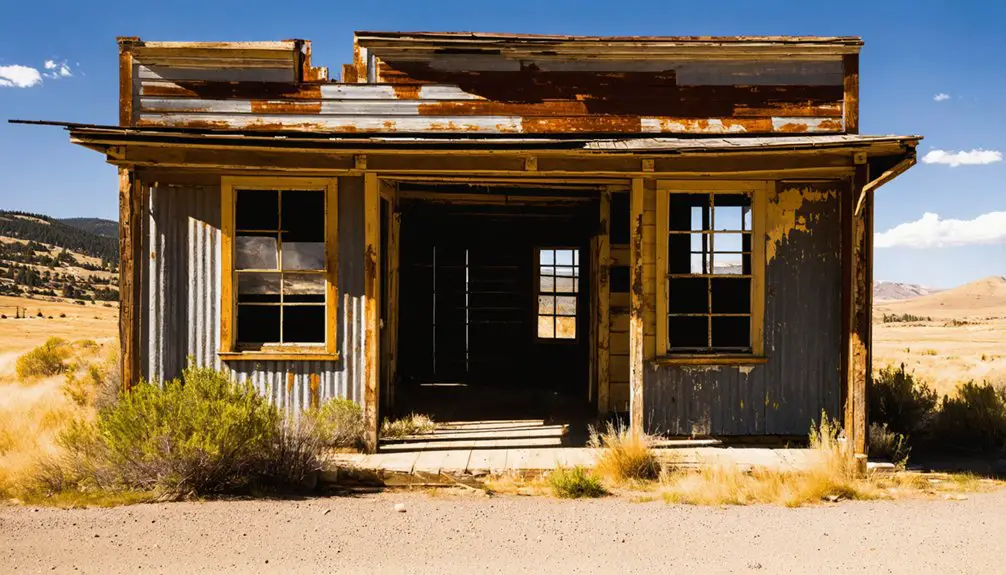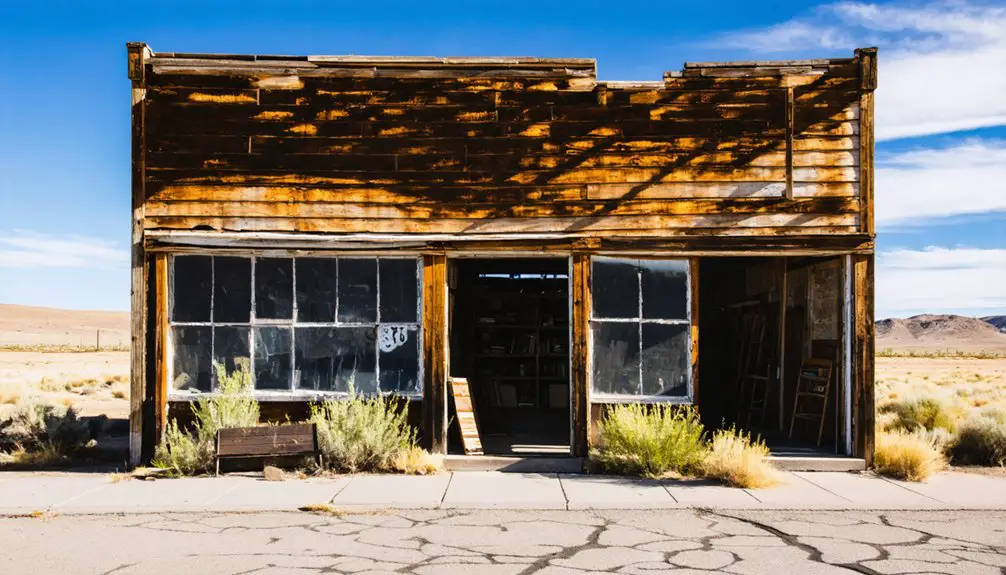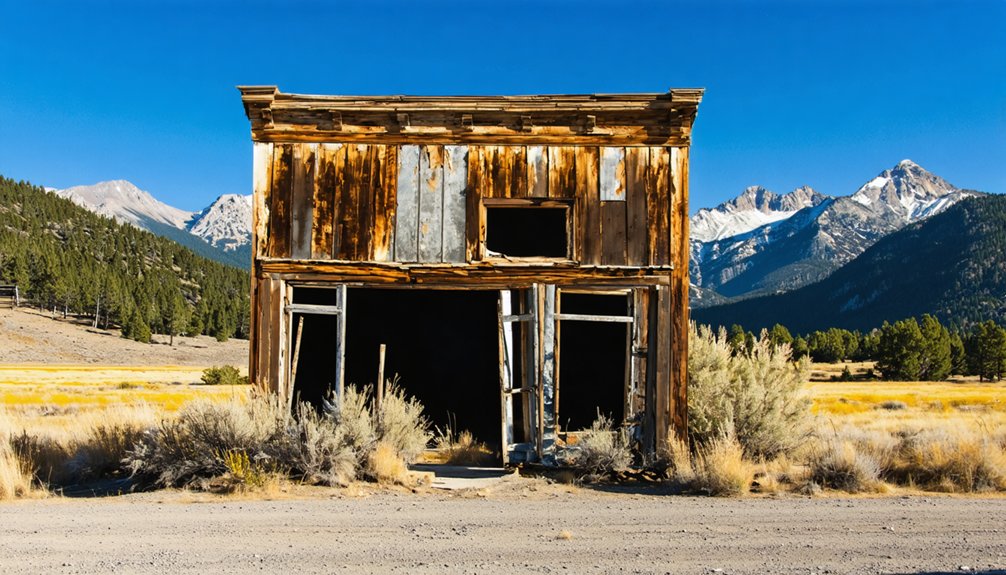
You’ll find Southwest Oregon’s most significant ghost towns in the gold-rich valleys of Jackson and Josephine Counties, where 1850s mining camps left weathered remnants along the Applegate and Illinois Rivers. Buncom preserves three early-1900s structures from its Chinese mining origins, while Golden—Oregon’s only state-owned ghost town—protects four buildings including an 1852 church. Sterlingville vanished entirely after 1,200 residents abandoned it in 1860, leaving only a cemetery accessible via Cady Road. The Illinois River Valley harbors additional forgotten camps where overgrown trails reveal authentic frontier narratives beyond these primary sites.
Key Takeaways
- Southwest Oregon features historic ghost towns from the 1850s gold rush era, primarily concentrated in Josephine County along river valleys.
- Buncom, established in 1851, preserves three early 1900s structures and hosts annual Buncom Day heritage celebrations each May.
- Golden is Oregon’s only state-owned ghost town, featuring four historic structures including an 1852 church available for self-guided tours.
- Sterlingville vanished by 1860 after peaking at 1,200 residents, leaving only a cemetery accessible via Highway 238 and Cady Road.
- Illinois River Valley contains numerous mining camps offering authentic wilderness exploration beyond typical regulated tourist experiences.
Buncom: A Well-Preserved Mining Settlement
Nestled at the confluence of the Little Applegate River and Sterling Creek, Buncom emerged in 1851 when Chinese miners followed gold discoveries that had already transformed nearby Jacksonville and Sterling Creek into bustling centers of extraction.
Chinese miners sought fortune at the confluence of two waterways, creating Buncom in gold-rich Southern Oregon territory.
You’ll find Buncom history etched into traditional Athapaskan Dakubetede homelands, twenty miles southwest of Medford. The settlement became a crucial supply hub for Little Applegate Valley‘s independent farmers and ranchers who couldn’t make Jacksonville’s day-long wagon journey frequently.
Gold depletion forced abandonment by 1920, yet three structures survive. Buncom architecture from the early 1900s—a post office, cookhouse, and bunkhouse—stands preserved by the Buncom Historical Society since 1990. The General Store and Livery Stable once anchored this remote outpost, serving the miners and farmers who carved lives from the surrounding hills. Each last Saturday in May, the Buncom Historical Society organizes Buncom Day to celebrate local heritage and raise funds for preservation efforts.
These buildings represent Oregon’s best-maintained mining settlements, offering you tangible connections to autonomous frontier existence before automobiles eliminated geographic isolation.
Golden: Oregon’s State Heritage Ghost Town
Three miles east of I-5 along Coyote Creek, Golden stands as Oregon’s only state-owned mining ghost town—a distinction that sets it apart from dozens of abandoned settlements across the state’s gold country.
You’ll find four primary structures here: the 1852 Golden Community Church built by Rev. William Ruble, a mercantile building, residence, and shed.
This Golden Heritage site differs from typical mining camps—it prominently featured two churches but no saloons in its town center.
After the Oregon Parks and Recreation Department acquired the property in 2002, they designated it a state heritage site and added it to the National Register of Historic Places.
You can explore self-guided tours with interpretive signs, accessing the ghost town via Coyote Creek Road from Interstate 5.
The site is open for day use year-round, allowing visitors to experience this piece of Oregon’s mining history whenever they choose to visit.
The town’s population peaked at 150 residents during its operational years in the late 1800s.
Sterlingville: The Vanished Mining Hub
Unlike Golden’s preserved churches and orderly heritage, Sterlingville exploded into existence and vanished almost completely, leaving only a hilltop cemetery to mark where 1,200 fortune-seekers once crowded along Sterling Creek.
When James Sterling and Aaron Davis struck gold in 1854, miners swarmed the site before Sterling could even return with provisions. Jackson County Court formalized the boom by establishing Sterling election precinct that July.
Sterlingville history reflects Oregon’s wildest mining legacy—saloons, gambling houses, and dance halls filled streets during the 1850s peak.
By 1860, abandoned shafts undermined empty buildings. The 1870 census found only derelict structures. Farmers replaced miners, working claims seasonally until operations ceased in 1957.
Today, you’ll find Sterlingville Cemetery 4.2 miles from Buncom, where typhoid and diphtheria headstones tell stories no town remains to witness. Tall eucalyptus and fir trees surround the site, accessed via a dirt road with an aluminum gate. The cemetery stands as the only remaining feature of what was once a thriving gold mining community.
Illinois River Valley’s Forgotten Camps
The Illinois River Valley concealed dozens of mining camps whose fortunes rose and fell between the 1850s and early 1900s. Their remote locations in southwestern Josephine County ensured obscurity even during productive years.
Southwestern Josephine County’s remote mining camps flourished and faded in obscurity, their isolation guaranteeing anonymity even during their most prosperous decades.
You’ll find these Valley Camps scattered across rolling hills and reclaimed forests, each telling stories of boom-and-bust cycles.
Notable remnants you can explore:
- Holland Mining community maintaining 200 residents amid accessible historical sites
- Waldo Ghost Town standing completely abandoned with dilapidated Gold Rush structures
- Almeda Mining area hiding among hills with early prospecting traces
- Cave Junction serving as your gateway with 2,000 residents
- Overgrown pathways and forest-reclaimed settlements throughout
These settlements shifted from gold extraction to logging before most disappeared entirely, leaving you authentic wilderness exploration opportunities far from highways. Many of these towns now exist as unincorporated communities with minimal infrastructure remaining from their prosperous days. Kerby preserves its mining heritage through the Kerbyville Museum while housing approximately 500 residents along the Redwood Highway.
Understanding Oregon’s Ghost Town Legacy
Across Oregon’s varied terrain, historians have documented between 200 and 256 ghost towns, giving the state the country’s highest concentration of abandoned settlements according to Visit Oregon’s tourism records.
You’ll find most sites scattered through central, eastern, and southern regions, where 19th-century gold rushes and timber operations created boom-and-bust cycles. State statute defines these locations as historic towns of interest with no residents, though some persist with minimal populations.
Their cultural significance extends beyond empty structures—they’re physical records of frontier economies that collapsed when mines depleted or lumber markets declined. Historical narratives reveal communities like Sumpter peaked at 2,000 residents before resource exhaustion triggered abandonment. Many settlements also disappeared due to flooding and natural disasters that forced residents to relocate or rebuild elsewhere.
Not all ghost towns emerged from mining activity—Fairfield served as a grain port in the Willamette Valley during the 1850s and 1860s before river transportation declined.
Today, you can trace these settlements through cemetery plots, National Register listings, and preserved buildings that document Oregon’s expansion era.
Visiting and Exploring These Historic Sites
When you venture into southwest Oregon’s backcountry, you’ll encounter three distinct ghost town sites that preserve the region’s 1840s-1850s gold rush heritage.
Each location offers unique access to historical artifacts and atmospheric settings where ghost stories naturally emerge from creaking structures and shadowed woodlands.
Essential Site Details:
- Buncom (Jackson County): Founded 1851, features preserved silver, chromite, and cinnabar mining remnants alongside gold operations.
- Golden (Josephine County): Four remaining structures including church and store/post office; designated State Heritage Site with no modern amenities.
- Sterlingville Cemetery: Only trace of 1,200-resident township; access via Highway 238 west to Cady Road, then Sterling Creek Road 6.3 miles.
Travel Medford routes connect these atmospheric locations, where overgrown brush and eerie silence transport you beyond regulated tourist experiences into authentic frontier history.
Frequently Asked Questions
What Safety Precautions Should Visitors Take When Exploring Abandoned Ghost Town Structures?
Before you livestream your adventure, pack essential safety gear including flashlights and first-aid kits. Never enter Southwest Oregon’s decaying structures—their compromised structural integrity risks collapse. Watch for rusty nails, toxic mine water, and unstable foundations near coastal sites.
Are There Guided Tours Available for Southwest Oregon Ghost Towns?
You’ll find limited guided tours for southwest Oregon’s ghost towns. Travel Dream West offers customizable day tours with local historians, while Buncom and Golden remain primarily self-guided experiences where you’re free to explore independently.
Can Visitors Use Metal Detectors to Search for Artifacts in These Areas?
You can’t just treasure-hunt freely—metal detecting regulations require written permission at ghost towns like Buncom and Hardman. Artifact preservation laws mandate reporting historic finds over 100 years old to authorities, ensuring Southwest Oregon’s mining heritage remains protected.
What Wildlife Might Visitors Encounter When Exploring These Remote Ghost Town Sites?
You’ll encounter wildlife sightings including deer, elk, black bears, and coyotes in these forested elevations. Fauna diversity spans mountain lions, eagles, and smaller mammals throughout Buncom’s pines and Golden’s ancient woodlands, reflecting Oregon’s wilderness character.
Are Overnight Camping Facilities Available Near Any of These Ghost Towns?
You’ll find Wolf Creek Campground operates minutes from Golden Ghost Town along Interstate 5, while Jackson County provides camping options near Buncom. Check reservation details beforehand, as southern Oregon’s heritage sites coincidentally cluster within concentrated touring areas.
References
- https://www.travelmedford.org/southern-oregon-ghost-towns-
- http://www.photographoregon.com/ghost-towns.html
- https://en.wikipedia.org/wiki/List_of_ghost_towns_in_Oregon
- https://indigocreekoutfitters.com/news/2022/05/05/exploring-southern-oregons-ghost-towns/
- https://www.roy-stevenson.com/ghost-towns-oregon.html
- https://www.oregonencyclopedia.org/articles/ghost_towns_illinois_river_valley/
- https://www.pdxmonthly.com/travel-and-outdoors/2025/10/oregon-ghost-towns-history
- https://info.oregon.aaa.com/ghost-towns-of-oregon-and-idaho-experience-the-lore-history-and-intrigue-of-days-gone-by/
- https://traveloregon.com/things-to-do/culture-history/ghost-towns/
- https://bentoncountymuseums.org/vanished-towns-of-benton-county-oregon-pt-2/