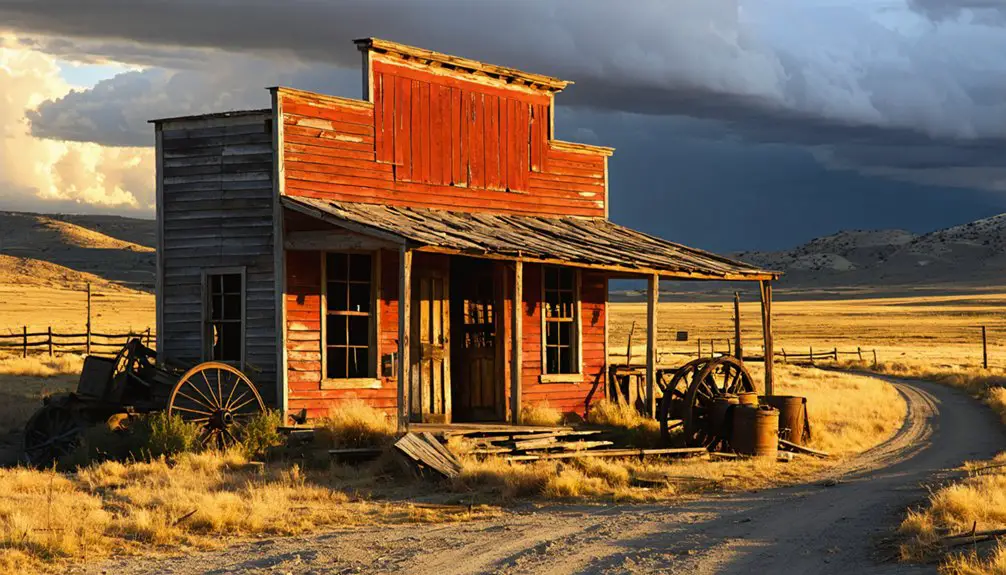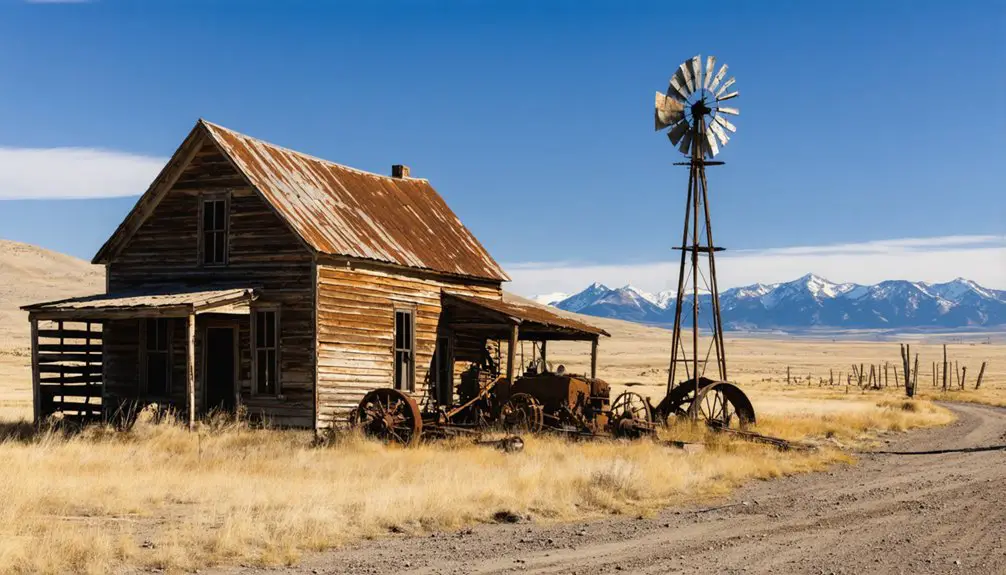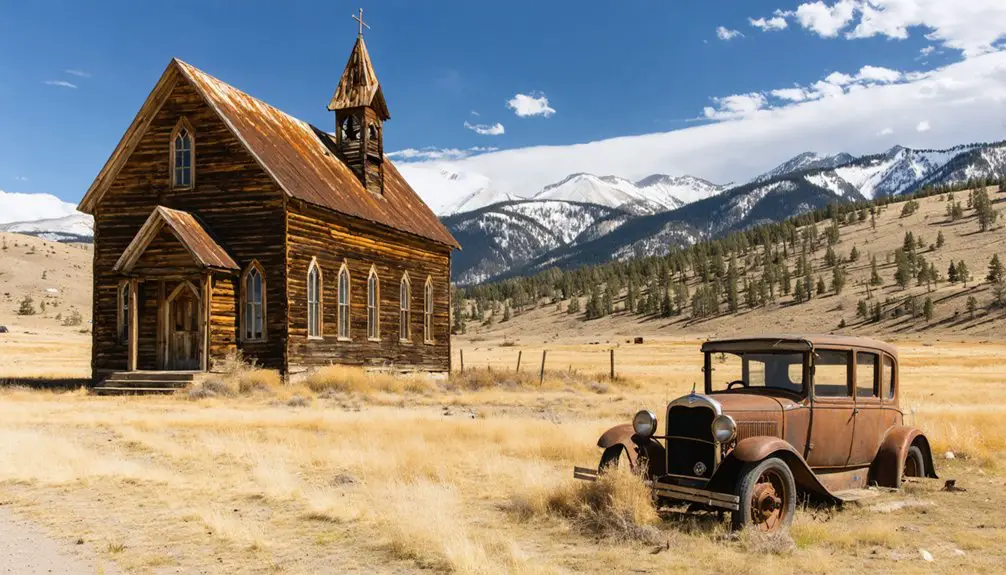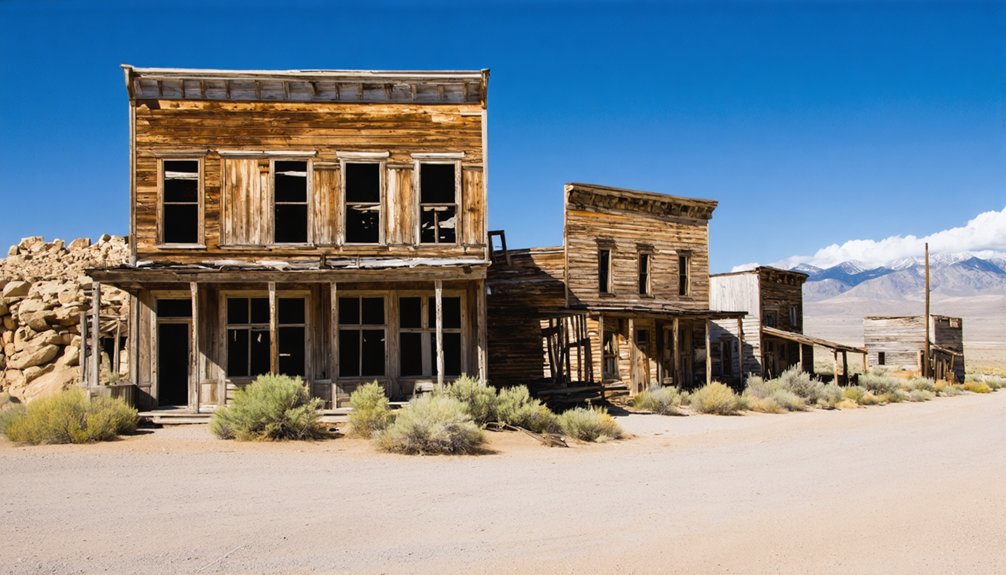
You’ll find Southwest Wyoming’s ghost towns scattered along old railroad routes and mining districts, each telling stories of boom and bust. South Pass City preserves its gold mining heritage with restored stamp mills, while Atlantic City emerged during 1867’s gold fever near the Continental Divide. Benton’s three-month existence in 1868 saw over 100 murders among railroad workers and gamblers. Carbon, Wyoming’s first coal town, peaked at 3,000 residents before disasters and strikes led to its 1902 abandonment. Superior and Gebo round out the region’s coal mining legacy, offering glimpses into frontier perseverance and industrial ambition.
Key Takeaways
- South Pass City preserves mining heritage with restored stamp mills and authentic structures from its 1860s gold rush era.
- Atlantic City emerged in 1867 at the Continental Divide, where gold discovery led to extensive placer mining operations.
- Benton was a violent railroad terminus that experienced over 100 murders during its three-month existence in 1868.
- Carbon, Wyoming’s first coal town established in 1868, peaked at 3,000 residents before abandonment in 1902.
- Superior’s five mines produced 890,735 tons of coal annually at their 1916 peak, supporting over 3,000 residents.
South Pass City: From Gold Rush Boom to Preserved Heritage
The mining legacy peaked when Carissa Mine produced 21,000 ounces and London investors offered $115,000.
But extraction costs killed quick fortunes.
In 1868, John Johnson’s partnership at Palmetto Gulch constructed a three-mile ditch to supply water for sluicing gold deposits two miles east of South Pass City.
Today, you’re free to explore this preserved state historic site, where restored stamp mills and authentic structures commemorate perseverance in Wyoming’s unforgiving frontier.
Benton: Wyoming’s Brief and Violent Railroad Town
If you’d traveled to Benton in summer 1868, you’d have witnessed over 100 men killed in its streets during just three months of existence.
This “Hell on Wheels” railroad terminus, positioned 11 miles east of present-day Rawlins, earned its reputation as Wyoming’s most lawless town through daily murders fueled by cheap whiskey and the chaos of 3,000 transient workers.
Despite the violence, Brigham Young sent wagons to Benton to assist Mormon emigrants making their way to Utah, with many camping just seven miles from the dangerous settlement.
The town featured 25 saloons that served “forty rod” whiskey for just five cents a glass, reportedly named because it could kill a man from forty rods away.
Three Months of Chaos
During summer 1868, Benton erupted along the Union Pacific tracks eleven miles east of present-day Rawlins, transforming from empty prairie to a settlement of 3,000 souls almost overnight.
You’d have found yourself among railroad workers, gamblers, and opportunists drawn by the promise of quick money during this era of relentless railroad expansion. The town’s transient lifestyle defined everything—shanty tents and cheap board structures that could be dismantled within hours.
Twenty-five saloons competed with five dance halls for your dollars, while “forty rod” moonshine sold for five cents per glass. Whiskey ran cheaper than water, miles from the nearest river. Violence claimed over 100 lives during Benton’s mere three months of existence, earning it a reputation as one of the most dangerous settlements in the Wyoming Territory.
The population consisted largely of young Civil War veterans seeking opportunity and adventure in the untamed West.
Violence and Gunfight Deaths
Murder became commonplace in Benton’s dusty streets, with over 100 deaths recorded during the settlement’s brief three-month existence in summer 1868.
You’ll find gunfight statistics that reveal a settlement where violence wasn’t exceptional—it was routine. Visitors compared the town to “Sodom and Gomorrah,” shocked by the normalized bloodshed.
Saloon culture fueled this brutality through:
- Twenty-five saloons serving armed, intoxicated miners in a three-block area
- The Belle of the West, dubbed “Bucket of Blood,” where self-appointed marshals had killed before arriving from Laramie
- Daily shootouts in establishments packed with mobs “furious with drink, furious with wildness”
- Vigilante lynchings of saloon operators Ace Moore, Con Moore, and “Big Ned” Bernard in October 1868
Jim Chisholm of the Chicago Tribune documented that railroad workers faced four times more deaths from violence than from construction accidents. This wasn’t frontier justice—it was lawless chaos. Like other settlements along the line, Benton emerged from the chaotic construction camps that followed the Union Pacific’s advance westward.
Railroad Town’s Quick Demise
By September 1868, Benton had vanished as abruptly as it appeared.
You’d find nothing but empty prairie where 3,000 souls had crowded together just weeks before. The railroad migration westward to Rawlins Springs emptied the settlement overnight, as workers dismantled their shanty tents and followed the tracks.
This transient lifestyle defined Hell on Wheels culture—entire communities existed only as long as construction required. What one visitor called a “repetition of Sodom and Gomorrah” left no lasting trace.
The twenty-five saloons, five dance halls, and Big Tent brothel simply moved to the next terminus. Violence claimed over 100 lives during Benton’s brief existence, with one murder per day marking the settlement’s deadly rhythm. Benton’s three-month existence earned it recognition as Wyoming’s first territorial ghost town, a reflection of the temporary nature of railroad boom settlements.
Carbon: Rise and Fall of a Union Pacific Coal Camp
You’ll find Carbon’s story etched in Wyoming’s landscape nine miles south of present-day Hanna, where the Union Pacific Railroad established the territory’s first coal mining town in 1868.
What began as dugouts and sod-roofed shacks grew rapidly into a bustling camp of 3,000 residents operating seven underground mines that fed coal to transcontinental locomotives.
The Union Pacific Coal Company built structures that became central to the town’s operations and economic development.
The boom wouldn’t last—an 1870 mine explosion, Wyoming’s first labor strike crushed by federal troops, an 1890 fire, and the railroad’s 1899 relocation through Hanna reduced Carbon to sandstone foundations and a restored cemetery by 1902.
Founding and Peak Years
Carbon sprang to life in 1868 as Wyoming Territory’s first coal mining town, strategically positioned along the Union Pacific Railroad line halfway between Laramie and Rawlins, west of Medicine Bow. The founding significance stemmed from its coal deposits, first discovered during Fremont’s 1843 expedition but commercially viable only after the railroad arrived.
Initial residents inhabited dugouts and shoddies—primitive structures with sod roofs that reflected frontier determination.
The town’s mining legacy emerged through impressive growth:
- First-year production reached 6,560 tons of coal in 1868
- Seven underground mines developed over subsequent decades
- Population peaked at approximately 3,000 residents
- Infrastructure expansion included a state bank, newspaper, and Carbon Cemetery
Wyoming Coal and Mining Company initially controlled operations, though ninety percent of stock belonged to Union Pacific directors, ensuring railroad profit margins.
Tragedy and Abandonment
Despite Carbon’s promising beginnings, disaster struck early and often. The Carbon No. 1 Mine exploded on December 20, 1870, rendering it a total loss.
Fire swept through town on June 19, 1890, stopped only by dynamiting buildings in its path.
Labor struggles intensified when you witnessed Wyoming’s first strike after operators slashed wages. Federal troops from Fort Steele crushed the effort, firing strikers and replacing them with immigrant workers.
The Knights of Labor organized boycotts, but authorities arrested even Carbon’s city marshal.
Union Pacific’s 1890 shift to Hanna mines sealed Carbon’s fate. The 1899 railroad relocation bypassed Simpson Hill entirely.
Superior: the Living Ghost Town With Mining Roots
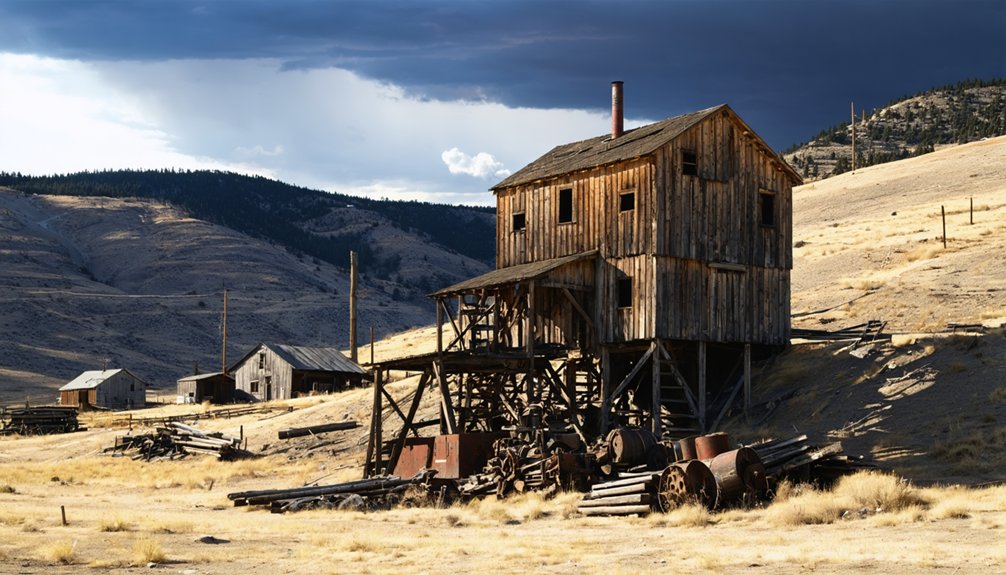
Tucked into Horse Thief Canyon—named for the outlaws who once concealed stolen horses in its natural corrals and underground passages—Superior sits 7 miles off Interstate 80, 23 miles northeast of Rock Springs.
This ghost town maintains a pulse with 336 residents preserving its mining heritage.
Founded in 1903 when Morgan Griffiths’ prospecting party discovered coal outcrops, Superior exploded into the West’s largest coal operation.
At its 1916 peak, five mines produced 890,735 tons annually, supporting over 3,000 residents across Superior, South Superior, and Dog Town.
What You’ll Find:
- Superior Museum (3 N. Main Street) featuring coal mining exhibits
- Wind-swept elevation exceeding 7,000 feet
- Remnants of company housing from Union Pacific Coal Company
- Stories of Italian miners who braved subzero winters
The 1950s coal bust ended this empire, yet Superior endures.
Gebo: Samuel Gebo’s Legacy in the Owl Creek Hills
Rising from the high desert hills twelve miles north of Thermopolis, Gebo materialized in 1915 as Samuel Gebo’s crowning achievement—a company town built on the nation’s first federal coal lease.
You’ll find Gebo’s influence embedded in every stone foundation scattered across these sagebrush-reclaimed slopes near Kirby. The Canadian immigrant’s Owl Creek Coal Company attracted 1,200 residents by 1929, making it the Bighorn Basin’s largest settlement.
Coal mining operations employed 600 workers from sixteen nations, all living in company houses with free rent and dollar-a-load coal. When demand shifted, the mines closed in 1938.
Atlantic City: Oregon Trail Gateway and Gold Mining Hub
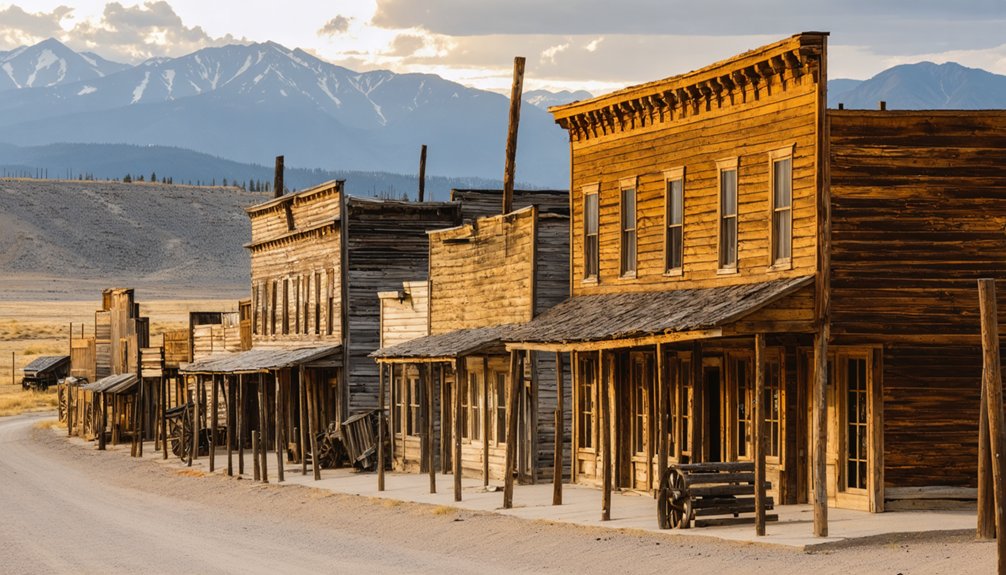
Where the Continental Divide slopes gently through South Pass, Atlantic City emerged in 1867 as Southwest Wyoming’s answer to California’s gold fever—a boomtown born from precious metal discoveries that transformed this Oregon Trail crossroads into a mining hub.
Your exploration reveals Atlantic City’s dual identity:
- Pioneer Gateway: Half a million emigrants crossed the South Pass corridor, following the Sweetwater River past Independence Rock and Devil’s Gate before trail branches diverged toward Oregon, California, and Salt Lake City.
- Gold Rush Transformation: The 1867 discovery triggered a stampede that created sprawling placer operations throughout the 1870s.
- Mining Legacy: Extensive workings still scar the landscape, evidence of fortune-seekers who chased opportunity westward.
- Living History: BLM-managed sites preserve both emigrant and mining eras along non-motorized trail sections.
Frequently Asked Questions
Can Visitors Explore These Ghost Towns Year-Round or Only Seasonally?
Seasonal access limits year-round exploration of Wyoming’s ghost towns. You’ll find summer through early fall offers the best conditions, while winter snow blocks higher elevations and spring rains render unpaved roads impassable without four-wheel drive.
Are There Guided Tours Available at Any of These Locations?
You’re out of luck for guided tour options in Southwest Wyoming’s ghost towns—these sites preserve their historical significance through self-exploration. You’ll need your own four-wheel drive vehicle to access Bryan, Superior, Winton, and Stansbury independently.
As you traverse the rugged landscapes, you might uncover the forgotten history of Wyoming towns that once thrived during the mining boom. Each settlement holds stories of resilience and community, waiting to be discovered by those willing to explore their remnants. Take a moment to reflect on the lives that shaped these places and the legacy they left behind.
In addition to the opportunities for self-exploration, there are numerous ghost towns to explore in Wyoming that offer a glimpse into the past. Whether you choose to hike through the remains of old buildings or visit the local landmarks, each ghost town provides a unique perspective on the state’s rich history. Embrace the adventure and let the stories of these abandoned places ignite your imagination as you wander their dusty streets.
What Safety Precautions Should Visitors Take When Exploring Ghost Town Sites?
You’ll need sturdy boots, emergency supplies, and offline maps for remote exploration. Respect the historical significance by maintaining distance from unstable structures, staying alert for wildlife encounters, and packing out everything you bring in.
Are Camping and Overnight Stays Permitted Near These Ghost Towns?
While ghost towns themselves are off-limits, you’ll find freedom in nearby overnight facilities. Camping regulations permit 14-day BLM stays, developed campgrounds dot the region, and living ghost towns offer modern amenities for adventurous explorers.
Which Ghost Towns Require Permits or Fees for Access?
You won’t find explicit permit requirements at these sites. South Pass City likely charges admission as a state historic site, while Kirwin, Piedmont Kilns, and Point of Rocks maintain free access without documented fee structures.
References
- https://travelwyoming.com/blog/stories/post/5-wyoming-ghost-towns-you-need-to-explore/
- https://sites.rootsweb.com/~wytttp/ghosttowns.htm
- https://www.wyomingcarboncounty.com/blog/123-5-ghost-towns-to-explore
- https://www.youtube.com/watch?v=sMDFPdq-dFM
- https://www.explorewy.com/blog/ghost-towns-halloween-southwest-wyoming-travel
- https://bighorndrifters.com/elementor-2633/
- https://takingthekids.com/long-abandoned-wyoming-ghost-towns-where-the-old-west-still-lingers/
- https://travelwyoming.com/blog/stories/post/wy-hidden-histories-pioneers-ghost-towns/
- https://en.wikipedia.org/wiki/List_of_ghost_towns_in_Wyoming
- https://www.youtube.com/watch?v=Oe33S_KII3k