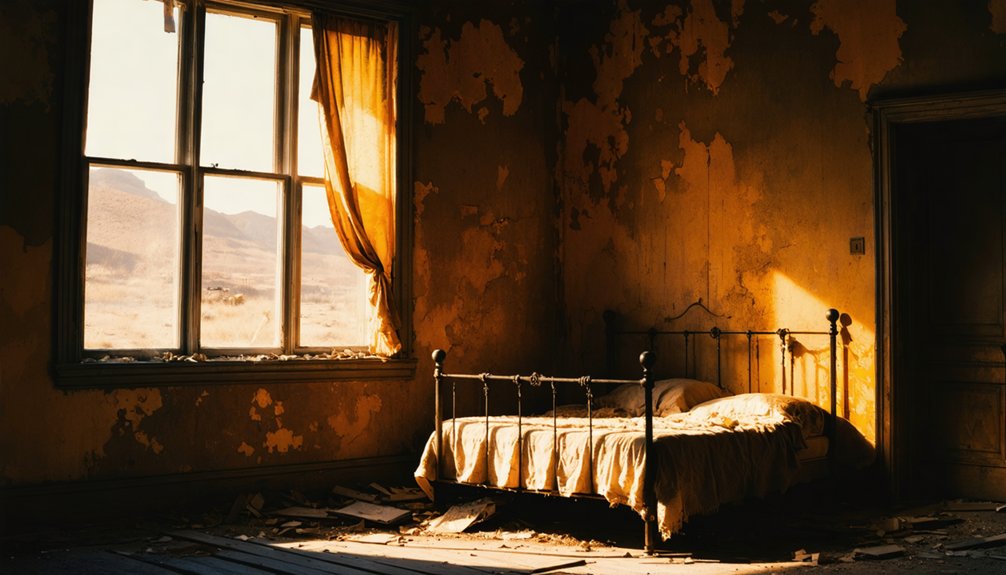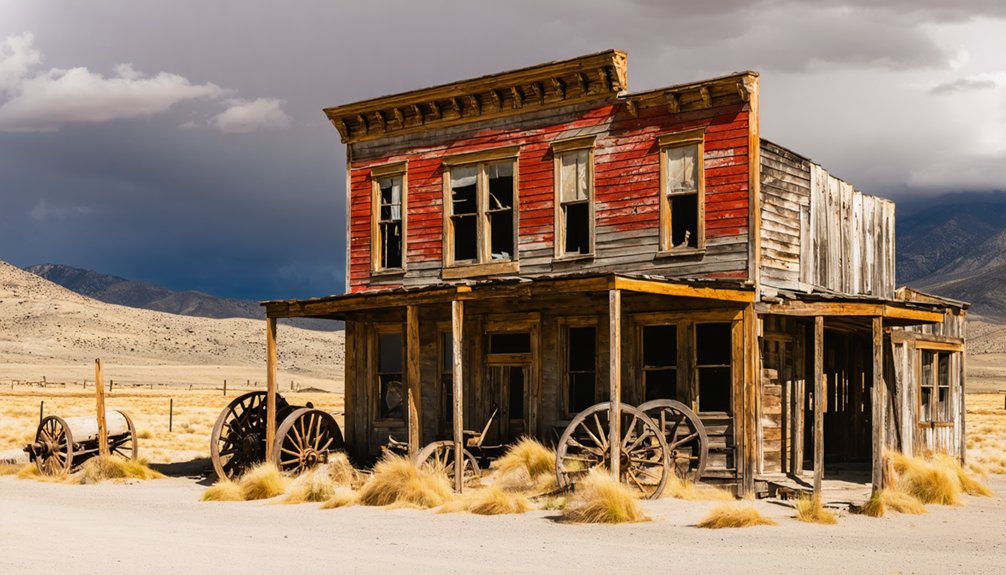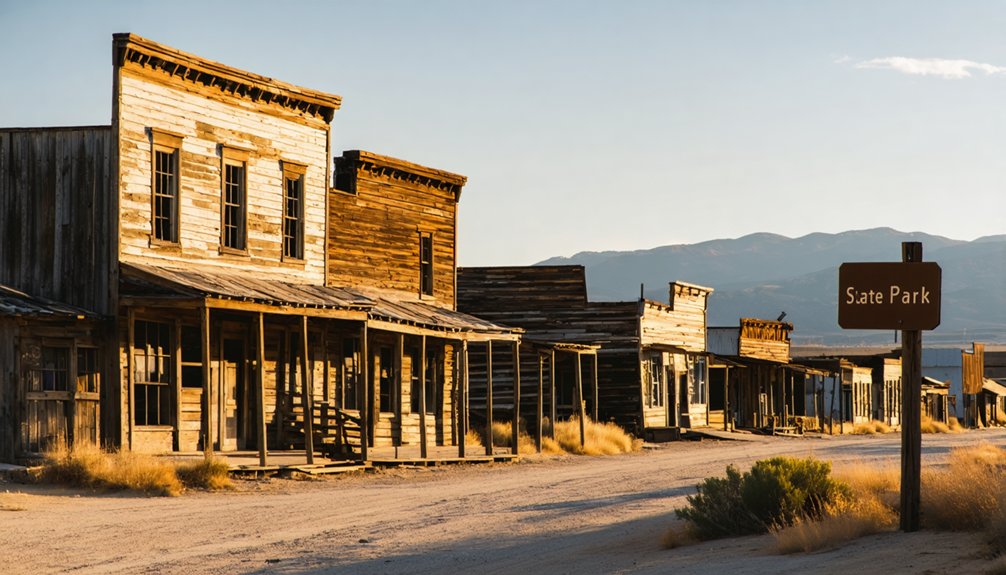
You’ll discover America’s most authentic ghost towns within state park systems, where abandoned buildings remain in “arrested decay” exactly as their final residents left them. Bodie State Historic Park in California preserves 110 original structures from its 1879 gold rush peak, while Montana’s Bannack offers immersive historical reenactments at the state’s first territorial capital. Idaho’s Land of the Yankee Fork encompasses three distinct mining settlements across 521 acres of rugged landscape. These sites prioritize historical authenticity over reconstruction, allowing you to experience genuine frontier history while protecting these fragile remnants for future generations.
Key Takeaways
- State park ghost towns preserve abandoned mining towns and settlements with authentic structures maintained in “arrested decay” rather than full restoration.
- Bodie State Historic Park in California features 110 original structures from its 1879 peak, attracting 200,000 annual visitors.
- Bannack State Park in Montana offers living history reenactments at Montana’s first territorial capital with 50 preserved structures.
- Idaho’s Land of the Yankee Fork encompasses three ghost towns including Custer, Bonanza, and surrounding mining landscapes across 521 acres.
- Preservation balances visitor safety with historical authenticity through minimal intervention and behind-the-scenes structural stabilization.
What Defines a State Park Ghost Town
State parks preserve ghost towns where abandonment causes include depleted mines, failed economic activity, or shifts in transportation routes.
You’ll find tangible remains ranging from dilapidated main streets to weathered cemeteries. Unlike completely destroyed sites, these locations offer standing structures or significant ruins.
The state’s management guarantees public access while protecting these settlements as historic places worthy of preservation, letting you experience authentic remnants of abandoned communities. These preserved towns often served as mining supply centers or railroad hubs during their active periods, making them historically significant beyond their mining operations alone. Some ghost towns with preserved architecture attract tourism, serving as historical sites reflecting past economic activities.
Exploring ghost towns in national parks provides a glimpse into the challenges faced by early settlers. Visitors can wander through the remnants of these once-thriving communities, where stories of hardship and resilience linger in the air. Each site offers a unique perspective on the interplay between nature and the human spirit, inviting reflection on how landscapes change over time.
California’s Bodie State Historic Park: Gold Rush Remnants Frozen in Time
Today, you’re free to explore 110 structures preserved in “arrested decay”—interiors remain exactly as abandoned.
The ghost town architecture includes the Boone Store’s original goods-lined shelves and the Miner’s Union Hall museum.
California designated this authentic Gold Rush remnant as Bodie State Historic Park in 1962, attracting 200,000 annual visitors seeking unvarnished Western history.
Access to Bodie requires traveling State Route 270, which intersects US 395 near Bridgeport in Mono County.
At its 1879 population peak, Bodie boasted over 10,000 residents and more than 250 buildings before resource depletion triggered its decline.
Montana’s Bannack State Park: Living History Through Reenactment
Unlike Bodie’s frozen interiors, Bannack State Park brings Montana’s first territorial capital back to life through immersive historical reenactments.
You’ll explore where gold discovery along Grasshopper Creek in 1862 sparked a boom that swelled the population to 5,000 within months. The town’s notorious past comes alive through Living History events—Bannack Reenactments during the third weekend of July let you experience frontier life amid 50 preserved structures, while October’s Ghost Walk shares tales of sheriff Henry Plummer and the vigilantes who hanged 22 suspected outlaws. The gold from Grasshopper Creek was remarkably pure, measuring 99-99.5% purity, significantly higher than typical gold deposits.
Montana designated this National Historic Landmark as a state park in 1954, ensuring you can wander boardwalks and buildings where desperados once roamed freely, experiencing authentic Western history without restriction. State Park officials maintain Bannack in a state of preserved decay, allowing the historical architecture to reflect the mining era authentically.
Idaho’s Yankee Fork and the Custer Ghost Town Experience
Idaho takes a different approach at Land of the Yankee Fork State Park, where you’ll discover not one but three distinct ghost towns spread across 521 acres of Custer County’s rugged mining landscape.
Custer stands as the centerpiece, offering guided and self-guided Custer Tours through restored buildings including a museum, saloon, and gift shop from Memorial Day through Labor Day.
Custer serves as the park’s centerpiece, with guided tours showcasing restored frontier buildings from Memorial Day through Labor Day.
You’ll find Bonanza in its authentic unrestored state, with remnants from its 1877-1911 heyday scattered among the sagebrush.
The interpretive center near Challis serves as your gateway, providing exhibits and gold panning for a $7 parking fee. Inside, you’ll encounter interactive displays and artifacts alongside a working model of a stamp mill that demonstrates historic ore processing methods.
You can explore the Yankee Fork drainage via unpaved roads best tackled with high-clearance vehicles, experiencing mining heritage on your own terms across this preserved frontier landscape.
The park operates through collaboration between the Idaho Department of Parks and Recreation and the United States Forest Service.
Nevada’s Berlin-Ichthyosaur: Mining Heritage Meets Paleontology
Where mining history intersects with prehistoric marine life, Berlin-Ichthyosaur State Park preserves dual narratives across 1,100 acres of Nevada’s remote Shoshone Mountains. You’ll explore the Berlin ghost town, established in 1897 for silver and gold extraction, where original buildings stand frozen since operations ceased after just 13 years. The site’s mining legacy shares space with remarkable paleontological treasures. Dr. Siemon Muller’s 1928 ichthyosaur discovery revealed approximately 40 specimens of *Shonisaurus popularis*, dating back 225 million years when warm oceans covered central Nevada. The Fossil House protects these remains in situ, offering you direct access to what was once Earth’s largest ichthyosaur concentration. Charles Lewis Camp initiated excavations in 1954 after recognizing the site’s scientific importance during his 1953 visit. Self-guided tours allow you to explore both the Fossil House and Berlin Townsite at your own pace. Nevada State Parks manages this National Natural Landmark, interpreting both human and prehistoric chapters.
Alabama’s Cahawba: From State Capital to Archaeological Site
At the confluence of the Alabama and Cahaba rivers, Old Cahawba Archaeological Park preserves Alabama’s most dramatic political rise and fall.
You’ll explore where the state’s first capital thrived from 1820 to 1826, generating $123,856 from initial land auctions before flooding and disease forced relocation to Tuscaloosa.
The Cahawba history reveals three distinct chapters:
Cahawba’s story unfolds in three dramatic acts: political prominence, cotton wealth, and complete abandonment within a single century.
- Political Center (1820-1826): First state capital with brick statehouse
- Cotton Boom (1840s-1850s): Wealthy planters built Greek Revival mansions
- Abandonment (1866-1900): Population crashed from 1,000 to ghost town status
Today’s archaeological significance lies in scattered columns, ornamental wellheads, and foundation ruins along abandoned streets.
The Clear Creek Nature Trail provides riverside access while interpretive signage documents this cautionary tale of political ambition meeting geographic reality.
Preservation Philosophy: Maintaining Authenticity Without Restoration
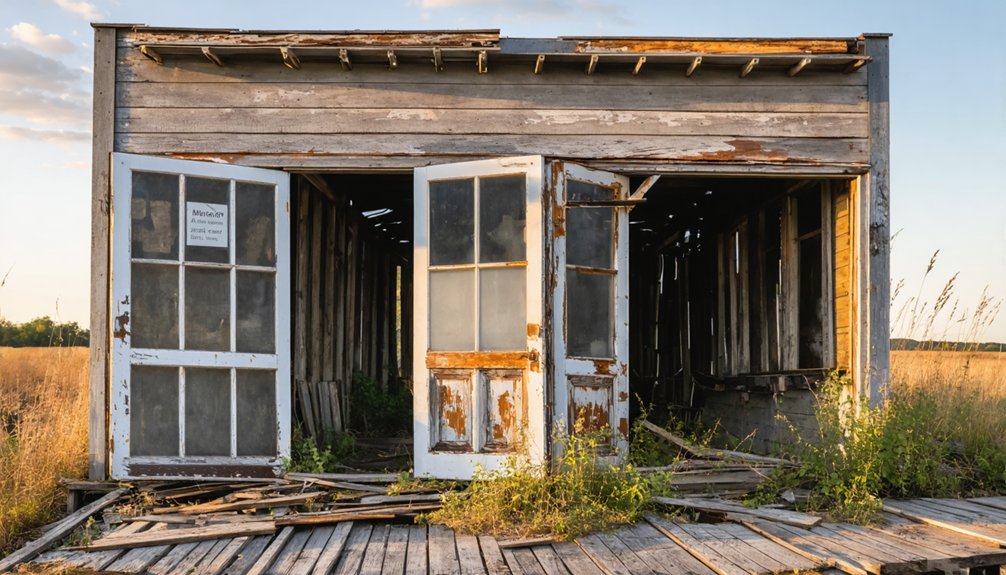
When you visit Bodie State Historical Park, you’ll notice structures maintained in “arrested decay”—stabilized but never restored to their original glory.
This preservation philosophy prioritizes authenticity over reconstruction, allowing you to experience ghost towns as they exist rather than how they once appeared.
You’ll find state park managers constantly balancing the tension between keeping these fragile sites safe for visitors while preserving the haunting, untouched character that makes them historically significant.
Arrested Decay Stabilization Methods
Ghost town preservation requires a delicate balance between protecting historic structures and maintaining their authentic character, which is why state parks employ the arrested decay method.
This stabilization technique, pioneered by Charles Peterson at Bannack in 1973, prevents structural collapse while deliberately avoiding full restoration.
You’ll find arrested decay preservation techniques implemented across multiple state parks:
- Bannack State Park maintains buildings in their 1940s abandoned condition.
- Fort Churchill stabilizes ruins for safe observation along designated trails.
- Bodie showcases turn-of-century gold-mining structures as genuine remnants.
Before any treatment begins, managers conduct thorough condition assessments following the Secretary of the Interior’s Standards.
This approach lets you experience these ghost towns as time genuinely left them—authentic, unaltered, and free from commercialized tourist modifications that would compromise their historical integrity.
Visitor Safety Versus Authenticity
Preserving structural integrity through arrested decay creates an immediate challenge: how do you let visitors explore deteriorating buildings without compromising their safety or the site’s authenticity?
At Bodie, you’ll find over 100 original structures accessible despite their weathered condition, where State Parks management deliberately avoids contemporary safety upgrades that would diminish historical character.
This preservation challenge requires balancing visitor access against the philosophy of minimal intervention. You can peer through windows at abandoned dishware and furnishings exactly as they were left, while structural stabilization happens behind the scenes to prevent complete collapse.
Unlike restored ghost towns that become tourist attractions, Bodie’s approach respects your intelligence—trusting you to navigate an authentic historical environment where original materials and construction methods remain visible and unaltered.
Frequently Asked Questions
Are Pets Allowed at State Park Ghost Towns?
Yes, you can bring pets to state park ghost towns, but you’ll need to follow specific pet policies and ghost town regulations. Keep dogs leashed, clean up after them, and expect building restrictions for preservation purposes.
What Are the Entrance Fees for Visiting Ghost Town State Parks?
You’ll find entrance fee structures ranging from $3-$8 per person at ghost town state parks, with vehicle passes costing $8. Park pass options include annual family passes at $50, plus reduced rates for children and groups.
Can Visitors Camp Overnight at Ghost Town State Parks?
You’ll discover overnight camping *is* available at several ghost town state parks, though camping regulations vary by location. Some require overnight permits and fees, while others offer free dispersed camping with minimal restrictions on public lands.
Are the Ghost Town Buildings Wheelchair Accessible for Disabled Visitors?
Accessibility varies by location. While some ghost towns offer accessible pathways and wheelchair ramps at visitor centers, historical buildings often retain original uneven terrain and boardwalks, limiting modifications due to preservation requirements. Advance planning helps maximize your experience.
What Photography Restrictions Exist at State Park Ghost Towns?
You’ll need photography permits for commercial work, with liability insurance requirements typically around $500,000. Drones are prohibited, and you can’t move or remove any historical items. Tripods are generally allowed for personal use.
References
- https://albiongould.com/ghost-towns-to-visit-in-the-states/
- https://www.loveexploring.com/gallerylist/188219/the-us-state-with-the-most-ghost-towns-revealed
- https://www.npca.org/articles/1935-spooky-beautiful-photos-of-abandoned-park-towns
- https://explorethearchive.com/western-ghost-towns
- https://whakestudios.com/us-ghost-towns/
- https://www.thedearbobandsuepodcast.com/139-ghost-towns-of-the-national-parks/
- https://www.geotab.com/ghost-towns/
- https://nvtami.com/2024/10/06/ghost-towns-are-not-theme-parks-how-to-visit-them-safely/
- https://www.atlasobscura.com/lists/united-states-of-abandoned-places
- https://westernmininghistory.com/664/what-is-a-ghost-town-wmh-town-classifications-explained/