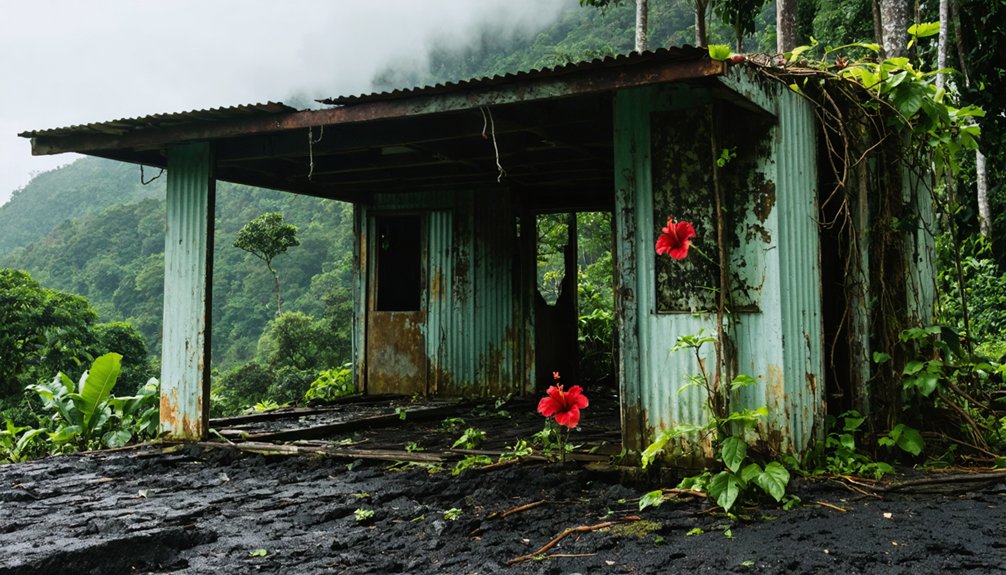
You won’t find traditional ghost towns near American Samoa National Park, but you’ll discover something more haunting: archaeological sites where ancient settlements meet supernatural lore. To’aga beach on Ofu Island forced the U.S. Navy to relocate a 1924 dispensary after persistent paranormal encounters locals attributed to aitu spirits. The vine-strangled ruins of Atauloma Girls School, abandoned since 1970, contain unmarked graves from the 1918 influenza epidemic. WWII fortifications, 3,500-year-old Lapita settlements at A’a Village, and ridge terraces with ceramic fragments reveal layers of abandonment spanning millennia, each site preserving its own secrets.
Key Takeaways
- To’aga beach features abandoned Navy dispensary foundations from 1924, relocated due to reported paranormal activity and spiritual warnings from locals.
- Atauloma Girls School, Tutuila’s first female school founded in 1900, closed in 1970 leaving colonial ruins and unmarked influenza graves.
- A’a Village Site preserves 3,500-year-old Lapita settlement remnants including wells, mounds, and platforms largely unexcavated today.
- WWII military installations remain scattered across American Samoa including concrete fortifications, naval guns, and approximately 50 beach pillboxes.
- Blunts Point contains 76 abandoned WWII archaeological features including ammunition handling infrastructure and anti-aircraft emplacements.
To’aga Aitu Site: Where Spirits Dance on Moonlit Shores
When the U.S. Navy planned a dispensary at To’aga beach in 1924, locals from Ofu protested vehemently. They warned the site served as a meeting place for aitu—spirit beings holding deep cultural significance throughout the Manu’a Group.
You’ll find the Navy ignored these warnings and constructed the facility anyway.
The spiritual experiences that followed were documented in 1950 public health reports. Navy pharmacist’s mates witnessed headless figures performing obscene dances on moonlit shores.
One pharmacist opened his door to see a beheaded spirit. His wife heard unexplained sounds and watched furniture move at high noon. Nurses also experienced paranormal activity in the dispensary during their time stationed there.
As the town’s eerie tales spread, a group of adventurous souls found themselves exploring abandoned places in Manitoba. They hoped to capture the ghostly presence on camera, unaware of the legends that lingered in every shadow. Each site unveiled more chilling stories, drawing them deeper into the haunting history of the region.
The Navy eventually relocated the dispensary to Ofu village. Residents continue warning against wandering To’aga beach at high noon or after sunset. Today, remnant foundations remain visible, and locals still warn against visiting To’aga after sundown or at noon.
Archaeological Remnants of 3,000 Years at To’aga
Beyond the spiritual significance that has kept locals wary of To’aga for generations, the site holds extraordinary archaeological value spanning three millennia of human occupation.
You’ll find deep ceramic stratigraphy documenting continuous settlement from Lapita origins through ancestral Polynesian phases dated 2,500–1,900 BP. The coastal stretch reveals abundant Polynesian Plainware ceramics, simple one-piece fishhooks, and stone tools near ridge terraces—tangible evidence of how early settlers shaped this landscape.
This four-mile archaeological sequence represents one of Samoa’s most significant records of Polynesian settlement, predated only by Mulifanua’s 3,000-year-old Lapita remains. At Mulifanua, excavations uncovered 4,288 pottery sherds alongside two Lapita-type adzes, providing crucial evidence of Samoa’s earliest inhabitants. Researchers like Kirch and Hunt have surveyed inland sites, though full excavation awaits. Archaeological study here reconstructs ancient diets and lifestyles of communities that oral traditions alone cannot fully preserve.
You’re standing where ancestors from Southeast Asia first transformed Pacific shores into enduring communities.
Atauloma Girls School: Jungle-Reclaimed Ruins on Tutuila
Perched above Afao village at coordinates 14°19′48″S 170°48′06″W, the concrete skeleton of Atauloma Girls School stands as Tutuila’s most haunting educational ruin.
Founded in 1900 by the London Missionary Society, this institution became Tutuila’s first to admit female students, training chiefs’ daughters primarily as pastors’ wives and later as nurses. The architectural style showcased colonial design—a two-story structure featuring 20-inch-thick coral cement walls and a 200-foot portico. Its jungle isolation intentionally protected students from Apia’s port dangers. The curriculum blended Western subjects like English, Arithmetic, Geography, Writing, and Scripture with traditional Samoan values and practical skills.
Despite its historical significance earning National Register designation in 1972, the school closed by 1970. You’ll find vine-strangled walls, unmarked graves from the 1918 influenza epidemic, and Reverend E.V. Cooper’s final resting place—testament to an era when education meant strict Christian oversight. Photographer Thomas Andrew documented the school in 1904, capturing group portraits that now reside in the Museum of New Zealand Te Papa Tongarewa collection.
A’a Village Site: Forgotten Settlement of Ancient Samoa
While colonial-era structures like Atauloma Girls School represent relatively recent abandonment, Ta’u island harbors settlement ruins that predate written records by millennia.
You’ll find the A’a Village site, dating back 3,500 years to the Lapita expansion, standing as one of American Samoa’s most sacred archaeological locations. The settlement’s wells, mounds, and platforms reveal how your ancestral Samoans organized their communities during prehistory.
According to Samoan mythology, Ta’u marks the birthplace of the god Tagaloa, and oral histories identify A’a as the location of Samoa’s first ‘ava ceremony.
Though surveyed, the site remains largely unexcavated, its stone tools and terraced foundations waiting to yield deeper secrets about ancient ceremonies and settlement patterns that shaped Polynesian civilization across the Pacific. Archaeological structures from approximately a thousand years ago include rock walls and platforms that demonstrate the emergence of hierarchical society. Visitors can access scenic viewpoints throughout the village area to observe these archaeological features while learning about the significance of this prehistoric settlement.
Abandoned Military and Infrastructure Sites From WWII Era
When Japan’s attack on Pearl Harbor thrust the Pacific into global warfare, American Samoa transformed overnight from a sleepy coaling station into a critical defensive stronghold.
You’ll discover extensive military relics scattered across Tutuila Island’s ridgelines and coastlines—concrete fortifications that once bristled with firepower. Six-inch naval guns still command Matautu and Papatele ridges, while approximately 50 machine-gun pillboxes remain embedded in beaches where Marines anticipated Japanese landings.
Concrete fortifications and naval guns still guard Tutuila’s ridges where Marines once watched for Japanese invasion forces.
The historical significance becomes tangible as you explore 76 archaeological features at Blunts Point, including ammunition handling infrastructure and concrete foundations. These gun batteries once protected Pago Pago Harbor, forming a defensive perimeter around one of the Pacific’s most strategic anchorages. The all-Samoan Fita Fita Guard served alongside the US Marine Corps, contributing essential local knowledge to the defensive operations.
Three anti-aircraft emplacements crown Utulei Ridge, silent witnesses to the 5,600-man Marine Brigade that arrived January 1942. These abandoned positions reveal how remote Pacific territories became America’s forward defense line.
Frequently Asked Questions
What Safety Precautions Should Visitors Take When Exploring Abandoned Sites?
You’ll need proper safety gear like sturdy boots and ropes for steep trails during urban exploration. Respect cultural timing restrictions, hire local guides, avoid sundown and noon visits, and watch for unstable structures at these historically significant sites.
Are Permits Required to Visit Archaeological Sites in American Samoa?
You’ll need permits for professional research and filming at archaeological sites, though general visitor access isn’t explicitly restricted. Archaeological regulations emphasize site preservation through trained specialists, while territorial laws protect significant cultural resources from unauthorized disturbance.
What Is the Best Time of Year to Visit These Locations?
The ideal visiting period is May through October during dry season when seasonal weather provides consistent sunshine, minimal rainfall, and calm seas for safely accessing remote archaeological sites and abandoned settlements across all islands.
How Do I Access American Samoa From the Mainland United States?
Your journey bridges vast Pacific waters through Hawaiian Airlines’ Honolulu hub—the essential gateway. Flight details reveal twice-weekly departures (Mondays, Thursdays) to Pago Pago. Travel options from mainland cities cost $1,000–6,500, requiring 15–17 hours total.
Can Artifacts Be Legally Collected From These Abandoned Sites?
No, you can’t legally collect artifacts from these sites. Federal and territorial laws mandate artifact preservation at both park and non-park locations, with serious legal implications including fines and prosecution for unauthorized removal or disturbance.
References
- https://www.nps.gov/npsa/learn/historyculture/toagaaitu.htm
- https://pacificislandparks.wordpress.com/2010/10/31/ghosts-in-polynesia/
- https://koa.com/blog/western-ghost-towns/
- https://amsamfam.com/top-places-in-american-samoa/
- https://www.youtube.com/watch?v=4zxK2o0SGGA
- https://www.latimes.com/travel/la-tr-nps-american-samoa-20161226-htmlstory.html
- https://www.atlasobscura.com/things-to-do/american-samoa/abandoned
- https://roamingtogether.com/ute-ulay-mine/
- https://marinesanctuary.org/blog/six-spooky-stories-from-the-sanctuaries/
- https://djedpress.com/2017/06/19/stories-we-grew-up-with-cautionary-tales-samoa/