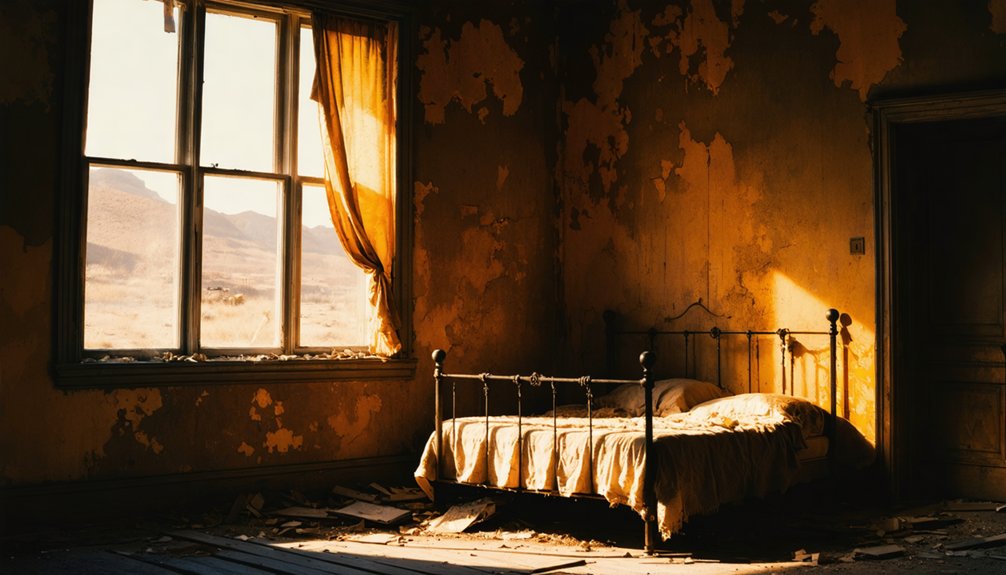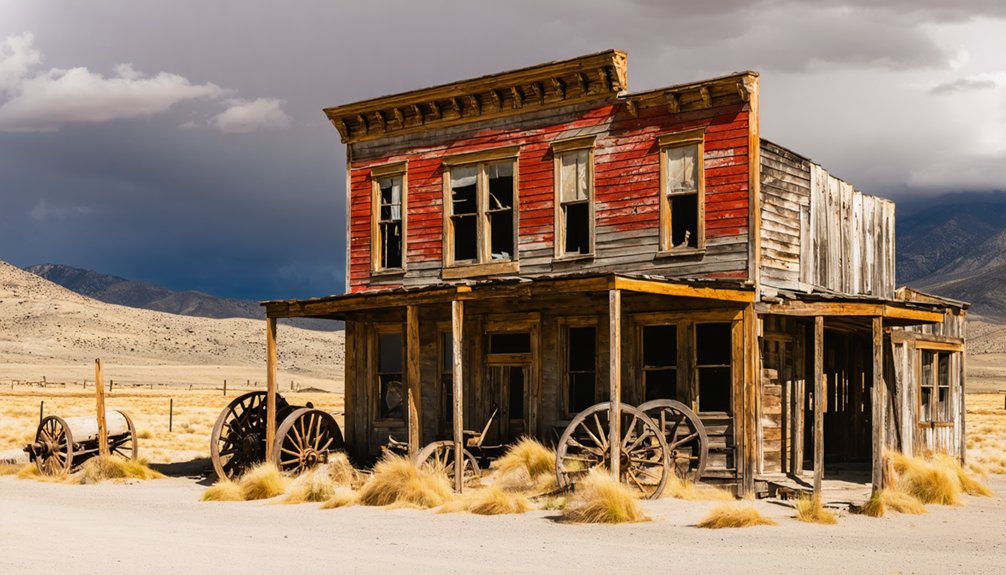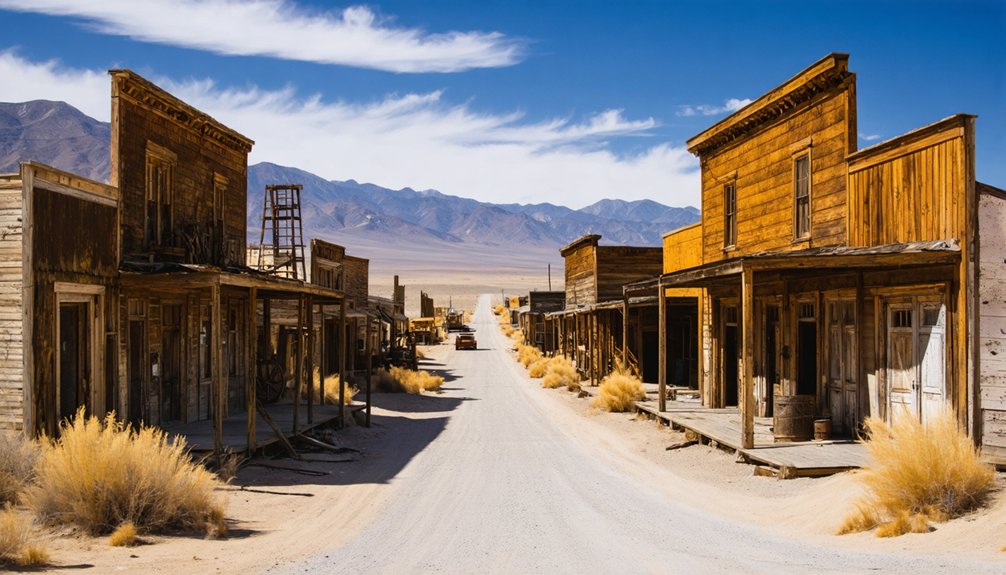
You’ll find several ghost towns near Area 51 along Nevada’s Extraterrestrial Highway, which runs 98 miles from Crystal Springs to Warm Springs. Crystal Springs served as Lincoln County’s first seat in 1865 before becoming ruins marked by Historic Marker 205. Warm Springs operated as a stagecoach stop from 1866 until its post office closed in 1929. Rachel, founded in 1973, remains the highway’s only inhabited town with fewer than 100 residents. Nearby Belmont and Manhattan showcase Nevada’s mining past, while restricted military zones conceal additional abandoned settlements whose histories remain largely undocumented.
Key Takeaways
- Crystal Springs, at Highway 93’s junction, served as Lincoln County’s first seat in 1865 before becoming abandoned ruins.
- Warm Springs began as an 1866 stagecoach stop with a post office operating from 1924 to 1929.
- Rachel, founded in 1973 for tungsten mining, became a UFO tourism hub after Bob Lazar’s 1989 claims.
- Manhattan peaked at 4,000 residents in 1906 and now has fewer than 100, making it a semi-ghost town.
- Belmont features an 1876 courthouse and authentic miners’ cabins from Nevada’s late 1860s silver rush era.
The Extraterrestrial Highway: Gateway to Abandoned Settlements
While most highways commemorate historical figures or geographic landmarks, Nevada’s State Route 375 earned its “Extraterrestrial Highway” designation in 1996 based on decades of reported UFO sightings—though skeptics point out the road’s proximity to classified military testing facilities offers a more terrestrial explanation for unusual aerial phenomena.
This 98-mile stretch through Nye and Lincoln counties has become a pilgrimage route for extraterrestrial tourism enthusiasts seeking abandoned settlements and alien folklore experiences.
You’ll find the route runs from Crystal Springs to Warm Springs, passing directly alongside Area 51 and the Nevada Test and Training Range.
The highway’s cultural significance stems from consistent reports of unexplained activity, though distinguishing experimental aircraft from alleged extraterrestrial encounters remains challenging given the military’s operational security requirements. The journey typically begins in Hiko, population 124, where travelers stock up on supplies and alien-themed memorabilia before heading into the remote desert landscape. The highway crosses an empty Nevada landscape characterized by vast valleys and isolated mountains, creating the desolate backdrop that has fueled decades of speculation about secretive government operations.
Crystal Springs: Southern Portal to UFO Country
You’ll find Crystal Springs at the junction of Highway 93 and White Pine Road, marking the southern entrance to Nevada’s UFO corridor near Area 51.
This ghost town served briefly as Lincoln County’s first county seat in 1865 following a silver discovery, but Governor Henry Blasdel relocated the seat to Hiko within a year after learning the settlement lacked sufficient population.
Today, Nevada Historic Marker 205 stands among the abandoned ruins where prospectors once rushed for silver before the boom collapsed.
Crystal Springs functioned as a principal stopover on the Mormon Trail alternate route, providing a crucial watering place for travelers crossing the harsh desert terrain.
The area’s strategic location with water and shade made it a haven for horse thieves during the Old West, as stolen horses from Utah and Arizona were fattened in the valley before being moved to California.
Gateway to Alien Territory
What you’re seeing isn’t accidental marketing.
UFO reports here trace back to 1950s U-2 aircraft reflections at 60,000 feet—though that hasn’t stopped true believers.
Bob Lazar’s 1989 claims about alien spacecraft work intensified the mythology, while 1959 sightings near Clark County and ongoing Nellis Air Force Base reports fuel speculation.
You’re entering territory where classified military projects meet public imagination.
The highway’s 1996 designation as the Extraterrestrial Highway officially recognized the area’s deep connection to UFO culture and alien folklore.
Rachel remains the only town along this 98-mile stretch, transforming into an unexpected tourist hub where extraterrestrial-themed businesses thrive.
Abandoned Mining Settlement Remains
Silver ore deposits brought prospectors to Crystal Springs in 1865, establishing Lincoln County’s first mining-grade silver discovery.
You’ll find this settlement emerged after Gen. Patrick Connor’s California Volunteers staked claims during their 1864 summer expedition. The site became Lincoln County’s first seat of government, capitalizing on natural springs that previously sustained a Native American village.
Mining challenges quickly dimmed the boom. Indian conflicts disrupted operations, and lack of processing facilities made ore extraction unprofitable.
Prospectors maintained claims mainly to prevent jumping rather than actual production. The settlement’s abandonment came swiftly as deposits proved insufficient for sustained mining. Unlike Crystal Peak, which saw its post office close in November 1869 after being bypassed by the railroad, Crystal Springs never developed the infrastructure to compete with better-positioned settlements.
The County Seat moved from Crystal Springs to Hiko before eventually settling in Pioche in 1871, reflecting the shifting centers of mining activity.
Today, Crystal Springs stands as evidence to Nevada’s speculative mining era—another ghost town where freedom-seeking prospectors discovered harsh economic realities trumped silver dreams.
Warm Springs: Desert Ruins at the Northern Terminus
Today’s Desert Landscape presents private property warnings, though the boiling hot spring still flows from the hills above.
At sixty miles east of Tonopah, these authenticated ruins offer tangible evidence of Nevada’s frontier economy. The settlement began in 1866 as a stagecoach stop, marking the first white presence in this remote junction.
The post office operated from January 19, 1924, until its closure on June 29, 1929, when mail service transferred to nearby Tybo.
Rachel: Nevada’s UFO Capital and Youngest Town
Unlike its century-old neighbors, Rachel didn’t emerge from Nevada’s silver boom—it arrived in May 1973 when alfalfa farmer D.C. Day founded Tempiute Village to support the reopening tungsten mine.
Union Carbide’s operation peaked the population at 200 before closing by 1980, nearly abandoning the isolated valley.
You’ll find the town’s naming story—honoring Rachel Jones, the first baby born here—documented at Clark County Museum, though her death after relocating to Washington cuts the tale short.
Bob Lazar’s 1989 alien spacecraft claims transformed this dying mining outpost into the self-proclaimed UFO Capital of the World.
Today’s UFO sightings draw tourists to the Little A’Le’Inn, while locals celebrate Rachel Day each May, commemorating both the town’s founding and its namesake.
Rhyolite: From Gold Rush Boom to Artistic Ruins
While Rachel’s UFO lore draws from late-20th-century conspiracy theories, Rhyolite’s fame stems from documented financial collapse—a gold rush boom and bust compressed into barely two decades.
Frank Harris and Ernest Cross discovered gold on August 4, 1904. Within months, 5,000 fortune-seekers flooded the desert, building 50 saloons, three railroad lines, and the iconic John S. Cook Bank.
Gold fever transformed desert wasteland into a 5,000-person boomtown practically overnight, complete with dozens of saloons and its own banking infrastructure.
The Montgomery-Shoshone Mine produced over $1 million before stocks crashed and high-grade ore vanished.
By 1920, only 14 residents remained among crumbling buildings.
Today’s artistic ruins—rehabilitated by Paramount Pictures in 1925, maintained by the Bureau of Land Management—attract photographers seeking authentic Western decay.
You’ll find no government cover-ups here, just capitalism’s raw physics: rapid expansion meeting equally rapid entropy.
The Beer Bottle House and Goldwell Open Air Museum
Four miles west of Beatty, where Route 374 cuts through Amargosa Valley, concrete phantoms frozen mid-meal mark the entrance to Goldwell Open Air Museum—7.8 acres of large-scale sculpture that transformed Rhyolite’s tourist periphery starting in 1984.
Belgian artist Albert Szukalski launched this ghost town artistry project before dying in 2000, leaving “The Last Supper” and other installations that now draw visitors to what organizers formalized as a nonprofit preservation site.
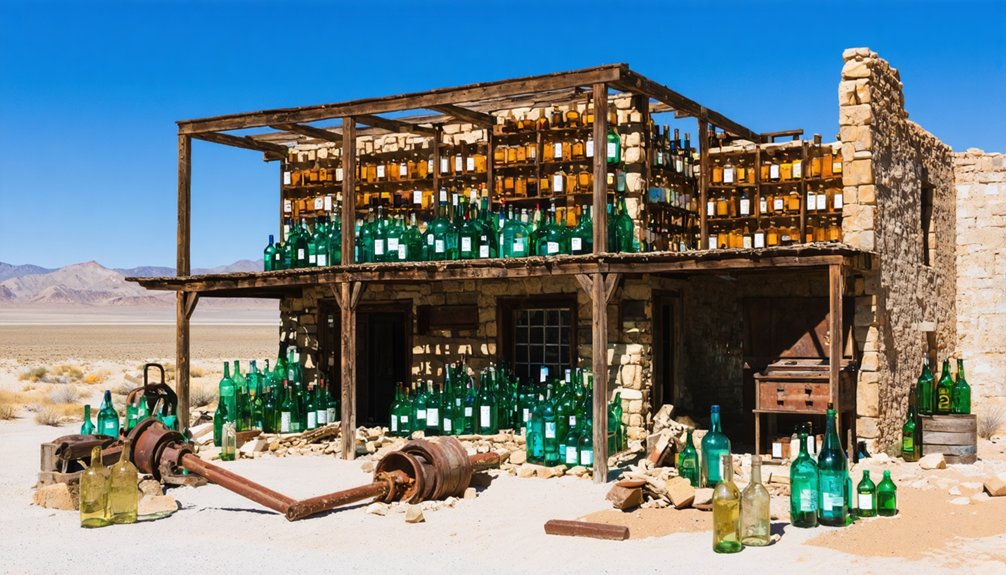
Nearby stands Tom Kelly’s 1905 Bottlehouse, showcasing beer bottle architecture predating modern art by eight decades.
You’ll find bottles embedded in adobe walls—practical insulation during Rhyolite’s mining era. The museum operates 24/7 with free admission, while its Red Barn Art Center maintains Wednesday-Saturday hours.
It’s accessible without permits or fees, 120 miles northwest of Las Vegas.
Manhattan: the Semi-Ghost Town With a Stolen Church
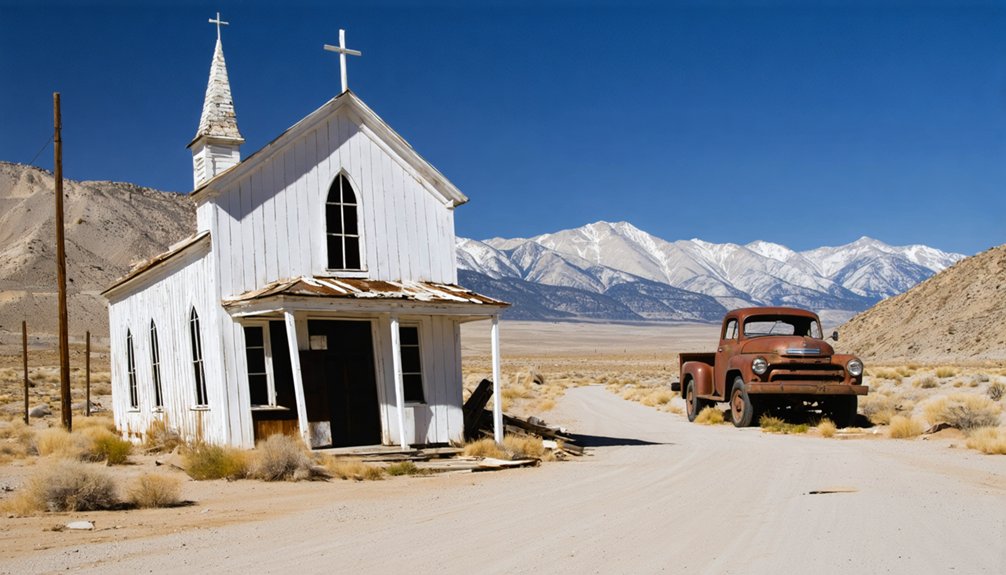
Manhattan’s population peaked at 4,000 in 1906 before the San Francisco earthquake halted investments, and today fewer than 100 full-time residents occupy what’s become a semi-ghost town.
The town’s most peculiar landmark isn’t from its own mining boom—it’s a Catholic church built in 1874 in nearby Belmont that was dismantled and moved piece by piece to Manhattan’s hillside in 1908.
Historical records confirm this wasn’t a sanctioned relocation: the wooden structure was “stolen in the night” from Belmont during Manhattan’s prospecting resurgence, making it both a preserved artifact and evidence of frontier-era theft.
Population and Current Status
Today, Manhattan clings to existence with approximately 135 residents scattered across 15.08 square miles of Nevada desert, earning it the designation of semi-ghost town rather than a fully abandoned settlement.
The population decline tells a stark story: from 140 residents in 2021 to 135 in 2023, following an annual decrease averaging 1-4.8% between 2019-2023.
The housing statistics reveal the town’s fragile infrastructure:
- 69 total housing units serve just 30-35 households
- Population density sits at merely 9 people per square mile
- Median listing price reaches $240,000 with only 1 active listing
- Average household contains 1.97 persons
- Median age ranges between 38-58 years depending on data sources
You’ll find Manhattan mirrors Nye County’s broader trend of declining unincorporated town populations, maintaining minimal human presence in Nevada’s remote interior.
The Church Theft Story
Among the many colorful tales of Nevada’s mining frontier, few stories capture the opportunistic spirit of boom-and-bust towns quite like St. Stephen’s Church relocation from Belmont to Manhattan.
Built in 1872 to serve Belmont’s Catholic miners, the wooden structure became a valuable commodity when silver fever died around 1900. As Belmont’s population crashed—drawing just 100 votes in the 1900 election—Manhattan’s 1905 gold discovery sparked reverse migration.
The church relocation occurred during this shift, colloquially described as being “stolen in the night.” Whether literal theft or opportunistic salvage, you’ll find this piece of Nevada history perched on Manhattan’s hillside.
Timber was precious in mining country, making the entire building worth moving when populations chased the next strike.
Belmont: Historic Courthouse and Miners’ Cabins
Perched at 7,400 feet in the Toquima Range, Belmont emerged from Nevada’s silver rush after prospectors discovered rich ore deposits in the late 1860s. The town’s $4 million in silver production funded substantial infrastructure, including the 1876 courthouse—a brick edifice designed by Carson City architect J.K. Winchell that served as Nye County’s seat until 1905.
Nevada’s 1860s silver boom birthed Belmont, whose $4 million ore deposits financed grand civic architecture high in the Toquima Range.
What You’ll Find:
- Historic courthouse with original 1870s courthouse architecture featuring square wooden cupola
- Authentic miners’ cabins showcasing the spartan miners’ lifestyle
- Self-guided walking tours year-round
- Guided courthouse tours May-September weekends
- National Register listing since 1972
The Friends of the Belmont Courthouse nonprofit maintains restoration efforts.
Located 45 minutes from Tonopah, this “living ghost town” preserves tangible evidence of Nevada’s mining heritage without commercialized interference.
Anus Mine and Other Remote Mining Settlements
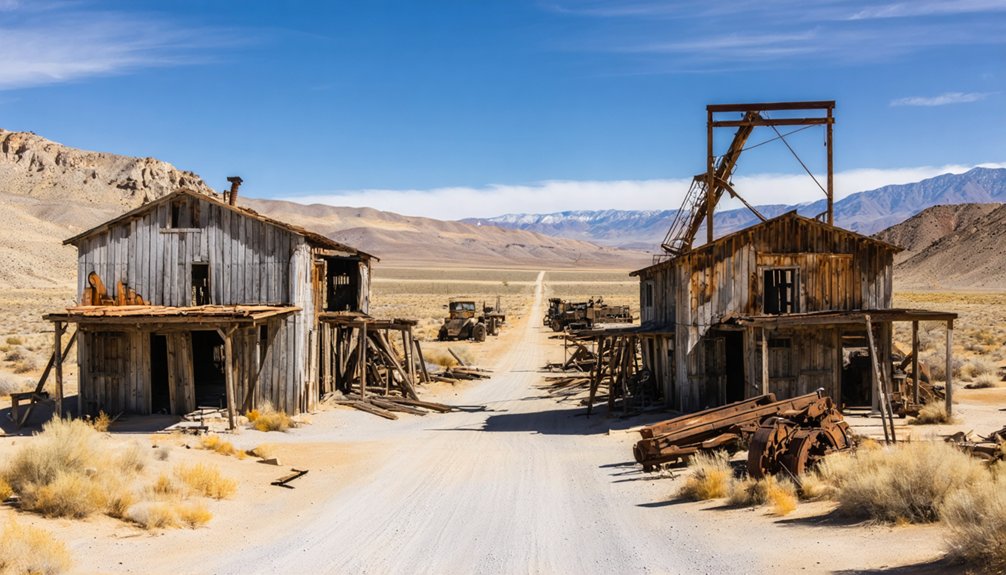
The Groom Mine operated in this region before government acquisition, leaving behind abandoned structures that few researchers can examine firsthand.
When you’re researching these remote sites, you’ll encounter gaps in the historical record. Many claims about obscure operations lack primary sources.
Without verifiable documentation or accessible sites, separating legend from fact becomes difficult. The desert keeps its secrets, especially when modern boundaries restrict exploration.
Frequently Asked Questions
Can Tourists Legally Visit Area 51 or Its Immediate Perimeter?
You can’t legally access Area 51’s immediate perimeter—guards don’t appreciate your curiosity. However, you’ll find legal access from public land 15 miles away, where perimeter restrictions end and Nevada’s Extraterrestrial Highway begins your constitutional viewing experience.
What Is the Best Time of Year to Explore Ghost Towns?
Spring and fall offer the best weather for exploring, with comfortable temperatures and fewer crowds. You’ll find seasonal attractions fully operational while avoiding summer’s extreme heat and winter’s impassable roads requiring verified local conditions.
Are the Ghost Town Structures Safe to Enter and Photograph?
Tread lightly—most ghost town structures aren’t safe to enter. You’ll need to assess each building’s structural integrity individually, as dilapidated conditions and collapse risks vary. Take safety precautions seriously: photograph exteriors from stable ground, respect fenced-off areas.
If you’re interested in exploring more of the region’s history, consider visiting ghost towns near Olympic National Park that showcase remnants of early settlement life. These locations often feature intriguing artifacts and stories waiting to be uncovered, adding depth to your adventure. Just be prepared—some of these sites could be harder to access due to overgrowth or weathering.
How Far Is the Extraterrestrial Highway From Las Vegas?
You’ll drive about 1.5 hours from Las Vegas to reach the Extraterrestrial Highway’s start. This 98-mile stretch offers unique highway road trips showcasing extraterrestrial attractions, though you’ll need proper planning for remote desert conditions.
Do Any Ghost Towns Offer Overnight Accommodations or Camping Facilities?
You’ll find overnight stays at Mizpah Hotel in Tonopah, a renovated historic property with documented paranormal activity. Most ghost towns lack camping options or accommodations, requiring you to base operations in nearby towns like Rachel for extended exploration.
References
- https://www.visittheusa.com/experience/silver-trails-territory-nevadas-mystical-region
- https://www.youtube.com/watch?v=8RnRac_nm7Y
- https://lincolncountynevada.com/discovering/towns/rachel/
- https://www.roadunraveled.com/blog/et-highway-ghost-towns-nevada/
- https://travelnevada.com/road-trips/extraterrestrial-highway/
- https://www.youtube.com/watch?v=2pvr7z-6vZo
- https://www.amatravel.ca/articles/nevada-area-51-ghost-town-road-trip
- https://www.afar.com/magazine/a-road-trip-through-nevadas-extraterrestrial-highway
- https://www.americansouthwest.net/nevada/scenic_drives/nv375.html
- https://www.birdandhike.com/Roads/Hwy375/_Hwy375.htm