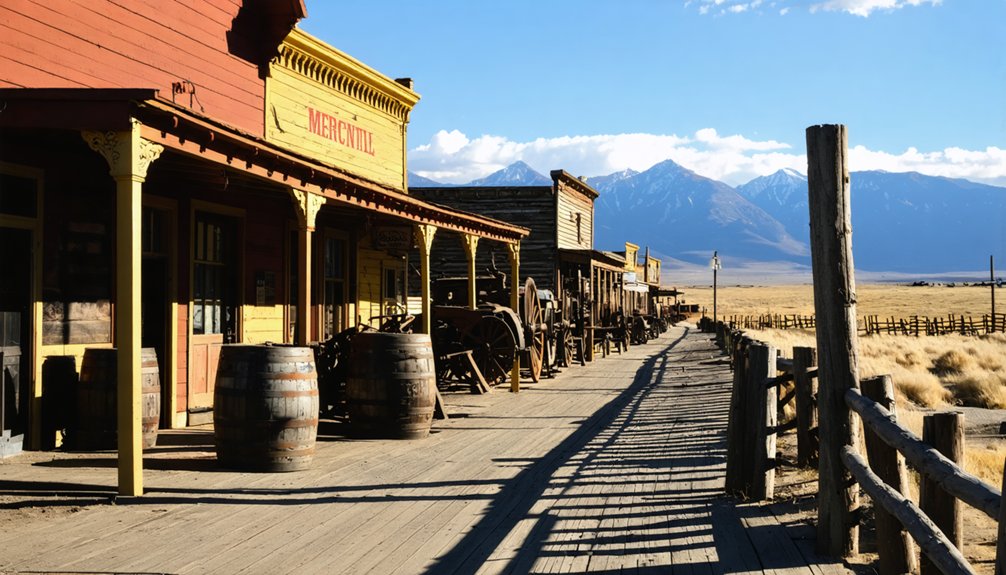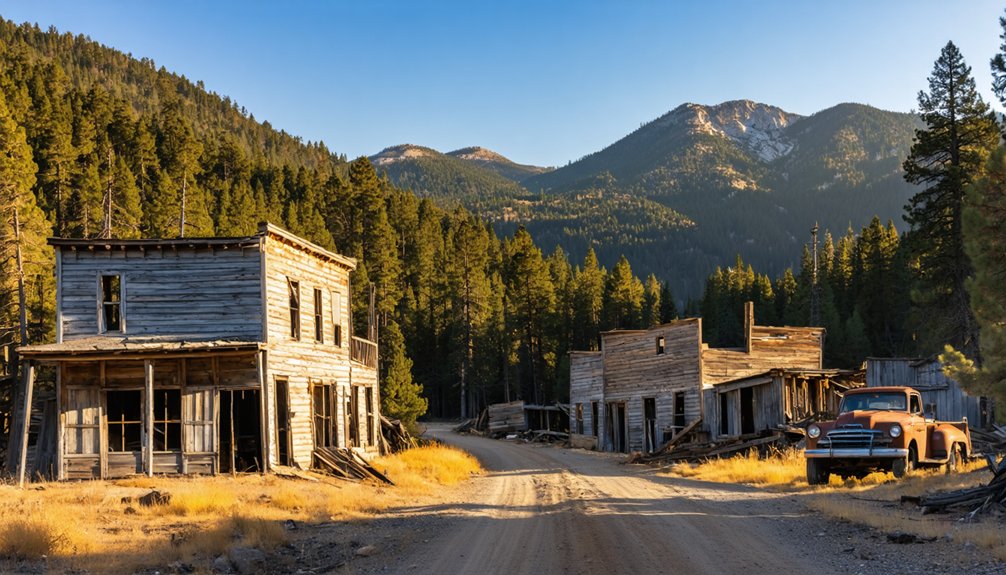
You’ll find fourteen ghost towns within 25 miles of Auburn, with Dutch Flat standing as the crown jewel—a once-thriving community of 5,000 souls that flourished from 1851 until hydraulic mining‘s 1884 ban. Westville, fifteen miles northeast of Foresthill, declined from a bustling supply hub to just two residents by 1925. These weathered remnants hold nearly 50 historic buildings at Dutch Flat alone, their stories preserved through crumbling headstones and collapsed structures that reveal California’s Gold Rush legacy in ways guidebooks can’t capture.
Key Takeaways
- Fourteen ghost towns exist within 25 miles of Auburn, including Dutch Flat and Westville, remnants of California’s Gold Rush era.
- Dutch Flat, founded in 1851, features nearly 50 historic buildings and peaked at 5,000 residents before hydraulic mining’s 1884 ban.
- Westville, 15 miles northeast of Foresthill, thrived as a supply hub from 1889 to 1919 before declining to abandonment.
- Visitors must practice Leave No Trace principles and avoid removing artifacts, as violations incur fines up to $20,000 plus imprisonment.
- Auburn’s Old Town offers Gold Country Ghost Tours in October and year-round cemetery exploration showcasing preserved 19th-century architecture.
Dutch Flat: A Gold Rush Relic in Placer County
The whisper of fortune drew German brothers Joseph and Charles Dornbach to a promising stretch of Sierra Nevada foothills in 1851, where they’d stake their claim in what mule drivers would dub “Dutch Charlie’s Flat.”
Within months of their arrival, this remote canyon transformed into one of California’s richest gold mining locations, surrounded by a constellation of camps—Green Valley with its 2,000 men, Little York, and Cold Springs trading post.
Dutch Flat’s mining techniques evolved dramatically from solitary pan-and-pick operations to industrial-scale hydraulic warfare against mountainsides.
By the 1870s peak, the Cedar Creek Company of London commanded high-pressure water cannons called monitors, blasting alluvial deposits from over 40 claims.
The town’s fortunes shifted between 1864 and 1866 when it flourished as a stagecoach stop, connecting mountain communities to Sacramento Valley settlements.
The community’s cultural sophistication earned it recognition as the “Athens of the Foothills”, hosting theatrical performances and debates that attracted luminaries like Mark Twain to its opera house.
You’ll find nearly 50 historic buildings standing sentinel over this semi-ghost town, where 5,000 souls once chased golden dreams before 1884’s hydraulic mining ban sealed their fate.
Exploring the Dutch Flat Cemetery and Historic Buildings
You’ll find Dutch Flat’s haunting beauty crystallized in its historic cemetery, where Gold Rush-era headstones emerge from ground depressions that mark collapsed coffins from the 1850s.
Walking among the weathered markers, you can still hear the rumble of trains that once brought fortune-seekers to this mountain town, while unmarked graves—their wooden markers long deteriorated—remind you of the countless stories lost to time.
The 1898 schoolhouse and weathered community halls stand as silent witnesses to an era when 2,000 Chinese inhabitants and hopeful miners made this remote settlement their home.
Stone walls and fencing often surround family plots, with some large burial areas containing few visible markers, suggesting the presence of additional unmarked graves within their boundaries.
The Golden Drift Historical Society now works to preserve this heritage, managing the cemetery and museum while hosting guided tours and events that bring the settlement’s forgotten stories back to life.
Historic Cemetery Walking Tour
Wandering through Dutch Flat Cemetery feels like stepping into a forgotten chapter of California’s Gold Rush saga, where weathered headstones and ground depressions tell stories that wooden markers couldn’t withstand.
You’ll discover unmarked graves marked only by sinking plots, evidences to burials that time nearly erased. The separate Chinese Cemetery stands empty now—families removed their loved ones for reburial in China—but its historical significance earned $6,000 in restoration funding from the Native Sons of the Golden West in 2025.
Cemetery preservation efforts face constant battles against fallen branches, overgrown trees, and pine needle accumulation. Border walls struggle to maintain level ground while coffins collapse beneath sloping earth. Professional restoration is necessary to prevent further damage to fallen stones and preserve the historical integrity of markers that families can no longer maintain themselves.
The Golden Drift Historical Society guides you through this walking tour, connecting pioneer graves to Dutch Flat’s peak population of 6,000. Dutch Flat itself may refer to multiple geographical locations, though this cemetery marks the historic California Gold Rush town.
1898 Schoolhouse and Halls
Standing sentinel along Dutch Flat’s weathered streets, three architectural survivors from before 1856—the Odd Fellows Building, Masonic Hall, and the later 1898 Old Dutch Flat Schoolhouse—anchor a walking tour that reveals how fraternal bonds and frontier education sustained a community through boom and bust.
You’ll discover how fraternal history shaped this former Pony Express stop when 6,000 souls sought prosperity and connection.
The schoolhouse architecture from 1898 captures late Gold Rush sensibilities, its empty classrooms now offering haunting photo opportunities instead of lessons.
These structures stand as defiant reminders that Dutch Flat wasn’t just another mining camp—it was a real town where children learned, men gathered in brotherhood, and communities persevered.
Today’s 133 residents maintain these monuments to independent frontier spirit.
Westville: A Barren Ghost Town Near Auburn
The weathered hills fifteen miles northeast of Foresthill once echoed with the sounds of forty working mines, but today Westville exists only as a fading memory in Placer County’s gold country.
Named after postmaster George C. West, this supply hub thrived from 1889 to 1919, serving miners who carved fortunes from Sierra Nevada foothills where Native Americans once roamed freely.
You’ll find Westville history woven into trails now traveled by hikers and horseback riders rather than gold seekers.
The town’s mining heritage included everything from dry goods stores to a brewery, even a fire company protecting wooden structures that stood until the 1950s.
By 1925, only two residents remained.
Today, alongside Iowa Hill and Deadwood, Westville stands as an embodiment of unfettered ambition—a barren ghost town where independence-minded prospectors once pursued their dreams. This unincorporated community in Placer County shares its name with other Westvilles scattered across the United States, each with its own distinct history. The Auburn Journal and other local publications continue to document the area’s rich mining past and preserve stories of these vanished communities.
Auburn Old Town’s Historic District and Haunted Sites
You’ll find Auburn’s Old Town Historic District remarkably preserved, its 22 acres of 1850s-era buildings standing as they did when miners rushed through these streets after the devastating 1855 fire.
The Auburn Joss House at 200-220 Sacramento Street tells two tales—one of Chinese immigrants who built their shrine here in the 1860s, and another of lingering spirits that locals claim still inhabit the 1930 structure.
Walking past the Lawyers Row buildings from 1855 and the weathered storefronts along Commercial Street, you’re treading the same paths where fortune-seekers once congregated, and where ghost tour guides now lead groups through shadowy evenings in search of Gold Rush phantoms. Founded in 1848 during the Gold Rush, Auburn served as a vital center of commerce that divided the Sierra Gold Belt into its northern and southern mining operations. The district earned its place on the National Register of Historic Places on December 29, 1970, preserving this snapshot of California’s mining heritage for future generations.
19th-Century Buildings Overview
Listed on the National Register of Historic Places on December 29, 1970, Auburn’s Old Town Historic District preserves a remarkable collection of 19th-century architecture that once bustled with miners, merchants, and fortune seekers.
You’ll discover the 1897 Placer County Courthouse anchoring downtown at 101 Maple Street, where free guided tours launch every Saturday morning.
The district’s historic preservation efforts showcase Travellers’ Rest, an 1860s blacksmith shop turned winery that served dusty stagecoach passengers.
Walk past Lawyers Row‘s 1855 buildings and Commercial Street’s 1850s storefronts, rebuilt after devastating fires swept through.
The Auburn Hose Company No. 1, constructed in 1888, displays stunning Victorian stick and Queen Anne styles.
Each weathered brick and timber tells stories of California’s untamed frontier days.
Joss House Ghost Stories
Beyond these well-documented architectural treasures, Auburn’s Old Town harbors stories that can’t be found in official records or preservation society archives.
The Joss House, built in 1920 after fire claimed its predecessor, stands as more than just a museum of Chinese heritage. Local wanderers speak of unexplained phenomena near the historic temple, though these tales remain unverified and undocumented in any historical sources.
While the building’s concrete history involves serving Gold Rush-era immigrants as a worship space, school, and community center, ghostly encounters remain purely speculative.
You’ll find the structure’s documented significance lies in preserving Chinese contributions to California’s development, not in paranormal claims. Sometimes the real story—immigrant resilience and cultural preservation—outshines the invented mysteries.
Cemetery and Ghost Tours
When October winds begin stirring the oak leaves along Auburn’s brick-lined streets, the Gold Country Ghost Tours emerge from the shadows of the Historic Courthouse, transforming Old Town into an open-air theater where California’s Gold Rush past refuses to stay buried.
You’ll join twenty-five fellow seekers on a two-hour walking odyssey through ten notorious sites where Rattlesnake Dick, Alma Bell, and Adolf Weber still linger. The cemetery legends come alive through theatrical encounters at the Fire House, Odd Fellows Hall, and haunted markers throughout the district.
These spectral encounters, priced at forty dollars, sell out faster than a miner’s claim in 1849. Year-round, you’re free to wander Old Town Auburn Cemetery independently, where stories whisper between weathered headstones without ticket limitations.
The Joss House: Auburn’s Taoist Temple and Chinese Heritage
At the corner of Sacramento Street and Brewery Lane in Old Town Auburn stands a weathered memorial to the thousands of Chinese immigrants who shaped California’s Gold Country—the Auburn Joss House, where the scent of incense once mingled with the sounds of Cantonese conversation and the clatter of communal meals being prepared in its expansive kitchen.
The Cultural Heritage preserved within these batten-and-board walls tells stories of resilience. Built in 1920 by Charlie Yue after the original 1860s structure burned, this temple served as the Ling Ying Association’s headquarters—a place where marginalized immigrants found community when American courts denied them legal standing.
The Architectural Significance extends beyond worship; travelers found beds, children received education, and merchants conducted business here.
Today’s museum, staffed by volunteer docents, opens its doors monthly, surviving on donations alone.
Lincoln: A Charming 1859 Settlement Worth Visiting
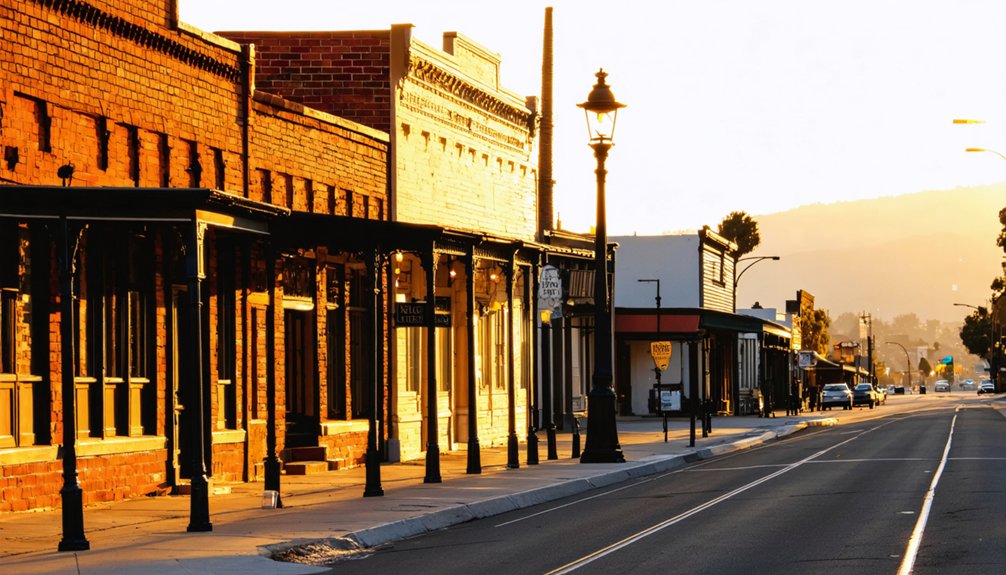
Twelve miles west of Auburn, where the proposed California Central Railroad would slice through gold-bearing foothills, engineer Theodore Judah laid out a new townsite in 1859 that would outlast dozens of its contemporaries.
Named for Charles Lincoln Wilson, this settlement absorbed the nearby mining camp of Fox’s Flat, where Auburn Ravine diggings once yielded $5 per pan.
Lincoln’s Heritage springs from pragmatic Gold Rush Origins:
- Fox’s Flat residents relocated entirely within three years, abandoning their blacksmith shop and saloon.
- The July 11, 1859 shootout saw outlaw Rattlesnake Dick Barter’s final stand, killing Deputy George Martin.
- Railroad positioning secured Lincoln’s survival when Central Pacific tracks reached Auburn in 1865.
- Historic architecture still marks downtown, preserving 1859-era character.
You’ll find Lincoln invigoratingly authentic—a survivor, not a ghost.
Placer County’s 14 Ghost Towns Within 25 Miles
Within a 25-mile radius of Auburn, fourteen ghost towns scatter across Placer County’s ridges and ravines like forgotten pages from a prospector’s journal.
You’ll discover settlements like Last Chance, perched high in the mountains where accidental prospectors struck gold in 1850, and Deadwood, where gun manufacturer Sam Colt once called home before the ore played out in 1855.
Each site carries historical significance beyond simple abandonment.
Dutch Flat’s haunted Joss House stands as evidence of Chinese immigrants’ contributions, while crumbling foundations at Caroline Diggings whisper tales of boom-and-bust cycles that defined California’s Gold Rush era.
Marshall Gold Discovery State Historic Park
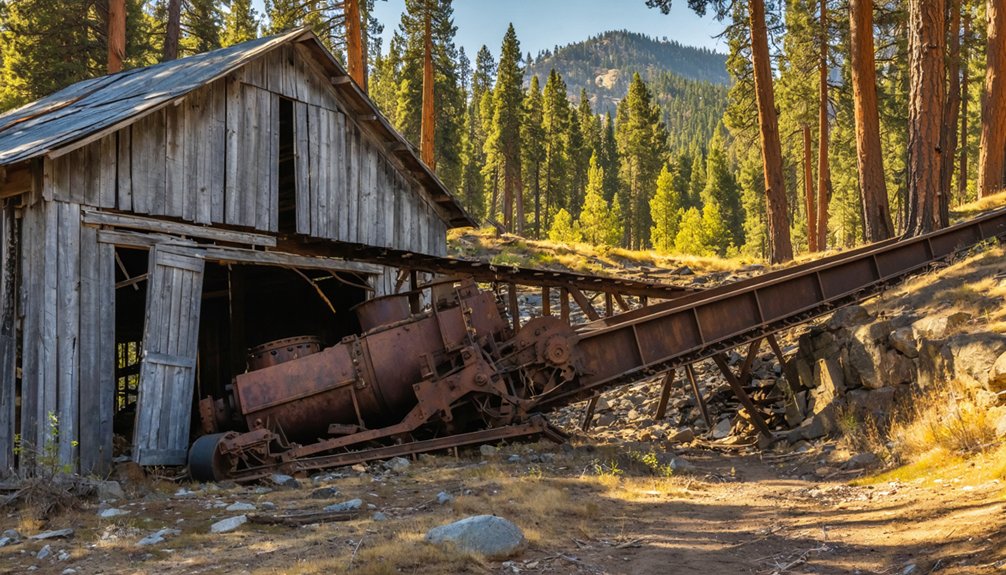
Where sunlight glinted off the American River‘s tailrace on January 24, 1848, James W. Marshall discovered gold flecks that’d forever change California.
Today, you’ll find this 576-acre historic park preserving Coloma’s transformation from Sutter’s sawmill site to boomtown of 10,000 prospectors.
From sleepy sawmill outpost to thriving Gold Rush metropolis of 10,000 fortune-seekers—Coloma’s dramatic transformation lives on across 576 preserved acres.
Within this National Historic Landmark District, you’re free to explore:
- Marshall Monument – Overlooking the river canyon where Marshall’s buried, pointing directly to his discovery spot
- Gold Panning – Try your luck in the American River where it all began
- Twenty historic buildings – Chinese stores, blacksmith shops, Marshall’s reconstructed cabin
- Gold Discovery Museum – Mining equipment and multicultural stories
Guided tours depart twice daily at 11 a.m. and 1 p.m., while the 1.5-mile Monument Loop Trail offers panoramic valley views.
Preservation Guidelines for Ghost Town Explorers
When you explore ghost towns near Auburn, you’ll discover that these fragile sites depend entirely on your commitment to leave everything exactly as you found it—from weathered mining tools resting against cabin walls to century-old bottles tucked in kitchen corners.
Removing even a single artifact doesn’t just violate California law; it erases an irreplaceable piece of the Gold Rush narrative that future visitors won’t experience.
Your footsteps should be the only trace you leave behind, preserving these arrested-decay sites so they’ll continue telling their stories for generations to come.
Leave No Trace Principles
Although Auburn’s ghost towns survived the ravages of time and abandonment, they’re now facing a different threat—well-meaning visitors who inadvertently damage what nature preserved.
Practicing Leave No Trace principles guarantees these historic sites remain for future generations who value exploration without government oversight.
Your Environmental Stewardship responsibilities include:
- Stay on established trails and walk single file through muddy sections rather than widening paths around puddles.
- Camp 200 feet from fragile structures and water sources, using rock, gravel, or already-impacted sites.
- Pack out everything—your trash, leftover food, and yes, even toilet paper from 6-8 inch catholes.
- Observe without touching historic artifacts, treating weathered wood and rusted metal as the irreplaceable treasures they are.
Artifact Removal Consequences
That rusted horseshoe half-buried in the dirt at Damascus or the hand-forged mining pick leaning against a collapsing cabin wall might seem like harmless souvenirs, but pocketing them transforms you from explorer into felon under federal law.
The Archaeological Resources Protection Act doesn’t distinguish between casual collectors and commercial looters—you’ll face fines up to $20,000 plus imprisonment for first offenses. California’s courts add civil penalties allowing double damages for artifact preservation violations.
That 2020 Columbia State Historic Park incident proved costly: a $10,000 fine for one mining tool.
Beyond legal repercussions, you’re erasing irreplaceable context from sites like Bodie, where “arrested decay” preservation depends on every artifact remaining exactly where gold rush pioneers left it.
Planning Your Placer County Ghost Town Road Trip
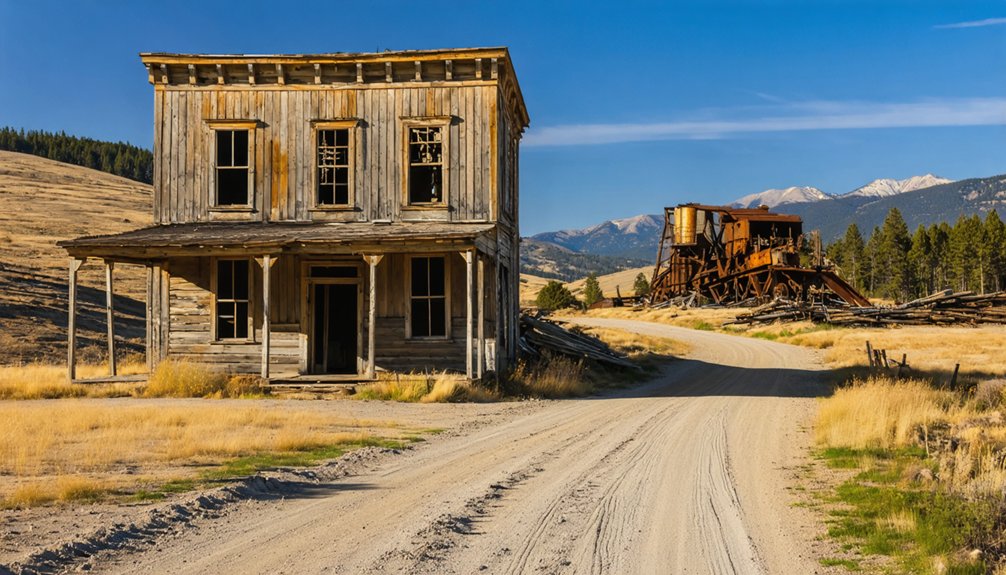
How do you transform a simple day trip into a journey through California’s gold-rich past? Start with Auburn Old Town‘s 19th-century architecture, then venture north for authentic ghost town exploration.
Your route should include:
- Morning in Auburn: Tour the Joss House temple and Placer County Courthouse Museum before heading north.
- Midday at Dutch Flat: Explore the 1898 elementary school, cemetery with historic headstones, and pre-1856 Odd Fellows Building.
- Remote Damascus: Drive 7 miles southeast to discover this former drift mining area and Hidden Treasure Mine site.
- High-mountain Last Chance: Trek 8 miles southwest of Michigan Bluff to where accidental gold discovery created historical significance in 1852.
Book Gold Country Ghost Tours tickets starting August 23rd—these popular 2-hour experiences sell out quickly, revealing Auburn’s haunted heritage.
Frequently Asked Questions
Are Ghost Town Tours Near Auburn Safe for Young Children?
Yes, they’re safe with proper child safety precautions. You’ll find gentle walking paths through preserved Old Town Auburn, where tour guidelines emphasize family-friendly exploration. The flat terrain and maintained historical sites let kids discover gold rush history freely.
What’s the Best Season to Visit Placer County Ghost Towns?
Fall’s your best time to explore these forgotten settlements, when golden foliage frames crumbling structures and crisp air carries whispers of history. You’ll find perfect weather for wandering freely, plus Halloween-season ghost tours and seasonal activities throughout Placer County.
Do Any Ghost Towns Near Auburn Offer Camping Facilities?
You can’t have your cake and eat it too—these ghost towns lack camping amenities within their boundaries. You’ll find ghost town activities during day visits, but must camp at nearby state parks or campgrounds for overnight freedom.
For those seeking adventure, there are several abandoned places near Bakersfield that offer a glimpse into the past. Exploring these forgotten locations can make for a thrilling day trip, especially when paired with the scenic beauty of the surrounding areas. Just remember to bring plenty of water and a camera to capture the unique sights along the way.
Are Pets Allowed at Dutch Flat and Other Ghost Town Sites?
You’ll find Dutch Flat welcomes dogs at their hotel and RV resort, following standard pet policies. While ghost town regulations vary, most historic sites let you explore freely with leashed pets—just check specific rules beforehand.
Which Ghost Towns Require Permits or Have Entrance Fees?
You’ll find freedom’s sweet embrace at most sites—Auburn’s Old Town streets cost nothing to roam. However, permit requirements don’t exist, though entrance fees apply at the Courthouse Museum and Joss House interiors.
References
- https://en.wikipedia.org/wiki/List_of_ghost_towns_in_California
- https://www.visitplacer.com/blog/gold-rush-ghost-towns-a-fall-road-trip-in-placer-county/
- https://nvtami.com/placer-county-california-ghost-towns/
- https://www.geotab.com/ghost-towns/
- https://www.onlyinyourstate.com/experiences/california/ghost-towns-in-northern-california
- https://www.honeytrek.com/gold-country-california/
- https://www.tripadvisor.com/ShowTopic-g28926-i29-k2980376-Northern_CA_ghost_towns-California.html
- https://www.parks.ca.gov/marshallgold
- https://westernmininghistory.com/towns/california/dutch-flat/
- https://www.youtube.com/watch?v=oG0e0cObOlk