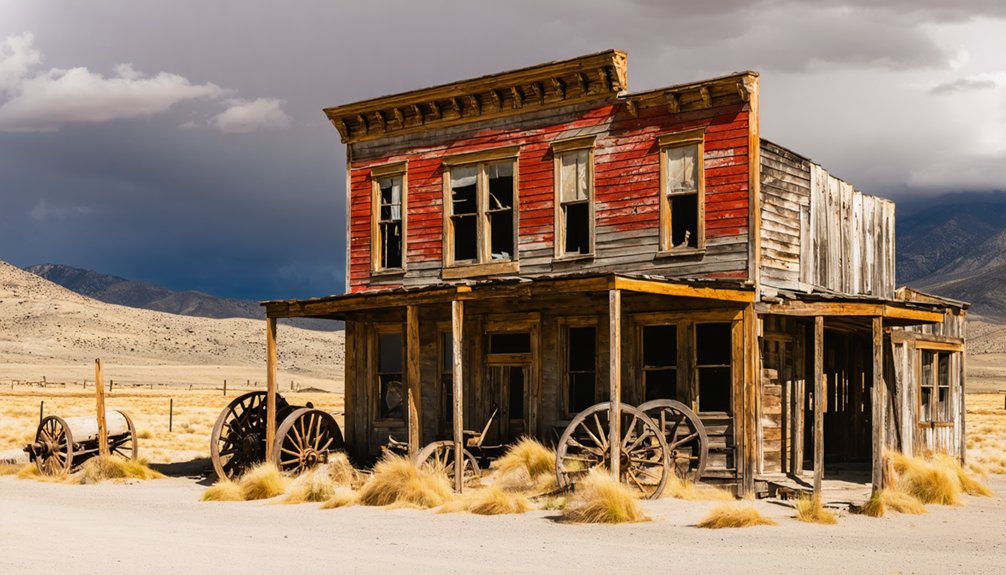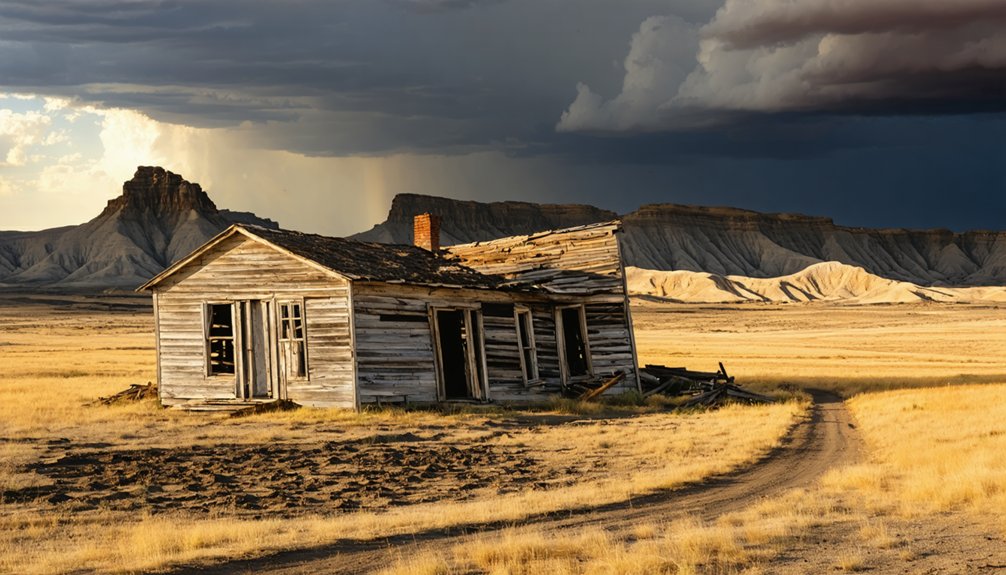
You’ll find Scenic just east of Badlands National Park near the Pinnacles overlook, featuring authentic mining-era structures including open-air jail cells and the Longhorn Saloon. Spokane, accessible via a 2.2-mile trail in Riverside State Park, showcases standing buildings from its quartz mining operations. Further west, Camp Crook lies submerged beneath Pactola Reservoir, its foundations and artifacts creating underwater archaeological sites. Mystic and Ardmore represent remote Black Hills settlements, part of the region’s 600+ documented ghost towns from the 1874 Gold Rush. The following sections explore each site’s distinctive historical significance and preservation challenges.
Key Takeaways
- Scenic, located east of Wall near Pinnacles overlook, features authentic ghost town architecture including open-air jail cells and the Longhorn Saloon.
- Spokane requires a 2.2-mile round-trip hike from Wilbur Trailhead, showcasing standing structures from a historic quartz mining settlement.
- Pactola Reservoir submerged Camp Crook, a gold rush town founded in 1875, with underwater foundations and artifacts still visible today.
- Mystic preserves fourteen original structures from 1875, accessible via Mickelson Trail, representing both mining and lumber production history.
- Over 600 documented ghost towns exist in the Black Hills region from the 1874 Gold Rush era.
Scenic: a Preserved Mining Community With Unique Architecture
While most travelers rush past en route to Badlands National Park’s dramatic formations, Scenic stands as a haunting tribute to South Dakota’s vanished frontier economy.
This preserved mining community, abandoned for over a century, offers you rare access to authentic ghostly architecture that defies commercial sanitization. You’ll encounter open-air jail cells exposed to prairie winds, a peculiar church-jail combination structure, and the skeletal Longhorn Saloon—all mining relics that document the region’s extractive past.
Located just east of Wall near the Pinnacles overlook, Scenic’s deteriorating buildings create an eerie tableau where you’re free to explore unmediated history. Like nearby Rockerville with its ties to mining activity, Scenic represents the decline of once-thriving communities that flourished during South Dakota’s extractive boom. Similar to Spokane’s fragile structures, visitors should exercise caution and avoid climbing on buildings to preserve the history of these delicate sites.
The site’s uncertain future under current ownership makes immediate visitation essential before preservation efforts potentially alter its raw, decaying authenticity.
Spokane: Hiking to a Historic Quartz Mining Settlement
You’ll reach the Spokane Mine site via a 2.2-mile round-trip trail from Wilbur Trailhead in Riverside State Park, requiring a parking pass for access.
The mine’s operational history centers on quartz extraction from Iron Mountain deposits, though limited documentation obscures specific yield records and the precise timeline of active mining. The Spokane prospect was situated in the Pine Creek Mining District within Shoshone County, Idaho, an area characterized by various mineral deposits.
Today, you can examine the remaining structures including a shallow adit carved into Grand Ronde basalt, alongside scattered prospecting entrances and excavated basalt piles marking the settlement’s industrial footprint. The site sits at an elevation of 5,151 feet, positioning it among the higher-elevation mining operations in Spokane County.
Trail Access and Parking
Located sixteen miles north of Custer along the northern perimeter of Custer State Park, Spokane’s remains sit at coordinates N43.840657, W103.376041, accessible via a short walk from Forest Service Road 330.
You’ll find parking logistics straightforward but minimal—no formal lots exist at this unmarked location.
Parking and Access Points:
- Spokane Creek Campground offers primary parking with trail sign access
- Alternative parking available along Forest Service Road 330
- Gated entrance permits foot and horse traffic only
- Trail follows Spokane Creek for approximately one mile to the settlement
The moderate-rated trail occasionally becomes wet and muddy.
Trail safety requires vigilance—concealed wells hide in tall grass, loose boards threaten footing in structures, and rattlesnakes inhabit abandoned buildings. Fences installed around some structures aim to deter vandalism while preserving the site’s historical integrity.
Old roadbeds create visible gaps between tree generations, guiding exploration through this unrestricted historic site. Along the trail, you’ll encounter rusted metal, cans, and bottles that serve as evidence of the settlement’s mining past.
Mining History and Resources
Spokane’s designation as a quartz mining settlement stems from the region’s complex geological history, though the scale of extraction remained modest compared to the Black Hills gold rush operations sixteen miles south.
You’ll find limited documentation of quartz mining activities in 1962 Badlands studies, reflecting the area’s secondary role in mineral extraction.
The White River Group’s sedimentary rocks—sandstone, siltstone, and claystone—hosted small quartz deposits within spherical cavities formed by material dissolution.
While miners pursued quartz in this remote settlement, paleontologists recognized greater wealth in Oligocene vertebrate fossils preserved within the same formations.
Since the 1840s, fossil preservation has dominated scientific attention here, with the South Dakota School of Mines conducting systematic excavations since 1899, ultimately overshadowing Spokane’s brief mining chapter.
The underlying Pierre Shale Formation, deposited 75-69 million years ago in a shallow sea, represents the oldest geological layer in the region, predating the quartz-bearing formations by millions of years.
The Badlands formations erode at approximately one inch per year, a rate dramatically faster than the granite of the nearby Black Hills, which erodes at merely one inch per 10,000 years.
Standing Structures and Ruins
Though sixteen miles from Custer and unmarked by any signage, the Spokane settlement reveals itself gradually to those who venture north of Custer State Park’s boundary via Forest Service Road 330.
This ghost town distinguishes itself among Black Hills sites through standing structures rather than mere foundations.
Primary Standing Structures:
- Mine manager’s house – Most intact building featuring multiple rooms, kitchen, upper level, and cellar with period furniture
- Schoolhouse – Located outside the main field area
- Residential homes – Fenced since September 2020 to prevent vandalism
- Root cellars and outbuildings – Scattered throughout the wooded terrain
Mining artifacts, deteriorated automobiles, ground-level storage tanks, and James Shepard’s 1908 grave punctuate the site. The Spokane mine extracted silver, galena, beryl, copper, mica, and zinc from its claims beginning in 1890.
Beyond the main settlement area, hiking trails extend deeper into the woods leading to a cabin located past the grave site. Navigate cautiously around loose boards, wells concealed in tall grass, and potential rattlesnake habitats.
Pactola: The Drowned Town Beneath the Lake
Beneath Pactola Reservoir‘s surface lies Camp Crook, a gold rush settlement founded in 1875 that once housed over 300 residents before federal authorities condemned the land for dam construction.
The Pick-Sloan Flood Control Act of 1944 authorized the reservoir’s creation, leading to the systematic dismantling and submersion of the entire town between 1952 and 1956.
Today, scuba divers explore underwater foundations and a Civilian Conservation Corps dynamite bunker while the lake serves Rapid City’s water needs and provides recreation where streets and buildings once stood.
Camp Crook Mining Boom
The placer mining settlement grew rapidly through practical mining techniques:
- Sluices separated gold particles from sand and gravel in stream beds.
- A long flume diverted water for extraction operations.
- Approximately 300 miners established claims by late 1876.
- Commercial infrastructure emerged—store (1876), hotel, post office (1877), and tri-weekly stage service.
The valley’s round shape earned it the nickname “O” Valley before settlers adopted the camp’s official designation.
Reservoir Construction and Submersion
Following gold’s discovery in Pactola Creek during the 1870s, this modest settlement developed into a community with sufficient civic importance to serve briefly as a county seat.
Pactola history encompasses a mining operation supporting 300 workers, railroad construction in 1906, and later facilities including a tuberculosis sanatorium and various camps.
The Bureau of Reclamation‘s 1937 studies culminated in federal authorization under the 1944 Flood Control Act, though construction didn’t commence until November 1952.
The reservoir impact proved absolute: government condemnation seized numerous acres, forcing demolition or relocation of all structures before August 1956 completion.
You’ll find underwater remnants today—foundations and a Civilian Conservation Corps dynamite bunker—submerged beneath Pactola Reservoir, which began delivering water May 1958.
Legacy of the Lake
While Pactola’s physical structures disappeared beneath reservoir waters in 1956, the settlement’s archaeological remnants endure as submerged testimony to Black Hills mining history.
You’ll find these underwater artifacts have transformed lake exploration into an unconventional form of historical preservation, where scuba divers document rotting foundations instead of traditional archaeologists.
The submerged town’s remnants include:
- Dynamite bunker from the Civilian Conservation Corps camp
- Building foundations scattered across the lakebed
- Mining infrastructure including flume remnants
- Early cabin structure remaining above water downstream
Today’s recreation area serves dual purposes—providing modern leisure activities while safeguarding nineteenth-century settlement evidence.
This preservation-through-submersion approach maintains Pactola’s legacy accessible to those willing to explore beneath Pactola Lake’s surface, connecting contemporary visitors with frontier-era mineral extraction operations.
Mystic: Remote Mining Town North of Hill City
Nestled in a remote canyon north of Hill City, Mystic emerged from the 1875 gold discovery on Castle Creek by geologists Walter Jenney and Henry Newton during their official survey of the Black Hills.
The settlement’s Mystic history traces from the 1876 mining camp called Sitting Bull through its 1889 renaming by Chicago, Burlington & Quincy Railroad officials.
Two railroads converged here: the CB&Q’s pioneering 1889 line and the remarkable Crouch Line, completed in 1906 with 14 circles and 100 bridges spanning 34 miles.
The Mystic economy evolved from placer mining to lumber production, anchored by the Frink sawmill operating 33 years until tourism supplemented local revenue in the 1920s.
You’ll find fourteen original structures preserved within the National Register district, accessible via Mickelson Trail’s Mystic Trailhead.
Ardmore: Recent Ghost Town on the Nebraska Border

One mile north of the South Dakota-Nebraska border, Ardmore stands as the region’s most recently expired settlement, officially designated a ghost town in 2004 after census records documented its final 16 residents in 1980.
Founded in 1889 as a railroad water stop for the New Burlington Railroad, Ardmore’s history reflects the harsh realities of High Plains settlement. When steam locomotives shifted to diesel, the town lost its primary function.
Ardmore landmarks reveal its rapid decline:
- White government barn from failed dry land farming experiments
- Abandoned car graveyard featuring dozens of rusted vehicles
- Boarded-up Main Street with general store and post office
- One-room schoolhouse and deteriorating volunteer fire station
President Calvin Coolidge visited the experimental farm for a picnic in 1927, marking the town’s brief prominence before drought sealed its fate.
Etta: From Tin Ore to Lithium Mining Operations
You’ll find Etta Mine’s operational history began in 1883 when Dr. S.H. Ferguson established tin mining operations after California assays confirmed profitable cassiterite deposits.
The enterprise evolved fundamentally in 1898 when spodumene extraction replaced tin as the primary mining focus, initiating production that reached 700 tons annually by 1900.
This shift from tin to lithium ore exploitation represented a significant mineral industry adaptation that sustained operations intermittently until final closure by 1968.
Original Tin Mining Era
The discovery of tin near Hill City in 1883 transformed the southern Black Hills from a region of depleted gold claims into a thriving mineral extraction zone.
You’ll find that tin mining operations centered on pegmatite deposits containing tin alongside feldspar, quartz, and mica. The Harney Peak Tin Mining, Milling and Manufacturing Company established headquarters on Hill City’s Main Street, ushering in a 75-year boom that yielded over $66 million in valuables.
The economic impact reshaped the isolated region:
- Population rebounded as prospectors abandoned played-out gold claims
- Hill City supported 15 saloons during peak prosperity
- Mining camps emerged overnight near Custer and Hill City
- Operations employed open-pit, underground, and hard-rock extraction methods
The Etta Mine exemplified this shift, extracting tin and tungsten from Precambrian-era pegmatite formations.
Lithium Ore Production Evolution
During World War II, the Black Hills pegmatite district transformed from a tin-producing region into America’s critical lithium supply zone.
You’ll find that pegmatite exploration between 1943-1944 reached unprecedented intensity, with mines like Helen Beryl, Tip Top, and Tin Mountain extracting spodumene alongside strategic beryl and columbite-tantalite.
The Custer and Keystone areas yielded nearly 200,000 tonnes of lithium through the 1950s, establishing extraction protocols that today’s operators study closely.
Modern lithium mining has resurged with nine companies now targeting the same 24,000 pegmatite bodies surrounding Harney Peak Granite.
These contemporary ventures—including United Lithium Corp., Rapid Critical Metals, and Midwest Lithium—stake claims on brownfield sites where spectacular spodumene crystals once measured 42 feet long, weighing 90 tons.
Camp Crook and the Black Hills Military History
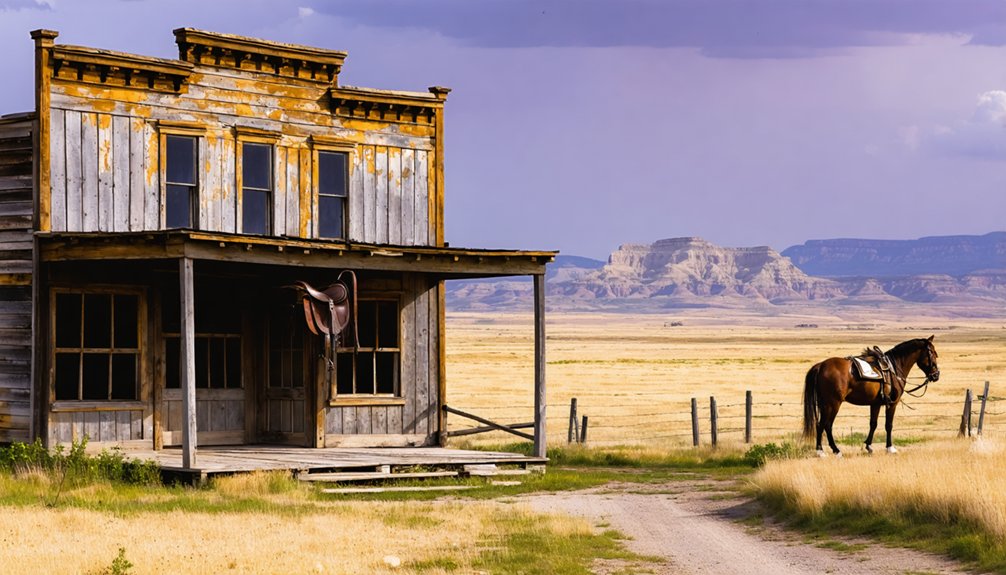
Following the devastating defeat at Little Bighorn in June 1876, Brigadier General George Crook led his command through some of the harshest terrain in Dakota Territory, establishing what would become Camp Crook along the Little Missouri River in Harding County.
This outpost emerged during Crook’s pursuit of Sioux Chief American Horse, approximately 20 miles west of Buffalo, South Dakota.
Crook’s military strategies during the 1876 campaigns included:
- Slim Buttes Battle – Forced American Horse’s surrender in Harding County, though the chief died from wounds shortly after.
- “Horsemeat March” – Troops endured extreme starvation conditions before recovering at Custer City’s Gordon Stockade.
- Winter Operations – Continued pressure through actions like the Dull Knife Fight to force reservation returns.
- Department of the Platte Command – Coordinated multi-territory campaigns from Fort Fetterman, Wyoming.
This temporary base transformed into a frontier community reflecting Dakota Territory’s volatile military period.
Notable Mining Sites: Hornblend, Blue Lead, and Galena
Mineral wealth scattered across the Badlands periphery drew thousands of prospectors to three distinct camps—Hornblend, Blue Lead, and Galena—each reflecting different aspects of Dakota Territory’s mining fever following George Armstrong Custer’s 1874 expedition into the Black Hills.
You’ll find Hornblend‘s collapsed adits 40 miles west, abandoned after lead-silver veins depleted in the 1880s.
Blue Lead operated northwest utilizing hydraulic mining techniques that yielded 50,000 gold ounces before water scarcity ended operations.
Hydraulic mining at Blue Lead extracted 50,000 ounces of gold before water shortages forced the northwest camp to close permanently.
Galena’s limestone deposits produced 10,000 tons of lead ore from 300-foot shafts until an 1906 fire destroyed its mill.
The environmental impacts persist today—mercury contamination plagues nearby creeks, while Hornblend’s tailings still contain 15% lead concentrations.
BLM now restricts access to these sites due to unstable shafts and toxic residue, preserving evidence of unfettered extraction.
Planning Your Ghost Town Adventure Along Route 385
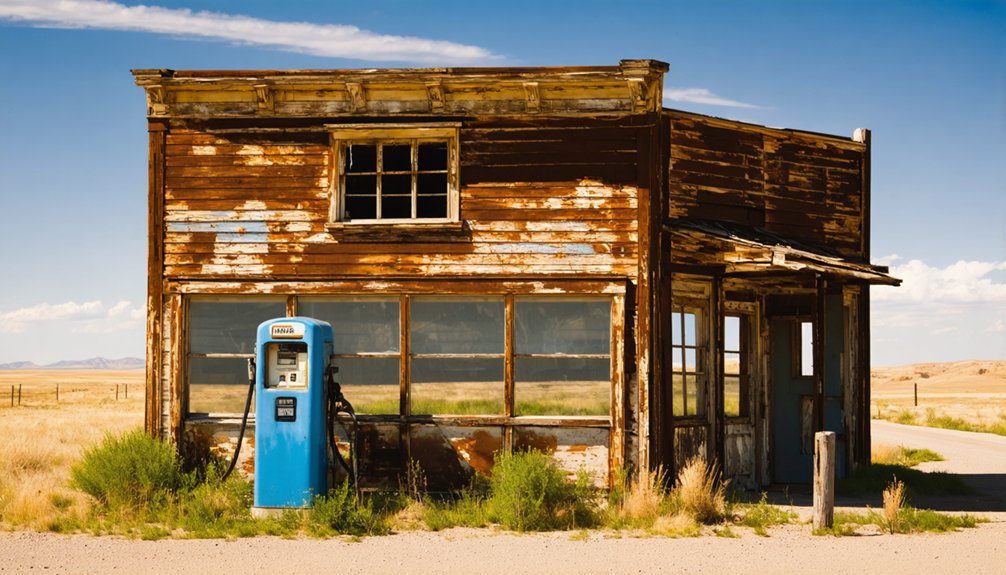
Stretching 88 miles from Deadwood to the Nebraska border, Highway 385 functions as the primary corridor for accessing the Black Hills‘ most significant ghost town clusters, with five major sites positioned within a 12-mile radius of this scenic byway.
Essential Planning Guidelines:
- Ghost Town Photography – Restrict shooting to road-level perspectives, as structural instability renders interior access dangerous and violates historical preservation protocols.
- Route Optimization – Begin at Bugtown (3 miles north of Custer) and proceed northward through concentrated mining settlements along the forested corridor.
- Access Restrictions – Respect private property boundaries; 15-25 structures across sites remain visible from public roadways and established railroad grades.
- Preservation Ethics – Avoid climbing on structures to maintain integrity for future documentation and scholarly research.
Highway 385’s strategic positioning provides efficient access to mining-era remnants while connecting to Interstate 90 at Exit 30.
The Legacy of 600+ Black Hills Ghost Towns
The Black Hills region harbors over 600 documented ghost towns—a density unmatched in Dakota Territory history—encompassing everything from substantial mining settlements to ephemeral stage stations that left only archaeological traces.
The exploration of ghost towns in Big Bend area reveals stories of ambitious settlers and the harsh realities they faced. Many of these towns flourished briefly before succumbing to the relentless desert environment, leaving behind remnants that spark curiosity and wonder. As visitors wander through these abandoned sites, they gain a unique perspective on the region’s dynamic history and cultural evolution.
Six hundred ghost towns dot the Black Hills—mining camps, stage stops, and forgotten settlements lost to time and terrain.
You’ll find this concentration stems from the 1874 Gold Rush, when $4,000,000 annual gold yields and $3,000,000 in silver transformed the area into Dakota Territory’s most populated region.
Hard rock mining techniques created distinctive site markers: vertical shafts, waste piles, and eroded tailings at places like Hornblend and Galena.
Ghost Town Preservation efforts face unique challenges here, as USGS mapping revealed many settlements existed under different names or appeared incorrectly on early maps.
Sites like Rochford and Tinton remain tangible, while others survive only as faint traces awaiting your discovery.
Frequently Asked Questions
What Caused the Mining Disputes That Led to Gunfights in Black Hills?
You’d find that overlapping mining rights and territorial claims sparked gunfights in the Black Hills. The gold rush’s lawless environment meant miners settled disputes through violence when no established government existed to adjudicate competing claims.
Are Ghost Tours in Deadwood Suitable for Children?
Yes, you’ll find family friendly activities like ScavengerHunt.com’s tours suitable for children, though Haunted History Walking Tour contains violent content. Consider tour safety by checking guides’ age recommendations, as some paranormal investigations require discretion for young participants.
What Happened to the Original Residents When Pactola Was Flooded?
The Pactola displacement followed government condemnation of valley lands, forcing residents from their flooded community. You’ll find structures were relocated to Silver City, though compensation details for displaced families remain undocumented in historical records.
Can Visitors Explore the Inside of Abandoned Mine Shafts Safely?
No, you can’t safely explore abandoned mine shafts. Federal mine safety policy prohibits shaft exploration beyond 25 feet without specialized training and equipment due to structural collapse, toxic gases, unstable explosives, and drowning hazards in flooded passages.
Why Did the Iglesia Ni Cristo Church Purchase Scenic in 2011?
The Iglesia ni Cristo church executed the Scenic acquisition in 2011 to obtain immediate worship facilities, accelerate US expansion through established infrastructure, and demonstrate organizational permanence while pursuing its strategic growth objectives in South Dakota’s Rapid City region.
References
- https://en.wikipedia.org/wiki/List_of_ghost_towns_in_South_Dakota
- https://www.blackhillsbadlands.com/blog/post/old-west-legends-mines-ghost-towns-route-reimagined/
- https://www.powderhouselodge.com/black-hills-attractions/fun-attractions/ghost-towns-of-western-south-dakota/
- https://www.onlyinyourstate.com/experiences/south-dakota/scenic-abandoned-town-sd
- https://www.sdpb.org/rural-life-and-history/2023-08-21/some-black-hills-ghost-towns-and-their-origins
- https://www.youtube.com/watch?v=LPCactXsVf4
- https://myxoadventures.com/the-ghost-town-of-spokane-south-dakota/
- https://www.tripadvisor.com/Attraction_Review-g54799-d22999414-Reviews-Scenic_Ghost_Town-Scenic_South_Dakota.html
- https://adventure.com/usa-americas-forgotten-ghost-towns/
- https://kxrb.com/the-creepiest-ghost-towns-in-all-of-south-dakota/